Definition, Laws and Equation for CSEC Physics
 Call Kai
 Learn
Learn Practice Test
 Spaced Repetition
 Match
Match Flashcards
 Knowt Play
1/69

There's no tags or description
Looks like no tags are added yet.
Name | Mastery | Learn | Test | Matching | Spaced | Call with Kai |
|---|
No analytics yet
Send a link to your students to track their progress
70 Terms
Heat

Boyel's Law
states that as pressure increases volume decreases and vis versa
Charles' Law
the law that states that for a fixed amount of gas at a constant pressure, the volume of the gas increases as the temperature of the gas increases and the volume of the gas decreases as the temperature of the gas decreases
Pressure law
The pressure of a prefect gas with a fixed mass and constant volume is directly proportional to its ideal temperature.
Heat capacity
the number of heat units needed to raise the temperature of a body by one degree.
Specific Heat Capacity
the amount of heat energy required to raise the temperature of one gram of substance by one degree celcius
Specific Latent Heat of Fusion
The specific latent heat for change between a solid and a liquid.
Specific Latent heat of Evaporation
It is when a material changes phase from solid to liquid, or from liquid to gas a certain amount of energy is involved in this change of phase.
Light

Snell's Law
The ratio of the sine of the angle of incidence to the sine of the angle of refraction is a constant, for a given frequency.
Refractive Index
a relationship between the path taken by a ray of light in crossing the boundary or surface of separation between two contacting substances and the refractive index of each.
Critical Angle
the angle of incidence that produces an angle of refraction of 90 degrees
Focal Length of A Lens
a specific zoom position
Principal Focus
the point where light rays parallel and close to the principal axis converge or appear to diverge
Lens Formula
lens formula is an equation that relates the focal length, image distance, and object distance for a spherical mirror.
Waves
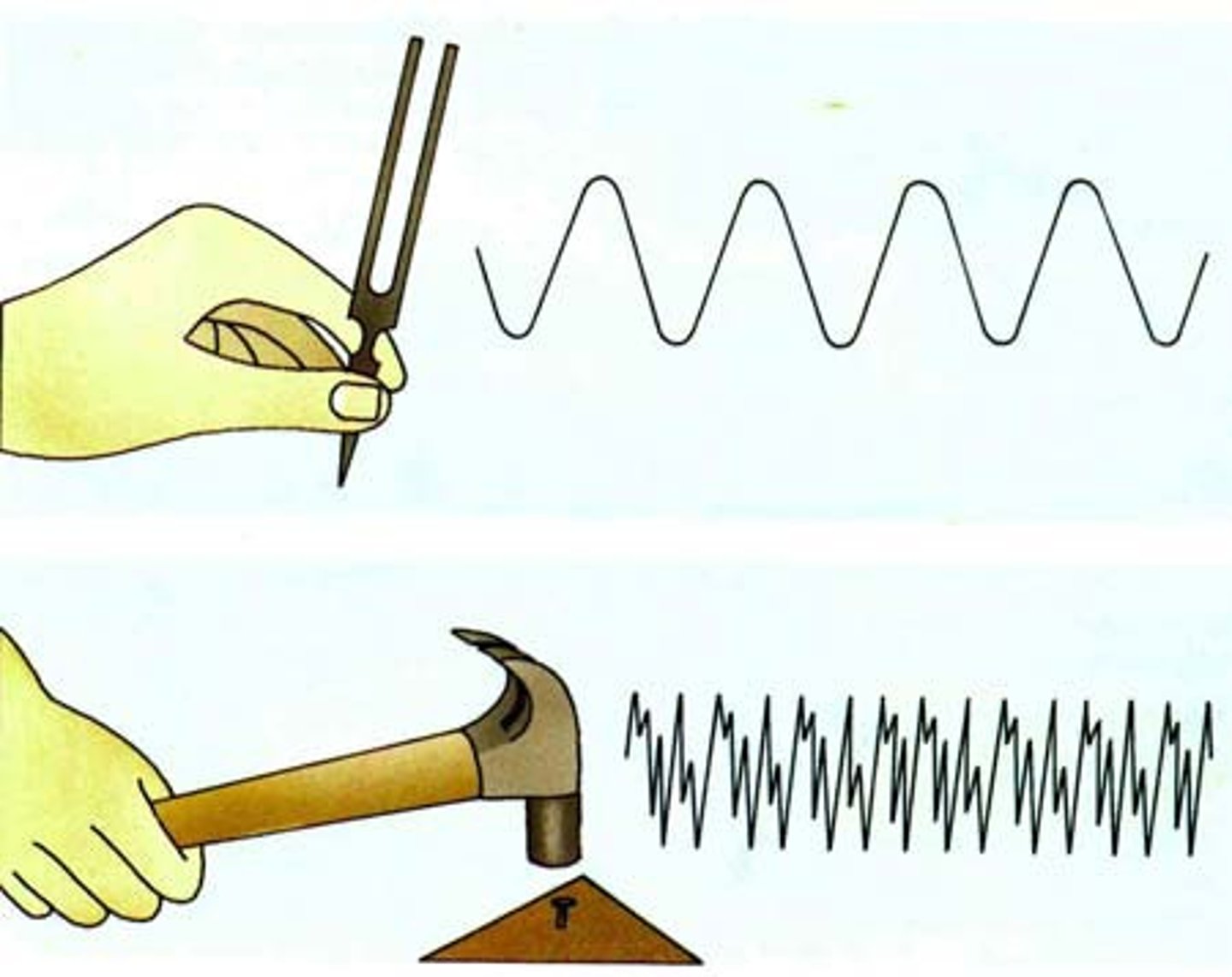
Wave Length
the distance between parts of a wave
Frequency
The number of waves passing a fixed point per second.
Amplitude
Height of a wave
Pitch
a tone's experienced highness or lowness; depends on frequency
Loudness
A physical response to the intensity of sound, modified by physical factors
Quality
The quality actually depends on the shape of wave form and the number of overtones
Transverse Wave
A wave that moves the medium in a direction perpendicular to the direction in which the wave travels
Longitudinal Wave
A wave in which the vibration of the medium is parallel to the direction the wave travels
Wave Speed
Wave speed is the distance the wave travels in a given amount of time, such as the number of meters it travels per second.
Electricity

Law of electrostatics
Electrostatic phenomena arise from the forces that electric charges exert on each other and are described by Coulomb's law
Resistors in series
Resistors are said to be in series whenever the current flows through the resistors sequentially.
Resistors in parallel
Resistors in Parallel A circuit is said to be connected in parallel when the voltage is the same across the resistors.
Ohm's Law
Provided the temperature and other physical conditions remain constant, the current, I, through a conductor is proportional to the pd, V , it ends
Right hand grip rule
The right-hand grip rule is also known as corkscrew-rule and it was named after the French physicist and mathematician Andre-Marie Ampere.
Law of Magnetism
law of magnetism is that like poles repel one another and unlike poles attract each other; this can easily be seen by attempting to place like poles of two magnets together.
Fleming's Left hand rule
Fleming's left-hand rule states that: When a current-carrying conductor is placed in an external magnetic field, the conductor experiences a force perpendicular to both the field and to the direction of the current flow.
Fleming's right hand rule
Fleming's right-hand rule gives which direction the current flows. The right hand is held with the thumb, index finger and middle finger mutually perpendicular to each other (at right angles), as shown in the diagram.
Lenz's Law
Lenz's law states that
The induced electromotive force with different polarities induces a current whose magnetic field opposes the change in magnetic flux through the loop in order to ensure that original flux is maintained through the loop when current flows in it.
Faraday's 2nd Law
Faraday's Second Law of Electrolysis states that "the mass of a substance deposited at any electrode on passing a certain amount of charge is directly proportional to its chemical equivalent weight."
Mechanics

Hooke's Law
When a material behaves elastically and exhibits a linear relationship between stress and strain, it is called linearly elastic material. In this case, stress is directly proportional to strain.
Newton's First law
Newton's First Law states that An object at rest tends to remain at rest, and an object in motion continues in motion with a constant velocity, unless the object is acted upon by a net external force.
Newton's Second law
Newton's Second Law states: The resultant force is equal to the rate of change in momentum. The change in momentum is in the same direction as the resultant force
Newton's Third law
Newton's law states that for every action there is an equal and opposite reaction. This law explains how rockets fly in space and it also accounts for the majority of the lift action generated by an airplane's wings.
Density
The density of a substance is its mass per unit volume
Density= Mass divided by Volume
Relative Density
Relative density, or specific gravity, is the ratio of the density (mass of a unit volume) of a substance to the density of a given reference material.
Pressure
Pressure is the force acting normally per unit area
Pressure= Force divided by Acceleration
Scalar Quantity
A quantity that has only magnitude
Vector Quantity
a quantity that has both magnitude and direction
Moment
The moment of a force about a point is the product of the force and the perpendicular distance of its line of action form the point
Law of Moments
The Law of Moments states that for equilibrium (balance) the clockwise moments are equal to the anti-clockwise moments.
Work
In physics, it is called mechanical work that develops a force on an object and may affect its position or its amount of movement.
Work= Force x Displacement
Principle of Conservation of Energy
Principle of Conservation of Energy states that energy cannot be created or destroyed but can be transformed form one type to another
Momentum
The linear momentum of a body is the product of its mass and its velocity
Momentum= Mass x Velocity
Principle of Conservation of Momentum
The principle of conservation of momentum states that in absence of external forces, the total momentum of a system of bodies is constant
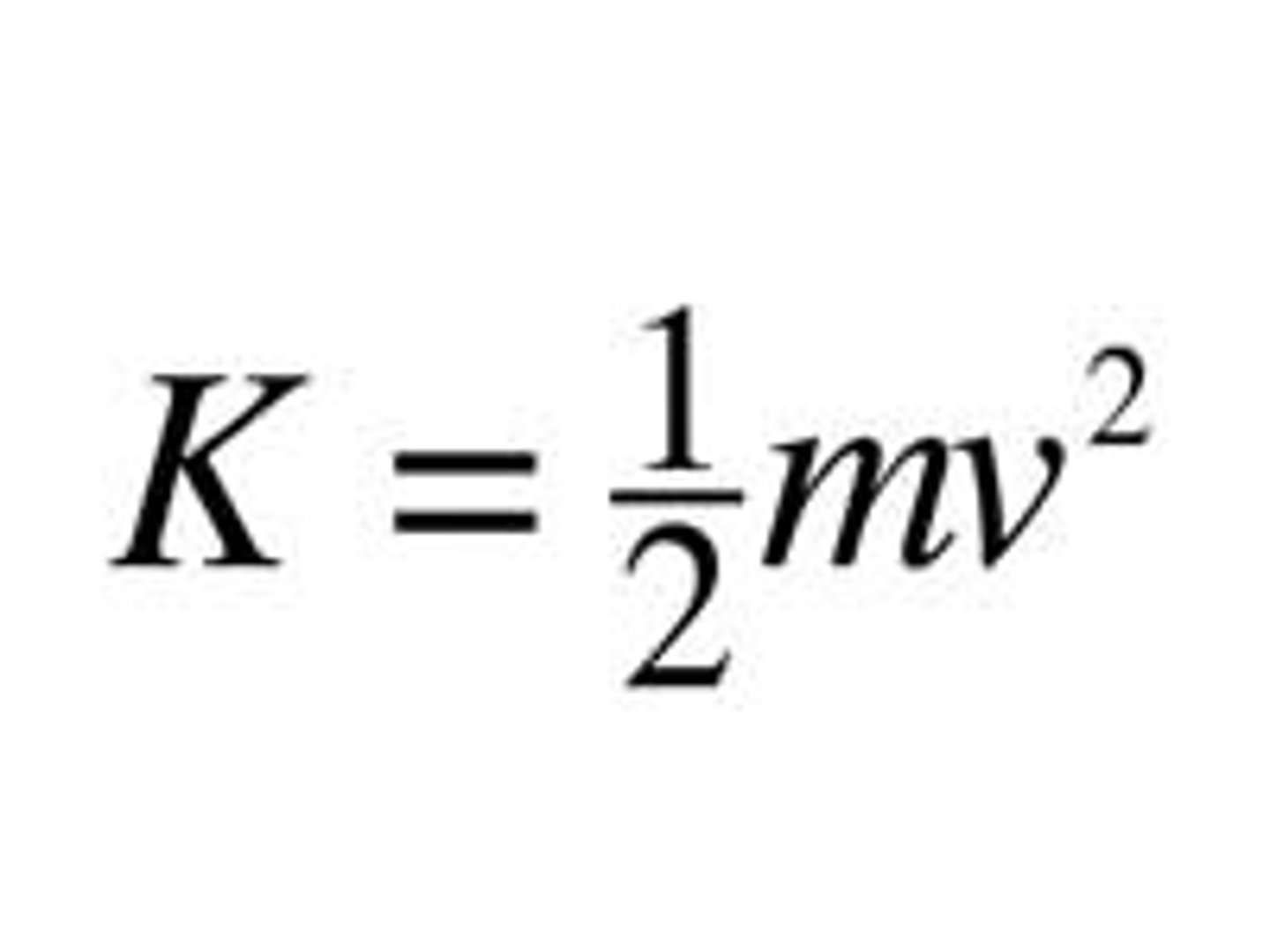
Kinetic energy
Kinetic energy is the energy a body has due to its motion
Gravitational Potential Energy
Potential energy that depends on the height of an object
Power
is the rate of doing work or of using energy
Power= Work divided by Time
Watt
is the power used in doing 1 J of work per 1 s
Efficiency
The efficiency of a system is the ratio of the useful energy output to the energy input

Average speed
total distance divided by total time
Average velocity
the total displacement divided by time
Centre of Gravity
The point where the entire weight of an object appears to act.
Acceleration
rate of change of velocity
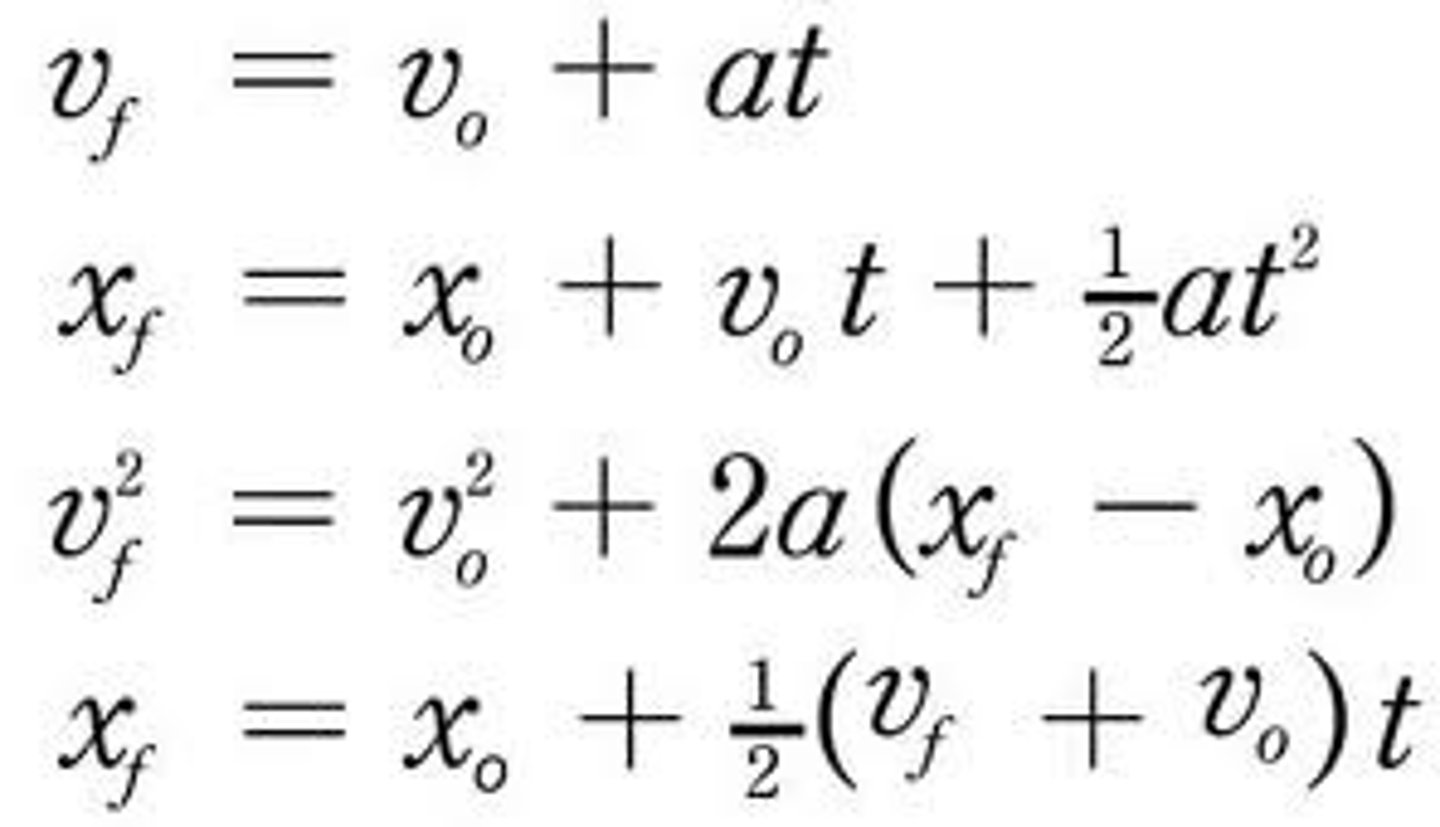
Constant acceleration equations of motion(4 eqns)
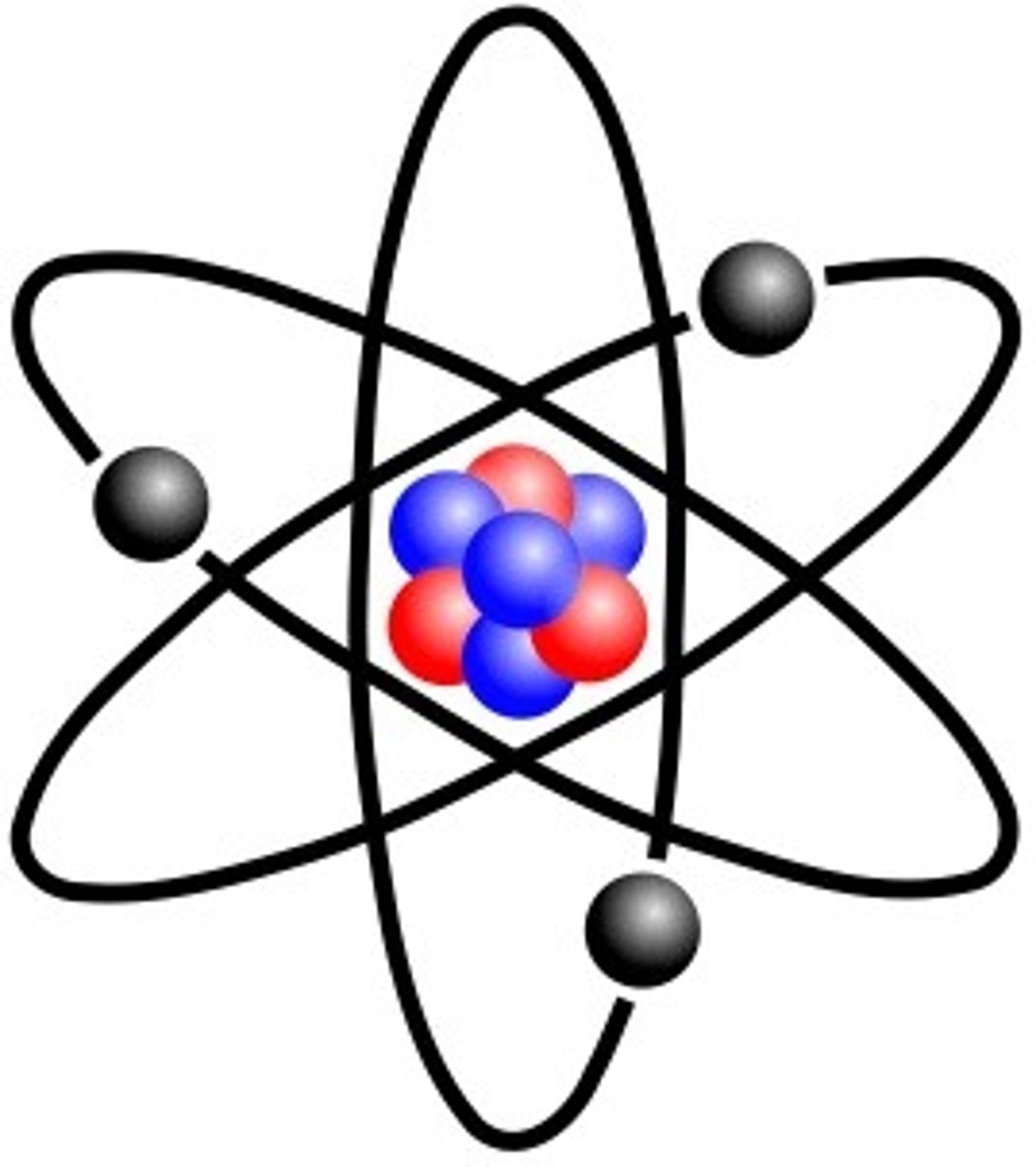
Physic of the Atom
Alpha particles
Alpha particles, also called alpha rays or alpha radiation, consist of two protons and two neutrons bound together into a particle identical to a helium-4 nucleus.
Beta particles
a negatively charged particle (an electron) emitted from the nucleus of an atom during radioactive decay.
Gamma rays
Electromagnetic waves with the shortest wavelengths and highest frequencies
Atomic number
the number of protons in the nucleus of an atom
Mass number
the sum of the number of neutrons and protons in an atomic nucleus
Isotope
Atoms of the same element that have different numbers of neutrons
Half-Life
is the time required for a quantity to reduce to half of its initial value.