Material Mid Sem
 Call Kai
 Learn
Learn Practice Test
 Spaced Repetition
 Match
Match Flashcards
 Knowt Play
1/83

There's no tags or description
Looks like no tags are added yet.
Name | Mastery | Learn | Test | Matching | Spaced | Call with Kai |
|---|
No analytics yet
Send a link to your students to track their progress
84 Terms
Single phase alloys can be strengthened by
precipitation hardening
precipitation strengthening
grain size reduction
solid solution precipitation
solid solution precipitation
The stages of creep may be characterised by a number of regions plotted on a creep versus time curve. The secondary stage of creep deformation is characterized by a straight line with
transient, secondary or steady-state
transient creep
tertiary or acceleration creep
decreasing strain data
transient, secondary or steady-state
Fatigue of metal alloys may be considered to correspond to
the ductile fracture of the alloy after a number of cycles above the yield strength
the brittle fracture of the alloy after a number of cycles above the yield strength
the ductile fracture of the alloy after a number of cycles below the yield strength
the brittle fracture of the alloy after a number of cycles below the yield strength
the brittle fracture of the alloy after a number of cycles below the yield strength
The fatigue life of materials may be determined using Miner's rule. This approach does not take into account the
applied strain
applies stress
applied number of cycles
the type of material.
appliead strain?
Plastic deformation of metals
can be recovered when the load is removed
is permanent deformation when the load is removed
has a small viscoelastic component which is recovered when the load is removed
shows a yield strength when the load is removed
is permanent deformation when the load is removed
Hardness measurement of a metal is achieved using a 'hardness test', and can be explained as
the resistance of a metal to a round indenter
the resistance of a metal to a pointed indenter
the resistance of a metal to a plastic deformation
the resistance of a metal to elastic deformation
the resistance of a metal to a plastic deformation
A high impact energy is associated with:
large strain energy at yielding
cleavage failure mechanism
high surface energy
a fatigue failure
large strain energy at yielding, high surface energy
Which kind of fracture is associated with the intergranular crack propagation mechanism?
Ductile
Brittle
Torsion
Brittle or ductile
brittle or ductile
The major difference between the Izod and Charpy test is
temperature of the test
the geometry of the test pieces
the configuration of the test pieces
the Izod test piece does not have a notch
the configuration of the test pieces
A brittle material typically exhibits substantial plastic deformation with high energy absorption before fracture
True
False
false
The elastic modulus of a material is related to the shear modulus, for small strains by
shear stress
Hooke's modulus
R-ratio
one plus Poisson's ratio
one plus Poisson's ratio
The main mechanism for plastic deformation in metals is generally due to
the presence of vacancies
the presence of mixed dislocations
the presence of only edge dislocations
the presence of only screw dislocations
the presence of mixed dislocations
The _____________ temperature determines whether hot or cold working is occurring in metals.
recrystalization
Polycrystalline alloys can not be strengthened by
grain size reduction
solid solution precipitation
solid solution strengthening
precipitation hardening
solid solution precipitation
Annealing is
cold worked process in which ametal is heat treated and may experiencerecovery, recrystallization, and grain growth
both a cold worked and a hot worked process in which a metal is heat treated and may experience recovery, recrystallization, and grain growth
hot worked process in which a metal is heat treated and may experience recovery, recrystallization, and grain growth
working process in which a metal may experience recovery, recrystallization, and grain growth
hot worked process in which a metal is heat treated and may experience recovery, recrystallization, and grain growth
What are the three major factosof material selection?
properties, composition and processing
What types of bulk properties can material have
emchanical, electrical, optical and thermal
3 mechanical porperties
elastic modulus, shear modulus, hardness
3 eleectrical properties
conductivity,r esistivity, capacitance
3 optical porperties
reflectivity, absorbance, emission
3 thermal proeprties
thermal expansion, heat capacity, thermal conductivity
Metal properties
strong, malleable, good conductors, can be alloyed to improve properties
What is tensile strentgh
the maximum amount of pulling or stretching stress a material can withstand before breaking or failing
What is compressive strength
he maximum capacity of a material or structure to withstand loads that reduce its size (pushing together), measured as the stress applied just before the material breaks or deforms permanently.
Common mechanical test peformed in tension
stress-strain test
Whati is deformation
change n shape due to application of force
Strain is proportinal to applied stress only when
elastic deformation exists
tensi..e stress occures when the load is applied
perpendicula to the specimen cross-sectional area
In a material, what makes ahiher modulus of elasticity
The greate rthe force of attraction between atoms
What is a shearforce?
an internal or external force acting parallel to a material's cross-section, causing one part of the object to slide, cut, or deform diagonally past the other
What is torsion
the act, process, or state of twisting an object, typically created by applying opposite torques at either end. (a type of shear stress)
What is a moment
a measure of its tendency to cause a body to rotate about a specific point or axis.
what is a tensile test?
Applies increasing tensile force , until breaks, applicable to ductile materials
Effects of alloying
strength is affected, stiffness(modulus of elastciity) 9s not.
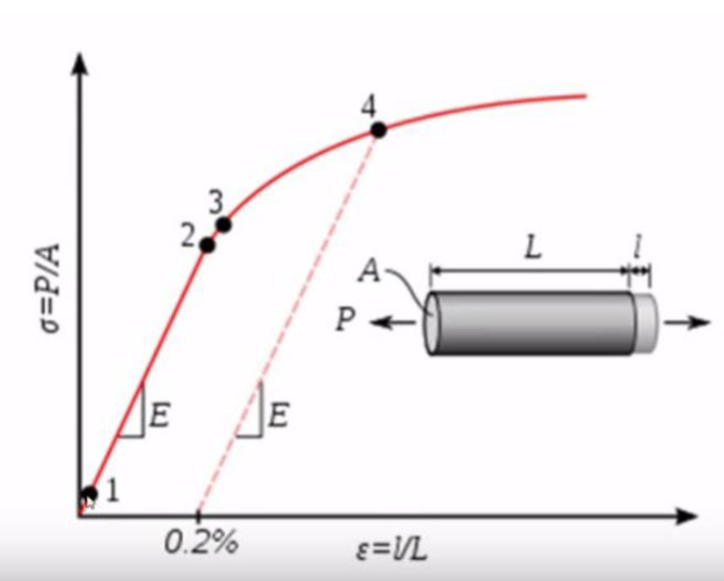
What is represented by E, 2, 3, 4 and the line at 4
Elastic region modulus, proportional limit, yield strentgh, yield strength at 0.2% offset, metals response when load is removed
What are anisotropic materials
substances whose physical properties—such as strength, conductivity, or elasticity—vary depending on the direction of measurement, rather than being uniform in all directions.
What does poisson’s ration describe
The deformation of a material in directions perpendicular to the direction of loading
What are isotropic materials
having a physical property which has the same value when measured in different directions.
What can we assume for polycrystalline materials with random grain orientation
assume isotropic
What is ductility
the general ability of a metal to be plastically deformed
Why do we generally want ductile materials
bends before it breaks and warns of something going wrong
What is a brittle material
a substance that breaks or shatters with little to no plastic deformation (bending or stretching) when subjected to stress, often failing abruptly without warning.
What is a flexural test
measures a material's behavior under bending loads, determining its ability to resist deformation and rupture, such as flexural strength and modulus.
Hardness test
measure of material’s resistance to localized plastic deformation
(e.g. dent or scratch)
Why check hardness
Machinability- Tool Life
Wear Properties
• Corrosion Resistance
• Fatigue/ Life Cycle
• Annealing
• Cost Savings
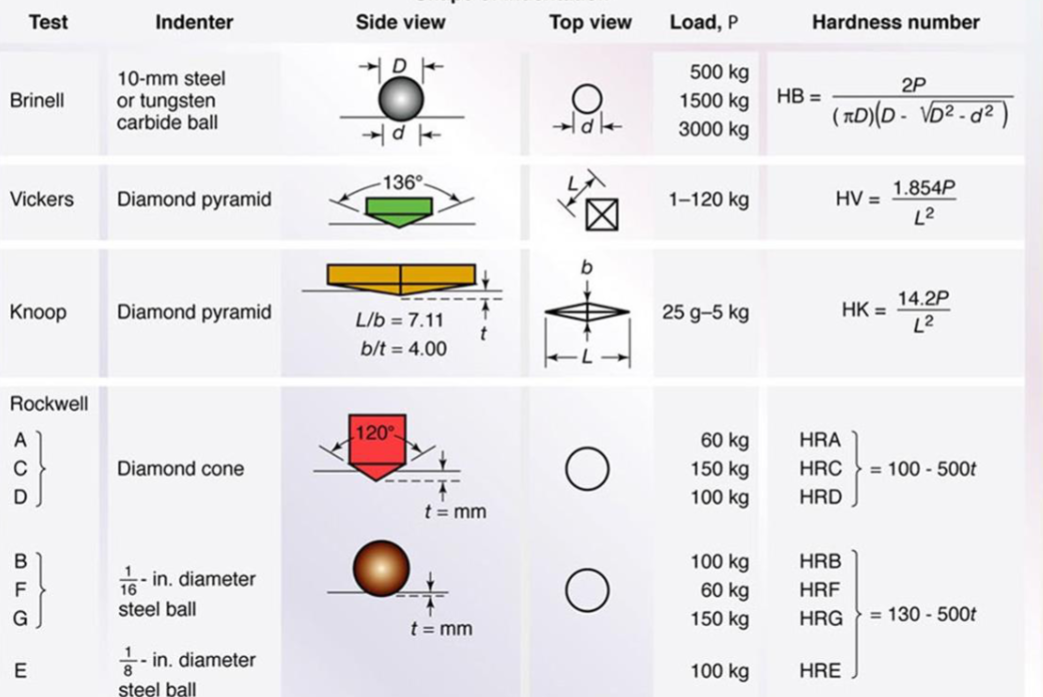
what type of tests
hardness tests
Hardness relation to tensile strength
Both show degree of resistance to plastic deformation, hardness proportional to tensile (depends on material)
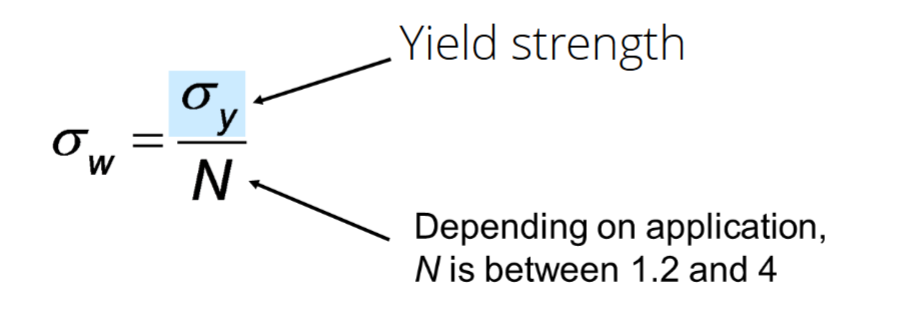
Design/saftety factors
Because of design uncertainties allowances must be made to
protect against unanticipated failure
• For structural applications, to protect against possibility of failure—
use working stress, σw, and a factor of safety, N
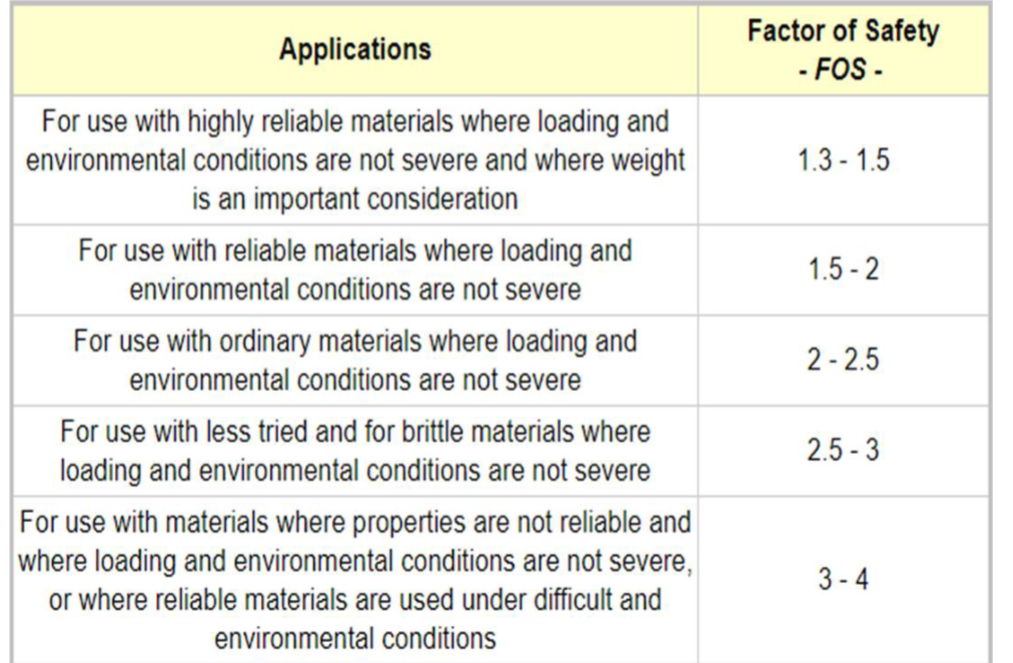
Read this
Where does fracture typically initiate in a three-point bending (flexural) test
At the outer surface of the specimen that is under tensile stressrather than at the surface under compression
Ductile materials have:
Extensive plastic deformation and energy absorption (“toughnesss”) before fracture
Brittle materials have:
little plastic deformation and low wnergy absorption before fracture
What is the stress concentration factor
Dimensionless ratio of maximal stress to nominal stress which quantifies how much localised stresses increase due to abript geometric changes like holes, fillets or notches.
What is fracture toughness
Measure of a material’s resistance to brittle fracture when a crack is present
Low fracture resiistance leads to:
rapid crack propogation and brittle fracture
What are the charpy and izod tets
standardized pendulum-based impact tests used to determine a material's toughness and energy absorption (notch toughness) during sudden shock loading. Both measure brittle-to-ductile transition, with Charpy using a horizontal specimen (often for metals) and Izod using a vertical cantilevered specimen (often for plastics)
What is fatigue
time based failure that occurs due to cyclic loading at stresses below material’s yield strength
What are the two main methods of fatigue testing
rotary bending method, uniaxial method
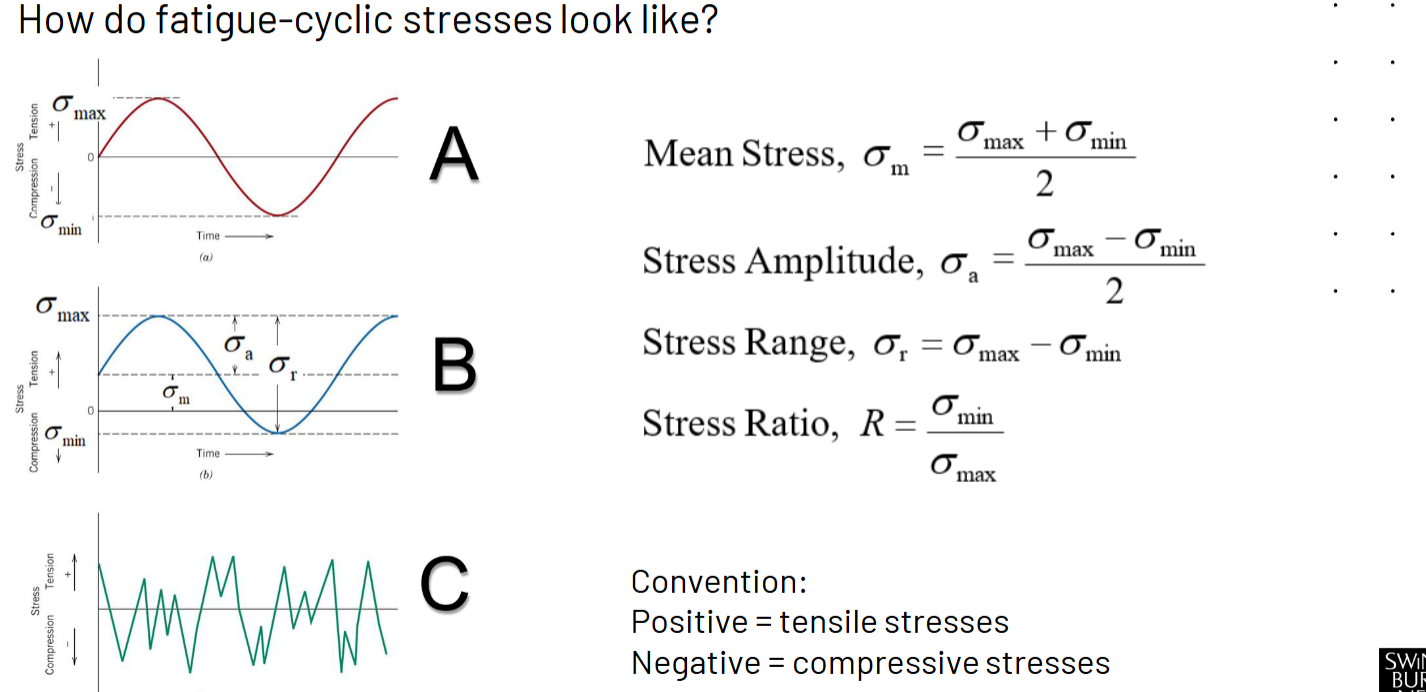
revise this
What do S N curves measure
stress vs number of cycles to failure
What is low cycle fatigue (LCF)
small number of cycles, high loads, elastic and plastic deformation
What is high cycle fatigie (HCF)
large number of cycles (N > 10^5)
Low loads, elastic eformation
What is a fatigue limit
When stress amplitude is below which material never fells (section becomes flat)
What is fatige strenght
stress at which fracture occurs at a specified nmber of cycles
What are the stages of fatigue failuer
Crack initiaition, crack propagation, complete fractre
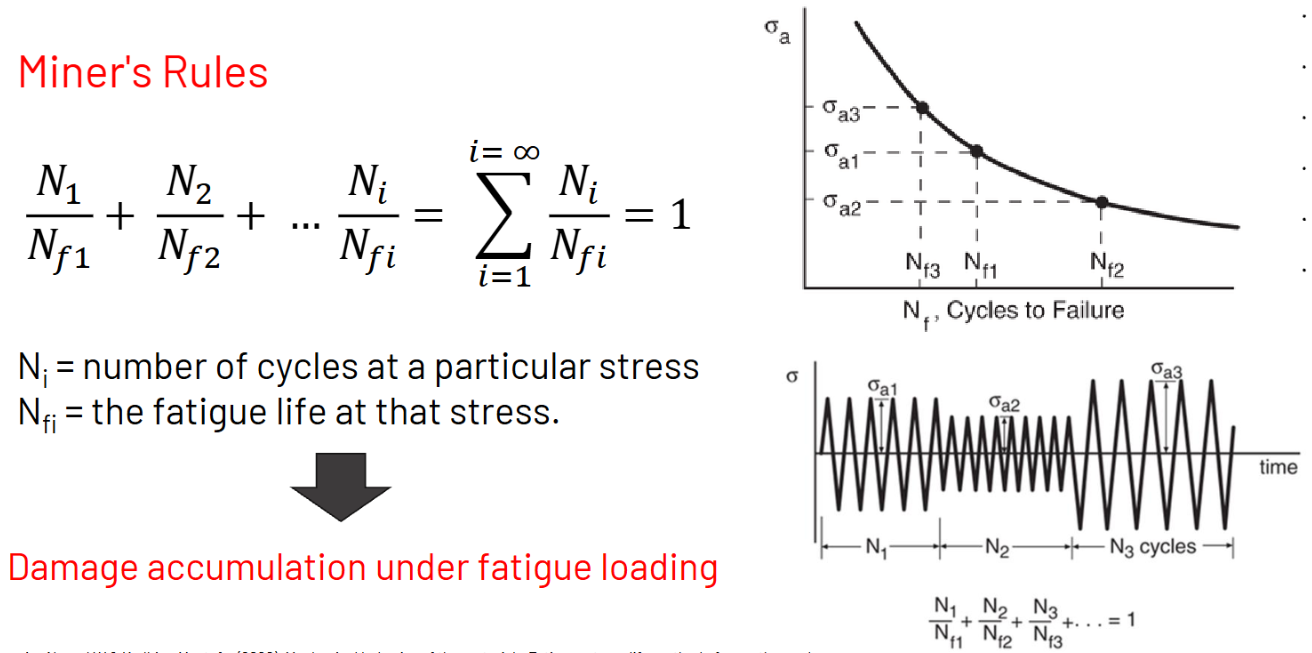
miner’s rule
an engineering principle used to predict fatigue failure in materials subjected to variable stress loading. It states that failure occurs when the sum of damage fractions—the ratio of applied cycles () to cycles causing failure () at various stress levels—equals or exceeds 1
Improving fatigue life
modifying degree of stree variation, minimize or remove stress concentration points, generate compressive residual stress, regulate the operational envionment
Avoiding fatigue failure
Control stress risers like holes, sharp corners, grooves, threads, keyways,
and stamped markings.
2. Control surface finish, including scratches in critical areas.
3. Avoid corrosion and exposure to embrittling gases.
4. Be very careful with welds – spot welds and fillet welds.
5. Higher temperatures usually reduce fatigue strength.
6. Manage residual stresses from fabrication operations, including welding.
7. Make critical areas inspectable for cracks.
8. Design in stress margin.
9. Measure real load environment and test parts to determine actual fatigue life.
10. Design in redundant load paths.
What is creep
Deformation under static stress at elevated temperatures ( > 0.4 Tm)
at long periods of
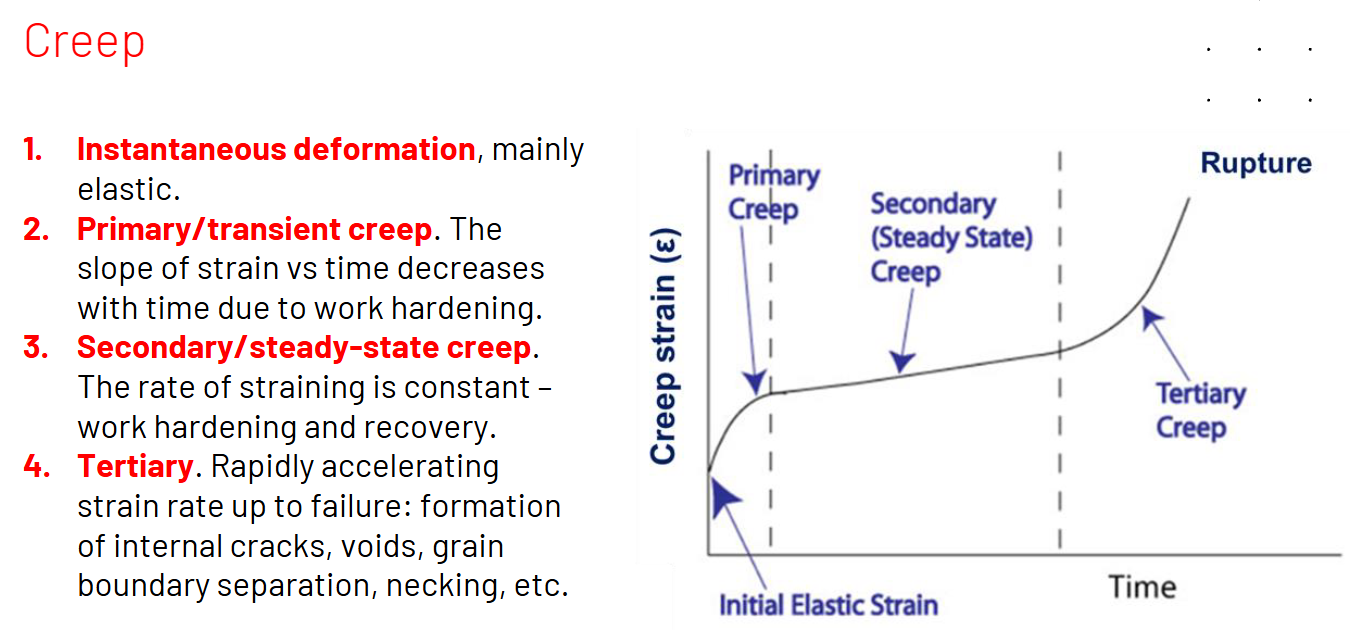
What is the effect of increased temperature and stress on creep strain
Higher temperature and increased stress accelerate creep strain, resulting in faster deformation rates, shorter material life, and faster transition through creep stages
What is Solidification
result of casting of molten materia, nuclei of the solid phase form, crystals grow until their boundries meet crystaks become grrains
What are equiaxed and columnar grains
equiaxed: roughly same dimension in a lldirections
columnar: grains elongated in one direction
Types of imperfections
point defects, linear defects, interfacial or boundry defects
What are vacancy atmoic sites
Missing atim from an atomic site atoms around the vacancy displaced, the tensile stress field produced in the vicinity
What are self-interstitials
Host atoms positioned in interstitial positions between atoms
Hume rothery rules
Great way to predict if two elemensts will from a solid solution:
1. Δr (atomic radius) < 15%
2. Proximity in the periodic table; i.e.
similar electronegativities
3. Same crystal structure
4. Valences; All else being equal, a metal
will have a greater tendency to dissolve
a metal of higher valence than one of
lower valence
Describe in your own words the three strengthening mechanisms discussed in this chapter (i.e., grain size reduction, solid-solution strengthening, and strain hardening). Be sure to explain how dislocations are involved in each of the strengthening techniques.
Grain Size Reduction:
Reducing the grain size increases the number of grain boundaries in the material. Grain boundaries act as barriers to dislocation motion because dislocations must change direction or stop when they reach a boundary. Therefore, with more boundries, dislocations are less able to move, resulting in increased strength.
Solid-Solution Strengthening:
This method involves adding impurity atoms (either substitutional or interstitial) into the metal lattice. These atoms create lattice distortions due to size differences, producing strain fields. These strain fields interact with and hinder dislocation movement, meaning greater applied stress is required for deformation, thus increasing strength.
Strain Hardening (Work Hardening):
When a metal is plastically deformed, the number of dislocations increases significantly. As dislocation density rises, they begin to interact, tangle, and block each other’s motion. This makes further dislocation movement more difficult, thereby increasing the strength and hardness of the material.

Molecular weight slightly increases modulus due to greater chain entanglement. Higher crystallinity increases modulus because ordered crystalline regions restrict chain movement. Drawing increases modulus in the drawing direction by aligning polymer chains, making the material stiffer along that axis.
5 Factors that favour brittle fracture for thermoplastic polymers
1) reduction in temperature
2) Increase in strain rate
3) Presence of sharp notch
4) Increased specimen thickness
5) modification of the material (e.g. additio of hard fillers)
Describe the phenomenon of viscoelasticity
a material property exhibiting both viscous (time-dependent flow) and elastic (instantaneous, recoverable) behaviors when deformed

In stress relaxation, a constant strain is applied and the test is conducted by rapiidly straining the material ellastically in tension. decrease in stress as a function of time is measured. The parameter of interest is the relaxation modulus, found from stress divided by the fixed strain. In creep testing, a constant stress is applied and the increase in strain with time is measured. The parameter of interest is the creep modulus, found from the fixed stress divided by the time-dependent strain
Advantages and disadvantages of using transparent polymeric materials for eyeglass lenses
Advantages
low densities, thus lightwieght
relatively easy to gring to have desired contours
Less likely to shatter than glass
They filter out more UV radiation than glass
Disadvantages
Relatively soft so easuly scratched
Not as mechanically stable so not as precise optically