week 14 - Transverse flux permanent magnet machines
 Call Kai
 Learn
Learn Practice Test
 Spaced Repetition
 Match
Match Flashcards
 Knowt Play
1/33

There's no tags or description
Looks like no tags are added yet.
Name | Mastery | Learn | Test | Matching | Spaced | Call with Kai |
|---|
No analytics yet
Send a link to your students to track their progress
34 Terms
what is transverse flux?
The combination of the axial flux path (from the stator coils) and the radial flux path (from the permanent magnets)
what is the pole pitch in a machine?
The angular distance between two close poles of the machine. In a four pole machine it would be 90 degrees
What are teh advantages of a small pole pitch?
Reduced iron losses from shorter magnetic flux path in the core
reduced saturation as lower flux per pole
compact magnetic structure and reduced overall material cost
what does it mean if in a transverse permanent magnetic machine it is decoupled?
The electric path is decoupled from the magnetic path. So you can control magnetic field separately from electric field
what is the assembly of a transverse permanent magnet machine stator?
Stacked C shaped silicon steel plates
the middl espace of the c shaped stator core is where the stator coild passes
the nich of the c shaped stator core is where the rotor pole passes (If it was a full loop this is the break in the full loop)
Each coild is called a pole
There are no slots like RFPMs as the stator is formed only by magnetic cores
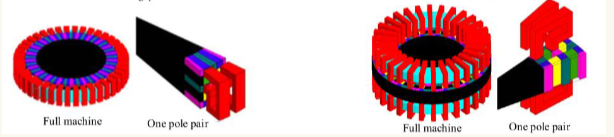
Which of these is a radial air gap?
the first one is
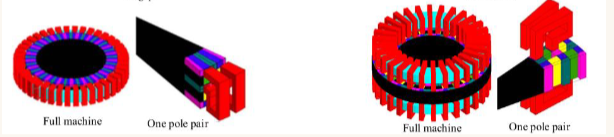
Which of these is an axiam air gap?
the second one is
what are the 3 configurations of transverse flux machines
(a) surface mounted (SM)
(b) Flux-concentrating (FC)
(c ) axially magnetised (AM)
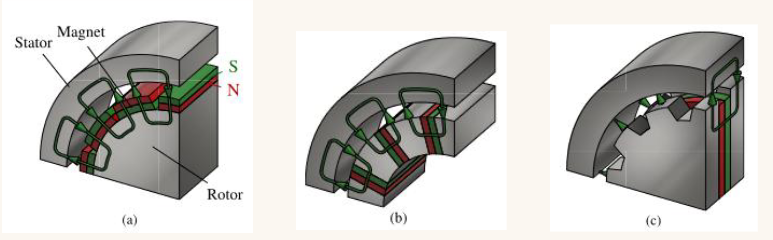
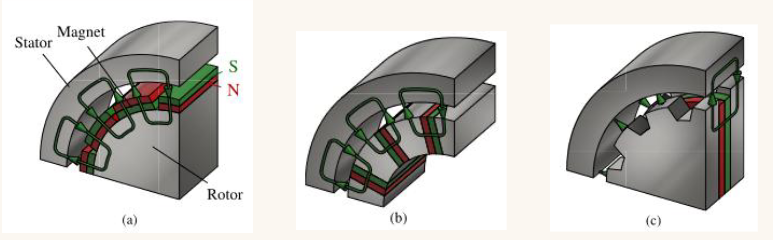
What are the names of each of these configurations?
A surface mounted
B Flux concentrating
C axially magnetised
what are the 6 core types of a transverse machines?
U core
U core with I bridge
C core
CP core
E core
Z core
what are the advantages of the transverse flux machine?
Higher torque density
decoupled magnetic and electrical loading
no end winding structure - les losses and copper mass
independent phases or modular design (easier scaling of the number of phases)
Fault tolerance operation (due to modular design, phases can be made to produce power even if other phases fail)
thermal advantages - better thermal conductivity so cools more
What are the benefits of having higher torque density in a transverse flux machine?
Higher specific tangential force
magenetic path ahs less restrictions in design, small pole pitch is possinle without affecting the coil cross section
Torque can be increased by increasing the number of poles (without effecting flux or current)
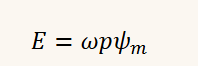
E is the peak EMF, ω is the electric speed, p is the pole number, ϕ is the pole pair flux linkage produced by PMs
what happens if you increase the number of poles in a RFPM or an AFPM?
The pole area is halved so Torque is not changed
what happens if you increase the number of poles in a TFPM?
The p can be doubled without changing the pole area and thus T will be doubled too. So the torque and volumetric torque density can change with the pole number.
why is the electric and magnetic circuits decouples in TFPM?
Because of its structure, where the magnetic flux is perpendicular (transverse) to the rotation plane
what is the impace of decouples magnetic and electrical loading in a TFPM
They can be controlled independently.
The megnetic circuit can be designed purely for hgih flux and low reactance
the electrical circuit can be designed purely for high current capacity and better cooling
What is the benefit of a TFPM not having an end windings structure?
This improves resistive losses
reduces copper mass
higher winding slot fill factor is achieved
conductor length of circumferential dimension is reduced
What are the benefits of independent phases (allowing modular design) of a TFPM?
There is easier scaling of the number of phases
The spatially seperated phases reduce the risk of a short circuit them compared to a radial flux PM with distributed windings
What does it mean if there is fault tolerance in a TFPM?
Multiple independent phases can be condigures (with power electronics) to produce power even if other phases experience a failure
this is important for reliability (like in aerospace)
What are the thermal advantages of the TFPM?
due to the more tightly wound tangential stator coils, higher surface contact is achieved which improves thermal heat conductivity
The stator teeth can act as cooling vanes, enabling an advantageous air cooling
What are the challenges of the transverse flux permanent-magnet machine?
Three dimensional flux path means more complicated machine
pole pitch
modelling and simulation difficulties
noise and torque ripples
magnetic insulation between the phases
low power factor
What is the challenge of the three dimensional flux path in a TFPM?
The machine has a complex structure so manufacturing and assembly is elaborate and cost intensive
What are the effects of the small pole pitch of the TFPM
Due to a small distance between the centres of two adjacent poles,there are many pole pairs and small angular misalignments ahve a strong effect in machine operation. This is a problem for small machines
What is the challenge of modelling and simulation difficulties in a TFPM
Due to the 3d flux path the flux distribution characteristic has to be solved for a 3d geometry in simulations which leads to a longer calculation time compared to 2D geometry.
what is the challenge of noise and torque ripples in a TFPM?
There is a large derivation of the magnetic reluctance during one rotation. So these machines have a high cogging torque as well as a large torque ripple.
what is cogging torque?
Cogging torque is the no-load torque ripple caused by the interaction between rotor permanent magnets and stator slotting, due to variations in magnetic reluctance as the rotor moves.
(The undesired torque ripple in a permanent magnet machine caused by the interaction between rotor permanent magnets and stator slots/teeth. This exists even when no current is flowing.)
what are the challenges of magnetic insulation between the phases of a TFPM
To get mangetic decoupling there must be magnetic insulation between the single phases. This is usually implemented with additional air gap in the axial direction
Why is there a low power factor in a TFPM?
due to:
high armature inductance there is high synchronous reactance.
stator excited flux leakage due to the segmented nature of the stator and fringing between the stator pieces
improper utilisation of PMS causing leakage between poles
armature flux dominated saturation
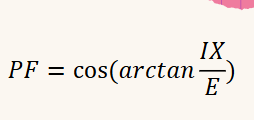
equation for the power factor of a TFPM
I is the phase current
X is the phase reactance
E is the back EMF
why are TFPMs food for direct drive WTs?
This is due to their high torque density and allowing direct coupling with the prime mover without a gearbox.
What are the benefits of using a TFPM for a direct drive WT?
Cost improvement (maintenance)
increased reliability
Increased efficiency
What kind of topology, air gap and diameter are good for TFPMS?
The TFPM has a higher dependency on the air gap, so needs a small air gap and a large diameter for mass and cost in wind power applications
how muh higher torque density does a TFPM have than a typical induction machine?
5 times higher torque denisty
What are key improvements for a TFPM
The copping torque, the efficiency, the low power factor and the manufacturing