3400 Lab Exam 4

0.0(0)
Studied by 2 people
call kaiCall Kai
learnLearn
examPractice Test
spaced repetitionSpaced Repetition
heart puzzleMatch
flashcardsFlashcards
GameKnowt Play
Card Sorting

1/50

encourage image

There's no tags or description

Looks like no tags are added yet.

Last updated 11:36 PM on 4/28/26
Name
Mastery
Learn
Test
Matching
Spaced
Call with Kai

No analytics yet

Send a link to your students to track their progress

51 Terms

1
New cards

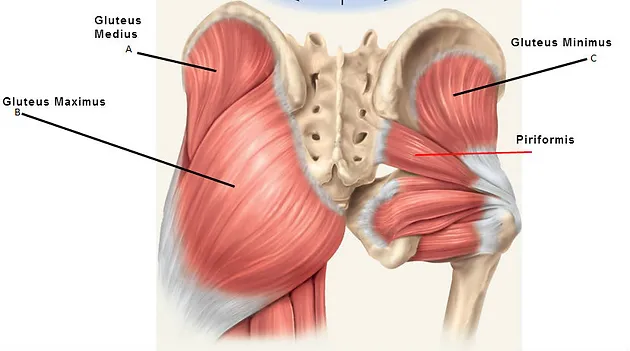
Gluteus maximus

Proximal Attachment (O): Ilium posterior to posterior gluteal line; dorsal surface of sacrum and coccyx; sacrotuberous ligament

Distal Attachment (I): Most fibers end in iliotibial tract, which inserts into lateral condyle of tibia; some fibers insert on gluteal tuberosity.

Nerve: Inferior gluteal nerve (L5, S1, S2)

Action: Extends hip joint (especially from flexed position) and assists in lateral rotation; fixes hip joint and assists in rising from sitting position
<p>Proximal Attachment (O): Ilium posterior to posterior gluteal line; dorsal surface of sacrum and coccyx; sacrotuberous ligament</p><p>Distal Attachment (I): Most fibers end in iliotibial tract, which inserts into lateral condyle of tibia; some fibers insert on gluteal tuberosity.</p><p>Nerve: Inferior gluteal nerve (L5, S1, S2)</p><p>Action: Extends hip joint (especially from flexed position) and assists in lateral rotation; fixes hip joint and assists in rising from sitting position</p>
2
New cards

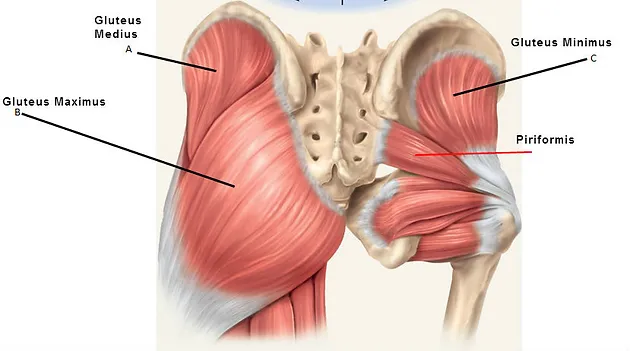
Gluteus medius

Proximal Attachment (O): External surface of ilium between anterior and posterior gluteal lines

Distal Attachment (I): Lateral surface of greater trochanter of femur

Nerve: Superior gluteal nerve (L5, S1)

Action: Abduct and medially rotate hip joint; keep pelvis level when ipsilateral limb is weight bearing and advance opposite (unsupported) side during its swing phase.
<p>Proximal Attachment (O): External surface of ilium between anterior and posterior gluteal lines</p><p>Distal Attachment (I): Lateral surface of greater trochanter of femur</p><p>Nerve: Superior gluteal nerve (L5, S1)</p><p>Action: Abduct and medially rotate hip joint; keep pelvis level when ipsilateral limb is weight bearing and advance opposite (unsupported) side during its swing phase.</p>
3
New cards

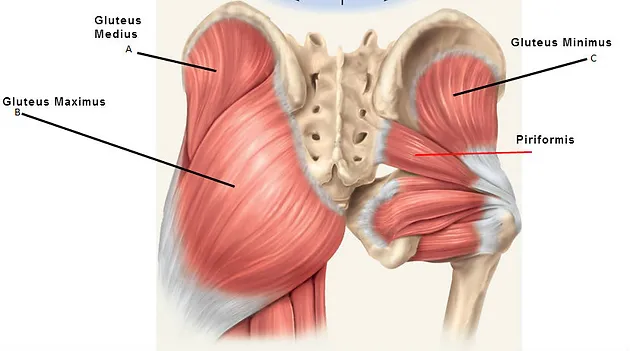
Gluteus minimus

Proximal Attachment (O): External surface of ilium between anterior and inferior gluteal lines

Distal Attachment (I): Anterior surface of greater trochanter of femur

Nerve: Superior gluteal nerve (L5, S1)

Action: Abduct and medially rotate hip joint; keep pelvis level when ipsilateral limb is weight bearing and advance opposite (unsupported) side during its swing phase.
<p>Proximal Attachment (O): External surface of ilium between anterior and inferior gluteal lines</p><p>Distal Attachment (I): Anterior surface of greater trochanter of femur</p><p>Nerve: Superior gluteal nerve (L5, S1)</p><p>Action: Abduct and medially rotate hip joint; keep pelvis level when ipsilateral limb is weight bearing and advance opposite (unsupported) side during its swing phase.</p>
4
New cards

Tensor fascia latae

Proximal Attachment (O): Anterior superior iliac spine; anterior part of iliac crest

Distal Attachment (I): Iliotibial tract, which attaches to lateral condyle of tibia

Nerve: Superior gluteal nerve (L5, S1)

Action: Abduct and medially rotate hip joint; keep pelvis level when ipsilateral limb is weight bearing and advance opposite (unsupported) side during its swing phase.
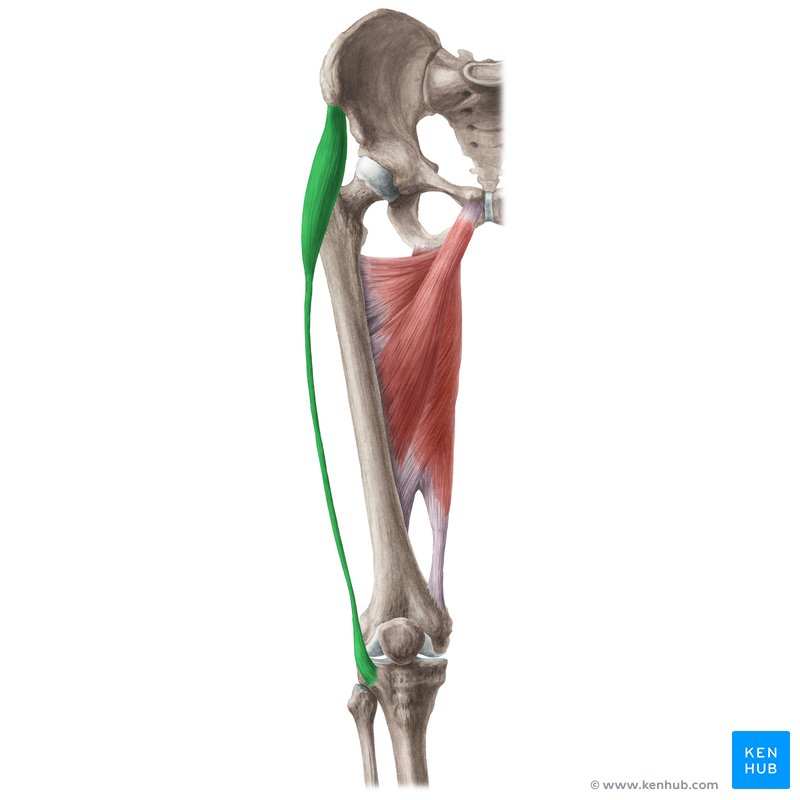
<p>Proximal Attachment (O): Anterior superior iliac spine; anterior part of iliac crest</p><p>Distal Attachment (I): Iliotibial tract, which attaches to lateral condyle of tibia</p><p>Nerve: Superior gluteal nerve (L5, S1)</p><p>Action: Abduct and medially rotate hip joint; keep pelvis level when ipsilateral limb is weight bearing and advance opposite (unsupported) side during its swing phase.</p>
5
New cards

Gracilis

Proximal Attachment (O): Body and inferior ramus of pubis

Distal Attachment (I): Superior part of medial surface of tibia (as part of pes anserinus)

Nerve: Obturator nerve (L2, L3)

Action: Adducts hip joint; flexes knee joint, medially rotating it when flexed
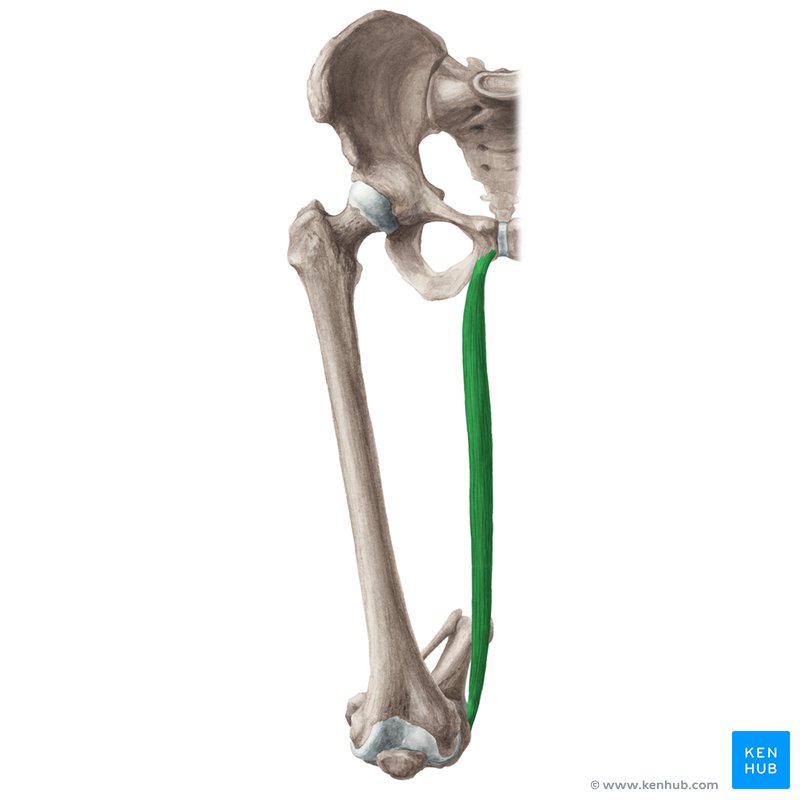
<p>Proximal Attachment (O): Body and inferior ramus of pubis</p><p>Distal Attachment (I): Superior part of medial surface of tibia (as part of pes anserinus)</p><p>Nerve: Obturator nerve (L2, L3)</p><p>Action: Adducts hip joint; flexes knee joint, medially rotating it when flexed</p>
6
New cards

Sartorius

Proximal Attachment (O): Anterior superior iliac spine and superior part of notch inferior to it

Distal Attachment (I): Superior part of medial surface of tibia (as part of pes anserinus)

Nerve: Femoral nerve (L2, L3)

Action: Flexes, abducts, and lateral rotates hip joint; flexes knee joint (medially rotates leg when knee joint is flexed)
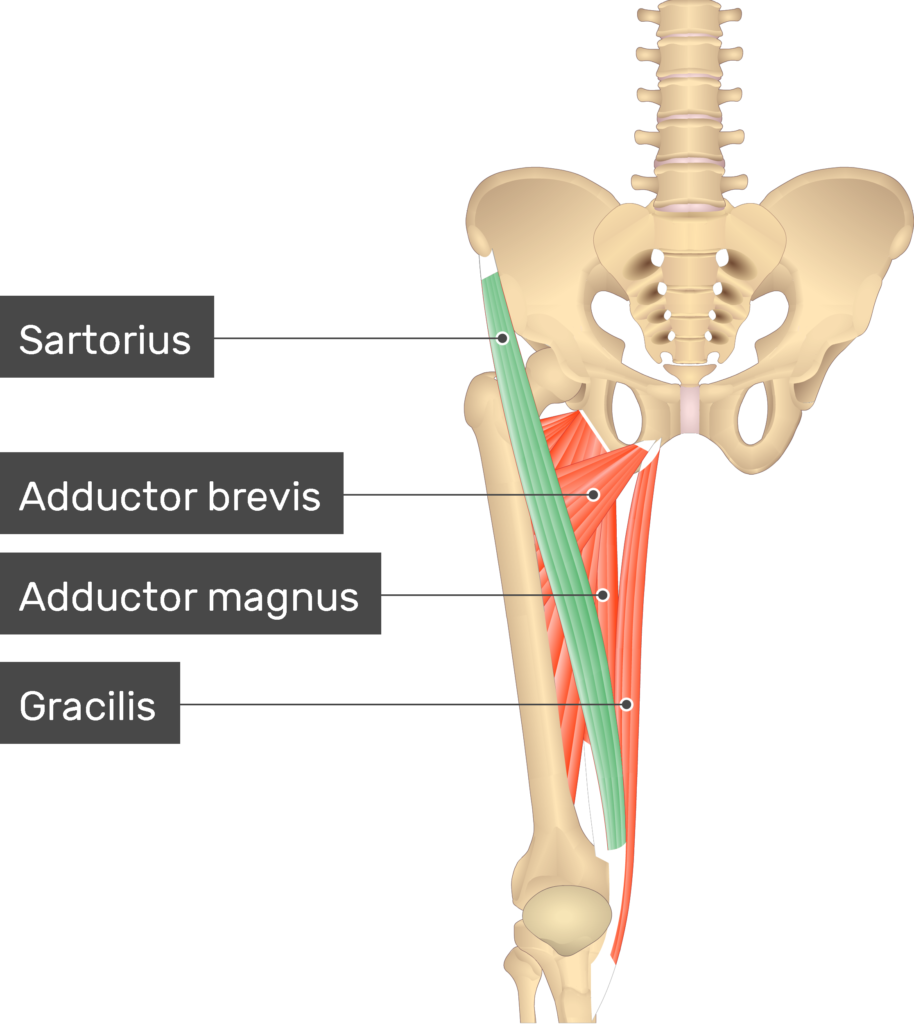
<p>Proximal Attachment (O): Anterior superior iliac spine and superior part of notch inferior to it</p><p>Distal Attachment (I): Superior part of medial surface of tibia (as part of pes anserinus)</p><p>Nerve: Femoral nerve (L2, L3)</p><p>Action: Flexes, abducts, and lateral rotates hip joint; flexes knee joint (medially rotates leg when knee joint is flexed)</p>
7
New cards

Piriformis

Proximal Attachment (O): Anterior surface of sacrum; sacrotuberous ligament

Distal Attachment (I): Superior border of greater trochanter of femur

Nerve: Branches of anterior rami of S1 and S2

Action: Laterally rotate extended hip joint and abduct hip joint when flexed; stabilize hip joint
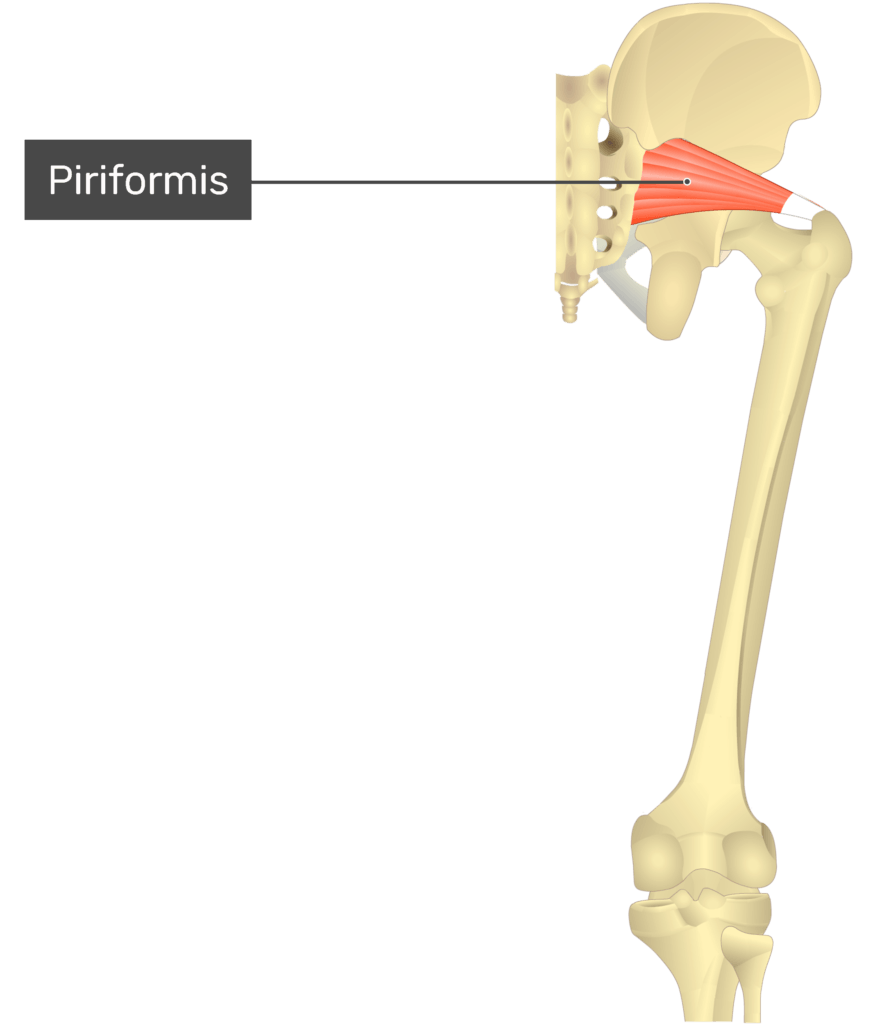
<p>Proximal Attachment (O): Anterior surface of sacrum; sacrotuberous ligament</p><p>Distal Attachment (I): Superior border of greater trochanter of femur</p><p>Nerve: Branches of anterior rami of S1 and S2</p><p>Action: Laterally rotate extended hip joint and abduct hip joint when flexed; stabilize hip joint</p>
8
New cards

Gemellus superior

Proximal Attachment (O): Ischial spine

Distal Attachment (I): Medial surface of greater trochanter (trochanteric fossa) of femurb

Nerve: same nerve supply as obturator internus (Nerve to obturator internus (L5, S1))

Action: Laterally rotate extended hip joint and abduct hip joint when flexed; stabilize hip joint
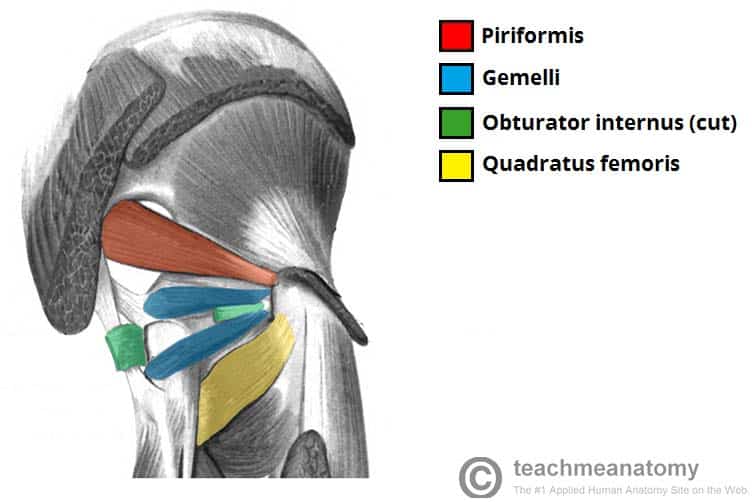
<p>Proximal Attachment (O): Ischial spine</p><p>Distal Attachment (I): Medial surface of greater trochanter (trochanteric fossa) of femurb</p><p>Nerve: same nerve supply as obturator internus (Nerve to obturator internus (L5, S1))</p><p>Action: Laterally rotate extended hip joint and abduct hip joint when flexed; stabilize hip joint</p>
9
New cards

Gemellus inferior

Proximal Attachment (O): Ischial tuberosity

Distal Attachment (I): Medial surface of greater trochanter (trochanteric fossa) of femur

Nerve: same nerve supply as quadratus femoris (Nerve to quadratus femoris (L5, S1))

Action: Laterally rotate extended hip joint and abduct hip joint when flexed; stabilize hip joint
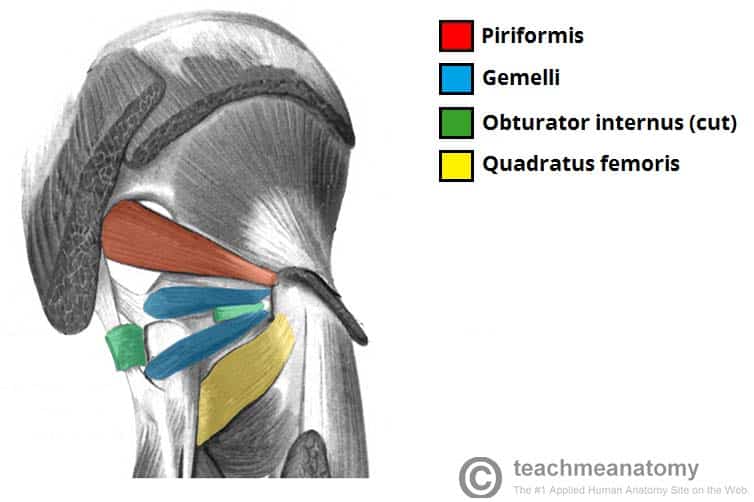
<p>Proximal Attachment (O): Ischial tuberosity</p><p>Distal Attachment (I): Medial surface of greater trochanter (trochanteric fossa) of femur</p><p>Nerve: same nerve supply as quadratus femoris (Nerve to quadratus femoris (L5, S1))</p><p>Action: Laterally rotate extended hip joint and abduct hip joint when flexed; stabilize hip joint</p>
10
New cards

Obturator internus

Proximal Attachment (O): Pelvic surface of obturator membrane and surrounding bones

Distal Attachment (I): Medial surface of greater trochanter (trochanteric fossa) of femur

Nerve: Nerve to obturator internus (L5, S1)

Action: Laterally rotate extended hip joint and abduct hip joint when flexed; stabilize hip joint
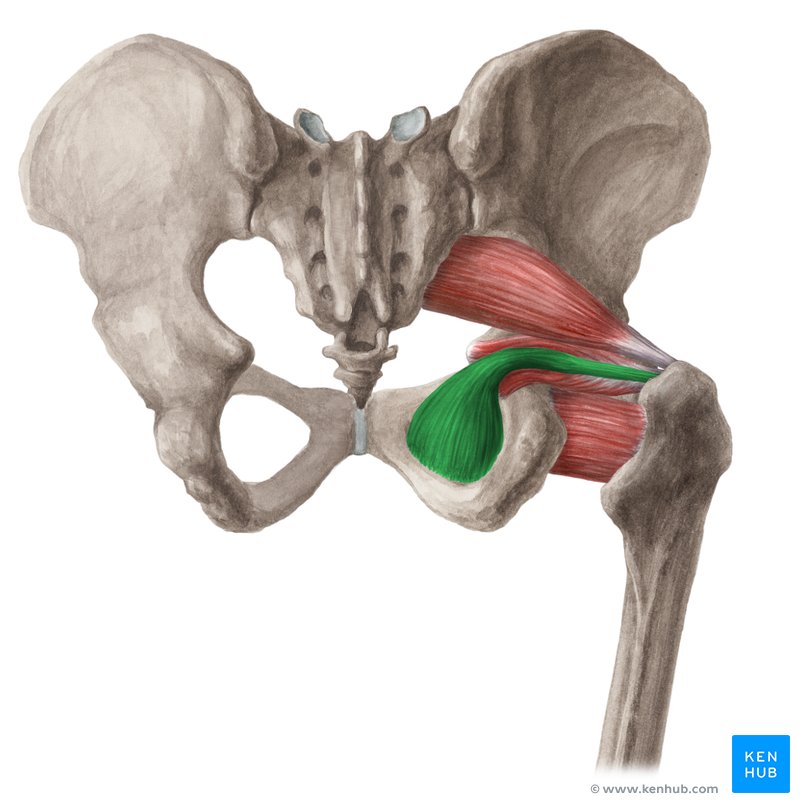
<p>Proximal Attachment (O): Pelvic surface of obturator membrane and surrounding bones</p><p>Distal Attachment (I): Medial surface of greater trochanter (trochanteric fossa) of femur</p><p>Nerve: Nerve to obturator internus (L5, S1)</p><p>Action: Laterally rotate extended hip joint and abduct hip joint when flexed; stabilize hip joint</p>
11
New cards

Obturator externus

Proximal Attachment (O): Margins of obturator foramen and obturator membrane

Distal Attachment (I): Trochanteric fossa of femur

Nerve: Obturator nerve (L3, L4)

Action: Laterally rotates hip joint; stabilizes hip joint
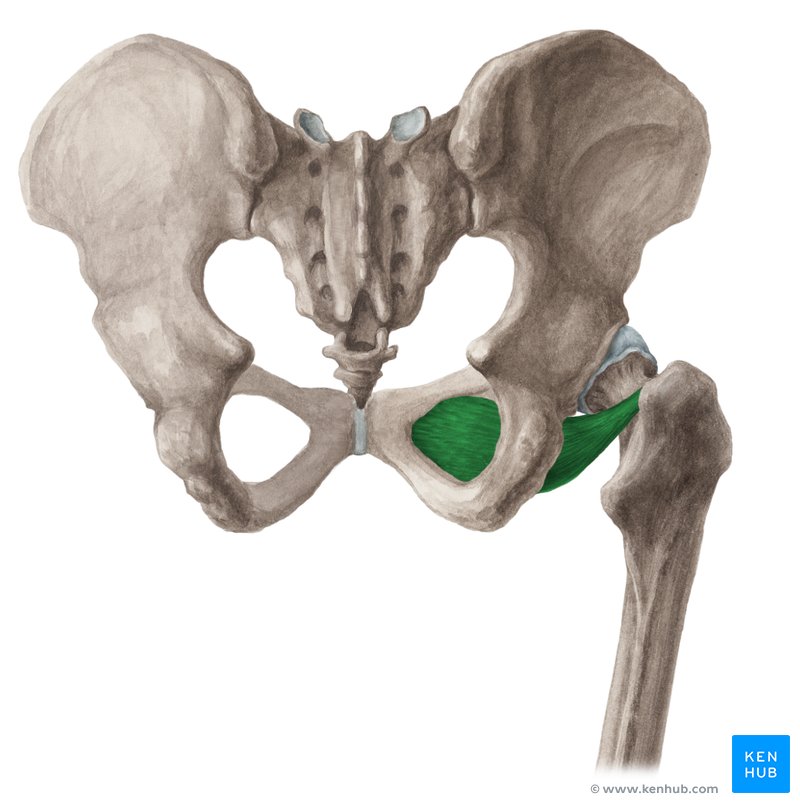
<p>Proximal Attachment (O): Margins of obturator foramen and obturator membrane</p><p>Distal Attachment (I): Trochanteric fossa of femur</p><p>Nerve: Obturator nerve (L3, L4)</p><p>Action: Laterally rotates hip joint; stabilizes hip joint</p>
12
New cards

Quadratus femoris

Proximal Attachment (O): Lateral border of ischial tuberosity

Distal Attachment (I): Quadrate tubercle on intertrochanteric crest of femur and area inferior to it

Nerve: Nerve to quadratus femoris (L5, S1)

Action: Laterally rotates hip jointc; stabilizes hip joint
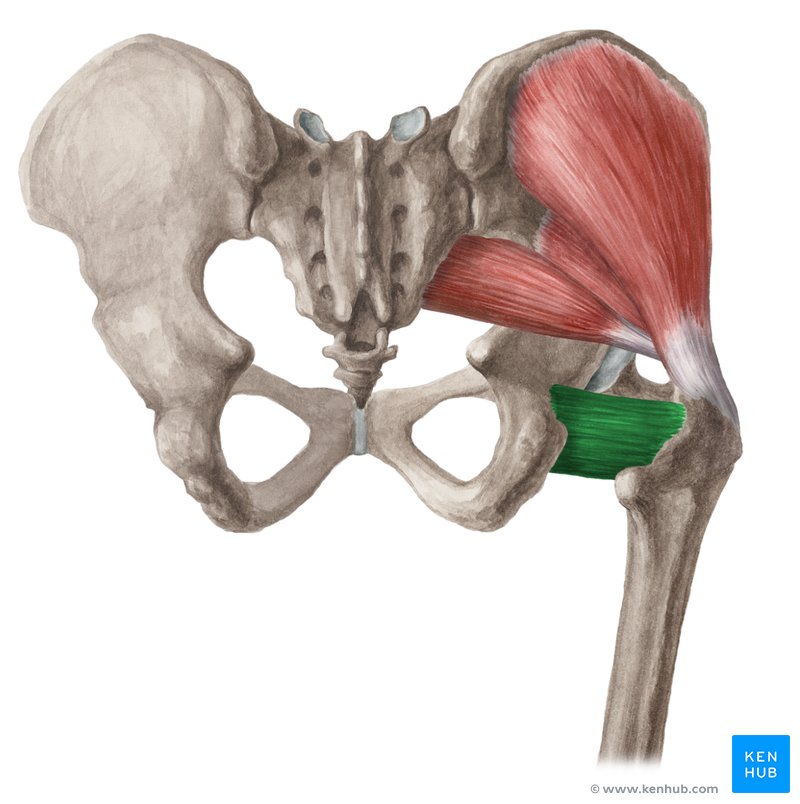
<p>Proximal Attachment (O): Lateral border of ischial tuberosity</p><p>Distal Attachment (I): Quadrate tubercle on intertrochanteric crest of femur and area inferior to it</p><p>Nerve: Nerve to quadratus femoris (L5, S1)</p><p>Action: Laterally rotates hip jointc; stabilizes hip joint</p>
13
New cards

Biceps femoris

Proximal Attachment (O):

  • Long head: ischial tuberosity

  • Short head: linea aspera and lateral supracondylar line of femur

Distal Attachment (I): Lateral side of head of fibula. Tendon is split at this site by fibular collateral ligament of knee.

Nerve:

  • Long head: tibial division of sciatic nerve (L5, S1, S2)

  • Short head: common fibular division of sciatic nerve (L5, S1, S2)

Action: Flexes knee joint and laterally rotates it when flexed; long head extends hip joint (e.g., accelerating mass during first step of gait and when rising from sitting position).
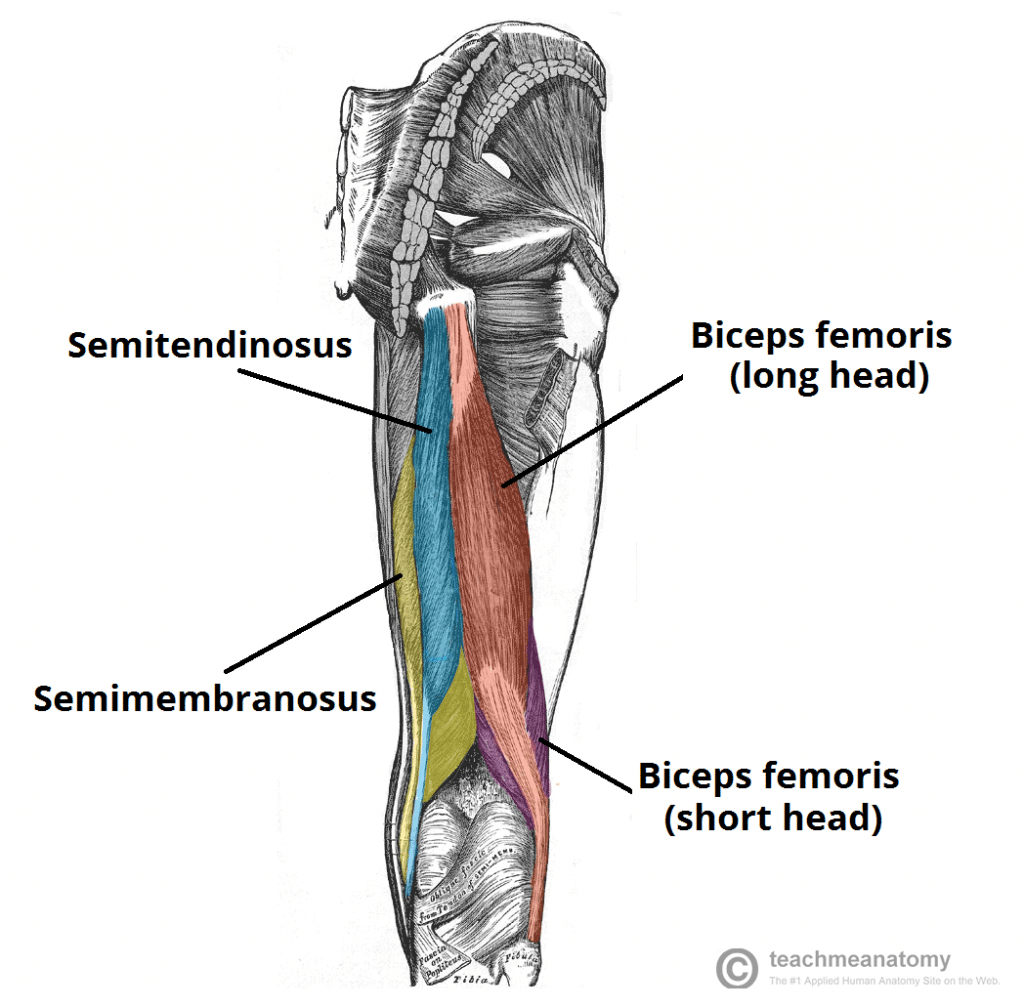
<p>Proximal Attachment (O):</p><ul><li><p>Long head: ischial tuberosity</p></li><li><p>Short head: linea aspera and lateral supracondylar line of femur</p></li></ul><p>Distal Attachment (I): Lateral side of head of fibula. Tendon is split at this site by fibular collateral ligament of knee.</p><p>Nerve:</p><ul><li><p>Long head: tibial division of sciatic nerve (L5, S1, S2)</p></li><li><p>Short head: common fibular division of sciatic nerve (L5, S1, S2)</p></li></ul><p>Action: Flexes knee joint and laterally rotates it when flexed; long head extends hip joint (e.g., accelerating mass during first step of gait and when rising from sitting position).</p>
14
New cards

Semimembranosus

Proximal Attachment (O): Ischial tuberosity

Distal Attachment (I): Posterior part of medial condyle of tibia. Reflected attachment forms oblique popliteal ligament (to lateral femoral condyle).

Nerve: Tibial division of sciatic nerve part of tibia (L5, S1, S2)

Action: Extend hip joint; flex knee joint and medially rotate it when flexed. When hip and knee joints are flexed (as when sitting), these muscles can extend trunk at hip joint (to rise).
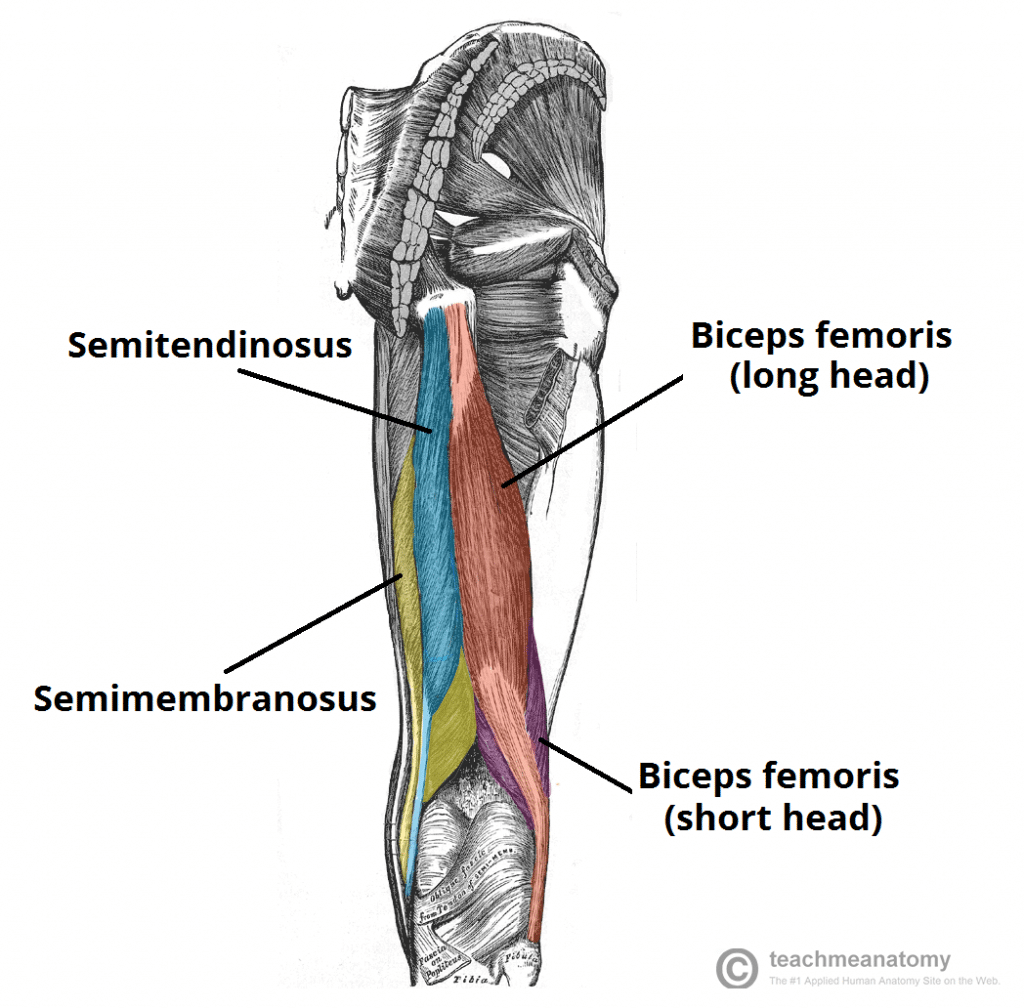
<p>Proximal Attachment (O): Ischial tuberosity</p><p>Distal Attachment (I): Posterior part of medial condyle of tibia. Reflected attachment forms oblique popliteal ligament (to lateral femoral condyle).</p><p>Nerve: Tibial division of sciatic nerve part of tibia (L5, S1, S2)</p><p>Action: Extend hip joint; flex knee joint and medially rotate it when flexed. When hip and knee joints are flexed (as when sitting), these muscles can extend trunk at hip joint (to rise).</p>
15
New cards

Semitendinosus

Proximal Attachment (O): Ischial tuberosity

Distal Attachment (I): Superior part of media surface of tibia (as part of pes anserinus)

Nerve: Tibial division of sciatic nerve part of tibia (L5, S1, S2)

Action: Extend hip joint; flex knee joint and medially rotate it when flexed. When hip and knee joints are flexed (as when sitting), these muscles can extend trunk at hip joint (to rise).
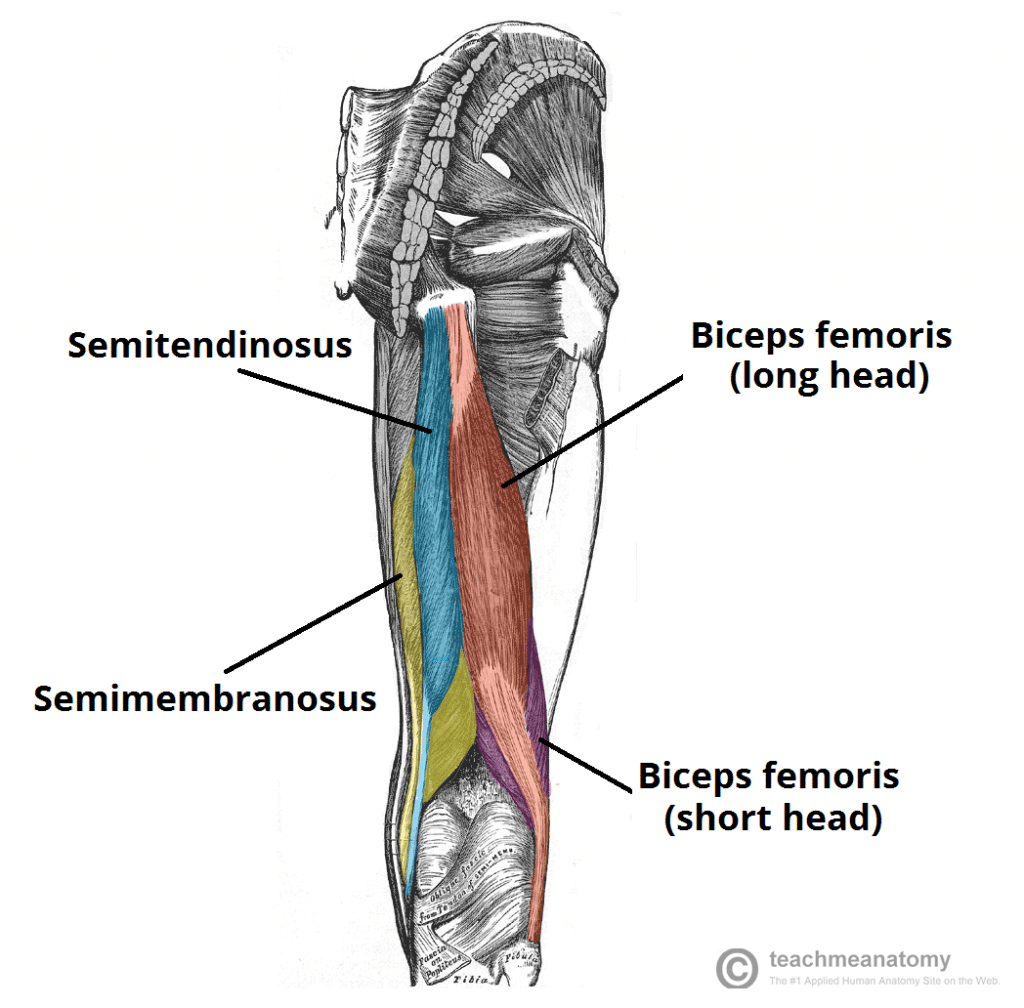
<p>Proximal Attachment (O): Ischial tuberosity</p><p>Distal Attachment (I): Superior part of media surface of tibia (as part of pes anserinus)</p><p>Nerve: Tibial division of sciatic nerve part of tibia (L5, S1, S2)</p><p>Action: Extend hip joint; flex knee joint and medially rotate it when flexed. When hip and knee joints are flexed (as when sitting), these muscles can extend trunk at hip joint (to rise).</p>
16
New cards

Rectus femoris

Proximal Attachment (O): Anterior inferior iliac spine and ilium superior to acetabulum

Distal Attachment (I): Via common tendinous (quadriceps tendon) and independent attachments to base of patella; indirectly via patellar ligament to tibial tuberosity; medial and lateral vasti also attach to tibia and patella via aponeuroses (medial and lateral patellar retinacula).

Nerve: Femoral nerve (L2, L3, L4)

Action: Extends knee joint; rectus femoris also steadies hip joint and helps iliopsoas flex hip joint.
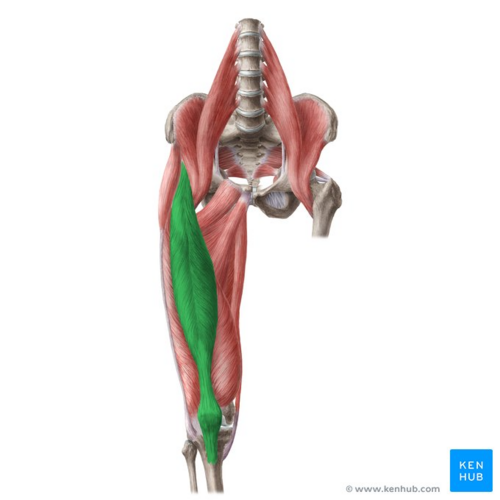
<p>Proximal Attachment (O): Anterior inferior iliac spine and ilium superior to acetabulum</p><p>Distal Attachment (I): Via common tendinous (quadriceps tendon) and independent attachments to base of patella; indirectly via patellar ligament to tibial tuberosity; medial and lateral vasti also attach to tibia and patella via aponeuroses (medial and lateral patellar retinacula).</p><p>Nerve: Femoral nerve (L2, L3, L4)</p><p>Action: Extends knee joint; rectus femoris also steadies hip joint and helps iliopsoas flex hip joint.</p>
17
New cards

Vastus lateralis

Proximal Attachment (O): Greater trochanter and lateral lip of linea aspera of femur

Distal Attachment (I): Via common tendinous (quadriceps tendon) and independent attachments to base of patella; indirectly via patellar ligament to tibial tuberosity; medial and lateral vasti also attach to tibia and patella via aponeuroses (medial and lateral patellar retinacula).

Nerve: Femoral nerve (L2, L3, L4)

Action: Extends knee joint; rectus femoris also steadies hip joint and helps iliopsoas flex hip joint.
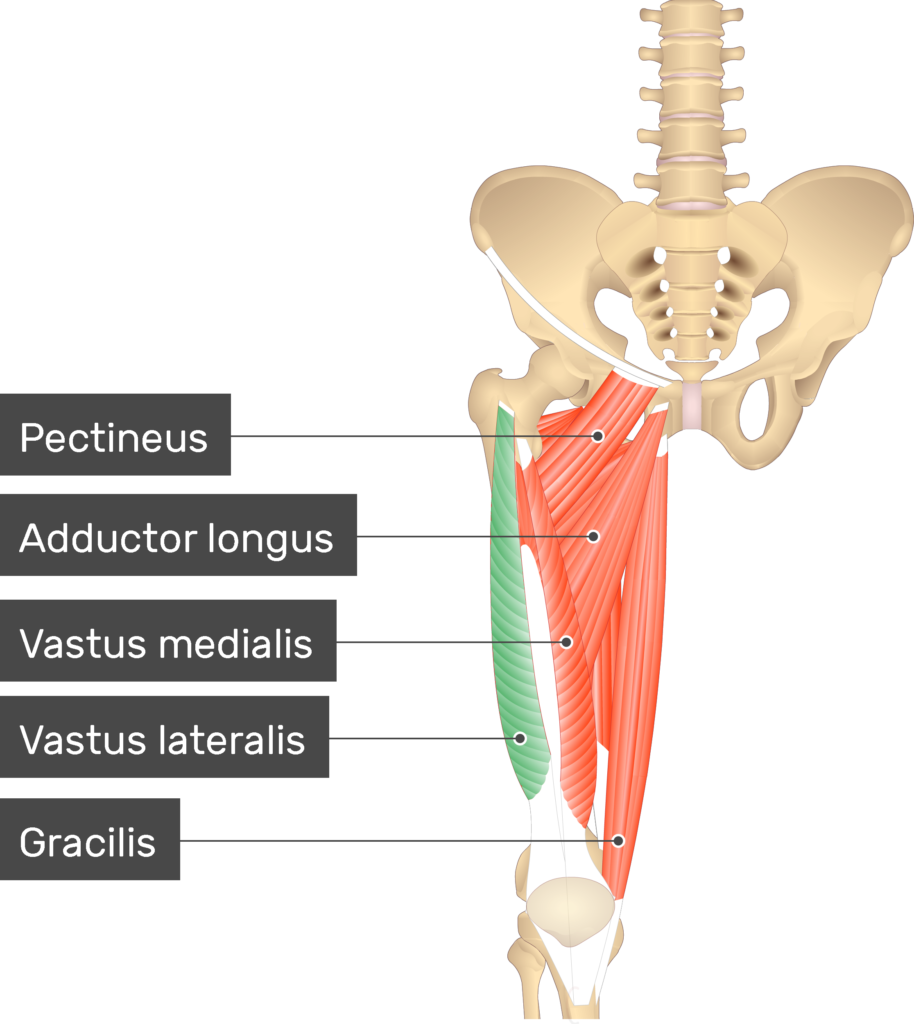
<p>Proximal Attachment (O): Greater trochanter and lateral lip of linea aspera of femur</p><p>Distal Attachment (I): Via common tendinous (quadriceps tendon) and independent attachments to base of patella; indirectly via patellar ligament to tibial tuberosity; medial and lateral vasti also attach to tibia and patella via aponeuroses (medial and lateral patellar retinacula).</p><p>Nerve: Femoral nerve (L2, L3, L4)</p><p>Action: Extends knee joint; rectus femoris also steadies hip joint and helps iliopsoas flex hip joint.</p>
18
New cards

Vastus intermedius

Proximal Attachment (O): Anterior and lateral surfaces of shaft of femur

Distal Attachment (I): Via common tendinous (quadriceps tendon) and independent attachments to base of patella; indirectly via patellar ligament to tibial tuberosity; medial and lateral vasti also attach to tibia and patella via aponeuroses (medial and lateral patellar retinacula).

Nerve: Femoral nerve (L2, L3, L4)

Action: Extends knee joint; rectus femoris also steadies hip joint and helps iliopsoas flex hip joint.
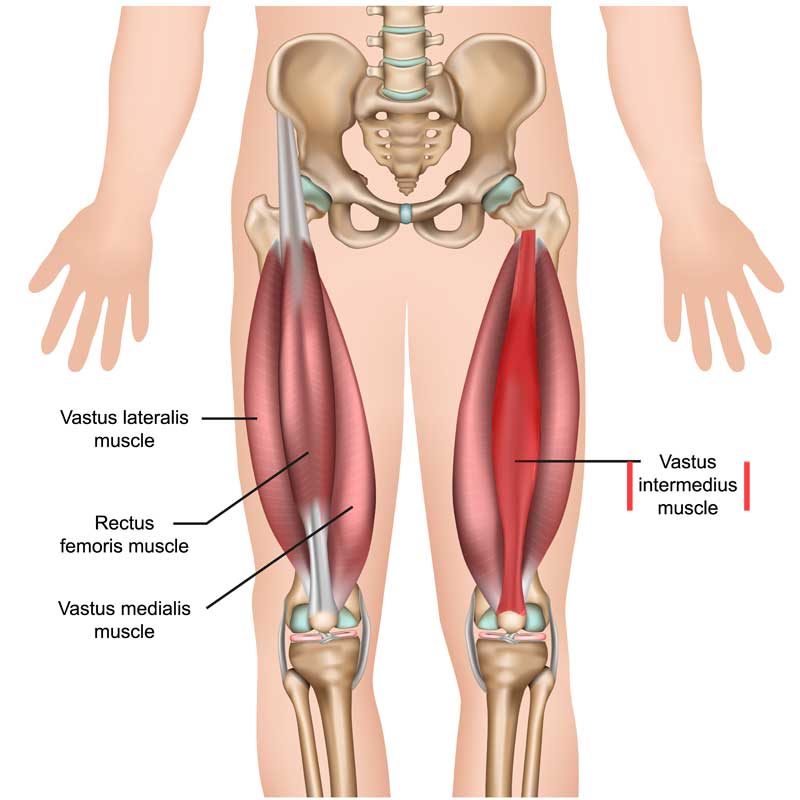
<p>Proximal Attachment (O): Anterior and lateral surfaces of shaft of femur</p><p>Distal Attachment (I): Via common tendinous (quadriceps tendon) and independent attachments to base of patella; indirectly via patellar ligament to tibial tuberosity; medial and lateral vasti also attach to tibia and patella via aponeuroses (medial and lateral patellar retinacula).</p><p>Nerve: Femoral nerve (L2, L3, L4)</p><p>Action: Extends knee joint; rectus femoris also steadies hip joint and helps iliopsoas flex hip joint.</p>
19
New cards

Vastus medialis

Proximal Attachment (O): Intertrochanteric line and medial lip of linea aspera of femur

Distal Attachment (I): Via common tendinous (quadriceps tendon) and independent attachments to base of patella; indirectly via patellar ligament to tibial tuberosity; medial and lateral vasti also attach to tibia and patella via aponeuroses (medial and lateral patellar retinacula).

Nerve: Femoral nerve (L2, L3, L4)

Action: Extends knee joint; rectus femoris also steadies hip joint and helps iliopsoas flex hip joint.
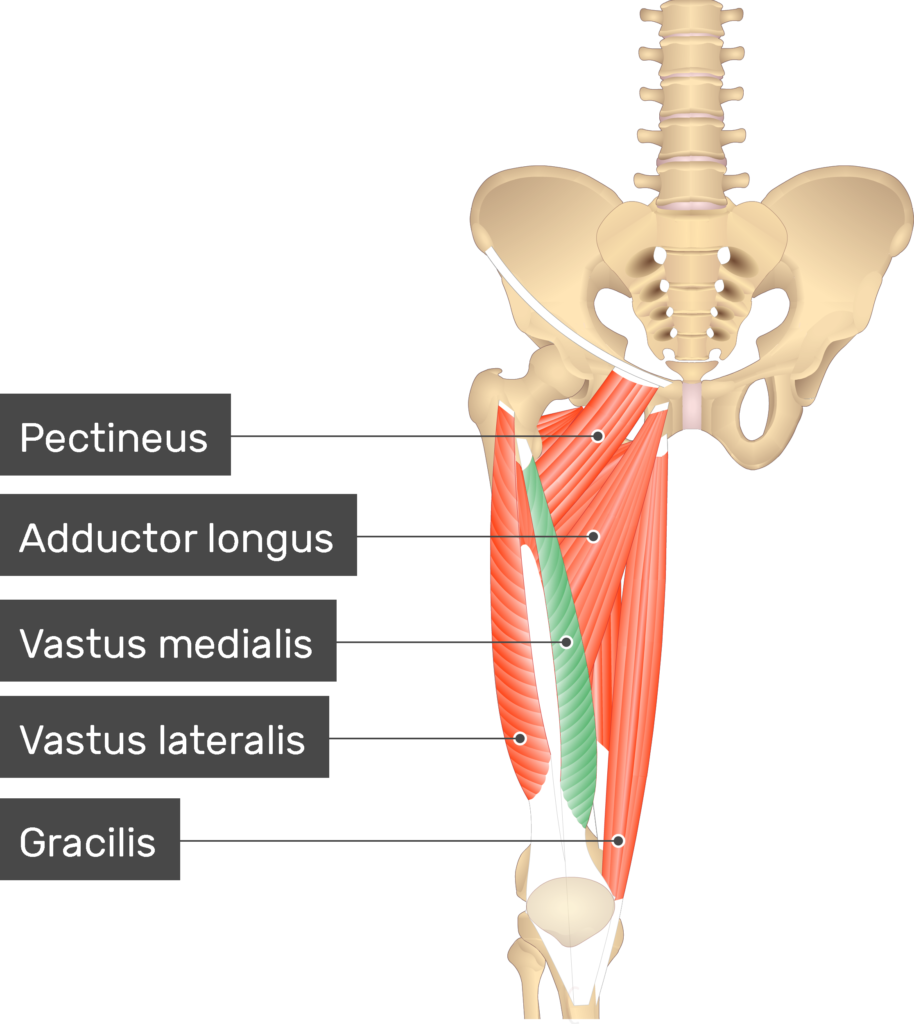
<p>Proximal Attachment (O): Intertrochanteric line and medial lip of linea aspera of femur</p><p>Distal Attachment (I): Via common tendinous (quadriceps tendon) and independent attachments to base of patella; indirectly via patellar ligament to tibial tuberosity; medial and lateral vasti also attach to tibia and patella via aponeuroses (medial and lateral patellar retinacula).</p><p>Nerve: Femoral nerve (L2, L3, L4)</p><p>Action: Extends knee joint; rectus femoris also steadies hip joint and helps iliopsoas flex hip joint.</p>
20
New cards

Adductor brevis

Proximal Attachment (O): Body and inferior ramus of pubis

Distal Attachment (I): Pectineal line and proximal part of linea aspera of femur

Nerve: Obturator nerve and branch of anterior division (L2, L3, L4)

Action: Adducts hip joint and, to some extent, flexes it
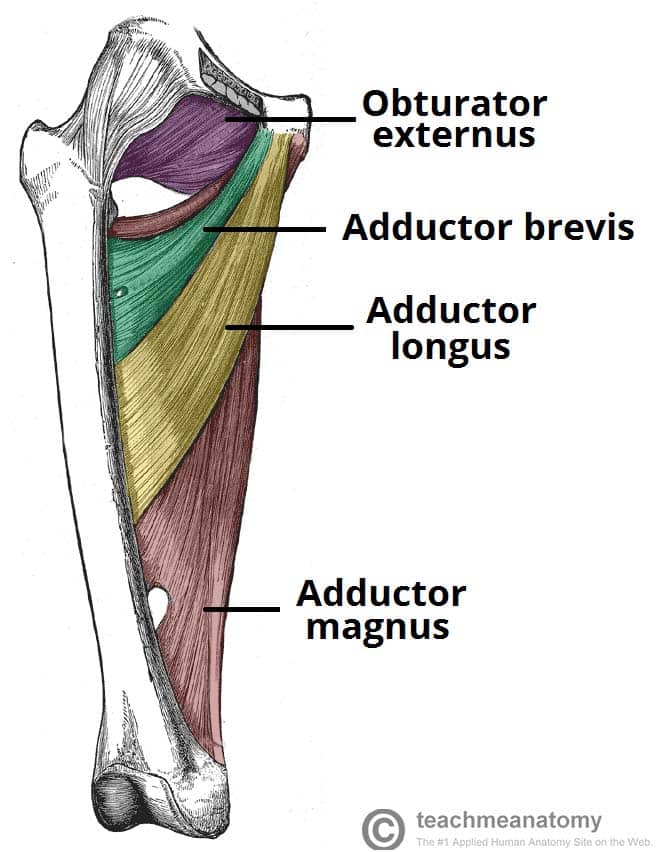
<p>Proximal Attachment (O): Body and inferior ramus of pubis</p><p>Distal Attachment (I): Pectineal line and proximal part of linea aspera of femur</p><p>Nerve: Obturator nerve and branch of anterior division (L2, L3, L4)</p><p>Action: Adducts hip joint and, to some extent, flexes it</p>
21
New cards

Adductor longus

Proximal Attachment (O): Body of pubis inferior to pubic crest

Distal Attachment (I): Middle third of linea aspera of femur

Nerve: Obturator nerve and branch of anterior division (L2, L3, L4)

Action: Adducts hip joint
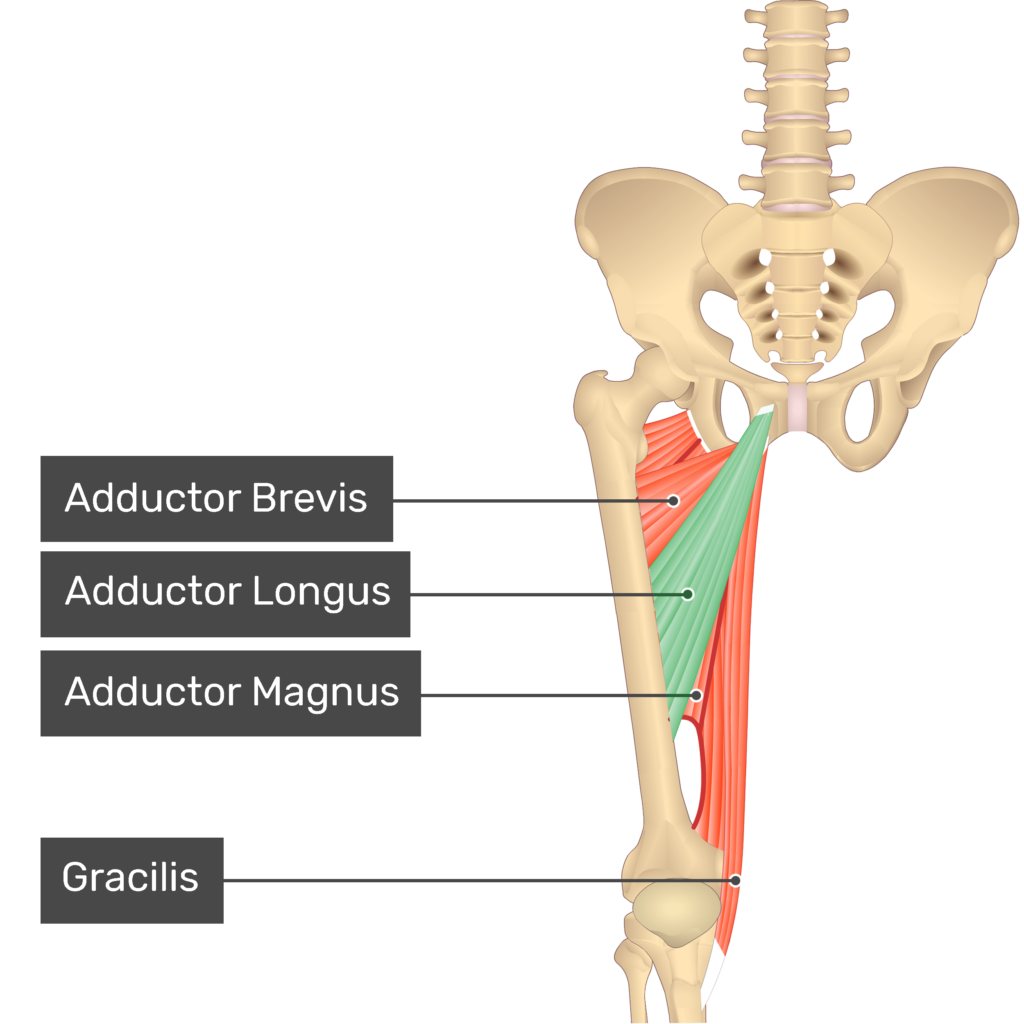
<p>Proximal Attachment (O): Body of pubis inferior to pubic crest</p><p>Distal Attachment (I): Middle third of linea aspera of femur</p><p>Nerve: Obturator nerve and branch of anterior division (L2, L3, L4)</p><p>Action: Adducts hip joint</p>
22
New cards

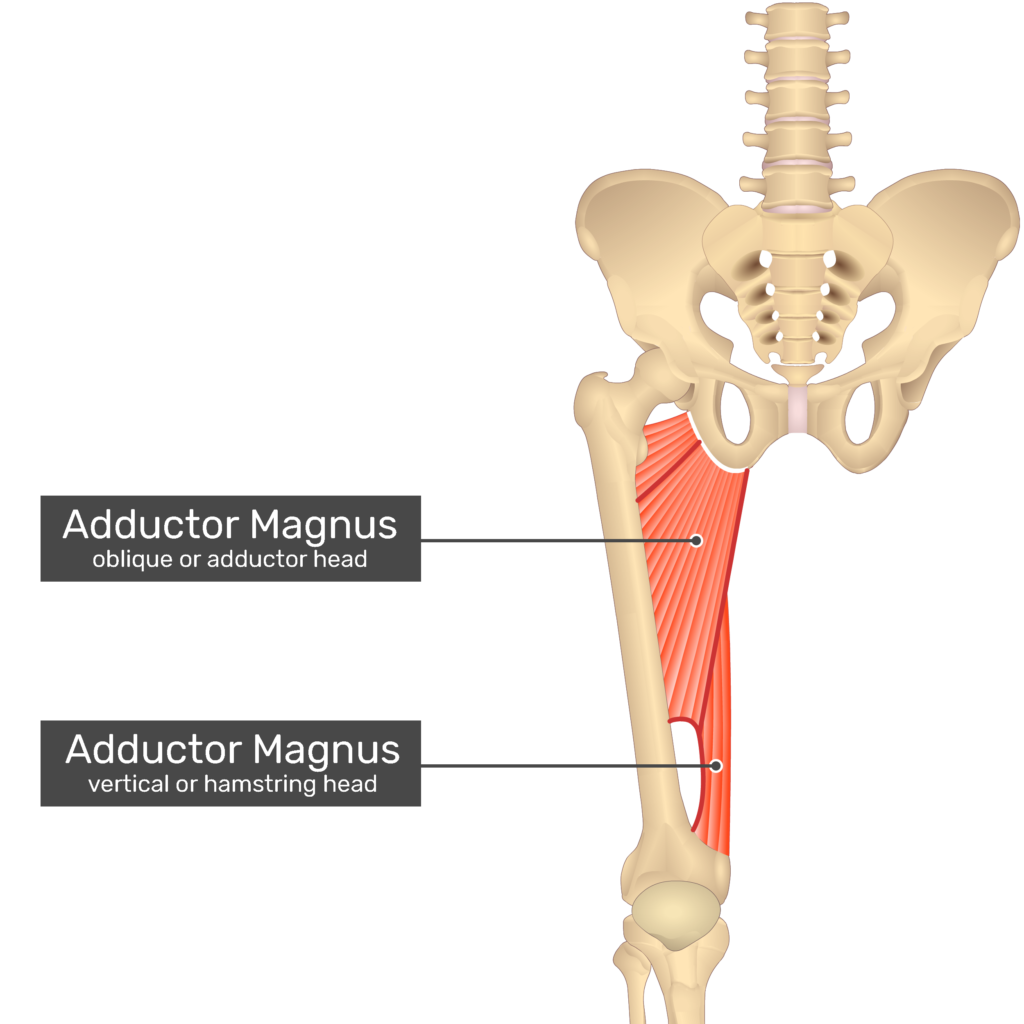
Adductor magnus

Proximal Attachment (O):

  • Adductor part: inferior ramus of pubis and ramus of ischium

  • Hamstring part: ischial tuberosity

Distal Attachment (I):

  • Adductor part: gluteal tuberosity, linea aspera, and medial supracondylar line

  • Hamstring part: adductor tubercle of femur

Nerve:

  • Adductor part: obturator nerve (L2, L3, L4) and branches of posterior division

  • Hamstring part: tibial part of sciatic nerve (L4)

Action:

  • Adducts hip joint

  • Adductor part: flexes hip joint

  • Hamstring part: extends hip joint

<p>Proximal Attachment (O):</p><ul><li><p>Adductor part: inferior ramus of pubis and ramus of ischium</p></li><li><p>Hamstring part: ischial tuberosity</p></li></ul><p>Distal Attachment (I):</p><ul><li><p>Adductor part: gluteal tuberosity, linea aspera, and medial supracondylar line</p></li><li><p>Hamstring part: adductor tubercle of femur</p></li></ul><p>Nerve:</p><ul><li><p>Adductor part: obturator nerve (L2, L3, L4) and branches of posterior division</p></li><li><p>Hamstring part: tibial part of sciatic nerve (L4)</p></li></ul><p>Action:</p><ul><li><p>Adducts hip joint</p></li><li><p>Adductor part: flexes hip joint</p></li><li><p>Hamstring part: extends hip joint</p></li></ul><p></p>
23
New cards

Pectineus

Proximal Attachment (O): Superior ramus of pubis

Distal Attachment (I): Pectineal line of femur, just inferior to lesser trochanter

Nerve: Femoral nerve (L2, L3); may receive a branch from obturator nerve

Action: Adducts and slightly flexes hip joint; assists with lateral rotation
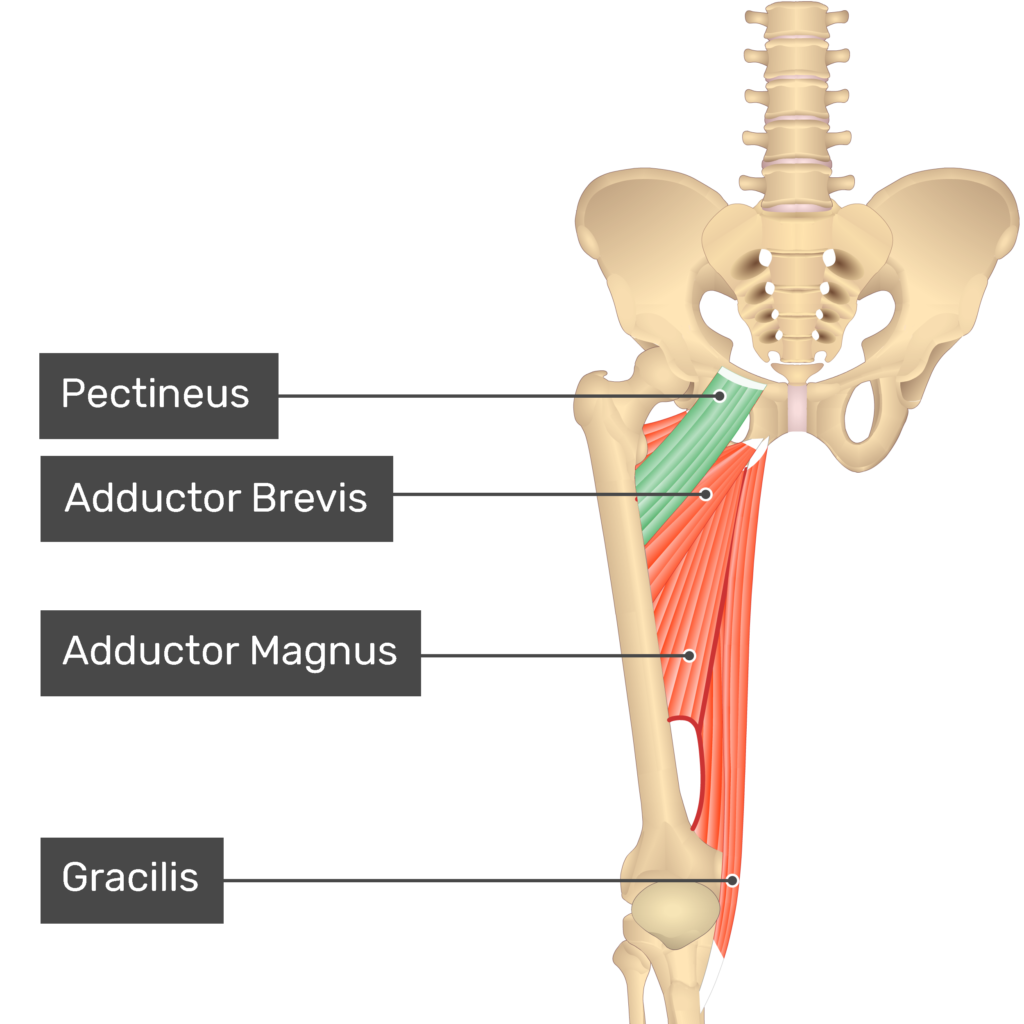
<p>Proximal Attachment (O): Superior ramus of pubis</p><p>Distal Attachment (I): Pectineal line of femur, just inferior to lesser trochanter</p><p>Nerve: Femoral nerve (L2, L3); may receive a branch from obturator nerve</p><p>Action: Adducts and slightly flexes hip joint; assists with lateral rotation</p>
24
New cards

Popliteus

Proximal Attachment (O): Lateral surface of lateral condyle of femur and lateral meniscus

Distal Attachment (I): Posterior surface of tibia and superior to soleal line

Nerve: Tibial nerve (L4, L5, S1)

Action: Weakly flexes knee joint and unlocks it by rotating femur 5° on fixed tibia; medially rotates tibia of unplanted limb
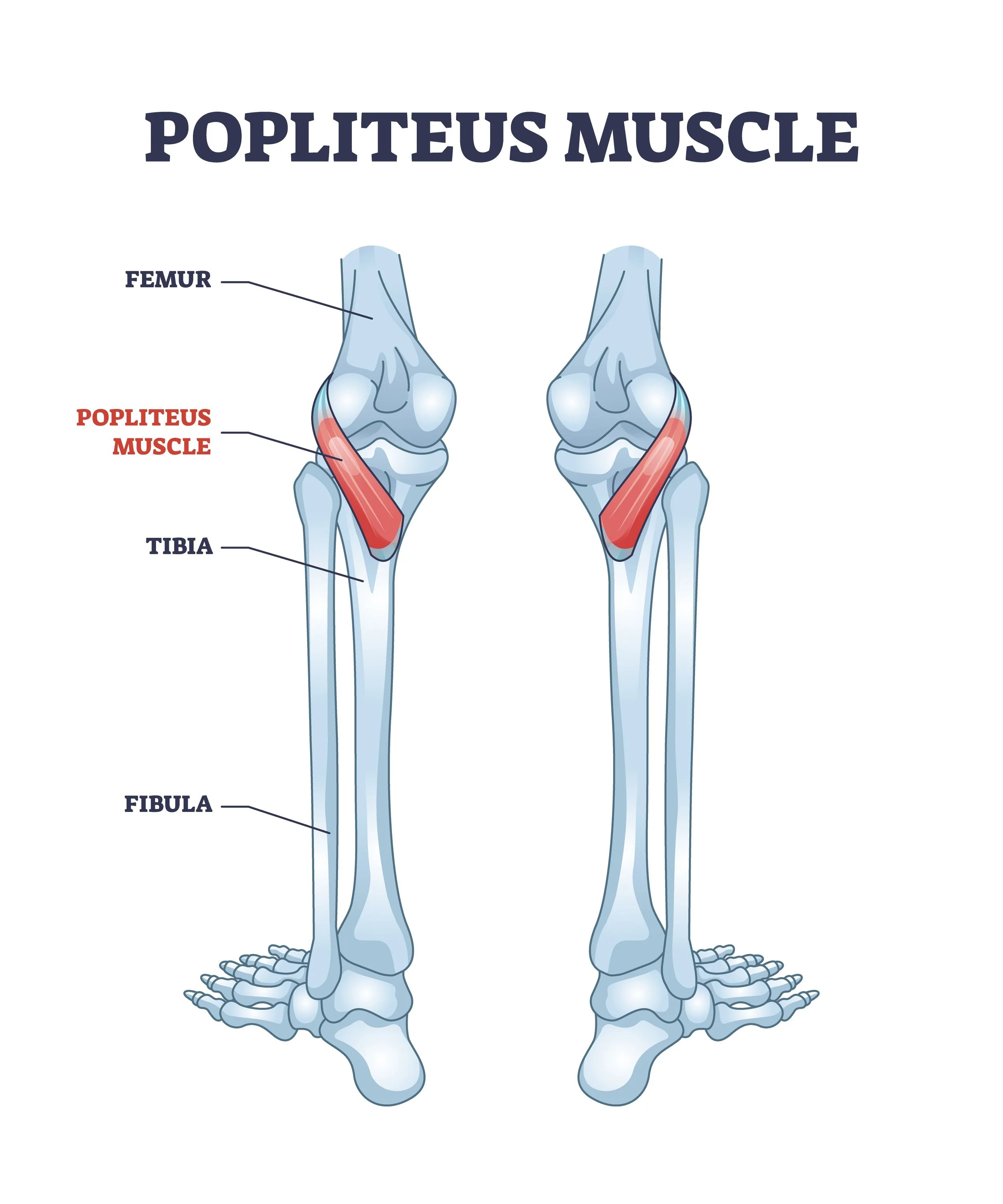
<p>Proximal Attachment (O): Lateral surface of lateral condyle of femur and lateral meniscus</p><p>Distal Attachment (I): Posterior surface of tibia and superior to soleal line</p><p>Nerve: Tibial nerve (L4, L5, S1)</p><p>Action: Weakly flexes knee joint and unlocks it by rotating femur 5° on fixed tibia; medially rotates tibia of unplanted limb</p>
25
New cards

Plantaris

Proximal Attachment (O): Inferior end of lateral supracondylar line of femur; oblique popliteal ligament

Distal Attachment (I): Posterior surface of calcaneus via calcaneal tendon

Nerve: Tibial nerve (S1, S2)

Action: Weakly assists gastrocnemius in plantarflexing ankle joint
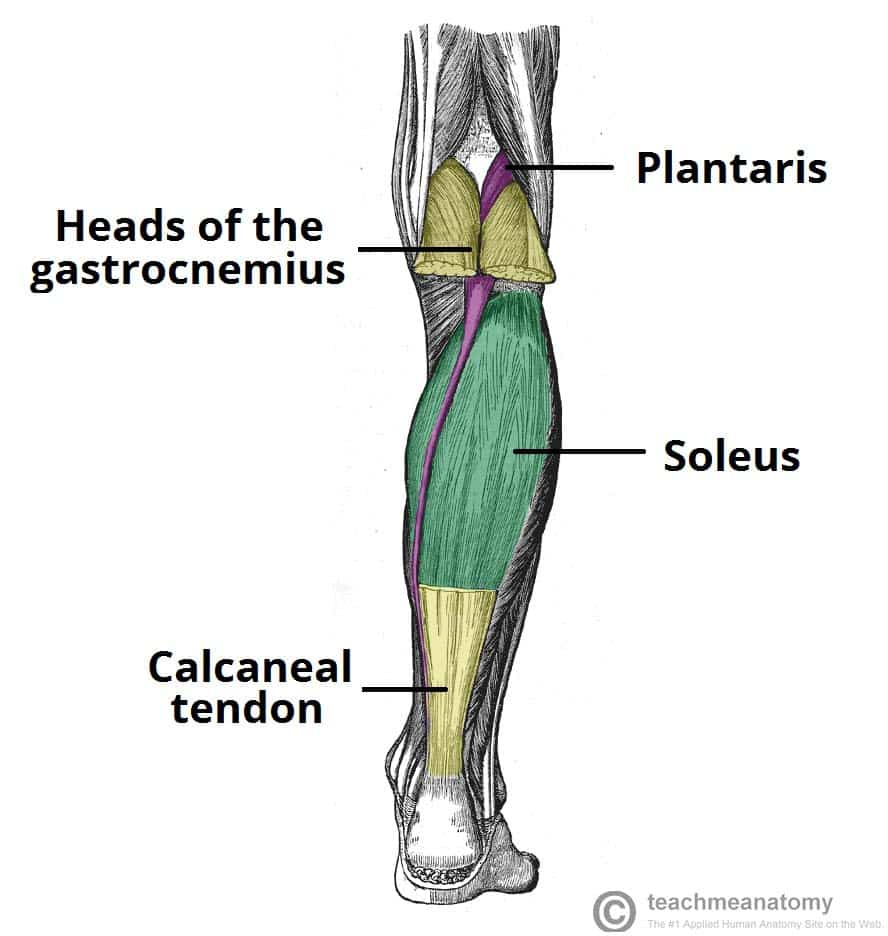
<p>Proximal Attachment (O): Inferior end of lateral supracondylar line of femur; oblique popliteal ligament</p><p>Distal Attachment (I): Posterior surface of calcaneus via calcaneal tendon</p><p>Nerve: Tibial nerve (S1, S2)</p><p>Action: Weakly assists gastrocnemius in plantarflexing ankle joint</p>
26
New cards

Gastrocnemius

Proximal Attachment (O):

  • Lateral head: lateral aspect of lateral condyle of femur

  • Medial head: popliteal surface of femur; superior to medial condyle

Distal Attachment (I): Posterior surface of calcaneus via calcaneal tendon

Nerve: Tibial nerve (S1, S2)

Action: Plantarflexes ankle joint when knee joint is extended; raises heel during walking; flexes knee joint
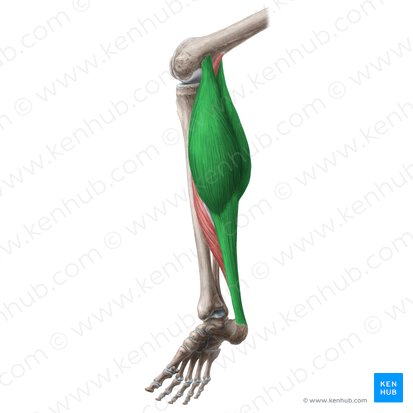
<p>Proximal Attachment (O):</p><ul><li><p>Lateral head: lateral aspect of lateral condyle of femur</p></li><li><p>Medial head: popliteal surface of femur; superior to medial condyle</p></li></ul><p>Distal Attachment (I): Posterior surface of calcaneus via calcaneal tendon</p><p>Nerve: Tibial nerve (S1, S2)</p><p>Action: Plantarflexes ankle joint when knee joint is extended; raises heel during walking; flexes knee joint</p>
27
New cards

Soleus

Proximal Attachment (O): Posterior aspect of head and superior quarter of posterior surface of fibula; soleal line and middle third of medial border of tibia; tendinous arch extending between the bony attachments

Distal Attachment (I): Posterior surface of calcaneus via calcaneal tendon

Nerve: Tibial nerve (S1, S2)

Action: Plantarflexes ankle joint independent of position of knee; stabilizes ankle joint
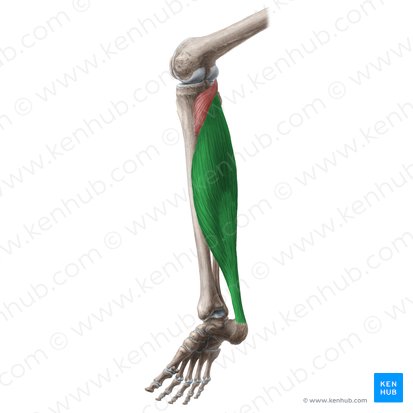
<p>Proximal Attachment (O): Posterior aspect of head and superior quarter of posterior surface of fibula; soleal line and middle third of medial border of tibia; tendinous arch extending between the bony attachments</p><p>Distal Attachment (I): Posterior surface of calcaneus via calcaneal tendon</p><p>Nerve: Tibial nerve (S1, S2)</p><p>Action: Plantarflexes ankle joint independent of position of knee; stabilizes ankle joint</p>
28
New cards

Tibialis posterior

Proximal Attachment (O): Interosseous membrane; posterior surface of tibia inferior to soleal line; posterior surface of fibula

Distal Attachment (I): Tuberosity of navicular, cuneiform, cuboid, and sustentaculum tali of calcaneus; bases of 2nd, 3rd, and 4th metatarsals

Nerve: Tibial nerve (L4, L5)

Action: Plantarflexes ankle joint; inverts foot; maintains medial longitudinal arch
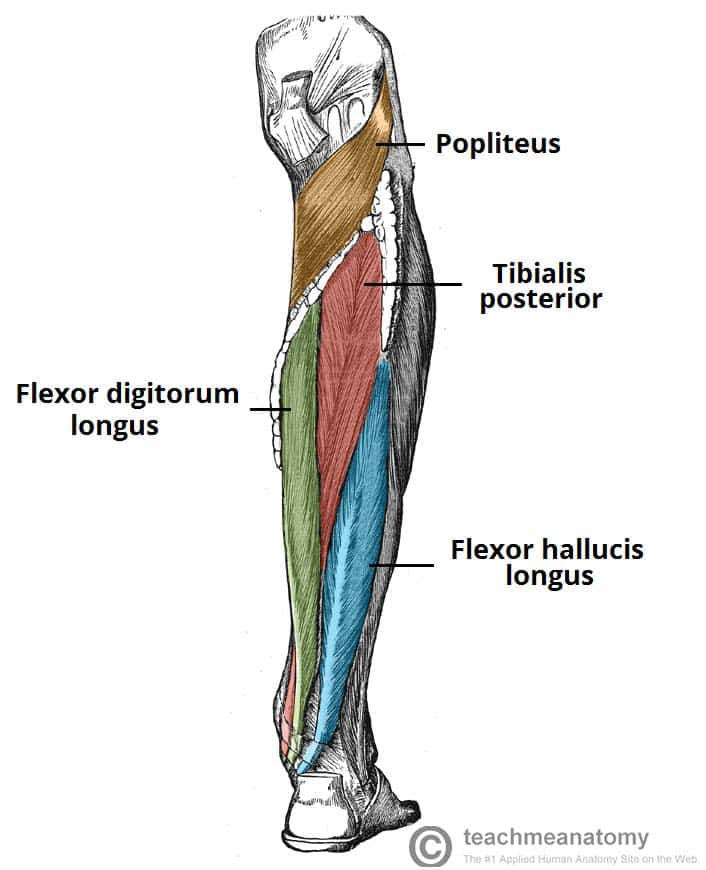
<p>Proximal Attachment (O): Interosseous membrane; posterior surface of tibia inferior to soleal line; posterior surface of fibula</p><p>Distal Attachment (I): Tuberosity of navicular, cuneiform, cuboid, and sustentaculum tali of calcaneus; bases of 2nd, 3rd, and 4th metatarsals</p><p>Nerve: Tibial nerve (L4, L5)</p><p>Action: Plantarflexes ankle joint; inverts foot; maintains medial longitudinal arch</p>
29
New cards

Flexor digitorum longus

Proximal Attachment (O): Medial part of posterior surface of tibia inferior to soleal line; by a broad tendon to fibula

Distal Attachment (I): Bases of distal phalanges of lateral four digits

Nerve: Tibial nerve (S2, S3)

Action: Flexes lateral four digits; plantarflexes ankle joint; supports longitudinal arches of foot
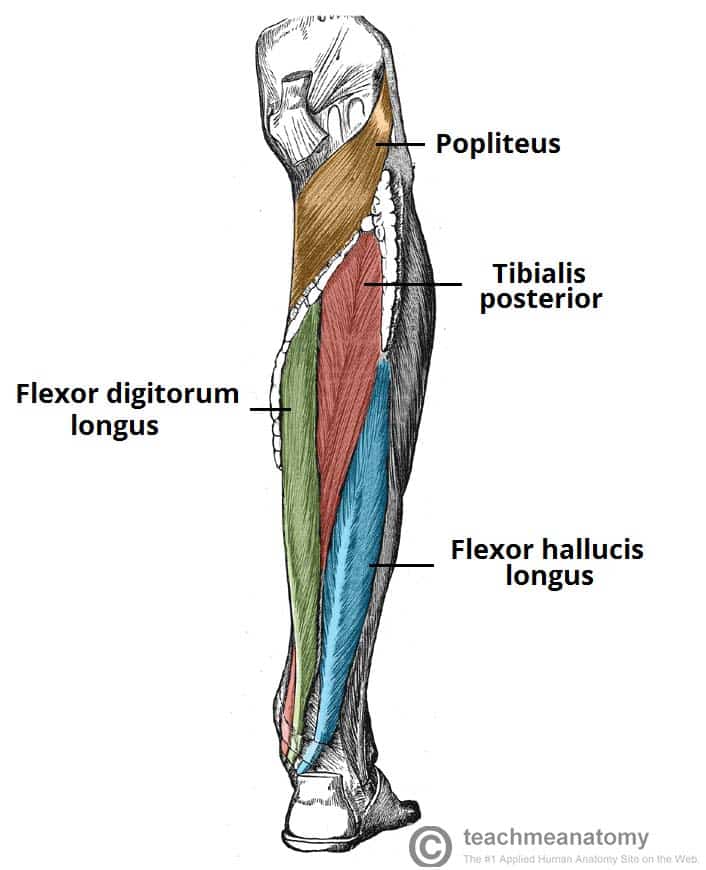
<p>Proximal Attachment (O): Medial part of posterior surface of tibia inferior to soleal line; by a broad tendon to fibula</p><p>Distal Attachment (I): Bases of distal phalanges of lateral four digits</p><p>Nerve: Tibial nerve (S2, S3)</p><p>Action: Flexes lateral four digits; plantarflexes ankle joint; supports longitudinal arches of foot</p>
30
New cards

Flexor hallucis longus

Proximal Attachment (O): Inferior two thirds of posterior surface of fibula; inferior part of interosseous membrane

Distal Attachment (I): Base of distal phalanx of great toe (hallux)

Nerve: Tibial nerve (S2, S3)

Action: Flexes great toe at all joints; weakly plantarflexes ankle joint; supports medial longitudinal arch of foot
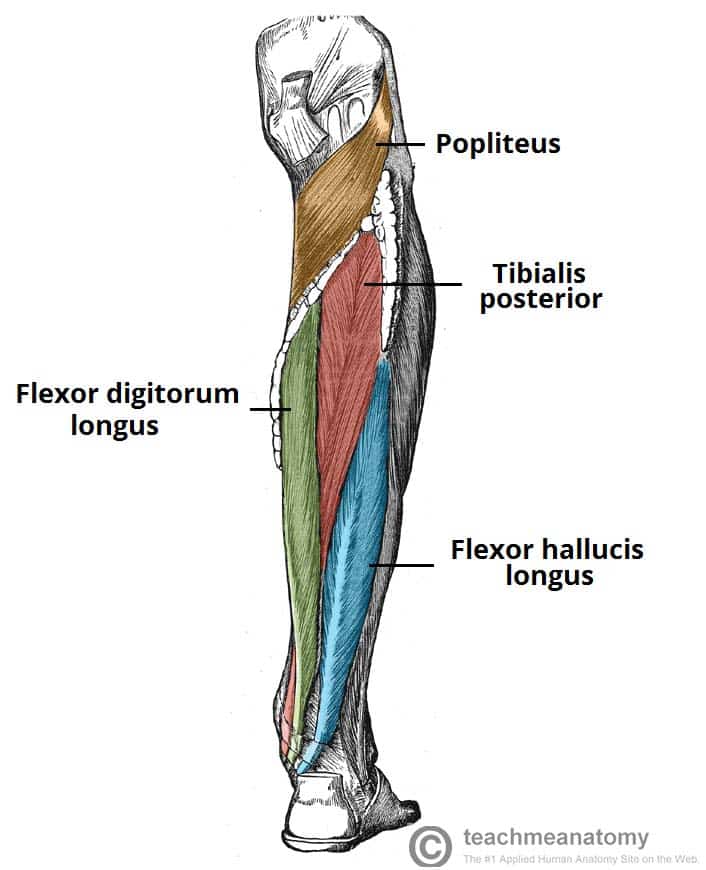
<p>Proximal Attachment (O): Inferior two thirds of posterior surface of fibula; inferior part of interosseous membrane</p><p>Distal Attachment (I): Base of distal phalanx of great toe (hallux)</p><p>Nerve: Tibial nerve (S2, S3)</p><p>Action: Flexes great toe at all joints; weakly plantarflexes ankle joint; supports medial longitudinal arch of foot</p>
31
New cards

Tibialis anterior

Proximal Attachment (O): Lateral condyle and superior half of lateral surface of tibia and interosseous membrane

Distal Attachment (I): Medial and inferior surfaces of medial cuneiform and base of 1st metatarsal

Nerve: Deep fibular nerve (L4, L5)

Action: Dorsiflexes ankle joint and inverts subtalar joint
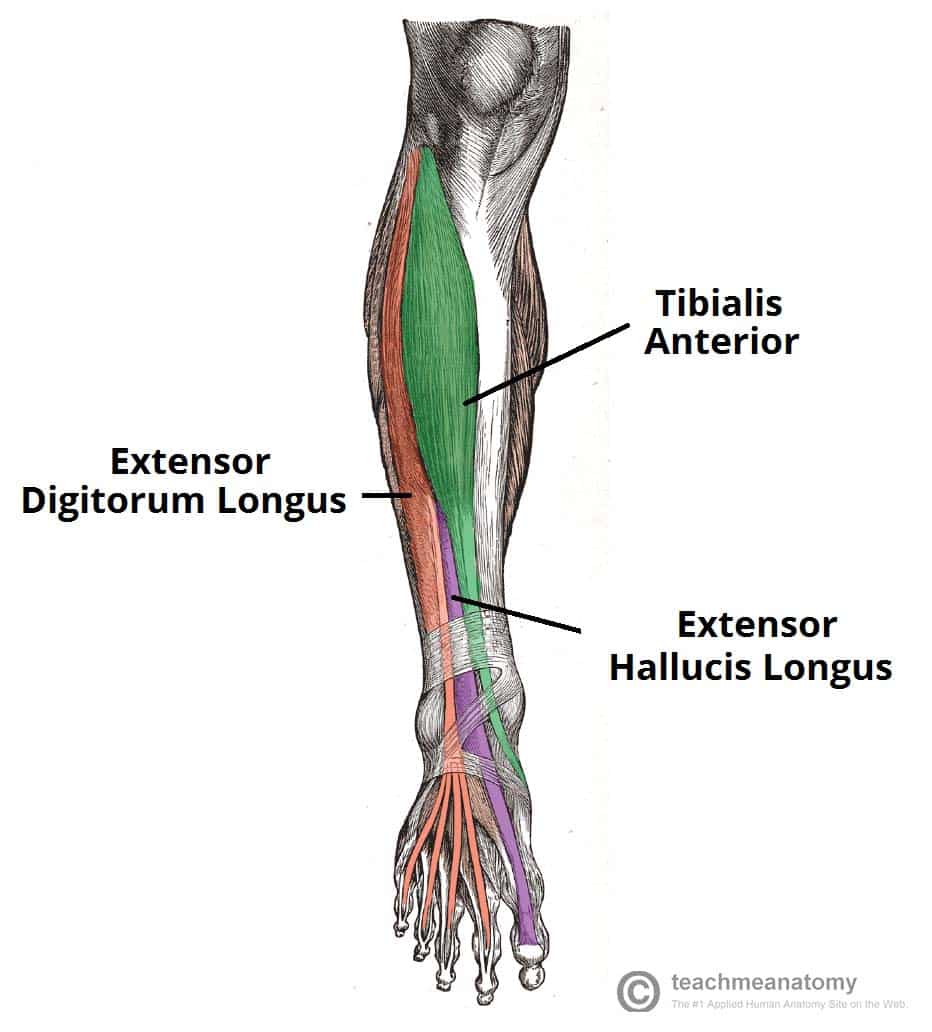
<p>Proximal Attachment (O): Lateral condyle and superior half of lateral surface of tibia and interosseous membrane</p><p>Distal Attachment (I): Medial and inferior surfaces of medial cuneiform and base of 1st metatarsal</p><p>Nerve: Deep fibular nerve (L4, L5)</p><p>Action: Dorsiflexes ankle joint and inverts subtalar joint</p>
32
New cards

Extensor digitorum longus

Proximal Attachment (O): Lateral condyle of tibia and superior three quarters of medial surface of fibula and interosseous membrane

Distal Attachment (I): Middle and distal phalanges of lateral four digits

Nerve: Deep fibular nerve (L5, S1)

Action: Extends lateral four digits and dorsiflexes ankle joint
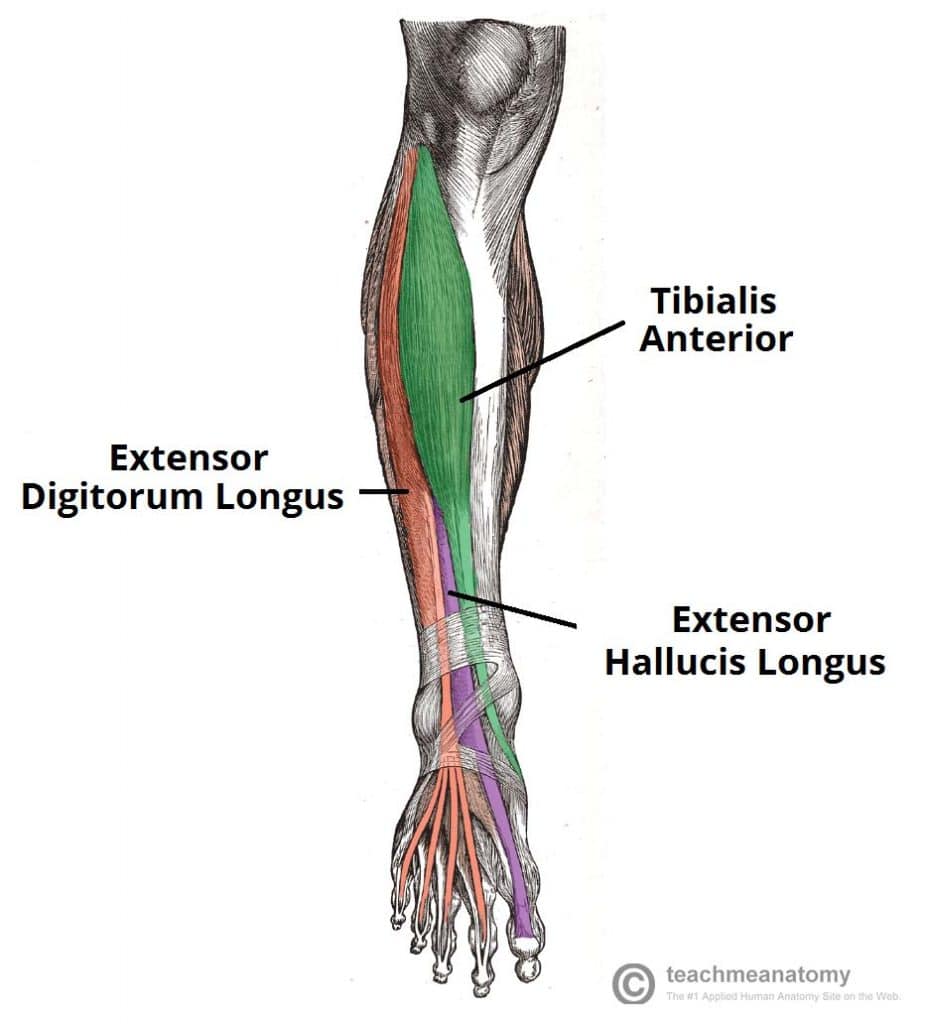
<p>Proximal Attachment (O): Lateral condyle of tibia and superior three quarters of medial surface of fibula and interosseous membrane</p><p>Distal Attachment (I): Middle and distal phalanges of lateral four digits</p><p>Nerve: Deep fibular nerve (L5, S1)</p><p>Action: Extends lateral four digits and dorsiflexes ankle joint</p>
33
New cards

Extensor hallucis longus

Proximal Attachment (O): Middle part of anterior surface of fibula and interosseous membrane

Distal Attachment (I): Dorsal aspect of base of distal phalanx of great toe (hallux)

Nerve: Deep fibular nerve (L5, S1)

Action: Extends great toe and dorsiflexes ankle joint
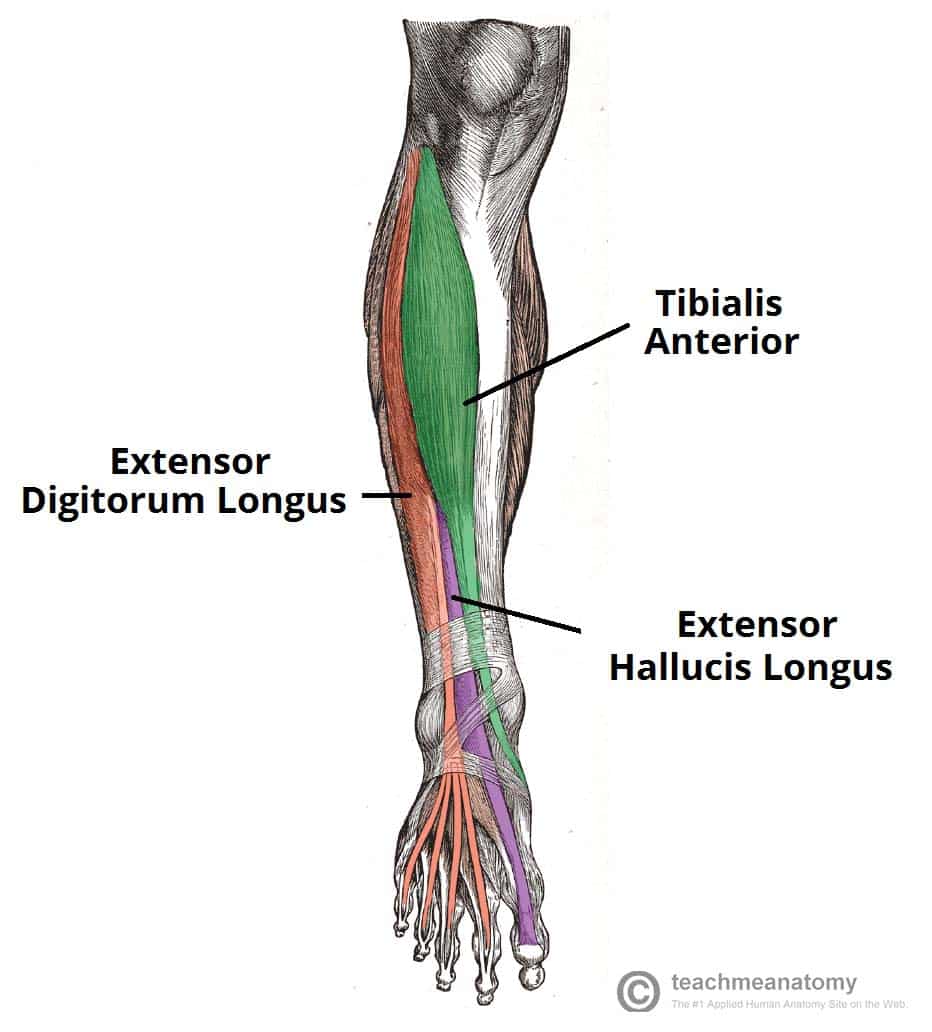
<p>Proximal Attachment (O): Middle part of anterior surface of fibula and interosseous membrane</p><p>Distal Attachment (I): Dorsal aspect of base of distal phalanx of great toe (hallux)</p><p>Nerve: Deep fibular nerve (L5, S1)</p><p>Action: Extends great toe and dorsiflexes ankle joint</p>
34
New cards

Peroneus longus (fibularis longus)

Proximal Attachment (O): Head and superior two thirds of lateral surface of fibula

Distal Attachment (I): Base of 1st metatarsal and medial cuneiform

Nerve: Superficial fibular nerve (L5, S1, S2)

Action: Everts subtalar joint and weakly plantarflexes ankle joint
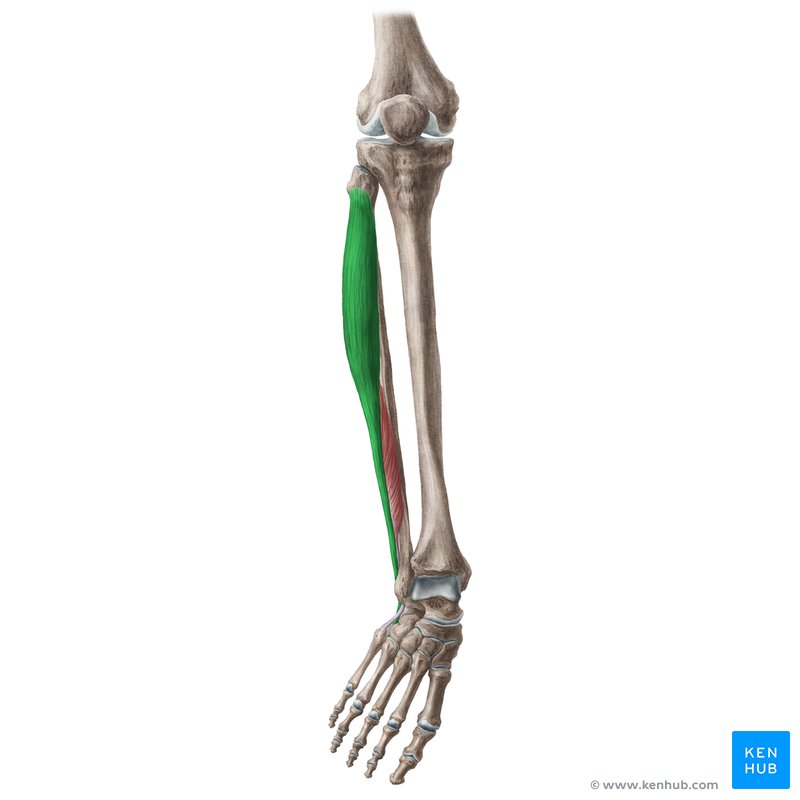
<p>Proximal Attachment (O): Head and superior two thirds of lateral surface of fibula</p><p>Distal Attachment (I): Base of 1st metatarsal and medial cuneiform</p><p>Nerve: Superficial fibular nerve (L5, S1, S2)</p><p>Action: Everts subtalar joint and weakly plantarflexes ankle joint</p>
35
New cards

Peroneus brevis (fibularis brevis)

Proximal Attachment (O): Inferior two thirds of lateral surface of fibula

Distal Attachment (I): Dorsal surface of tuberosity on lateral side of base of 5th metatarsal

Nerve: Superficial fibular nerve (L5, S1, S2)

Action: Everts subtalar joint and weakly plantarflexes ankle joint
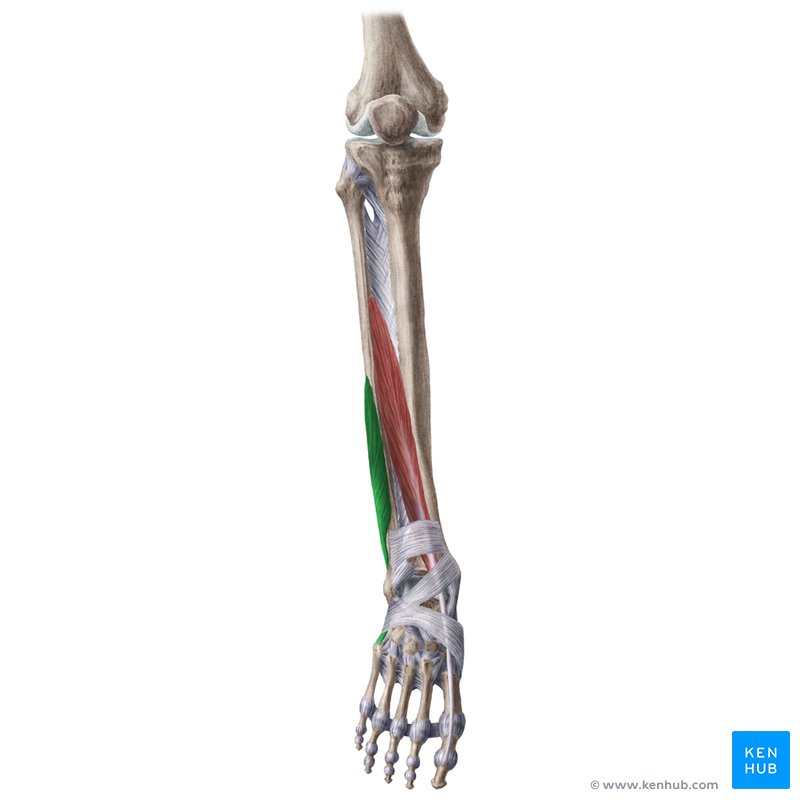
<p>Proximal Attachment (O): Inferior two thirds of lateral surface of fibula</p><p>Distal Attachment (I): Dorsal surface of tuberosity on lateral side of base of 5th metatarsal</p><p>Nerve: Superficial fibular nerve (L5, S1, S2)</p><p>Action: Everts subtalar joint and weakly plantarflexes ankle joint</p>
36
New cards

Peroneus Tertius (fibularis tertius)

Proximal Attachment (O): Inferior third of anterior surface of fibula and interosseous membrane

Distal Attachment (I): Dorsum of base of 5th metatarsal

Nerve: Deep fibular nerve (L5, S1)

Action: Dorsiflexes ankle joint and aids in eversion of subtalar joint
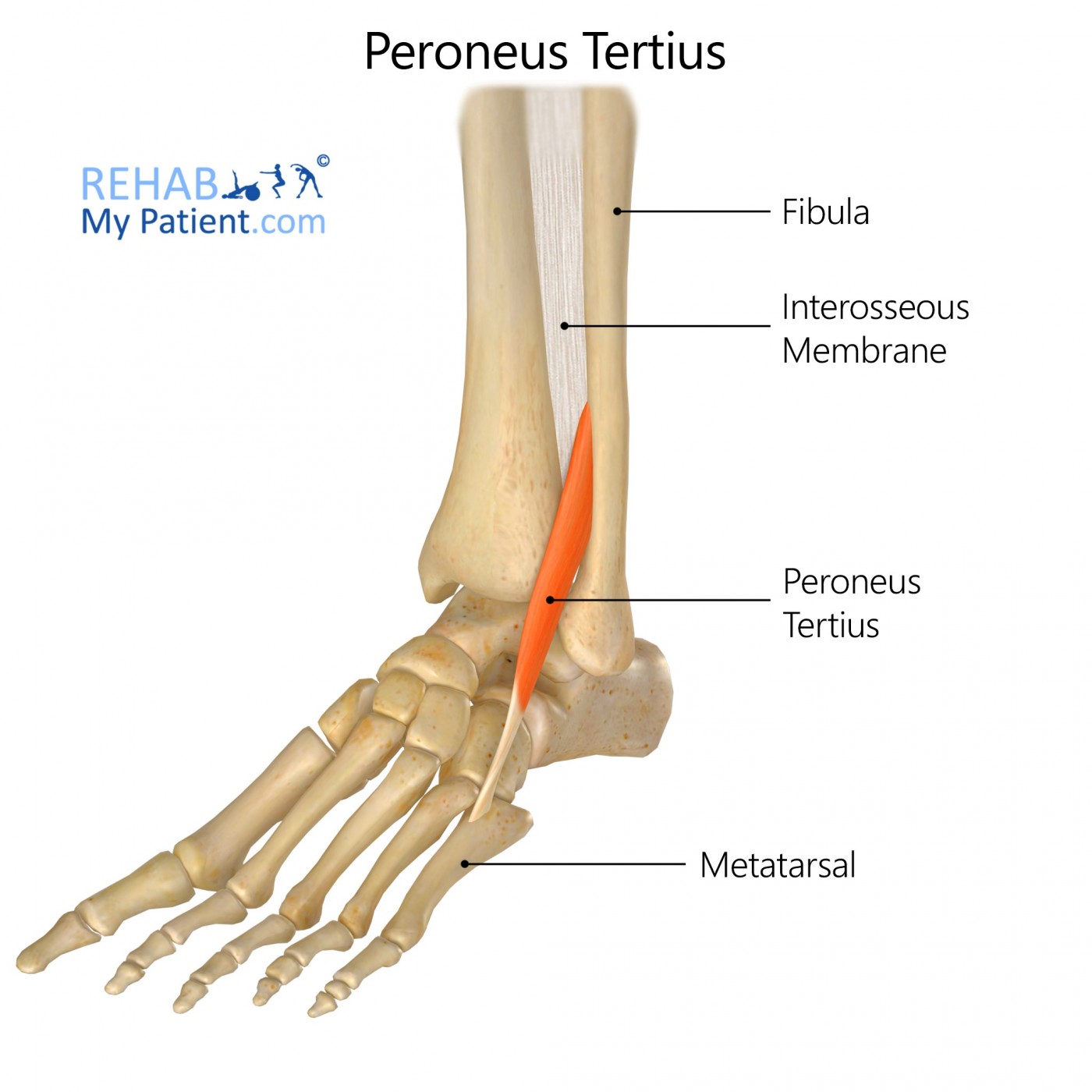
<p>Proximal Attachment (O): Inferior third of anterior surface of fibula and interosseous membrane</p><p>Distal Attachment (I): Dorsum of base of 5th metatarsal</p><p>Nerve: Deep fibular nerve (L5, S1)</p><p>Action: Dorsiflexes ankle joint and aids in eversion of subtalar joint</p>
37
New cards

Flexor digitorum brevis

Proximal Attachment (O): Medial tubercle of tuberosity of calcaneus; plantar aponeurosis; intermuscular septa

Distal Attachment (I): Both sides of middle phalanges of lateral four digits

Nerve: Medial plantar nerve (L5, S1)

Action: Flexes lateral four digits at MTP and IP joints
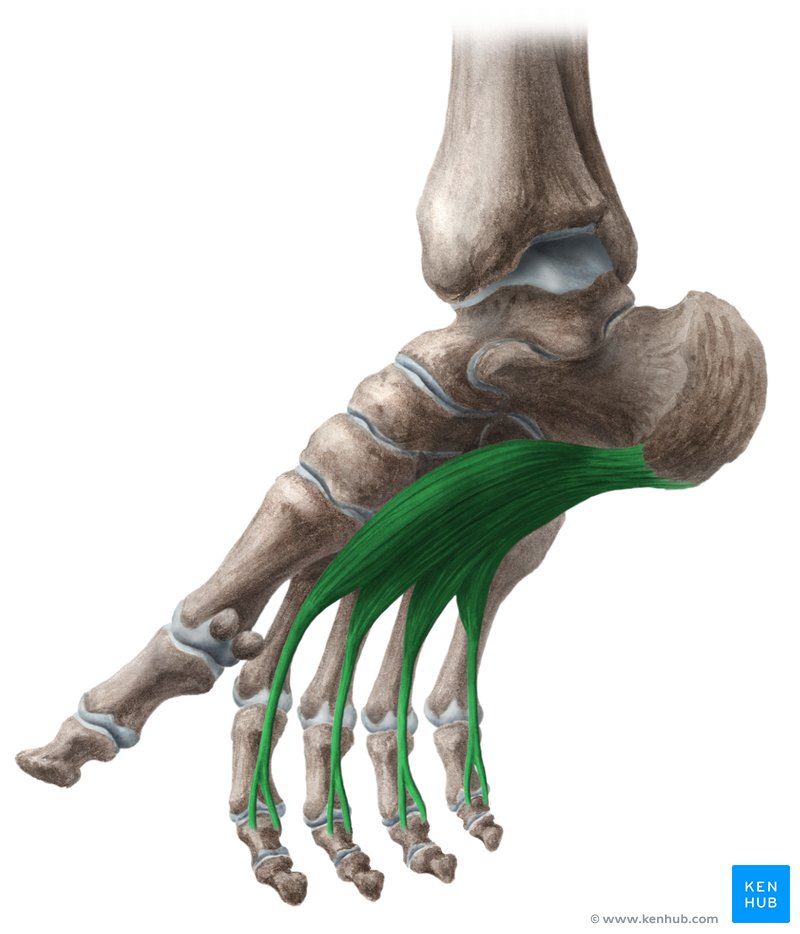
<p>Proximal Attachment (O): Medial tubercle of tuberosity of calcaneus; plantar aponeurosis; intermuscular septa</p><p>Distal Attachment (I): Both sides of middle phalanges of lateral four digits</p><p>Nerve: Medial plantar nerve (L5, S1)</p><p>Action: Flexes lateral four digits at MTP and IP joints</p>
38
New cards

Abductor digiti minimi

Proximal Attachment (O): Medial and lateral tubercles of tuberosity of calcaneus; plantar aponeurosis; intermuscular septa

Distal Attachment (I): Lateral side of base of proximal phalanx of 5th digit

Nerve: Lateral plantar nerve (S1–S3)

Action: Abducts and flexes little toe (5th digit) at MTP and IP joints
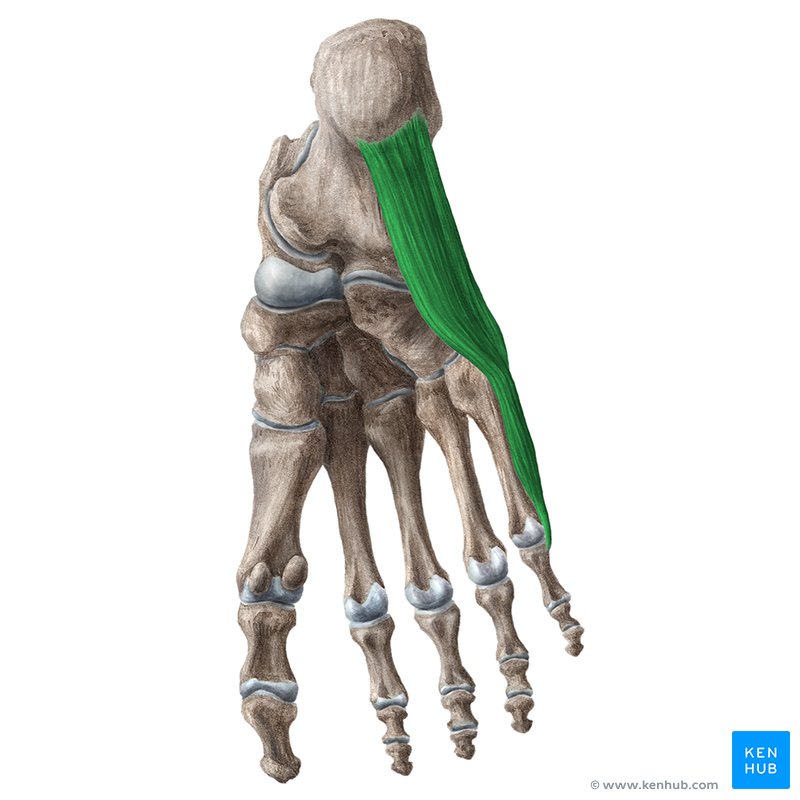
<p>Proximal Attachment (O): Medial and lateral tubercles of tuberosity of calcaneus; plantar aponeurosis; intermuscular septa</p><p>Distal Attachment (I): Lateral side of base of proximal phalanx of 5th digit</p><p>Nerve: Lateral plantar nerve (S1–S3)</p><p>Action: Abducts and flexes little toe (5th digit) at MTP and IP joints</p>
39
New cards

Abductor hallucis

Proximal Attachment (O): Medial tubercle of tuberosity of calcaneus; flexor retinaculum; plantar aponeurosis

Distal Attachment (I): Medial side of base of proximal phalanx of 1st digit

Nerve: Medial plantar nerve (L5, S1)

Action: Abducts and flexes 1st digit (great toe, hallux) at metatarsophalangeal (MTP) and interphalangeal (IP) joints
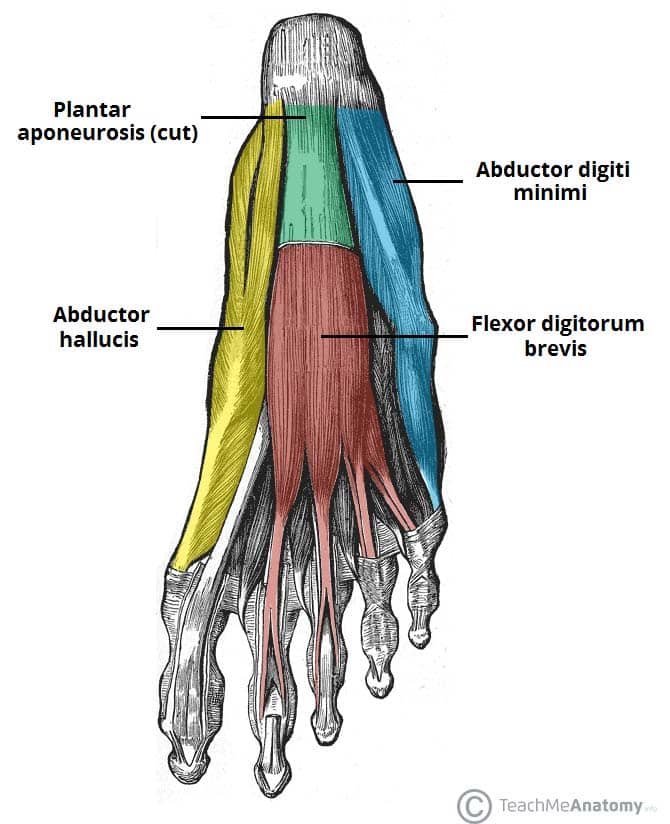
<p>Proximal Attachment (O): Medial tubercle of tuberosity of calcaneus; flexor retinaculum; plantar aponeurosis</p><p>Distal Attachment (I): Medial side of base of proximal phalanx of 1st digit</p><p>Nerve: Medial plantar nerve (L5, S1)</p><p>Action: Abducts and flexes 1st digit (great toe, hallux) at metatarsophalangeal (MTP) and interphalangeal (IP) joints</p>
40
New cards

Adductor hallucis

Proximal Attachment (O):

  • Oblique head: bases of metatarsals 2–4

  • Transverse head: plantar ligaments of metatarsophalangeal (MTP) joints

Distal Attachment (I): Tendons of both heads attach to lateral side of base of proximal phalanx of 1st digit.

Nerve: Deep branch of lateral plantar nerve (S1–S3)

Action: Traditionally said to adduct 1st digit; assists in maintaining transverse arch of foot by pulling metatarsals medially
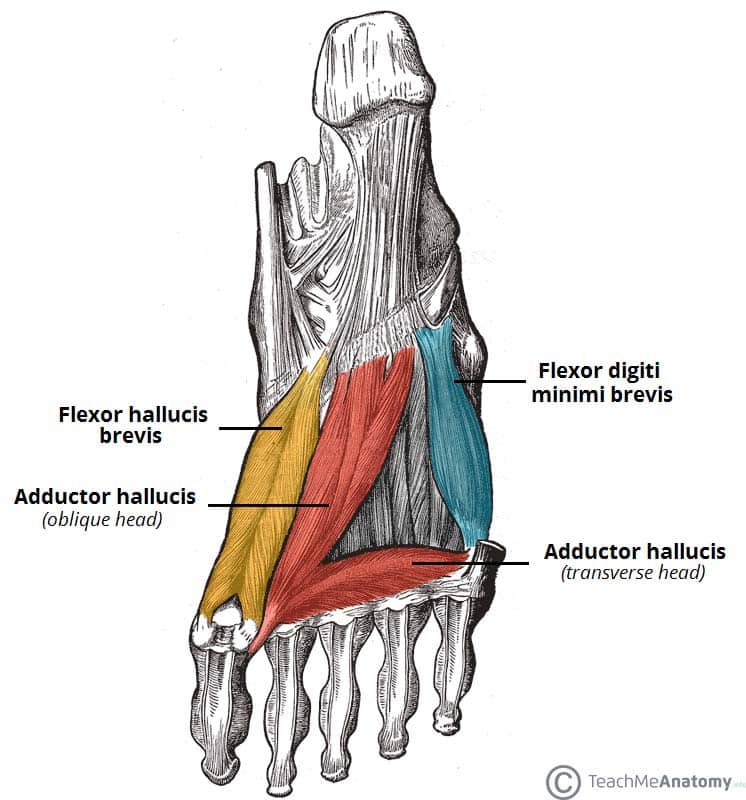
<p>Proximal Attachment (O):</p><ul><li><p>Oblique head: bases of metatarsals 2–4</p></li><li><p>Transverse head: plantar ligaments of metatarsophalangeal (MTP) joints</p></li></ul><p>Distal Attachment (I): Tendons of both heads attach to lateral side of base of proximal phalanx of 1st digit.</p><p>Nerve: Deep branch of lateral plantar nerve (S1–S3)</p><p>Action: Traditionally said to adduct 1st digit; assists in maintaining transverse arch of foot by pulling metatarsals medially</p>
41
New cards

Flexor digiti minimi brevis

Proximal Attachment (O): Base of 5th metatarsal

Distal Attachment (I): Base of proximal phalanx of 5th digit

Nerve: Superficial branch of lateral plantar nerve (S1–S3)

Action: Flexes proximal IP joint of 5th digit, thereby assisting with flexion of digit
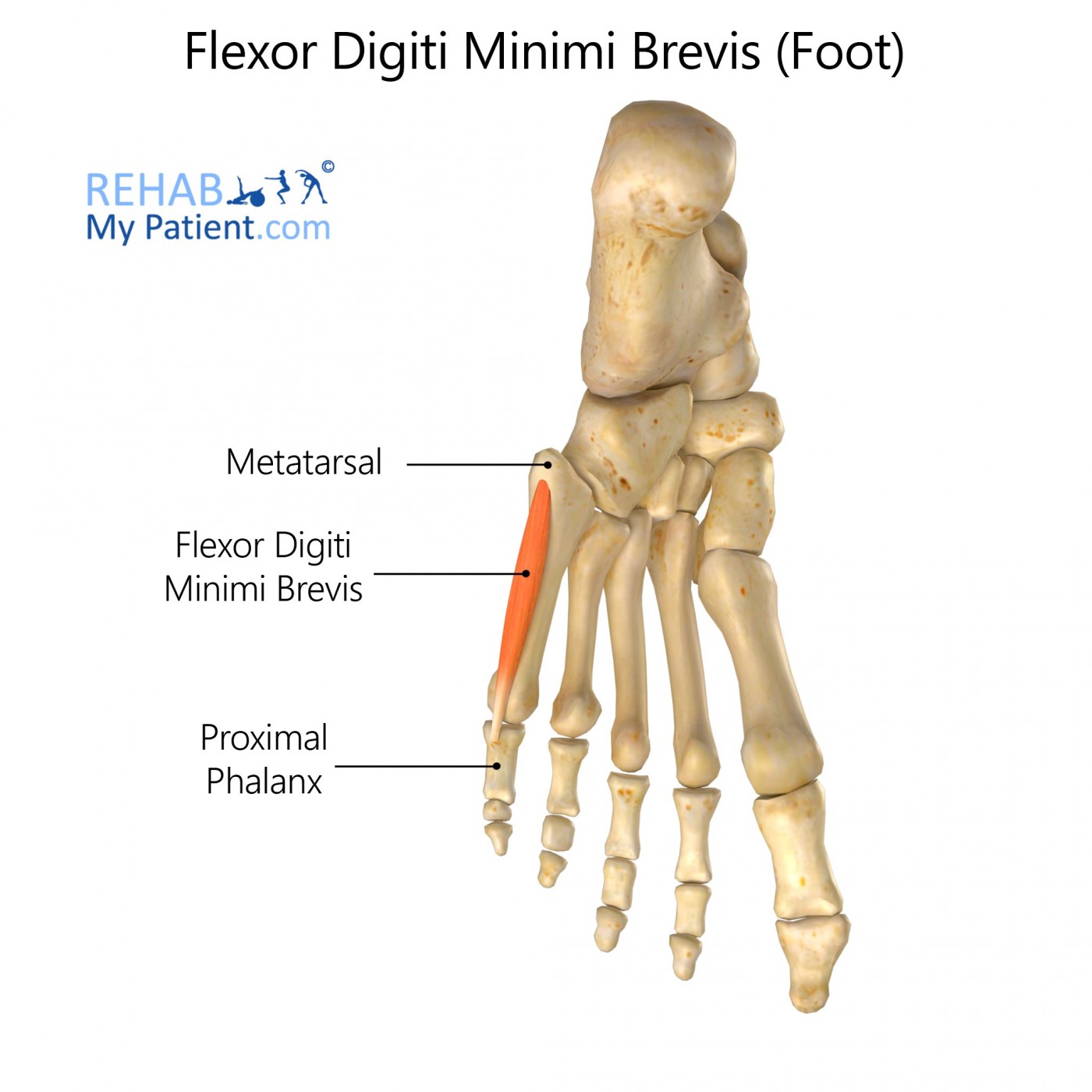
<p>Proximal Attachment (O): Base of 5th metatarsal</p><p>Distal Attachment (I): Base of proximal phalanx of 5th digit</p><p>Nerve: Superficial branch of lateral plantar nerve (S1–S3)</p><p>Action: Flexes proximal IP joint of 5th digit, thereby assisting with flexion of digit</p>
42
New cards

Flexor hallucis brevis

Proximal Attachment (O): Plantar surfaces of cuboid and lateral cuneiforms

Distal Attachment (I): Both sides of base of proximal phalanx of 1st digit

Nerve: Medial plantar nerve (L5, S1)

Action: Flexes proximal interphalangeal (IP) joint of 1st digit
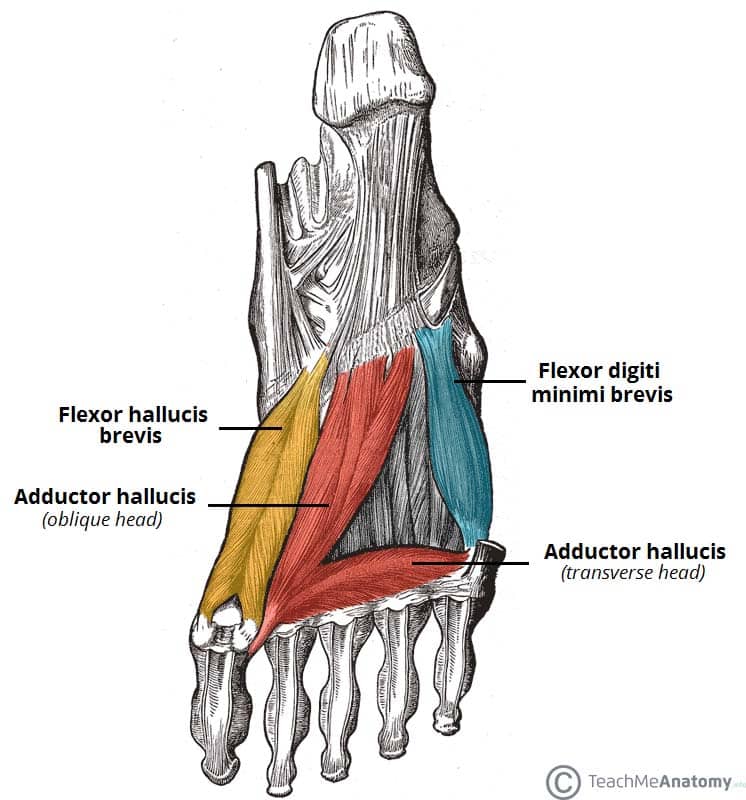
<p>Proximal Attachment (O): Plantar surfaces of cuboid and lateral cuneiforms</p><p>Distal Attachment (I): Both sides of base of proximal phalanx of 1st digit</p><p>Nerve: Medial plantar nerve (L5, S1)</p><p>Action: Flexes proximal interphalangeal (IP) joint of 1st digit</p>
43
New cards

Quadratus plantae

Proximal Attachment (O): Medial surface and lateral margin of plantar surface of calcaneus

Distal Attachment (I): Posterolateral margin of tendon of flexor digitorum longus

Nerve: Lateral plantar nerve (S1–S3)

Action: Assists flexor digitorum longus in flexing lateral four digits at MTP and IP joints
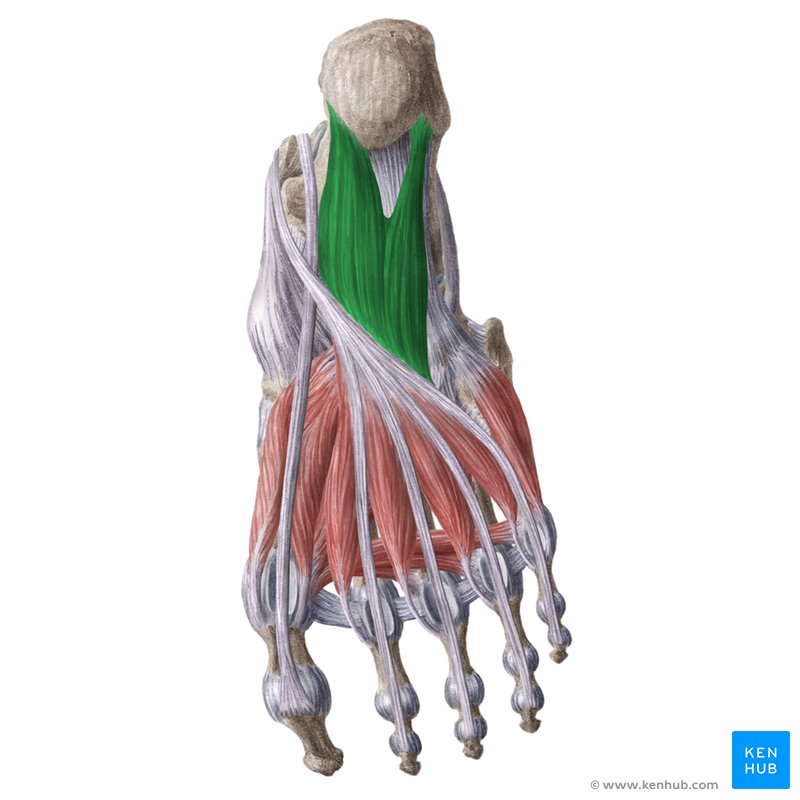
<p>Proximal Attachment (O): Medial surface and lateral margin of plantar surface of calcaneus</p><p>Distal Attachment (I): Posterolateral margin of tendon of flexor digitorum longus</p><p>Nerve: Lateral plantar nerve (S1–S3)</p><p>Action: Assists flexor digitorum longus in flexing lateral four digits at MTP and IP joints</p>
44
New cards

Psoas minor

Proximal Attachment (O): Sides of T12–L1 vertebrae and intervertebral discs

Distal Attachment (I): Pectineal line and iliopubic eminence via iliopectineal arch

Nerve: Anterior rami of lumbar nerves (L1, L2)

Action: Act conjointly in flexion and lateral rotation of hip joint and in stabilizing this joint when standing
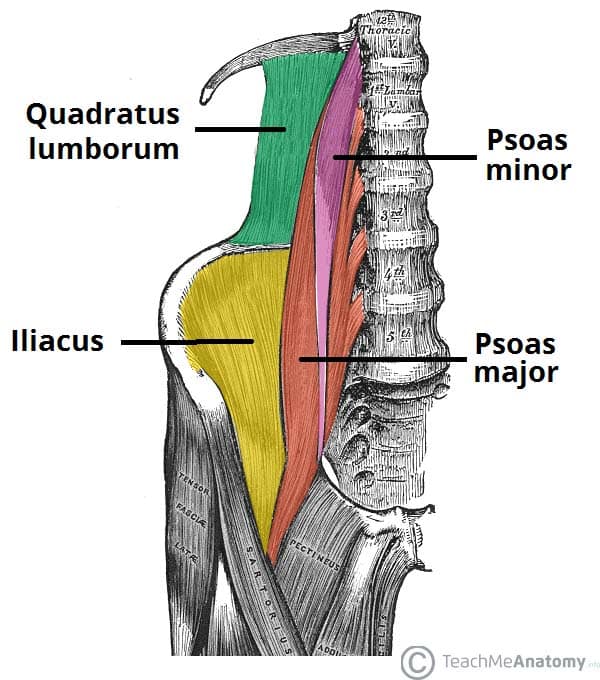
<p>Proximal Attachment (O): Sides of T12–L1 vertebrae and intervertebral discs</p><p>Distal Attachment (I): Pectineal line and iliopubic eminence via iliopectineal arch</p><p>Nerve: Anterior rami of lumbar nerves (L1, L2)</p><p>Action: Act conjointly in flexion and lateral rotation of hip joint and in stabilizing this joint when standing</p>
45
New cards

Psoas major

(Posterior Abdominal Wall)

Superior Attachment (O): Transverse processes of lumbar vertebrae; sides of bodies of T12–L5 vertebrae and intervening intervertebral discs

Inferior Attachment (I): By a strong tendon to lesser trochanter of femur

Nerve: Anterior rami of lumbar nerves L1, L2, and L3

Action: Acting inferiorly with iliacus, it flexes the thigh; acting superiorly, it flexes the vertebral column laterally; it is used to balance the trunk; when sitting, it acts inferiorly with the iliacus to flex the trunk
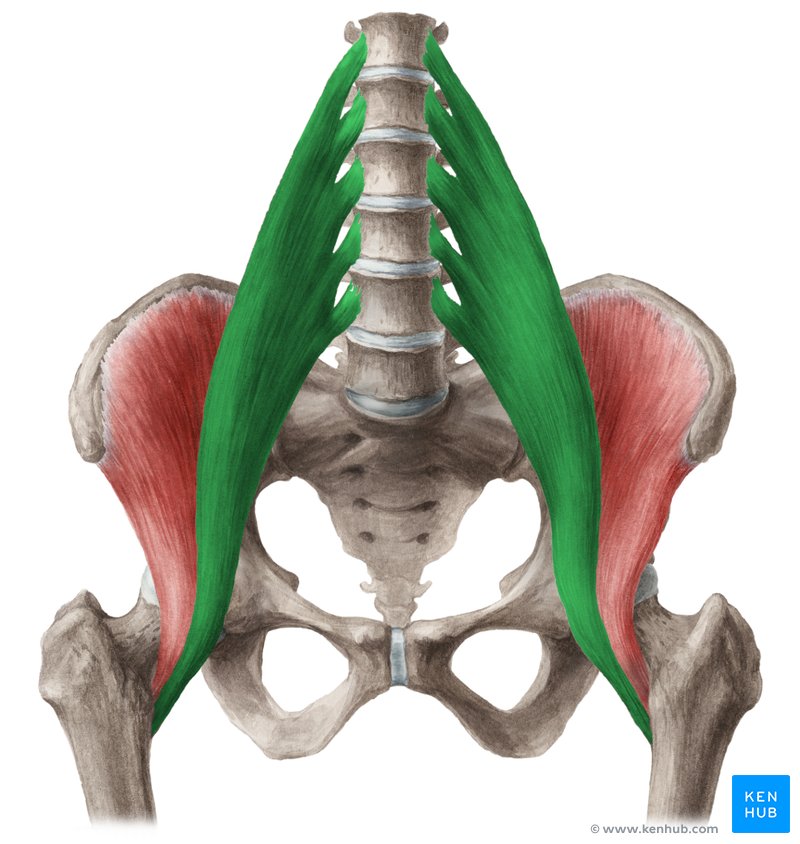
<p>(Posterior Abdominal Wall)</p><p>Superior Attachment (O): Transverse processes of lumbar vertebrae; sides of bodies of T12–L5 vertebrae and intervening intervertebral discs</p><p>Inferior Attachment (I): By a strong tendon to lesser trochanter of femur</p><p>Nerve: Anterior rami of lumbar nerves L1, L2, and L3</p><p>Action: Acting inferiorly with iliacus, it flexes the thigh; acting superiorly, it flexes the vertebral column laterally; it is used to balance the trunk; when sitting, it acts inferiorly with the iliacus to flex the trunk</p>
46
New cards

Iliacus

(Posteiror abdominal wall)

Superior Attachment (O): Superior two thirds of iliac fossa, ala of sacrum, and anterior sacro-iliac ligaments

Inferior Attachment (I): Lesser trochanter of femur and shaft inferior to it and to psoas major tendon

Nerve: Femoral nerve (L2-L4)

Action: Flexes thigh and stabilizes hip joint; acts with psoas major
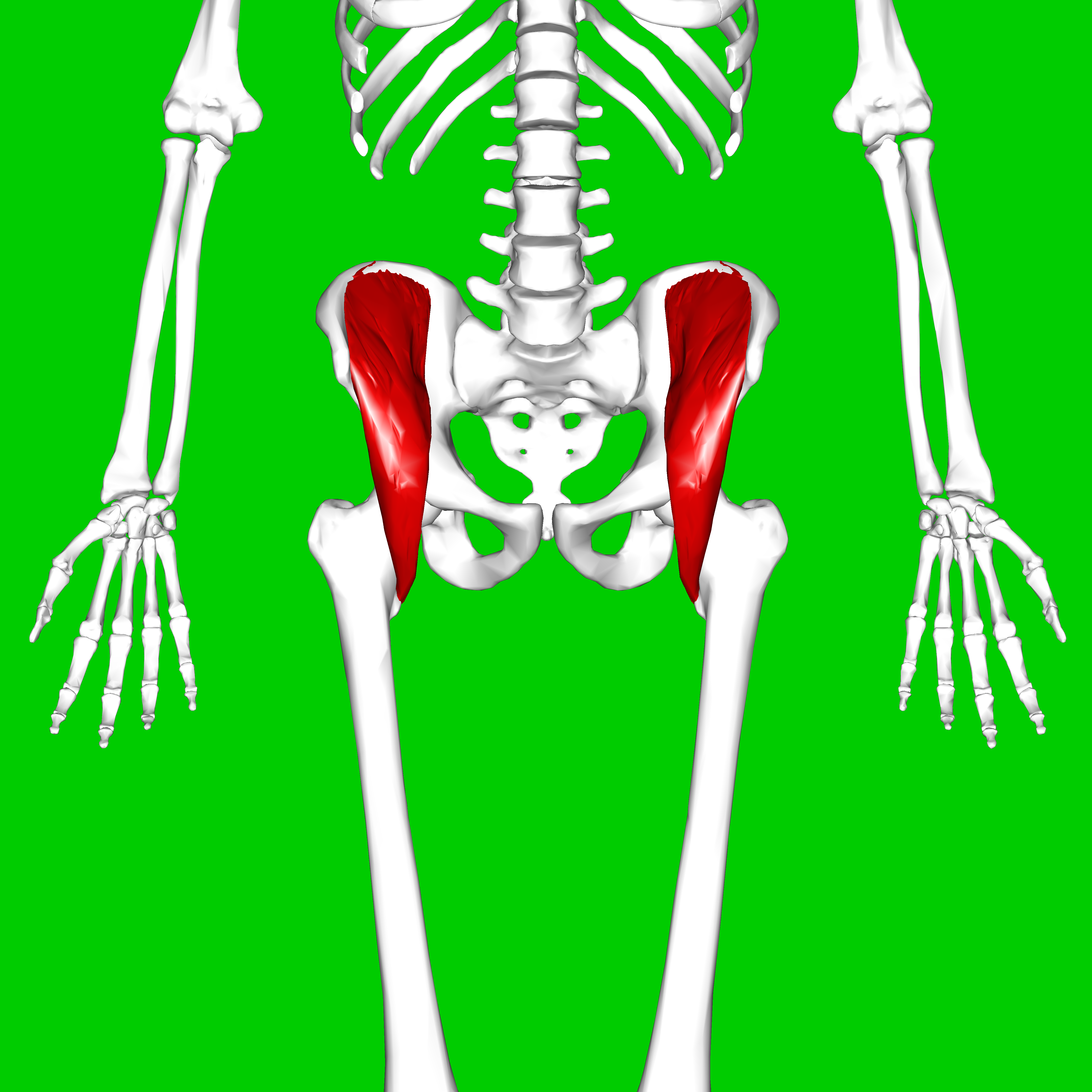
<p>(Posteiror abdominal wall)</p><p>Superior Attachment (O): Superior two thirds of iliac fossa, ala of sacrum, and anterior sacro-iliac ligaments</p><p>Inferior Attachment (I): Lesser trochanter of femur and shaft inferior to it and to psoas major tendon</p><p>Nerve: Femoral nerve (L2-L4)</p><p>Action: Flexes thigh and stabilizes hip joint; acts with psoas major</p>
47
New cards

Extensor digitorum Brevis

Proximal Attachment (O): Calcaneus (floor of tarsal sinus); interosseous talocalcaneal ligament; stem of inferior extensor retinaculum

Distal Attachment (I): Long extensor tendons of three intermediate digits (toes 2–4)

Innervation: Deep fibular nerve (L5 or S1, or both)

Action: Aids the extensor digitorum longus in extending the three intermediate toes at the metatarsophalangeal (MTP) and interphalangeal joints
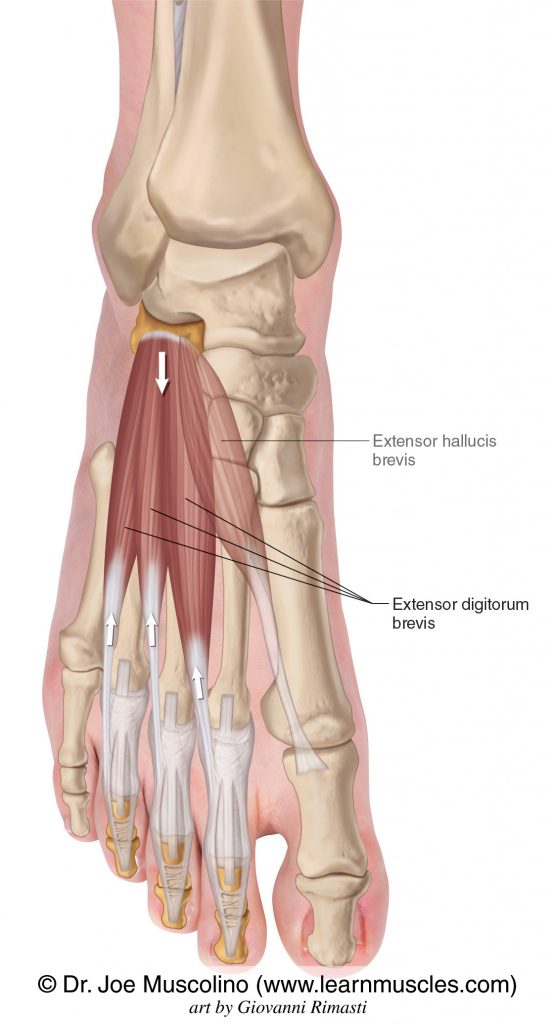
<p>Proximal Attachment (O): Calcaneus (floor of tarsal sinus); interosseous talocalcaneal ligament; stem of inferior extensor retinaculum</p><p>Distal Attachment (I): Long extensor tendons of three intermediate digits (toes 2–4)</p><p>Innervation: Deep fibular nerve (L5 or S1, or both)</p><p>Action: Aids the extensor digitorum longus in extending the three intermediate toes at the metatarsophalangeal (MTP) and interphalangeal joints</p>
48
New cards

Extensor hallucis brevis

Proximal Attachment (O): Calcaneus (floor of tarsal sinus); interosseous talocalcaneal ligament; stem of inferior extensor retinaculum

Distal Attachment (I): Dorsal aspect of base of proximal phalanx of great toe (digit 1)

Innervation: Deep fibular nerve (L5 or S1, or both)

Action: Aids the extensor hallucis longus in extending the great toe at the MTP joint
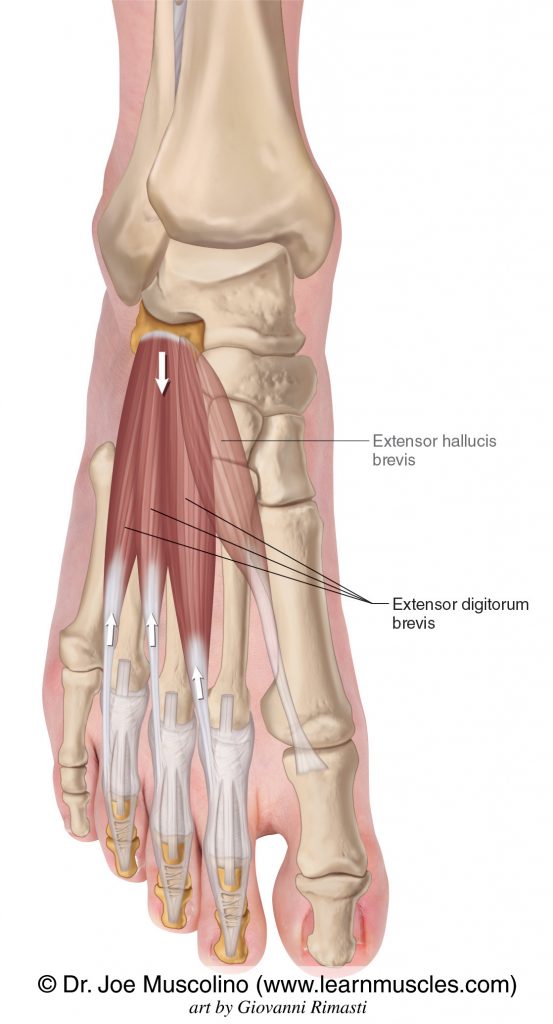
<p>Proximal Attachment (O): Calcaneus (floor of tarsal sinus); interosseous talocalcaneal ligament; stem of inferior extensor retinaculum</p><p>Distal Attachment (I): Dorsal aspect of base of proximal phalanx of great toe (digit 1)</p><p>Innervation: Deep fibular nerve (L5 or S1, or both)</p><p>Action: Aids the extensor hallucis longus in extending the great toe at the MTP joint</p>
49
New cards

Lumbricals

Proximal Attachment (O): Tendons of flexor digitorum longus

Distal Attachment (I): Medial aspect of expansion over lateral four digits

Innervation:

  • Medial one: medial plantar nerve (L5–S1)

  • Lateral three: lateral plantar nerve (S1–S3)

Action: Flex proximal IP joint; extend middle and distal IP joints of lateral four digits
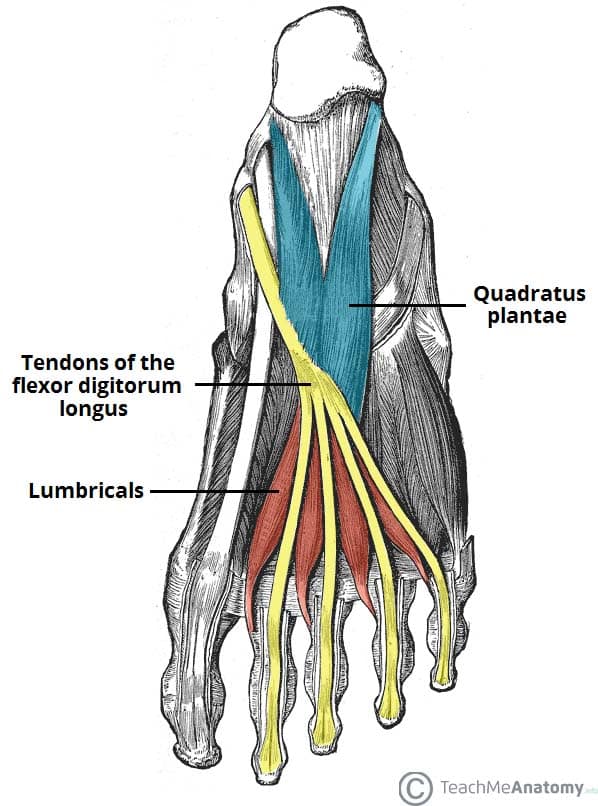
<p>Proximal Attachment (O): Tendons of flexor digitorum longus</p><p>Distal Attachment (I): Medial aspect of expansion over lateral four digits</p><p>Innervation:</p><ul><li><p>Medial one: medial plantar nerve (L5–S1)</p></li><li><p>Lateral three: lateral plantar nerve (S1–S3)</p></li></ul><p>Action: Flex proximal IP joint; extend middle and distal IP joints of lateral four digits</p>
50
New cards

Plantar Interossei (3)

Proximal Attachment (O): Plantar aspect of medial sides of shafts of metatarsals 3–5

Distal Attachment (I): Medial sides of bases of phalanges of 3rd–5th digits

Innervation: Lateral plantar nerve (S1–S3)

Action: Adduct and flex digits 3–5 at MTP joints
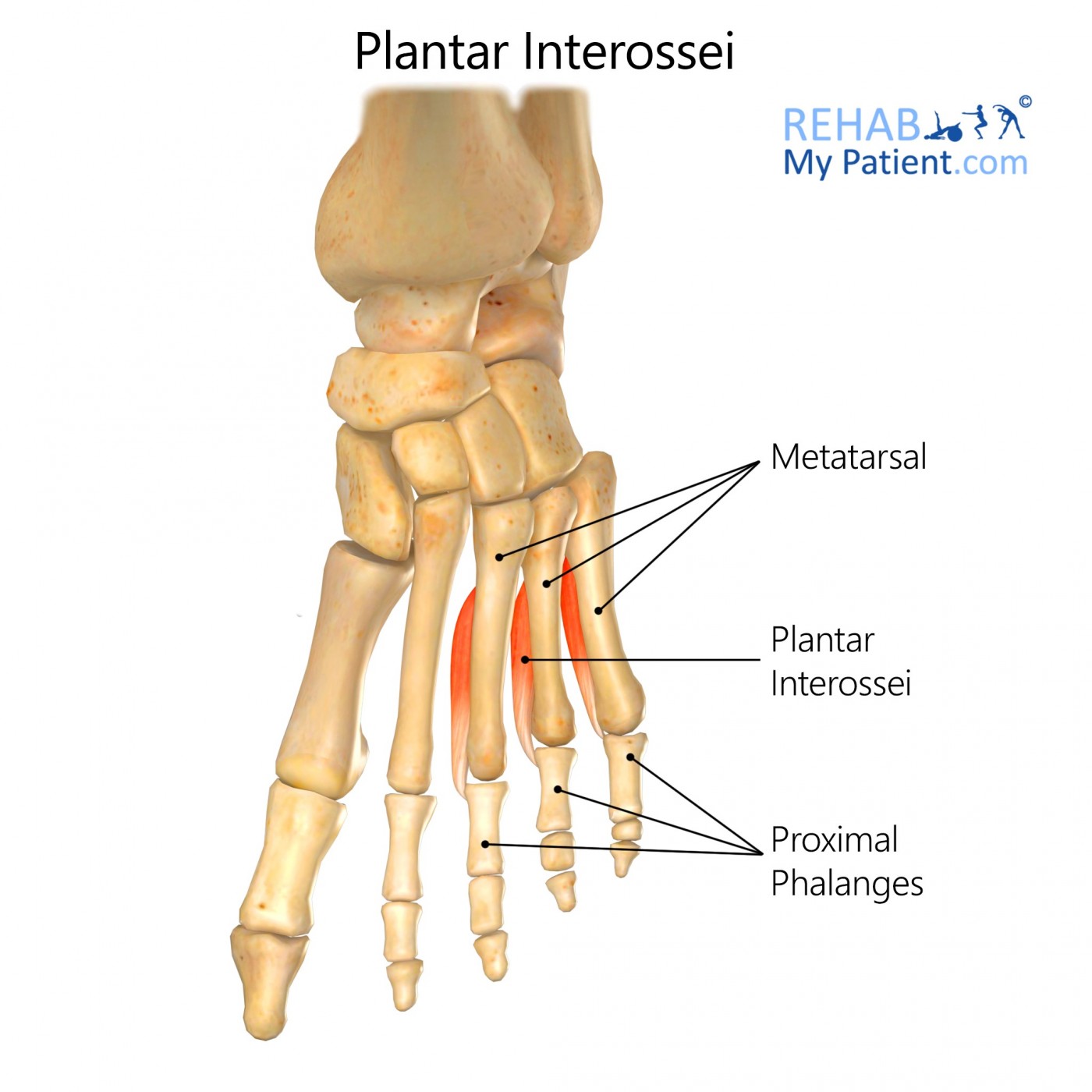
<p>Proximal Attachment (O): Plantar aspect of medial sides of shafts of metatarsals 3–5</p><p>Distal Attachment (I): Medial sides of bases of phalanges of 3rd–5th digits</p><p>Innervation: Lateral plantar nerve (S1–S3)</p><p>Action: Adduct and flex digits 3–5 at MTP joints</p>
51
New cards

Dorsal Interossei (4)

Proximal Attachment (O): Adjacent sides of shafts of metatarsals 1–5

Distal Attachment (I):

  • 1st: medial side of proximal phalanx of 2nd digit

  • 2nd–4th: lateral sides of 2nd–4th digits

Innervation: Lateral plantar nerve (S1–S3)

Action: Abduct and flex digits 2–4 at MTP joints
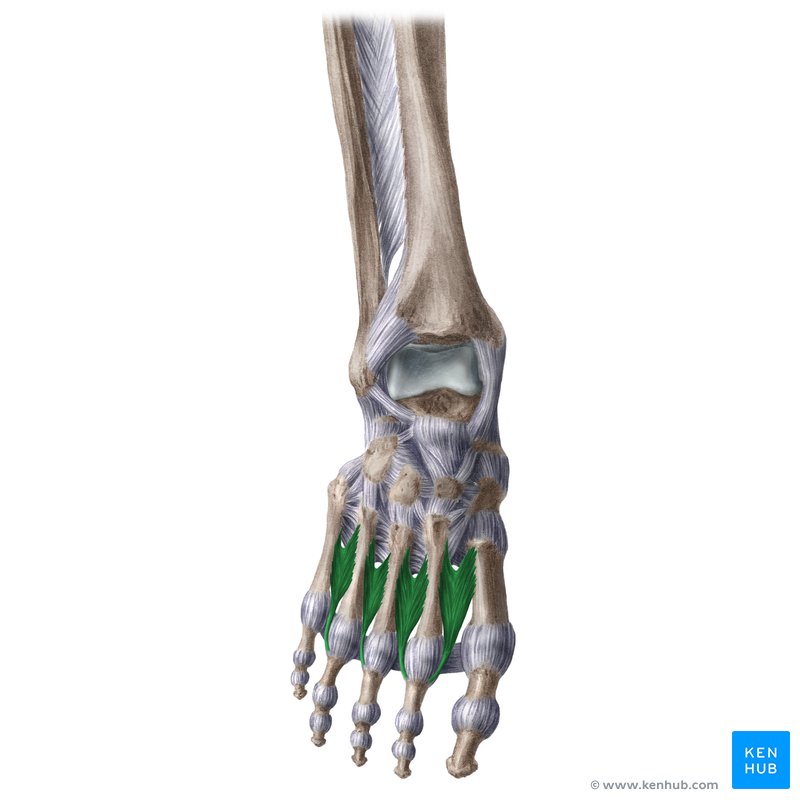
<p>Proximal Attachment (O): Adjacent sides of shafts of metatarsals 1–5</p><p>Distal Attachment (I):</p><ul><li><p>1st: medial side of proximal phalanx of 2nd digit</p></li><li><p>2nd–4th: lateral sides of 2nd–4th digits</p></li></ul><p>Innervation: Lateral plantar nerve (S1–S3)</p><p>Action: Abduct and flex digits 2–4 at MTP joints</p>