GCSE Biology (OCR A) B6.2 - Feeding the human race
 Call Kai
 Learn
Learn Practice Test
 Spaced Repetition
 Match
Match Flashcards
 Knowt Play
1/34

There's no tags or description
Looks like no tags are added yet.
Name | Mastery | Learn | Test | Matching | Spaced | Call with Kai |
|---|
No analytics yet
Send a link to your students to track their progress
35 Terms
What is food security?
When all people at all times have access to sufficient safe and nutritious food to live a healthy life.
What are 5 factors that affect food security?
Increasing human population
Changing diets in people
Climate change
New pests and pathogens
Sustainability and costs of agricultural inputs (e.g. oil prices increasing)
How can food production be increased?
Maximising photosynthesis with optimum conditions, fertiliser usage, removing competition and pests, pest resistant crops
What is intensive farming?
It maximises the amount of food yield from a small space by using fertilisers, chemicals, machinery and controlled environments for optimal growth.
What is organic farming?
It uses a large amount of land for a slower grown yield, but is more natural and uses no chemicals. It is, however, the more expensive option.
What are hydroponics?
Growing plants in nutrient dissolved liquids other than soil, which is more space efficient than regular methods and doesn't use up soil minerals.
What are the advantages of hydroponics over soil-based growing?
lants can be grown in areas without fertile soil; water and nutrients are recycled so there is less waste; growth is faster; fewer pests and diseases; conditions can be precisely controlled.
What are the disadvantages of hydroponics?
High set-up and running costs; requires specialist knowledge; artificial nutrient solutions still needed; risk of disease spreading rapidly through shared water supply.
What is fish farming?
Farms where fish are bred and grown for eating purposes, which helps wild populations recover better.
What are the advantages of fish farming?
Reduces pressure on wild fish populations; fish can be selectively bred for desirable traits; controlled environment means faster and more reliable growth.
What are the disadvantages of fish farming?
High-density conditions increase disease spread; waste products can pollute surrounding water; escaped fish can interbreed with wild populations and reduce genetic diversity.
What is biological control?
Controlling pests by deliberately introducing natural predators of the pest.
How can gene technology help agriculture?
Beneficial genes for pest resistance or the ability to grow in harsher conditions could be introduced.
How can fertilisers and pesticides help agriculture?
Pesticides kill pests that could harm the growth of the plant; fertilisers provide the plant with all the nutrients it needs so that it can grow more quickly.
Describe how selective breeding is carried out.
Animals with the desired traits are chosen, these animals are bred together, repeat the process over several generations until the offspring have the desired traits.
Why use selective breeding?
Can grow organisms that have optimum genes (e.g. disease resistant crops, and fast-growing pigs) for food sources.
Why not use selective breeding?
It reduces the gene pool, reducing variation in a species, making them all susceptible to the same issues. Inbreeding can also increase the chance of inheriting genetic diseases.
What is genetic engineering?
Altering the genome of an organism so it can introduce more desirable characteristics.
What is a vector in genetic engineering?
A carrier used to deliver a new gene into a host organism. A bacterial plasmid is the most common example.
What are the issues related to genetic engineering?
Eating GM organisms may introduce allergens that weren't there before, GM plants may cross-pollinate with wild plants, introducing the gene into wild plants, disrupting an ecosystem, and people say it is wrong for humans to "play God"
How are new genes introduced into an organism?
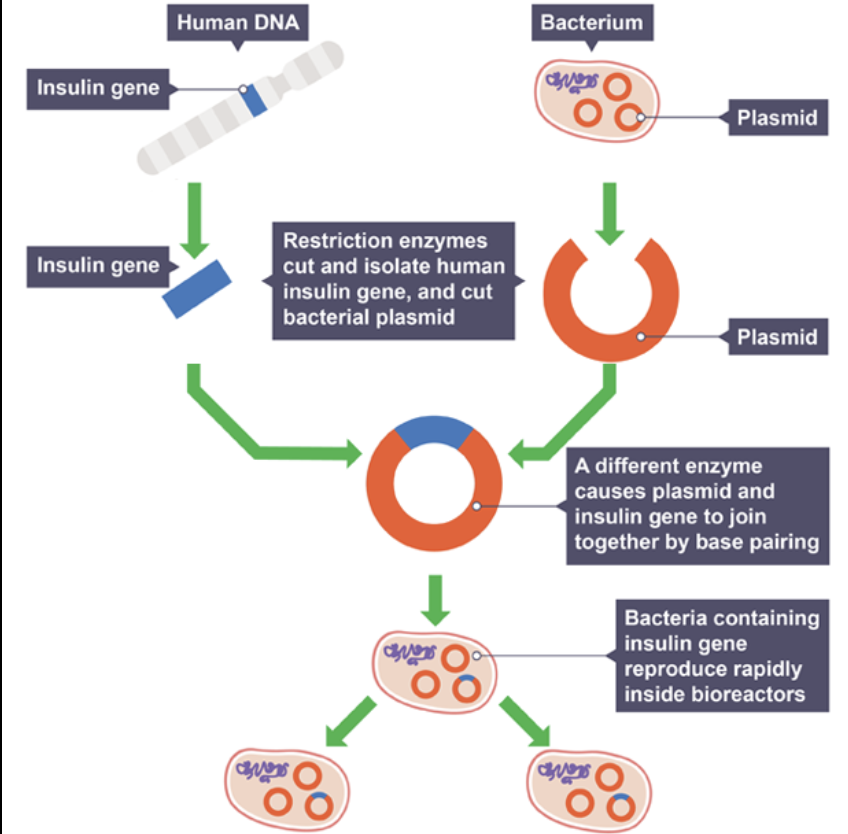
The desired gene is cut from donor DNA using restriction enzymes, creating sticky ends. A bacterial plasmid (vector) is cut with the same restriction enzymes to produce matching sticky ends. The gene is inserted into the plasmid using ligase enzymes, along with an antibiotic resistance marker gene. The plasmid is taken up by host bacteria. Antibiotics are then added — only bacteria that successfully took up the plasmid survive.
Why add antibiotic resistance genes in genetic engineering?
To identify which bacteria have taken up the genes.
What is a sticky end?
A short, single-stranded overhang of unpaired bases left on a DNA fragment after cutting with a restriction enzyme, allowing complementary sticky ends from different DNA fragments to join together.
What is a transgenic organism?
An organism that contains foreign DNAAn organism that contains a gene from a different species inserted into its genome. For example, bacteria engineered to carry the human insulin gene.
What are 2 advantages of genetically modified crops?
Better crop yields; food will last longer and taste better.
What are 2 disadvantages of genetically modified crops?
The new genes can easily spread to other plants in the environment; we don't know what long term effects GM crops cause on health.
What is the difference between intensive and organic farming in terms of biodiversity impact?
Intensive farming reduces biodiversity through pesticide and herbicide use, monocultures and removal of hedgerows. Organic farming supports greater biodiversity by avoiding chemicals and maintaining varied habitats.
What does the genetic engineering process look like?