Modalities Exam 2
 Call Kai
 Learn
Learn Practice Test
 Spaced Repetition
 Match
Match Flashcards
 Knowt Play
1/158

There's no tags or description
Looks like no tags are added yet.
Name | Mastery | Learn | Test | Matching | Spaced | Call with Kai |
|---|
No analytics yet
Send a link to your students to track their progress
159 Terms
What is more excitable- muscle or nerve?
Nerve!
Ex: stim on the face means stimulating Facial Nerve, not those muscles
Muscle usually does NOT respond to what?
The electrical currents we use in therapy
Short duration stim won't excite a muscle, ONLY a nerve. What do you need?
Wider duration
What does Reaction of Degeneration (R/D) Classifications indicate?
the severity of nerve degeneration
If there is no response from E-stim, what R/D Classification is it?
either Full or Absolute R/D
If there is a response from E-stim, what R/D classification is it?
either No R/D or Partial
No R/D
Strong response to PC or AC
Partial R/D
Weak response to AC or PC
Full R/D
No response to AC or PC, but there is a response to DC (excites muscle, not nerve)
Absolute R/D
No response to AC, PC, or DC (no more healthy muscle left)
What do Electromyography (EMG) Nerve Conduction Velocity (NCV) Studies test?
test the integrity of nerve and muscle for neuromuscular & MSK dysfunction
EMG & NCV are contemporary electrodiagnosis often performed together that do what in conjunction with other tests? Give some examples
"Ruling out" MS, ALS, Polio, myopathies, neuropathies, compression syndromes
What is EMG?
VOLITIONAL potential: have the patient contract and see what you get on the screen (essentially opposite of E-Stim)
What are the 3 types of EMG electrodes?
Ground Electrodes
Needle Electrodes
Active Electrodes
What are EMG Ground Electrodes used for?
to eliminate outside "noise" or interference to magnify the potentials
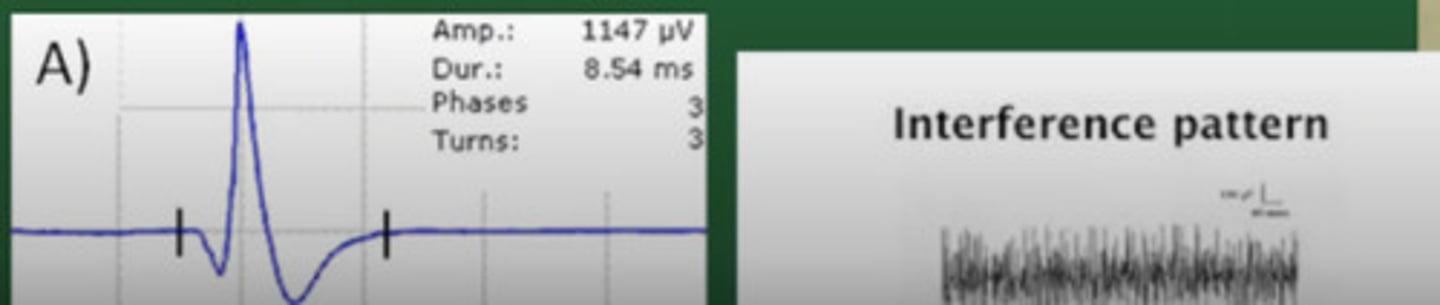
What is the EMG Motor Unit Potential?
200-3000 microvolts
Duration 2-15 msec
Frequency depends on effort
What are the 4 Phases of EMG Evaluation?
1. During needle insertion
2. At rest
3. Minimal effort contraction
4. Maximal effort contraction
What are Normal EMG findings?
1. Needle Insertion: Brief burst electrical activity
2. At Rest: Electrical silence
3. Minimal Effort: Typical MUP's with normal values
4. Maximal Effort: Full interference pattern
What are Abnormal EMG findings?
1. Needle Insertion: Prolonged or absent insertional activity
2. At Rest: Spontaneous potential
+ sharp waves
Fibrillation potentials
Fasciculation potentials
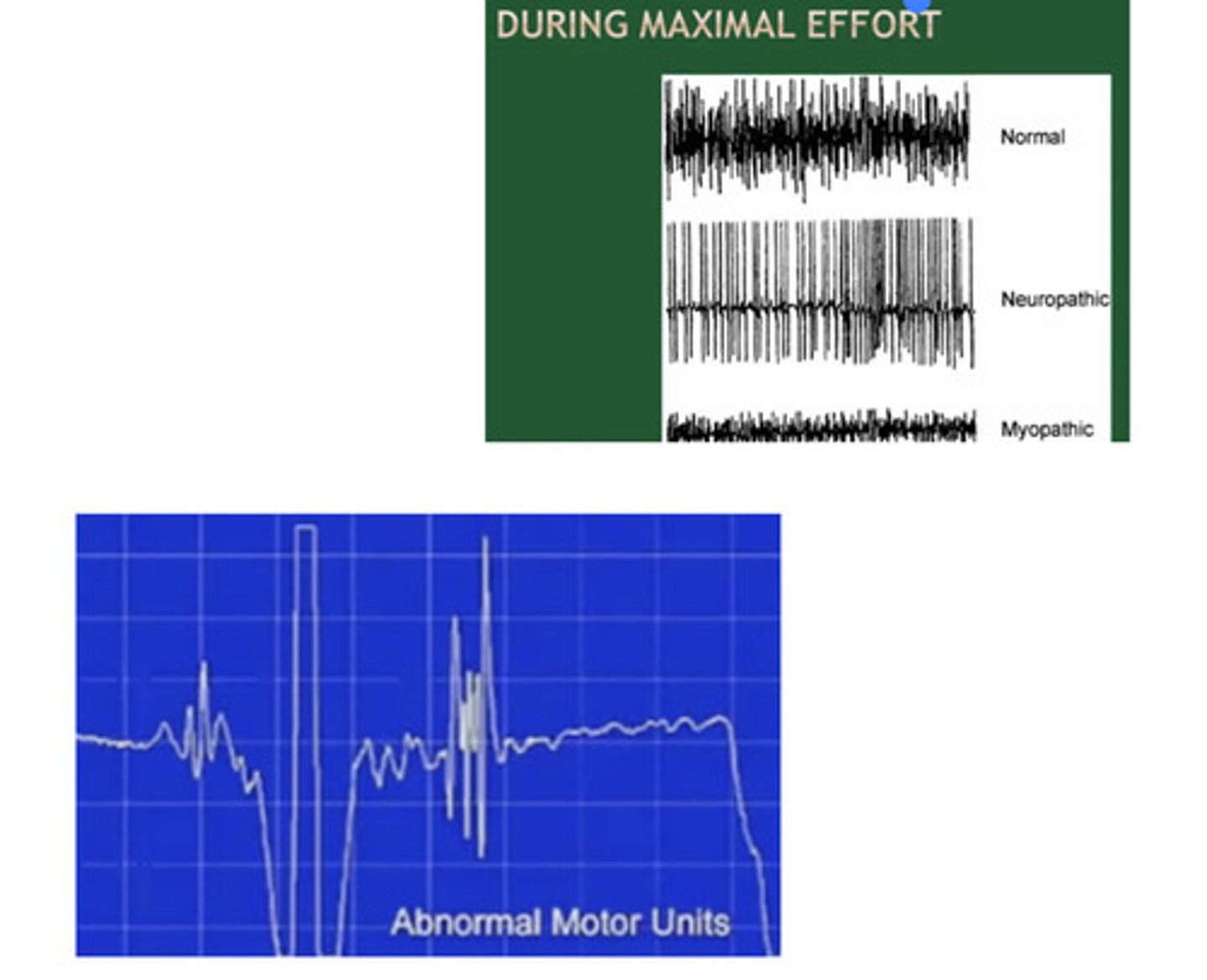
3. Minimal Effort: Abnormal waveforms, GIANT MUP
4. Maximal Effort: Myopathic/ neuropathic patterns
What is Nerve Conduction Velocity (NVC)?
EVOKED Potential: stimulating the nerve and seeing how long it takes the impulse to go from point A to point B
What are the NCV stimulation electrodes?
Anode
Cathode
What are the NCV Pickup (Sensor) Electrodes?
Active
Reference
What are the 2 types of Sensory NCV?
Orthodromic
Antidromic
What is Orthodromic?
Stimulate distal, pickup proximal
What is Antidromic?
Stimulate proximal, pickup distal
What is the Sensory NCV Calculation?
(distance between cathode and active) / latency
Ex: Evaluate the sensory component of the ulnar nerve in the forearm.
SNVC = cathode to anode distance / latency
Distance between cathode and anode = 42.5
Latency = 8 msec
(0.425m) / (0.008sec) = 53.1 m/sec
What is Motor NCV?
Need to stimulate 2 points, 2 cathodes
What is the Motor NCV calculation?
(distance between 2 stimulating cathodes) / (difference between the 2 latencies)
Ex: Evaluate the motor component of the deep fibular nerve.
MNCV = (distance between 2 stimulating cathodes) / (L2-L1)
Distance between the stimulating cathodes: 50cm
Latency 1 is 4 msec, Latency 2 is 15 msec
(0.50m) / (0.11) =45.5 m/sec
Which conduction fibers are faster: sensory or motor?
Sensory!
Which conduction fibers are faster: UE or LE?
UE!
Normal NCV Values
Sensory UE >53 m/sec
Sensory LE > 48 m/sec
Motor UE > 41 m/sec
Motor LE > 41 m/sec
What is NCV Local Abnormality?
A local issue, one slow velocity
Ex: carpal tunnel syndrome
What is NCV General Abnormality?
A systemic issue, all velocities are slow
Ex: ALS
What is Iontophoresis?
The use of continuous direct current (DC) to deliver therapeutic charged ions through the skin into the systemic circulation
In Iontophoresis, why is the drug in its ionic form is placed under the electrode bearing the same charge?
because likes repel → kicks and pushes the medication through the skin to the body, so pair positive with positive (know what charge the med is)
In Iontophoresis, what is the anode?
Positively charged ions
In Iontophoresis, what is the cathode?
Negatively charged ions
In Iontophoresis, what is the Active Electrode?
Where therapeutic ions are placed
In Iontophoresis, what is purpose of the Dispersive / Return Electrode? Is it mandatory?
Closes the electrical circuit
Yes!
What is the main therapeutic effect of Dexamethasone and what is its polarity?
Reduces tissue inflammation
Negative polarity!
What is the main therapeutic effect of Lidocaine and what is its polarity?
Decreases local pain
Positive polarity
What is a big consideration for Iontophoresis? What does it look like?
Electrochemical skin burn!
Initially burn lesion pink and raised → gray → oozing within hours
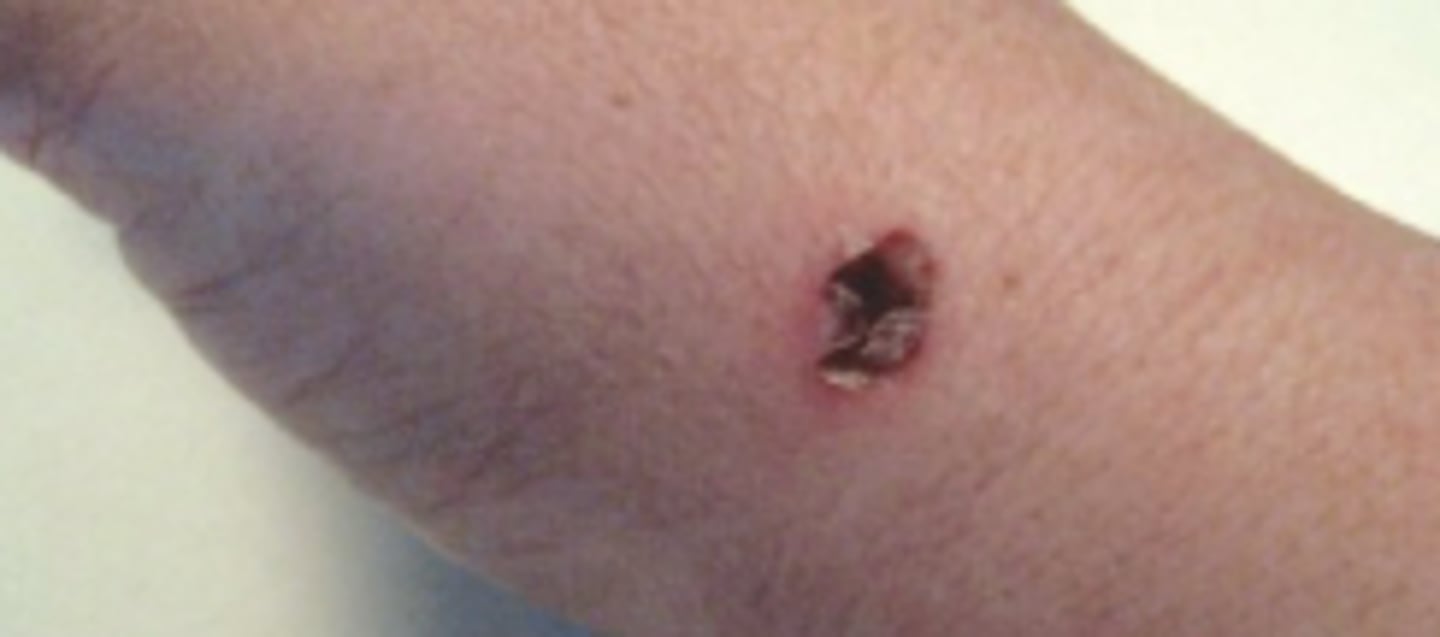
What is an electrochemical burn from Iontophoresis mainly caused by?
the alkaline reaction under cathode
Formation of a strong NaOH base → Soften skin over time → expose it to potential irritation and burn
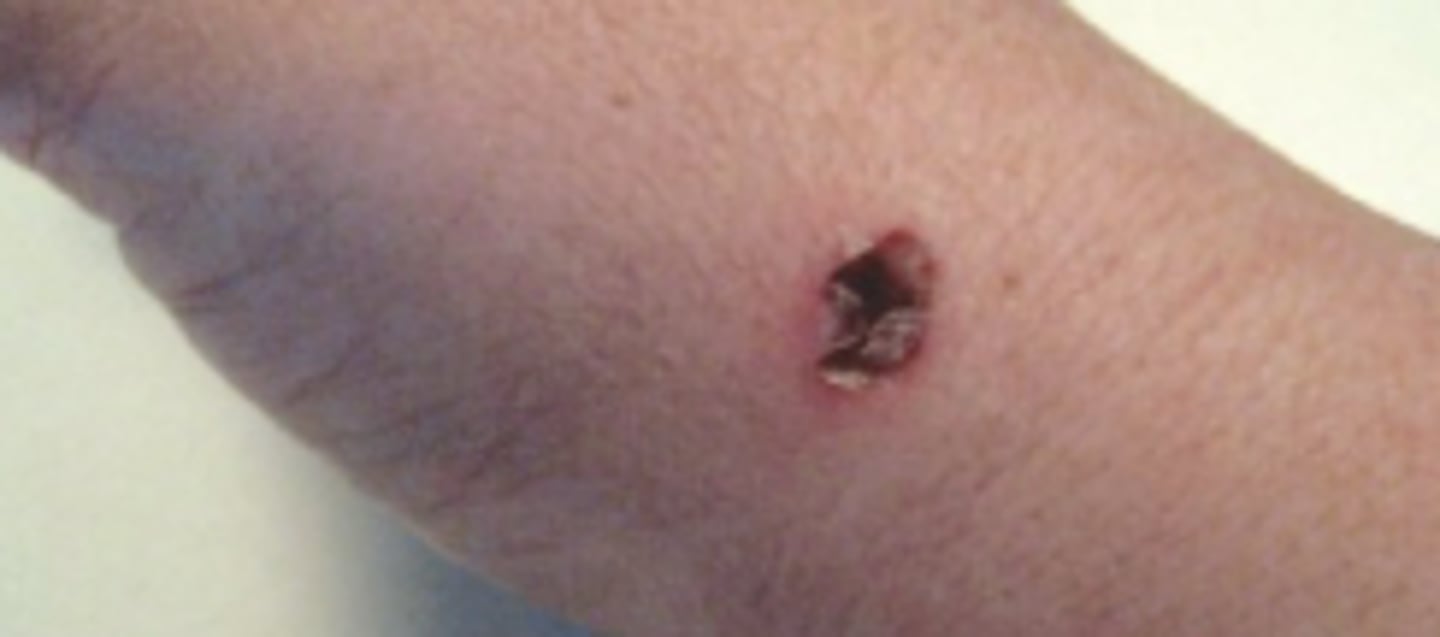
What is another consideration for Iontophoresis?
pH instability
In Iontophoresis, the conductive surface of what should always be larger?
Cathode!
Regardless of whether the cathode is used as the active or dispersive electrode
Iontophoresis is limited to what?
1 ionized medication per delivery electrode
In Iontophoresis, where is the Active Electrode?
Over the treatment area
In Iontophoresis, where is the Dispersive Electrode?
Separated from the active electrode by at least 3 inches
What should the patient feel during Iontophoresis?
A MILD tingling
What would lead to poor Iontophoresis contact?
If electrodes not moist enough
Wrinkles in the gauze
How much weight should be applied to the electrodes?
NONE
What is the dosage for Iontophoresis?
dose mA.min = Amplitude x Time
What is the typical dose for Iontophoresis?
40 mA.min
What is typical amplitude for Iontophoresis?
0-4 mA
Ex: When the Iontophoresis dose is 40 mA.min and current amplitude is 4 mA, what is the time?
40 = (4)(x)
x = 10 mins
For a portable, battery operated Iontophoresis unit, how long can medicated electrodes be left in place? For what purpose?
12-24 hours after to enhance initial treatment
For a wireless non programmable patch of Iontophoresis, how long can a 40 mA.min patch and an 80 mA.min patch be left on for?
40 mA.min: 12 hours
80 mA.min: 24 hours
What is the max recommended safe CD for active electrode Iontophoresis?
0.5 mA/cm^2
What is the Iontophoresis Current Density (CD) calculation?
CD (mA/cm^2) = A (mA) / S (cm^2)
In the Current Density calculation, what is A? What is S?
A = current amplitude, mA
S = electrode conductive surface area (smaller than the electrode), cm^2
If the conductive surface area is 3, what is the current density?
3/2 = 1.5
(hint: always cut the conductive surface area in half!)
When S = 6cm^2, what is the max safe current amplitude?
CD = A / S
0.5 = x / 6
x = 3 mA
The frequency of Iontophoresis treatment should be no more than what? Why?
no more than every 2 days in order to allow the skin to recover from the effects of DC
When should beneficial effects occur within Iontophoresis treatment?
2-5 treatments
What are the advantages of Iontophoresis?
Non-invasive
Painless
Facilitates delivery of charged and high molecular weight compounds that cannot be effectively delivered by simply applying them to the skin
Safer than injection of drug (risk of infection)
Advantages relative to taking oral meds
What are the disadvantages of Iontophoresis?
amount of medication actually induced into tissues is unknown
areas of thick skin are harder to penetrate
deep structures (like the hip joint) are too deep to be affected by iontophoresis
What is TENS used for?
pain modulation
What is the order of TENS depolarizing fibers?
sensory → motor & nociceptive fibers
What kind of current does TENS use?
Pulsed!
usually biphasic, either symmetrical or asymmetrical and balanced
What are the two ways that TENS is thought to work?
The Gate Control Theory
The Opiate System: AKA Descending Endogenous Opiate System (DEOS)
What is the main consideration when using TENS?
symptomatic only treatment = must always investigate and treat the root cause of pain
What are the 3 Therapeutic Modes of TENS?
Conventional
Acupuncture-Like
Brief Intense
What is TENS Conventional Mode used for? What should the patient feel?
To control pain during sedentary work and recreational activities
comfortable tingling sensation, no muscle contraction
What is TENS Acupuncture-Like Mode used for? What is it not recommended for? What should the patient feel?
chronic pain & longer lasting relief without continuous stimulation
NOT recommended for use during ADL, work activities and exercise
visible muscle contraction & comfortable tingling sensation
What is TENS Brief Intense Mode used for? What is it not recommended for? What is an example? What should the patient feel?
Minimizes pain during therapeutic procedures that can be painful
Ex: friction massage and wound debridement
visible strong muscle contraction & highest current amp
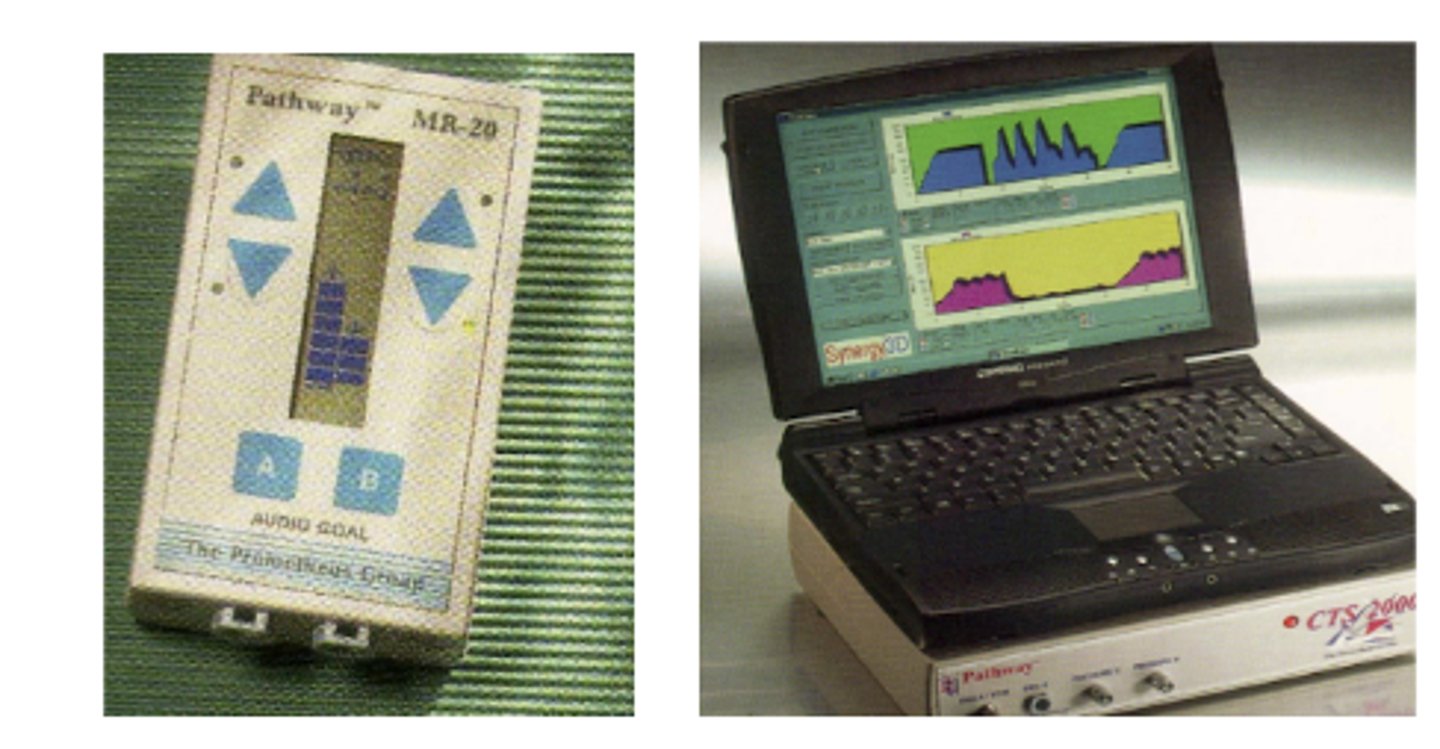
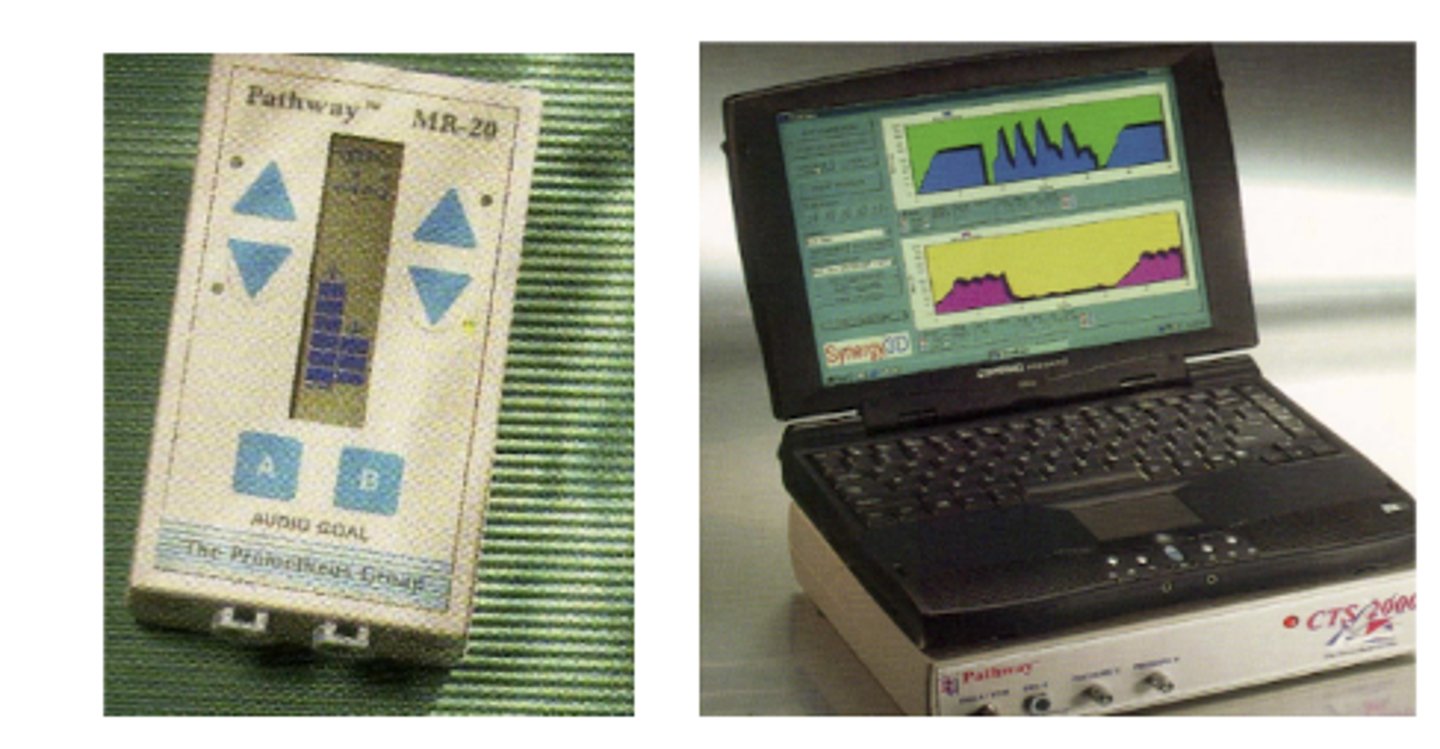
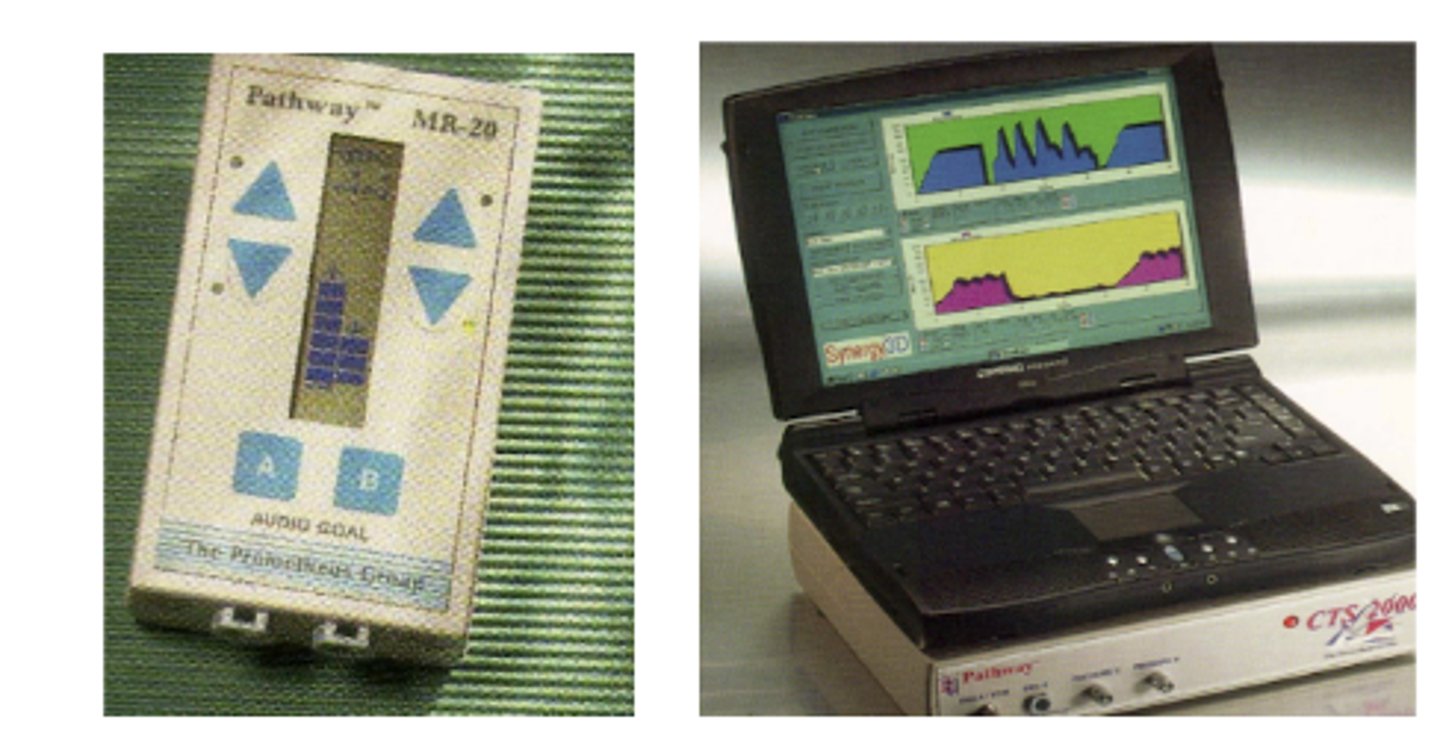
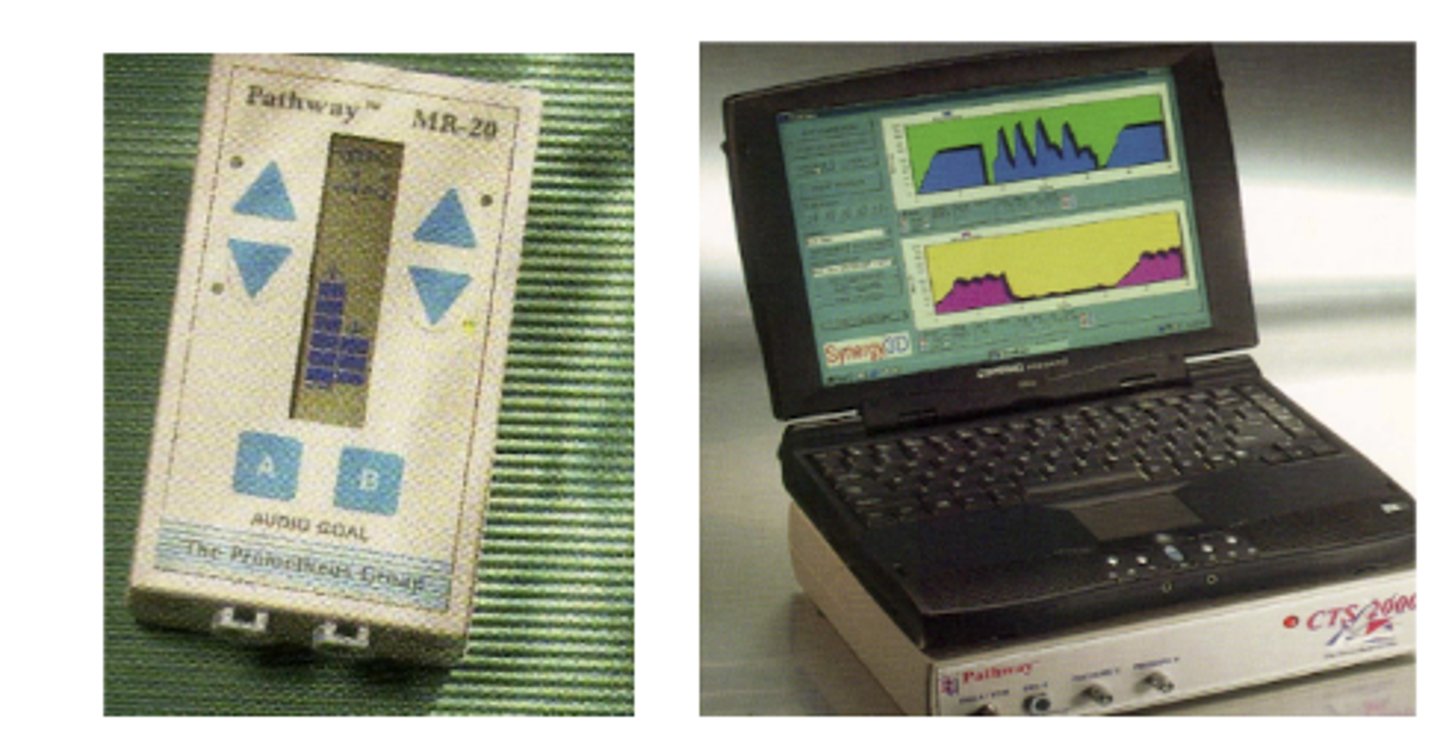
What is Biofeedback? What can feedback be?
Feedback from some measuring instruments that provide moment-to-moment info about specific biologic functions
feedback can be verbal, visual, tactile, etc
What is the biggest advantage of Biofeedback?
Provides pt with a chance to make appropriate small changes in performance that are immediately rewarded, so eventually larger changes or improvements in performance can be accomplished
Also no contraindications yay!
What is the goal of Biofeedback? Can they practice indepdently?
Train patients to perceive those changes without use of measuring instrument
Yesssss
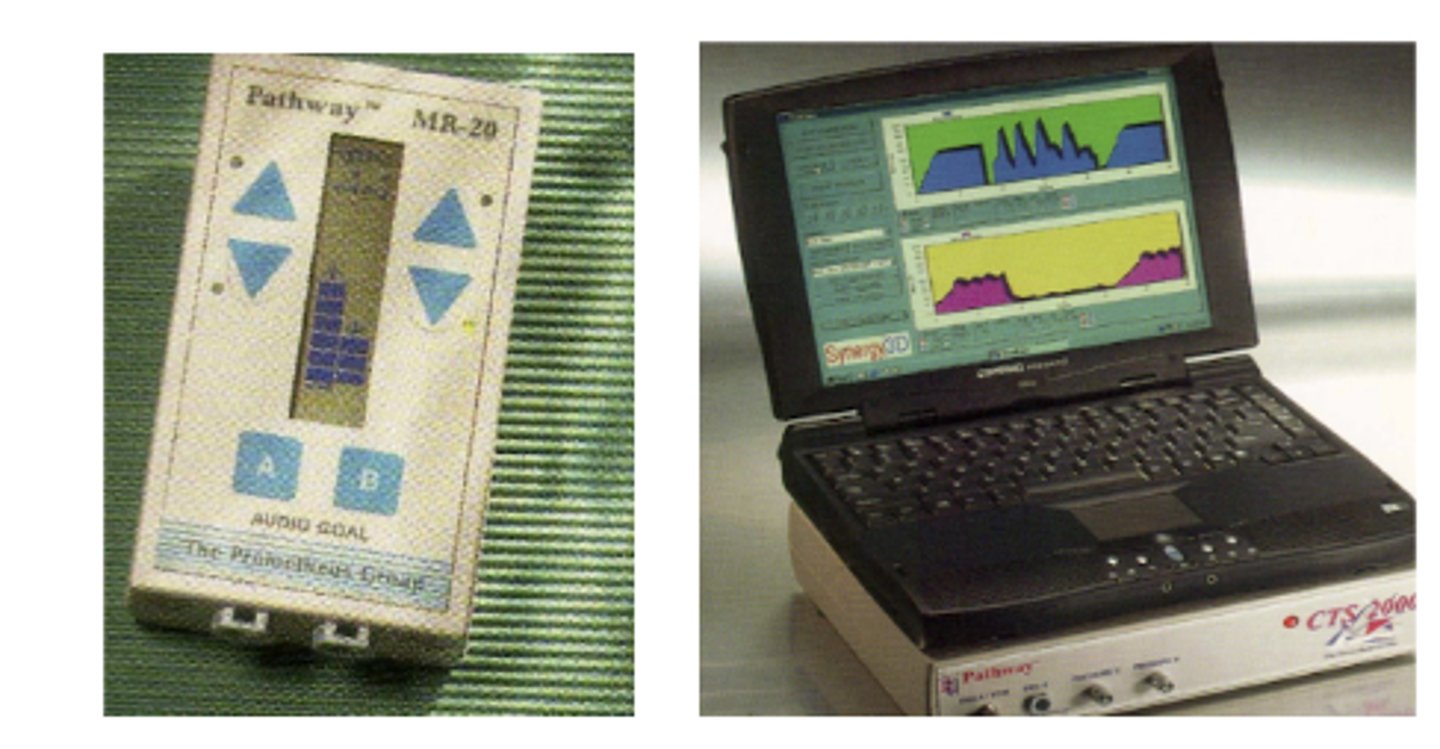
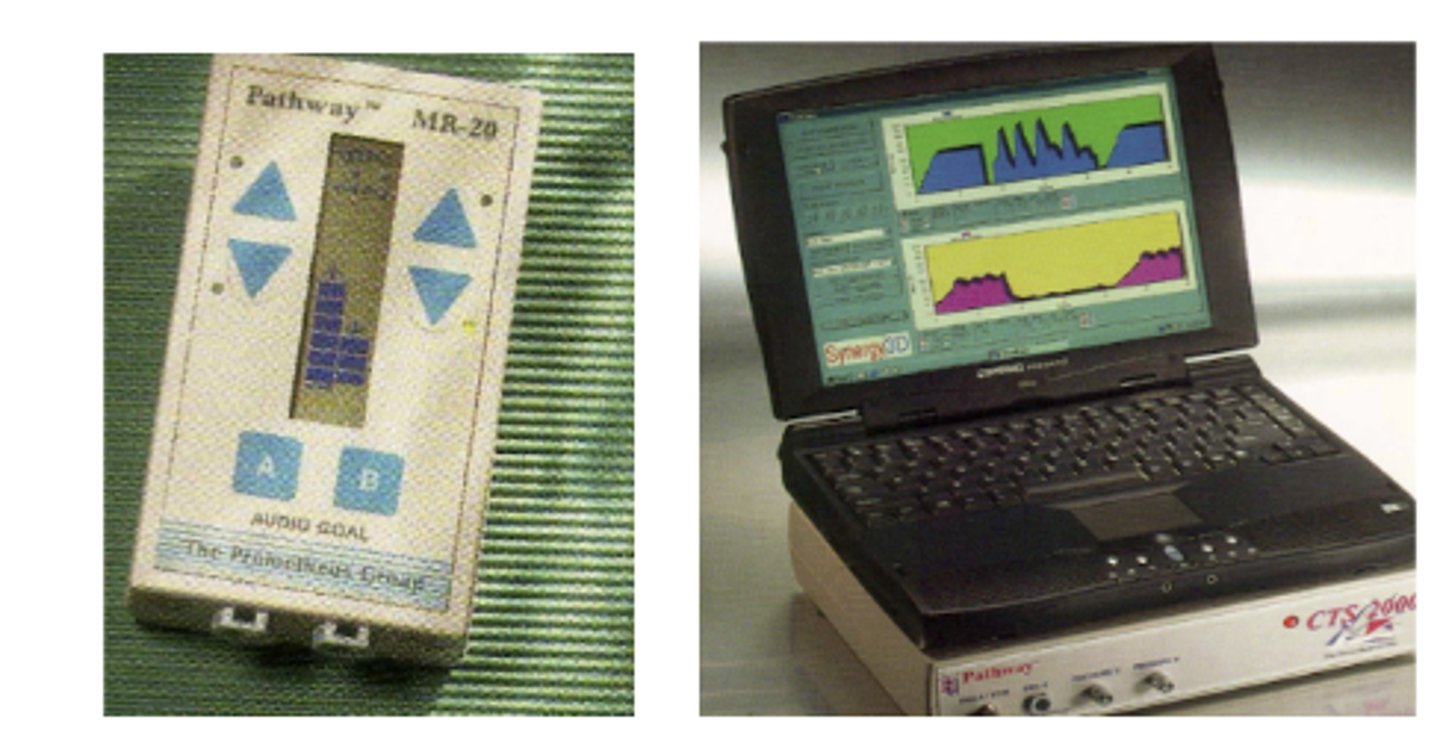
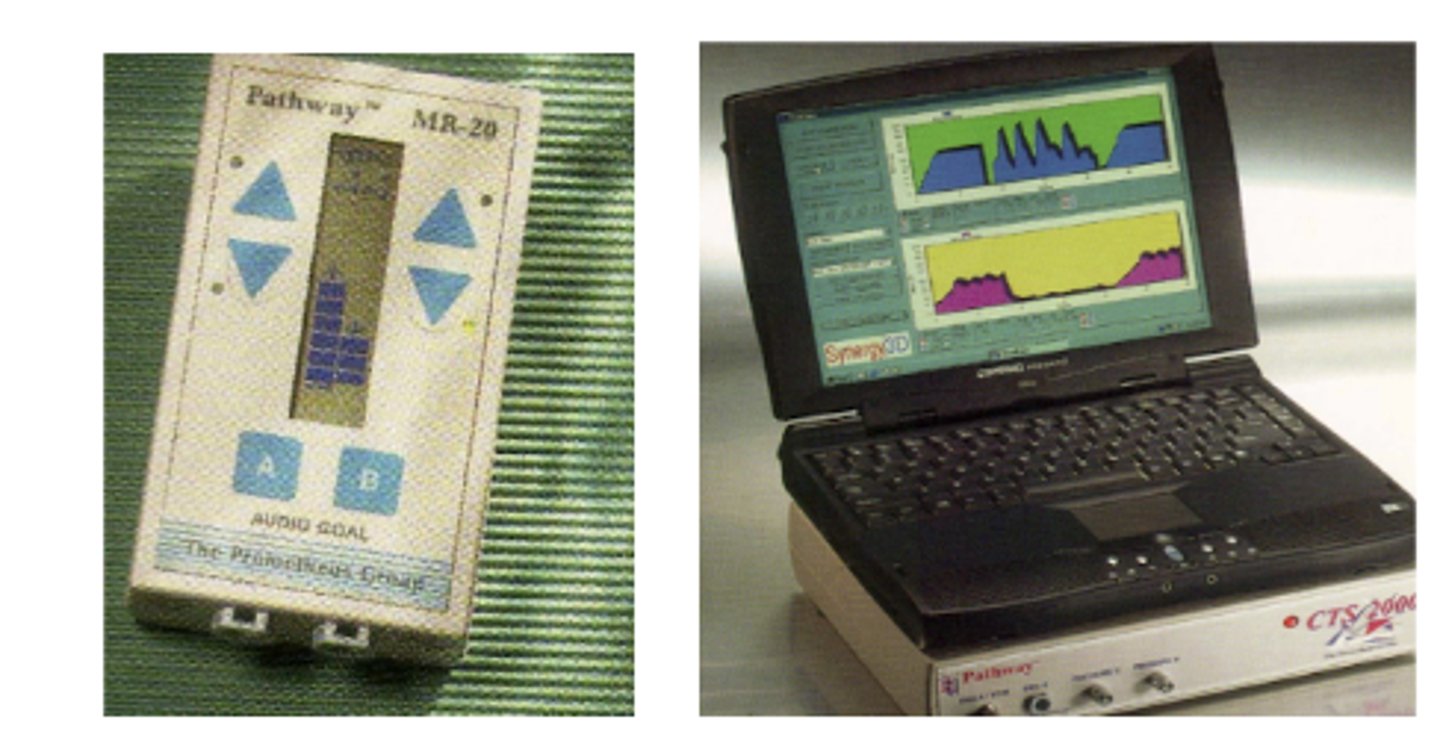
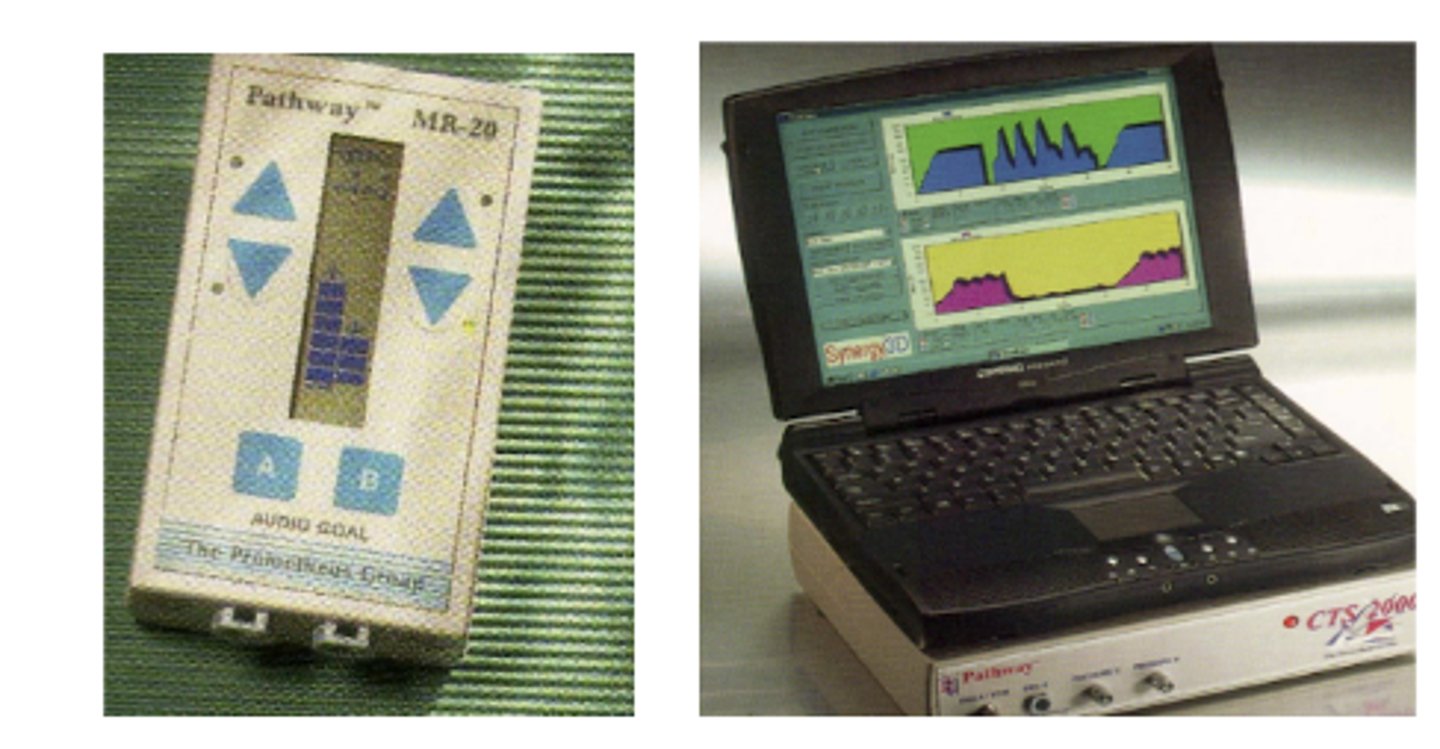
What is Electromyographic Biofeedback?
Measures, processes, & feedback electrical activity associated with a muscle via auditory or visual signals
What does Electromyographic Biofeedback not measure?
DOES NOT DIRECTLY MEASURE MUSCLE CONTRACTION!
What are 4 Clinical Applications of Biofeedback?
1. Muscle Re-education
2. Relaxation of Muscle Guarding
3. Pain Reduction
4. Treating Neurologic and other conditions (hemiplegia, SCI, spasticity, CP, facial paralysis, UI)
How does Biofeedback help with Muscle Re-education? Who is it most useful for? What should you have these patients complete!
Used to elicit muscle contraction
Weak patients who perform poorly on MMT!
Complete with a functional exercise!
What is Muscle Guarding?
a protective response in muscle that occurs due to pain or fear of movement (ex: around neck during whiplash)
How does Biofeedback help with Relaxation of Muscle Guarding?
By reducing the visual or auditory feedback to 0
How does Biofeedback help with Pain Reduction?
relaxes muscles that are tense → reduce the pain from guarding
Pain will then be reduced by breaking the pain-guarding-pain cycle
How should you set the Biofeedback sensitivity? How should you place the electrodes?
Sensitivity: appropriately so it is not too high so the pt can achieve it which is motivating
Electrodes: parallel to direction of muscle fibers and as near as possible to the muscle being monitored
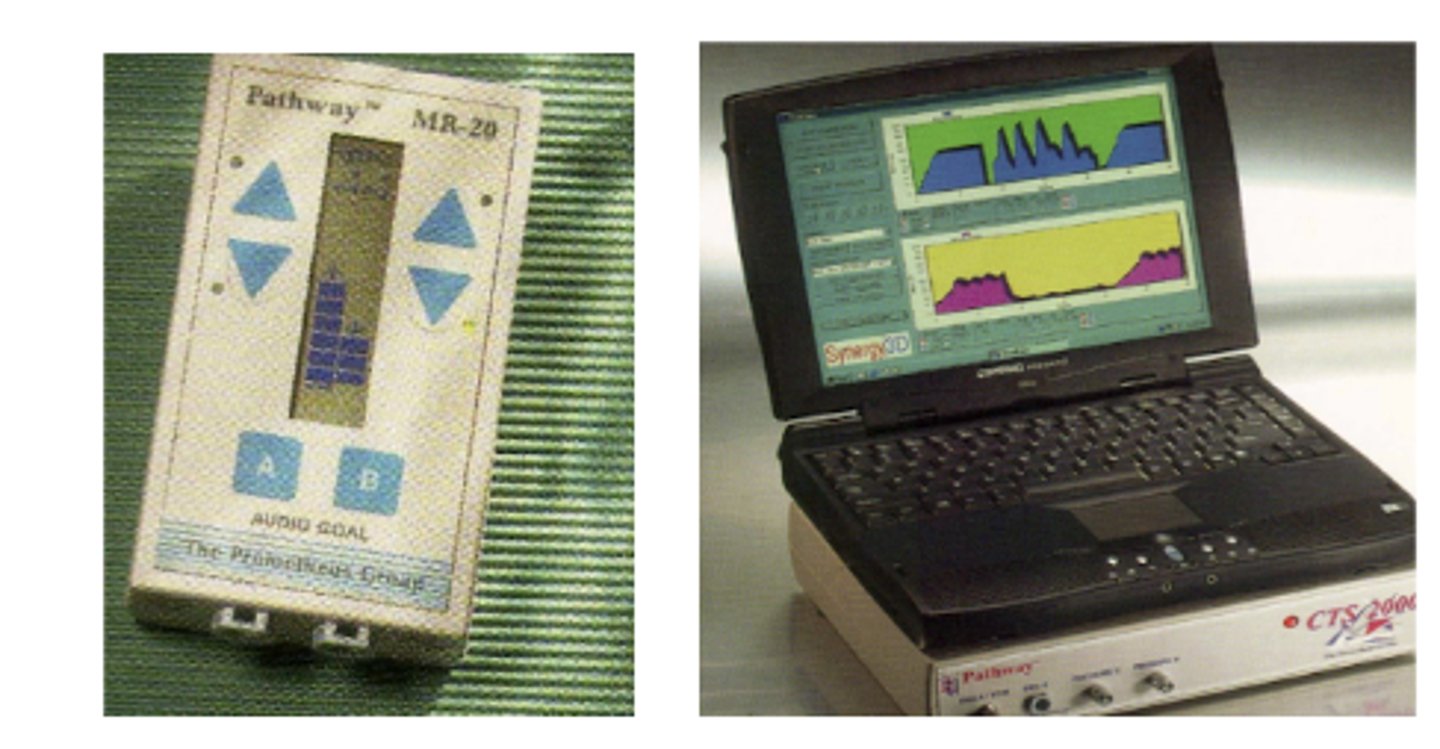
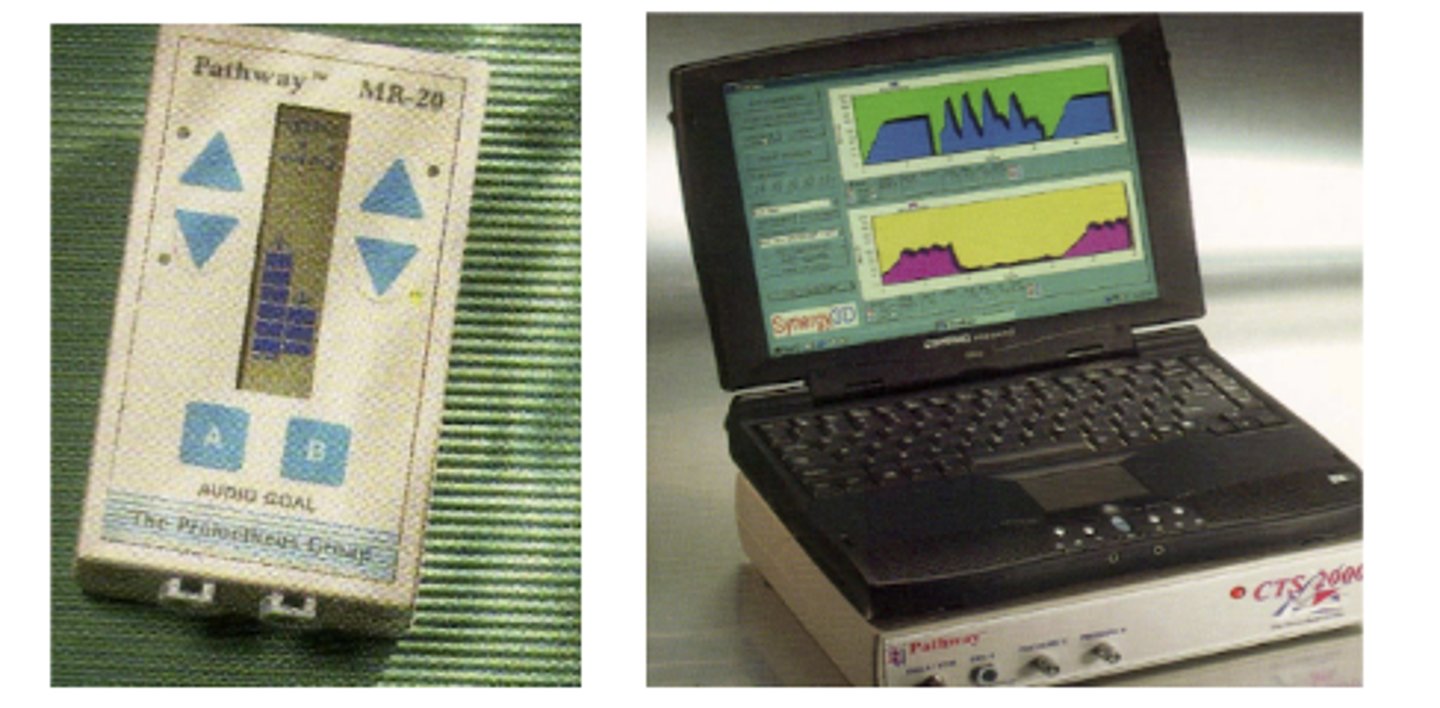
Does Biofeedback provide an electrical current?
NO, it just picks up electrical signal from the body
What are the contraindications for Biofeedback?
NONE! Very safe, just be cautious if pt has allergies to electrodes
What can Biofeedback also be used for?
pelvic floor training
WB training post stroke to learn how to evently distribute weight to both feet
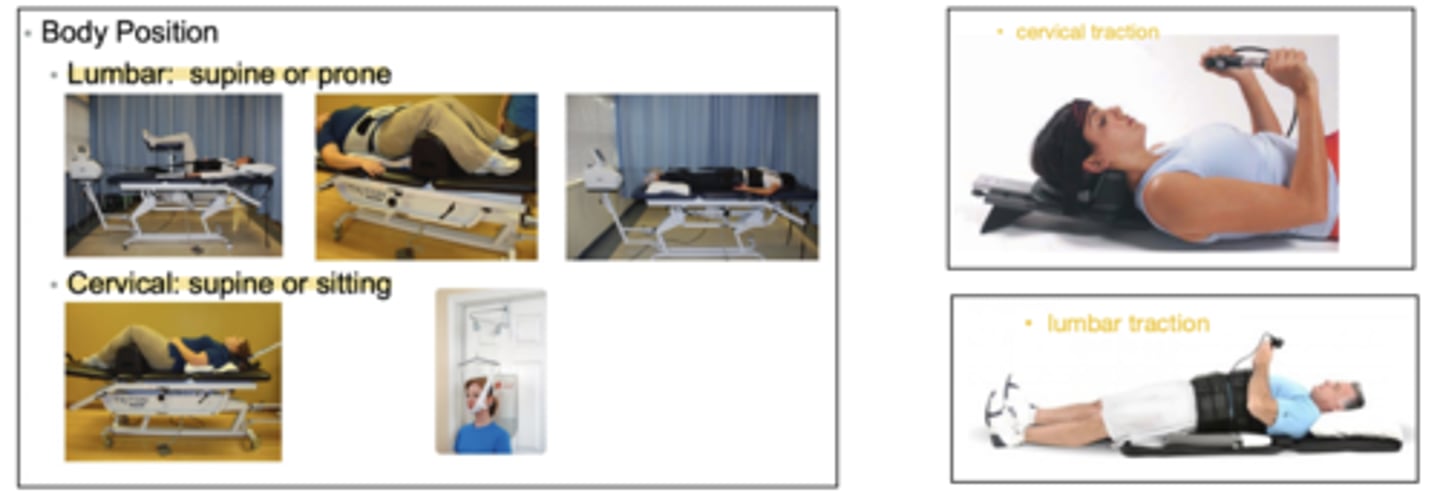
What is Mechanical Traction?
Application of mechanical force to the body to separate joint surfaces and elongate surrounding soft tissue
Applying tension to a body segment through a rope attached to various straps, halters, or devices
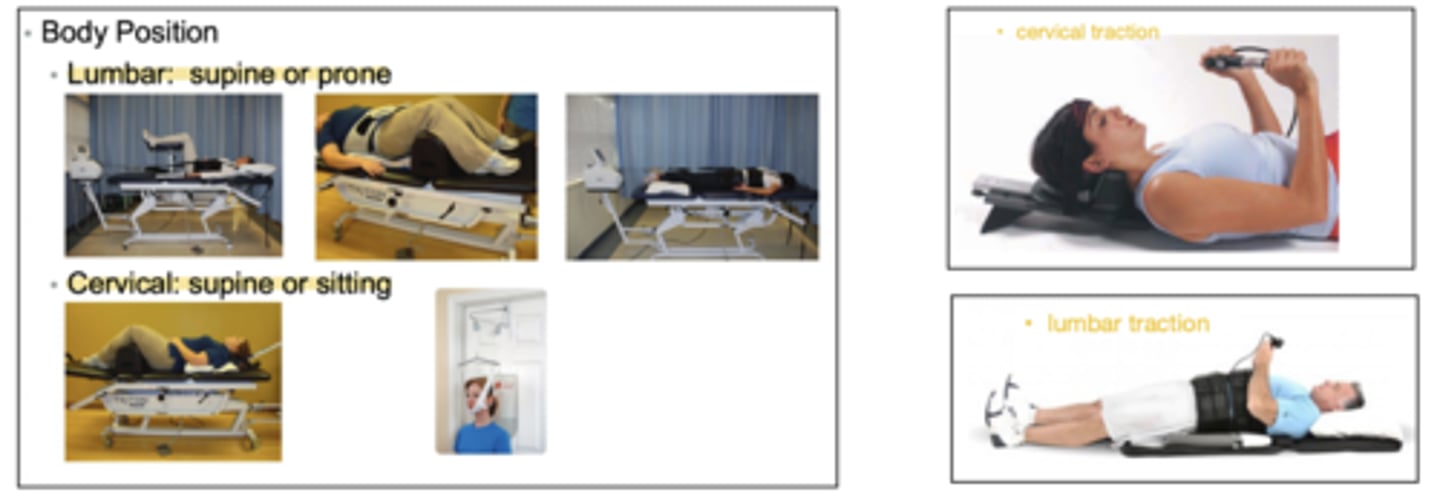
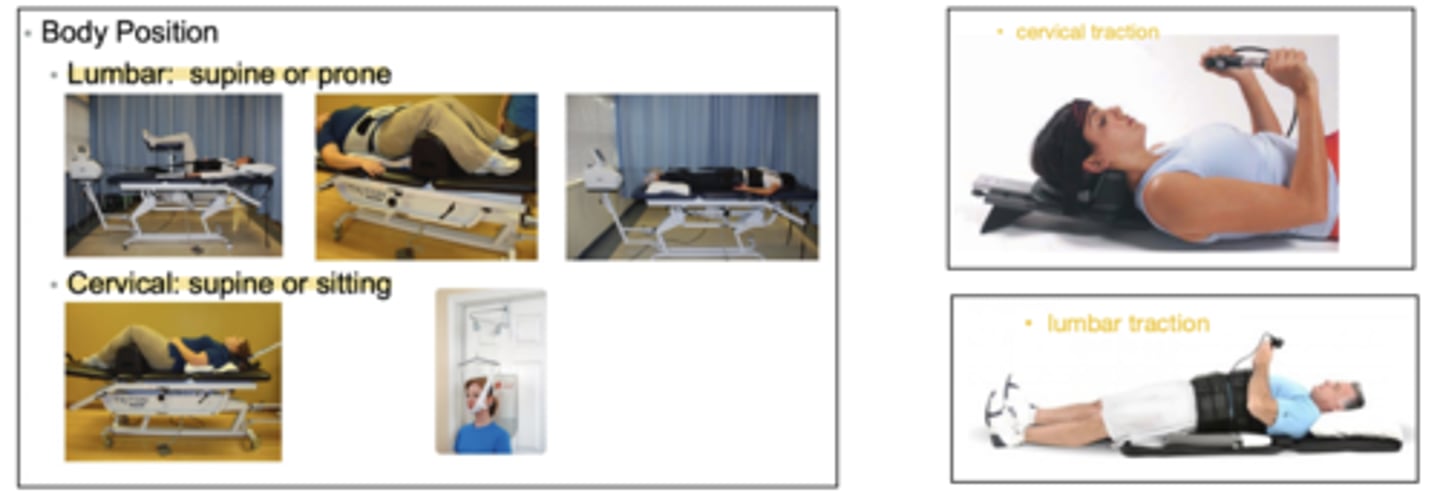
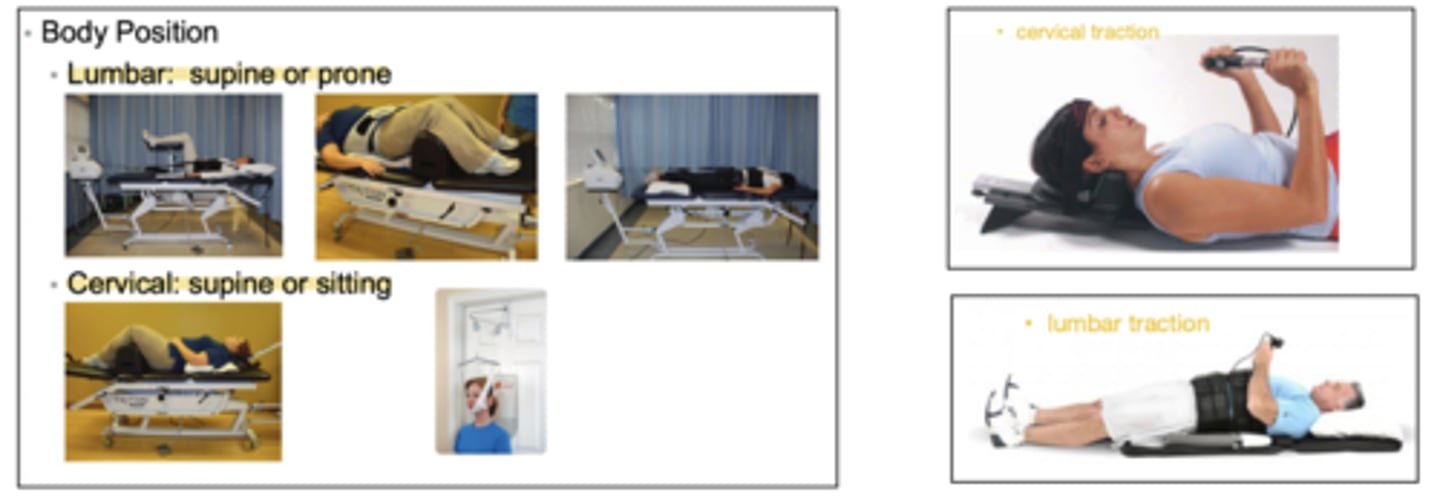
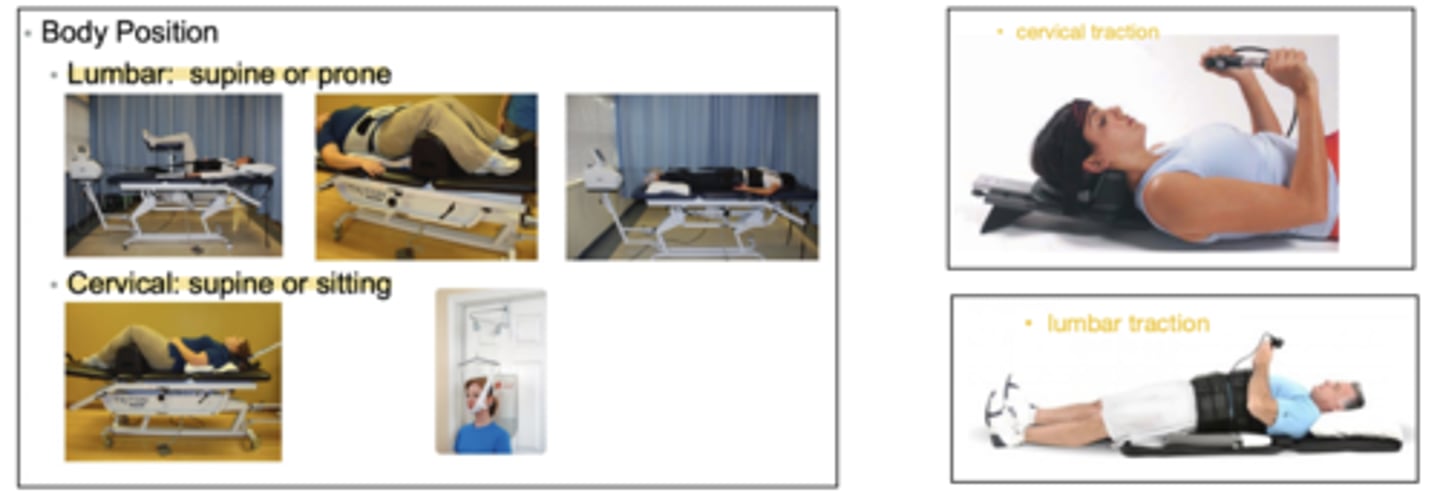
What are the types of spinal traction?
Lumbar + Cervical
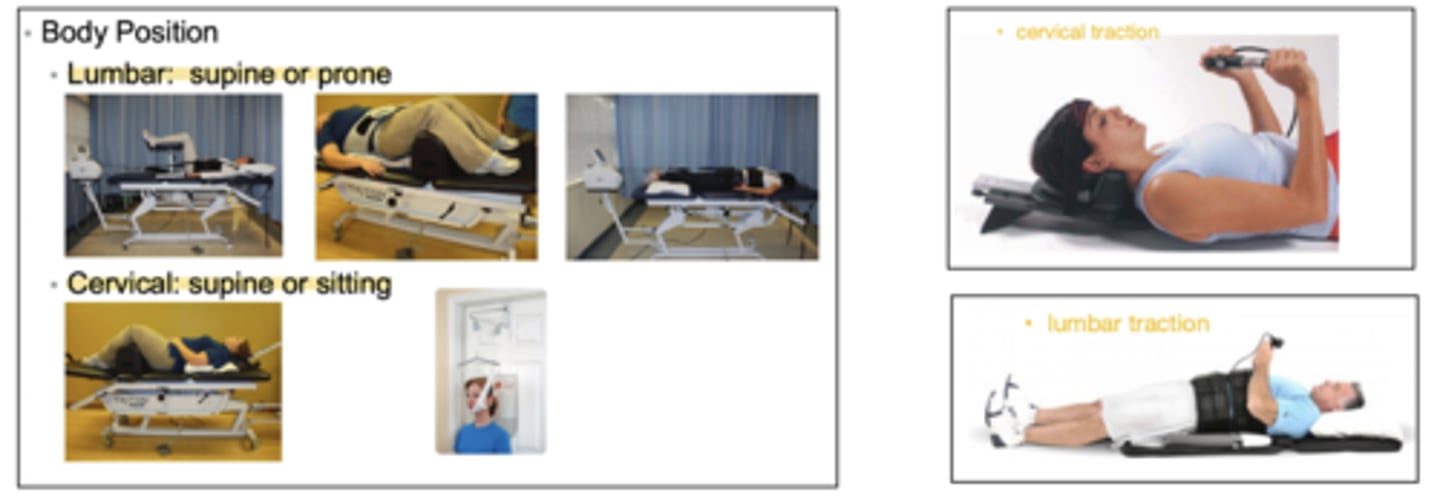
What are the 3 types of Traction Units?
1. Electrical traction devices
2. Weighted traction devices
3. Pneumatic traction devices
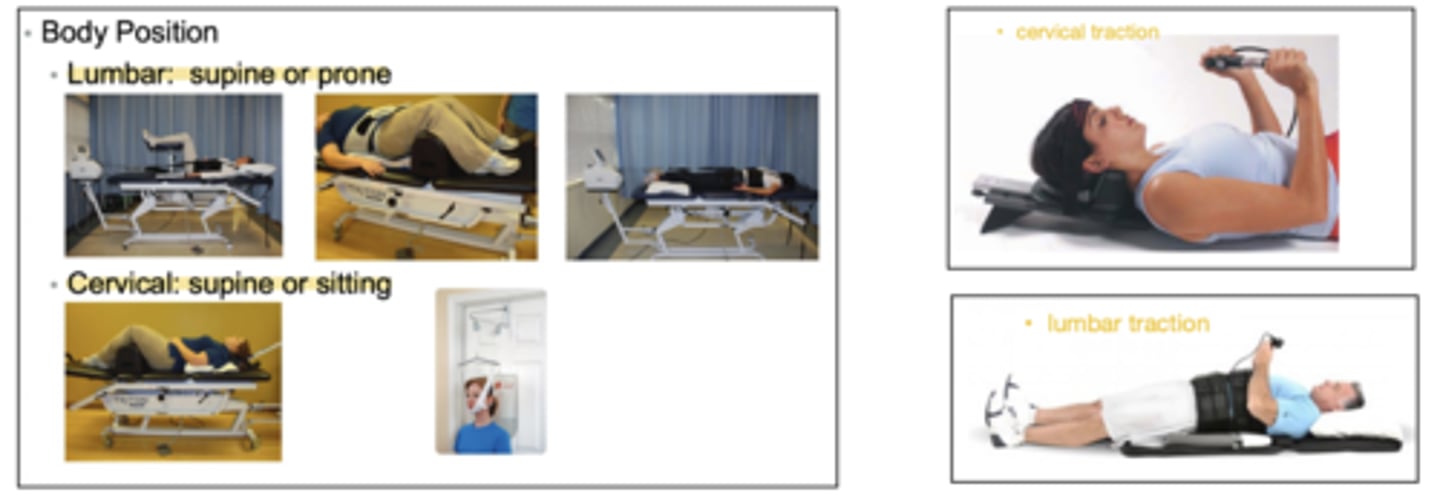
What are the effects of Spinal Traction?
Joint Distraction / Spinal Elongation
Soft Tissue Stretching
Reduction of Disc Protrusion
Muscle Relaxation
Joint Mobilization: distraction & gliding of facet joints
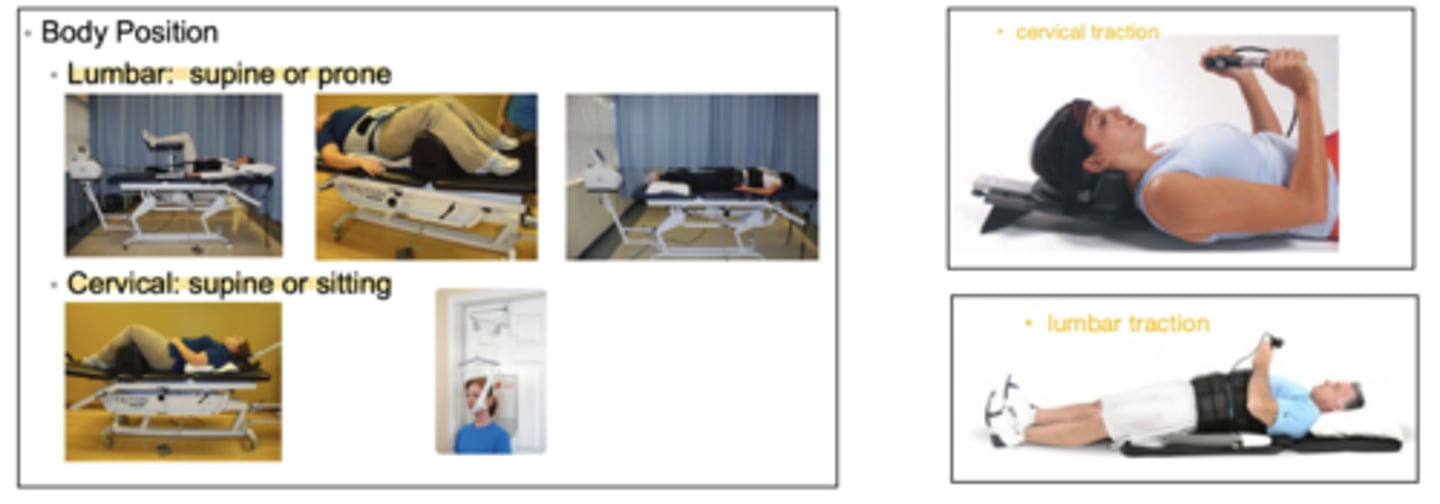
How does Spinal Traction help with Joint Distraction / Spinal Elongation? When is this helpful?
Separation of vertebral bodies
Widening of intervertebral foramen
Helpful for Nerve Impingement bc we want to widen that to relieve the pressure on nerves
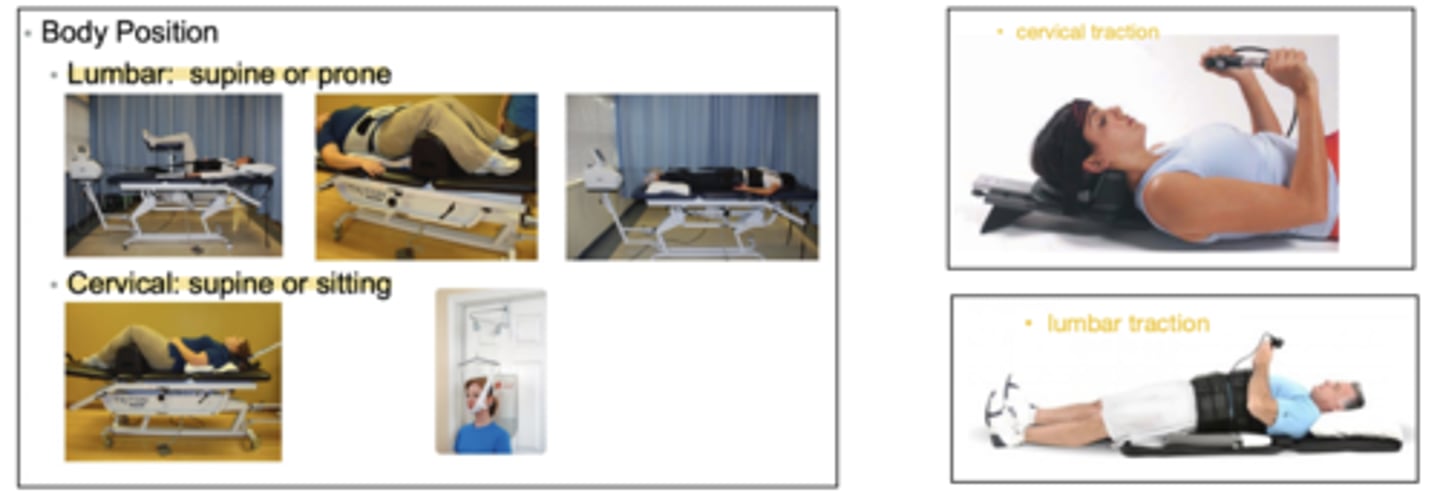
What are Indications for Mechanical Spinal Traction?
Nerve root impingement
Disc herniation or bulge
Joint hypomobility
Paraspinal muscle spasm or guarding
Subacute joint inflammation
Radiculopathy
DJD of spine
What are Contraindications for Mechanical Spinal Traction?
Acute injury
Acute inflammation
Vertebral joint hypermobility or instability
Any condition where movement exacerbates problem
Peripheralization of symptoms with traction (indicates that whatever is producing the preferred pain is getting even worse)
Structural diseases of the spine: tumor, infection, osteoporosis, RA (can damage the integrity of bones, especially C1 / C2 can become unstable)
Severe disc herniation with displaced disc fragment
Abnormal hernia
Vertebral artery occlusion (can still do lumbar)
Spinal cord compression
Aortic aneurysm
What are Risks / Cautions for Mechanical Spinal Traction?
Claustrophobia
Pts unable to tolerate supine or prone position
Disorientation
Acute neck or back pain
History of surgery to spine
Where pressure of belts = hazardous: pregnancy, vascular compromise
Respiratory impairments: esp Lumbar traction
Cardiovascular problems
TMJ problems: Cervical traction
Children or frail elderly
What is Static Traction used for?
Disc protrusion / herniation
If symptoms easily aggravated by motion
Subacute inflammation
May prevent stretch reflex of muscles