chapter 6 gen chem
 Note
 Call Kai
 Learn
 Practice Test
 Spaced Repetition
 Match
 Flashcards
 Knowt Play
1/11

There's no tags or description
Looks like no tags are added yet.
Name | Mastery | Learn | Test | Matching | Spaced | Call with Kai | Chat |
|---|
No analytics yet
Send a link to your students to track their progress
12 Terms
although chemical properties obey the periodic law, its impossible to predict physical properties of elements based on their location in the Periodic table
false
All of the non metals on the periodic table are gasses
false
the transition elements consist of those that are found in block d of the periodic table
False
elements in the same family tend to have the same number if valence electrons
true
the radius of an atom is defined as half the distance btwn the niclei of two adjacent or bounded or bounded atoms of element
true
the octet rule states that atoms will gain, lose, or share electrons to achieve a complete set of 8 valence electrons
true
Element in group 17 are classified as halogens
True
element in group 2 are classified alkali metals
False (group 1 is alkali metals and group 2 is alkali-earth metals
When an atom loses electrons its radius gets smaller
true because there are now fewer electrons for the protons to pull towards the nucleus and will result in a stronger pull of the electrons towards the nucleus
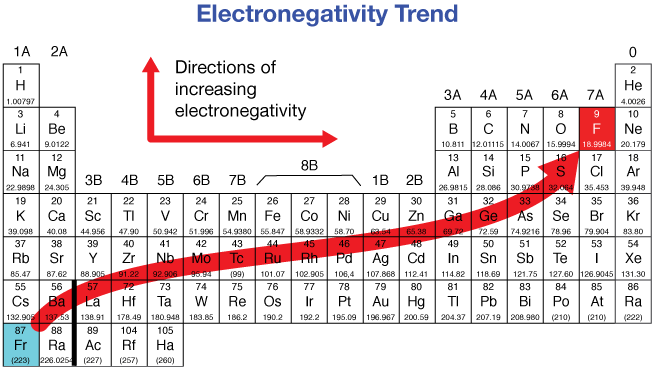
the electronegativity of elements increase from left to right and top to bottom
false because electronegativity increases as you move from left to right across a period and decreases as you move down a group.
An atom that gain an electron will form a positive ion
false (The atom that gains an electron becomes a negative ion)
the same amount of energy is required to remove each electron sequentially from an atom
false