Carbon Cycle
 Call Kai
 Learn
Learn Practice Test
 Spaced Repetition
 Match
Match Flashcards
 Knowt Play
1/30

There's no tags or description
Looks like no tags are added yet.
Name | Mastery | Learn | Test | Matching | Spaced | Call with Kai |
|---|
No analytics yet
Send a link to your students to track their progress
31 Terms
TRUE or FALSE
The carbon cycle controls the atmospheric concentration of CO2 and CH4.
The carbon cycle refers to the continuous exchange of carbon between the atmosphere, biosphere, hydrosphere and lithosphere by a range of processes (e.g. volcanism, rock weathering, photosynthesis, respiration, etc.)
True
PQS6.1. DESCRIBE the carbon cycle
TRUE OR FALSE
The carbon cycle refers to the continuous exchange of carbon between the atmosphere and plants by photosynthesis and respiration.
FALSE
DESCRIBE the carbon cycle
Sequence the following carbon reservoirs in order of increasing size:
Carbon in living organisms <atmospheric CO2<carbon in fossil fuels
DESCRIBE the carbon cycle
Sequence the following carbon reservoirs in order of increasing size:
Carbon in living organisms (The smallest reservoir; primarily plants/biomass).
Carbon in fossil fuels (A significantly larger reservoir, containing carbon stored over millions of years).
Carbon in the deep ocean (The largest of these three; the ocean is the largest active carbon sink on Earth).
Sequence the following carbon reservoirs in order of decreasing size:
Carbon in rocks (The largest reservoir; mostly in the form of sedimentary rocks like limestone).
Carbon in fossil fuels (A significant but much smaller reservoir than the Earth's crustal rocks).
Carbon in living organisms (The smallest reservoir among these three, consisting of the total biomass of plants, animals, and microbes).
DESCRIBE the carbon cycle
Changes in atmospheric are controlled by the exchange of carbon between the atmosphere and reservoirs of different sizes.
Exchanges with large reservoirs produce slow/rapid changes in atmospheric because the processes controlling the exchanges are slow/fast.
Changes in atmospheric are controlled by the exchange of carbon between the atmosphere and reservoirs of different sizes.
Exchanges with large reservoirs produce slow/rapid changes in atmospheric because the processes controlling the exchanges are slow/fast.
DESCRIBE the carbon cycle
The residence time of in the atmosphere with respect to respiration/photosynthesis is 12.7 years. This means that:
molecules of produced by heterotrophs and released to the atmosphere remain: at most/on average/exactly/ at least 12.7 years in the atmosphere before being taken up by phototrophs for photosynthesis.
DESCRIBE the carbon cycle
The residence time of in the atmosphere with respect to respiration/photosynthesis is 12.7 years. This means that:
molecules of produced by heterotrophs and released to the atmosphere remain: at most/on average/exactly/ at least 12.7 years in the atmosphere before being taken up by phototrophs for photosynthesis.
Which of these reservoirs has the longest residence time?
(a)
reservoir size = 20 Pg C, flux =10 Pg C/yr
(b)
reservoir size = 20 Pg C, flux = 100 Pg C/yr
(c)
reservoir size = 200 Pg C, flux =100 Pg C/yr
(d)
reservoir size = 200 Pg C, flux = 10 Pg C/yr
Residence time = reservoir size/flux
A) 20/10=2
B)20/100=0.2
C) 200/100=2
D) 200/10=20
PQS6.5. DESCRIBE the carbon cycle
Which of these reservoirs has the longest residence time?
(a)
reservoir size = 400 Pg C, flux =100 Pg C/yr
(b)
reservoir size = 40 Pg C, flux =10 Pg C/yr
(c)
reservoir size = 400 Pg C, flux = 10 Pg C/yr
(d)
reservoir size = 40 Pg C, flux = 100 Pg C/yr
Residence time= reservoir size / flux
A) 400/100=4
B) 40/10=4
C)400/10=40
D) 40/100=0.4
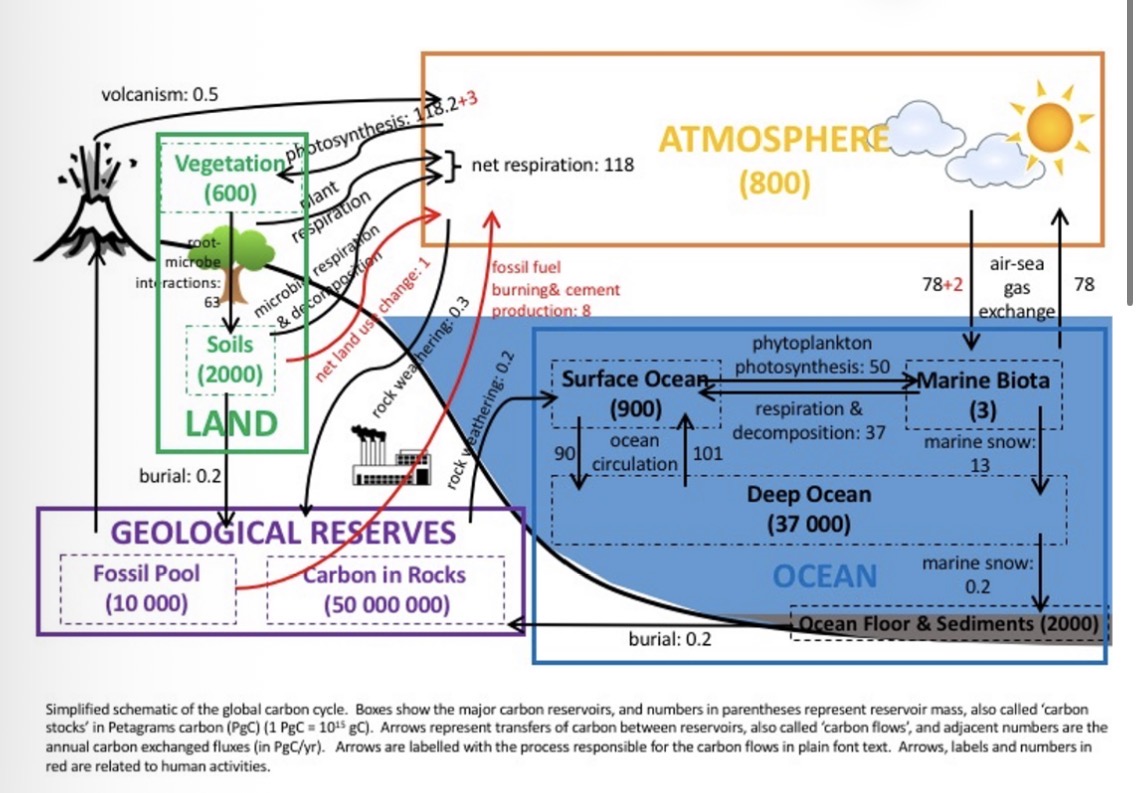
PQS6.6. DESCRIBE the carbon cycle
How much carbon is stored in the the atmosphere?
800 PgC
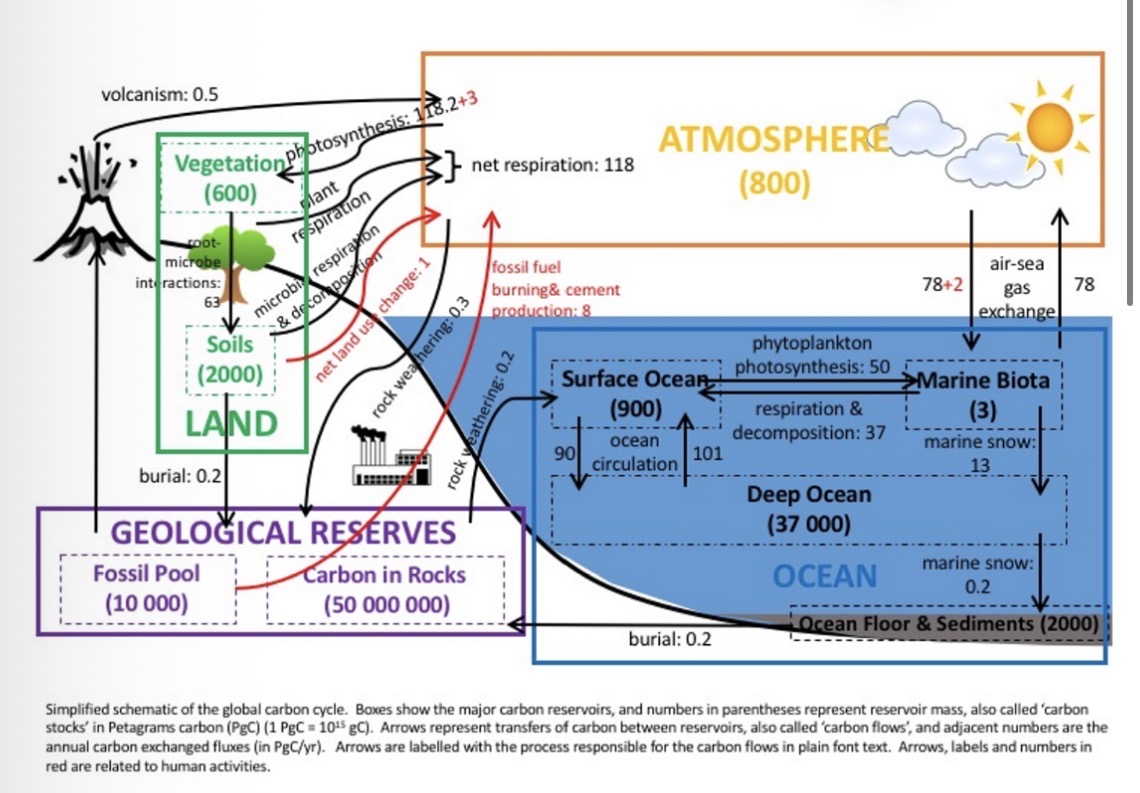
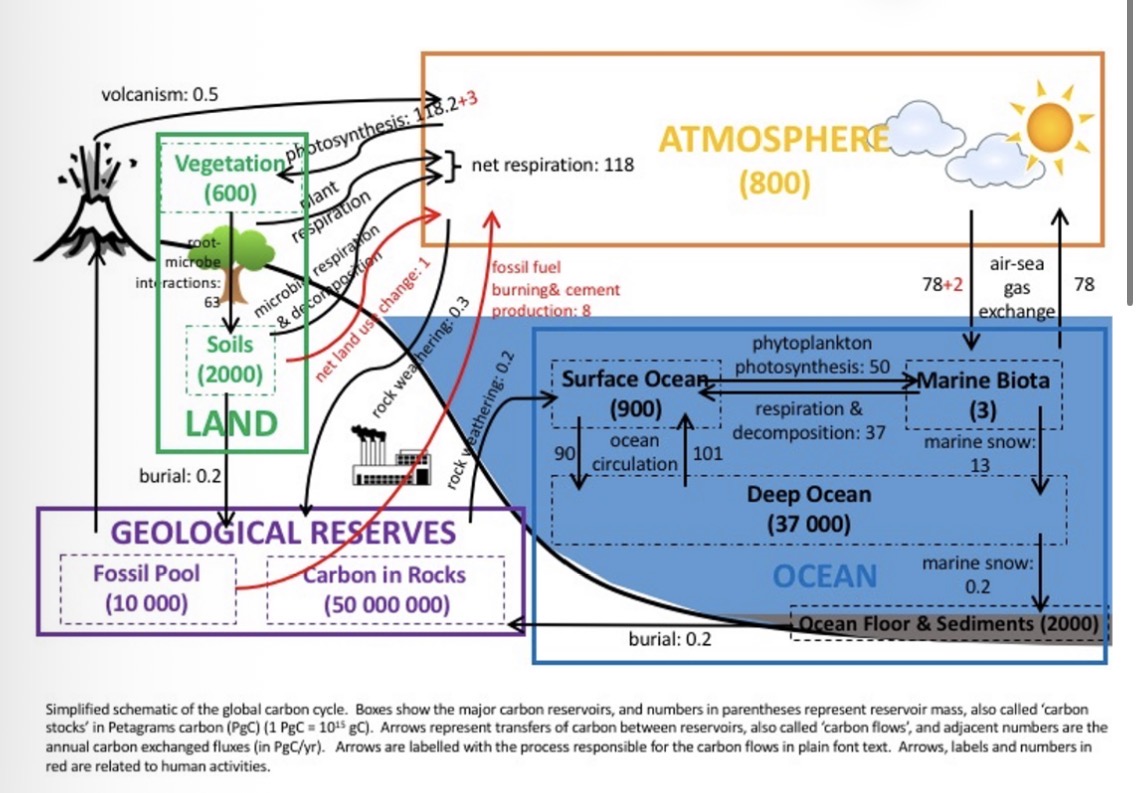
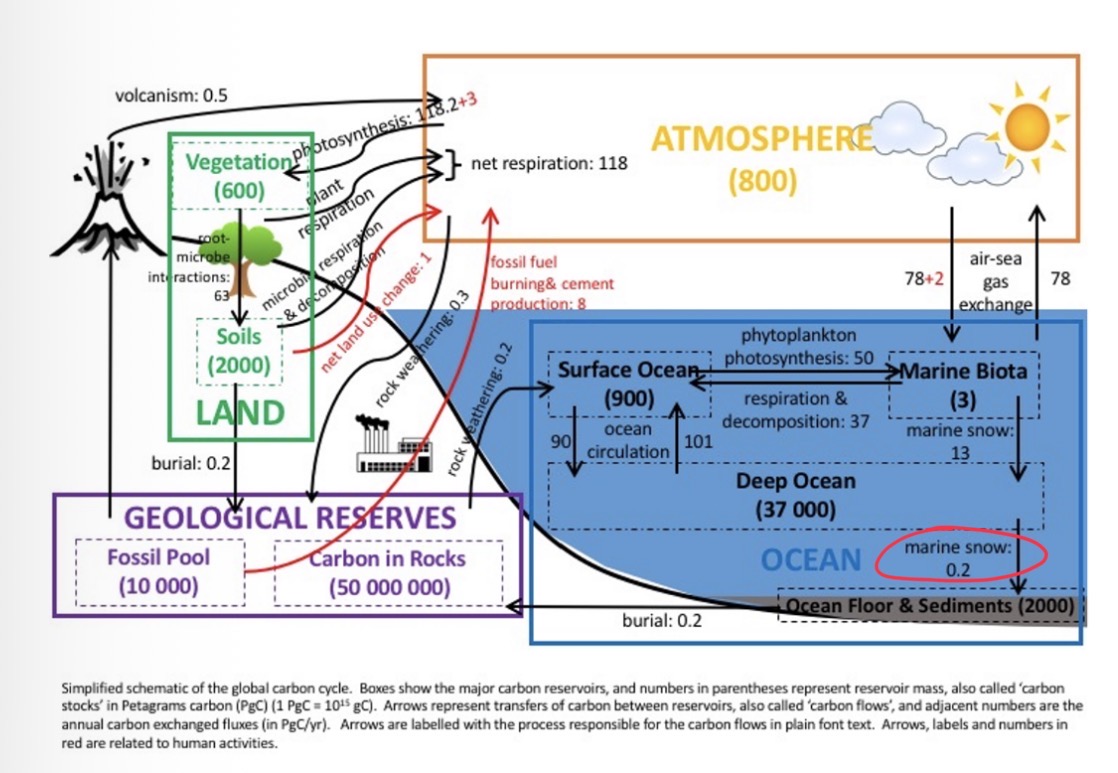
PQS6.7. DESCRIBE the carbon cycle
How many Pg of carbon move into the ocean floor each year?
0.2
EXPLAIN how the following processes in the carbon cycle control atmospheric CO2 on different time scales
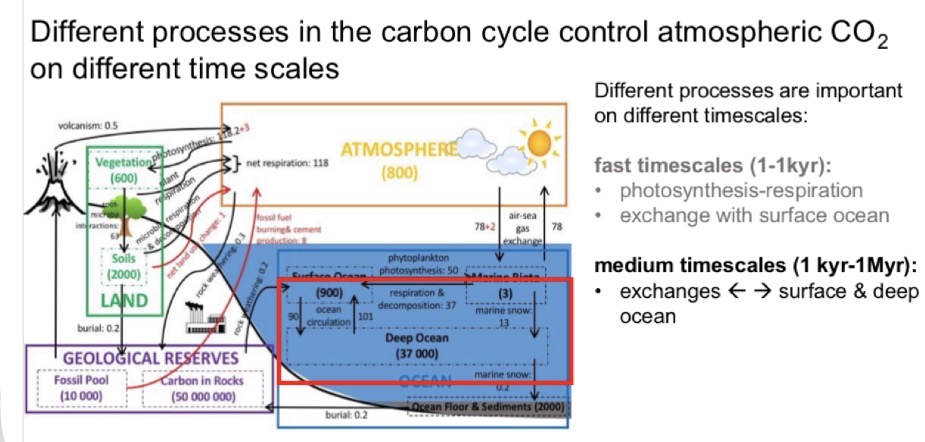
Atmospheric concentration is controlled by different processes on different timescales.
On 1000-year timescales atmospheric is affected by exchange of carbon between the atmosphere and….which is controlled by…
Atmospheric concentration is controlled by different processes on different timescales.
On 1000-year timescales atmospheric is affected by exchange of carbon between the atmosphere and THE OCEAN which is controlled by OCEAN
PRODUCTIVITY AND OCEAN CIRCULATION.
EXPLAIN how the following processes in the carbon cycle control atmospheric CO2 on different time scales
Atmospheric concentration is controlled by different processes on different timescales.
On seasonal timescales atmospheric CO2 is affected by exchange of carbon between the atmosphere and …
which is controlled by…
Atmospheric concentration is controlled by different processes on different timescales.
On seasonal timescales atmospheric CO2 is affected by exchange of carbon between the atmosphere and LAND AND OCEAN BIOMASS
which is controlled by THE BALANCE BETWEEN PHOTOSYNTHESIS AMND RESPIRATIONS.
EXPLAIN how the following processes in the carbon cycle control atmospheric CO2 on different time scales
Atmospheric concentration is controlled by different processes on different timescales.
On multi-million year timescales atmospheric CO2 is affected by exchange of carbon between the atmosphere and …
which is controlled by…
Atmospheric concentration is controlled by different processes on different timescales.
On multi-million year timescales atmospheric CO2 is affected by exchange of carbon between the atmosphere and the Earth’s crust (rocks) which is controlled by tectonic processes.
PQS6.9. EXPLAIN how the following processes in the carbon cycle control atmospheric CO2 on different time scales
On multi-million year timescales, atmospheric concentration is controlled by _____.
Checkbox options
(a)
the balance between the addition of to the atmosphere by respiration and the removal of from the atmosphere by photosyntheis
(b)
the balance between the removal of from the atmosphere by rock weathering and the addition of to the atmosphere by volcanism
(c)
the balance between the removal of organic carbon by burial in the sediments and the addition of by carbonate metamorphism at mid-ocean ridges
(d)
the balance between the removal of from the atmosphere by rock weathering and the addition of to the atmospherere by respiration
(e)
the balance between the removal of from the atmosphere by the ocean and addition of to the atmosphere by volcanism
The balance between the removal of from the atmosphere by rock weathering and the addition of to the atmosphere by volcanism
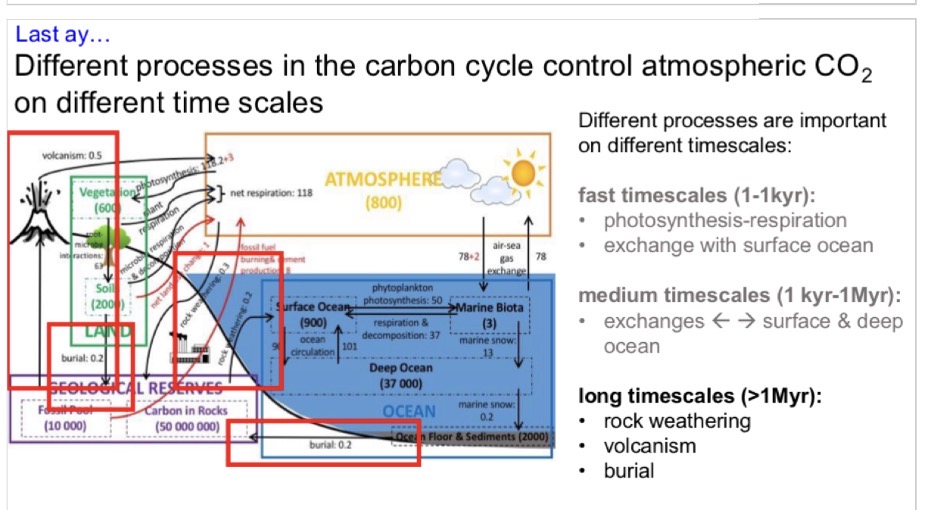
PQS6.10. CONSTRUCT the stabilizing feedback loop involving silicate weathering, that moderates temperature and atmospheric CO2 concentration on long time scales
Try this one based on what you know about various topics in this course. Lower rates of seafloor spreading…
increase the volume of ocean basins by producing thinner mid-ocean ridges, thereby lowering sea level, increasing the surface area of continent subjected to weathering and increasing the uptake of atmospheric CO2 by this process.
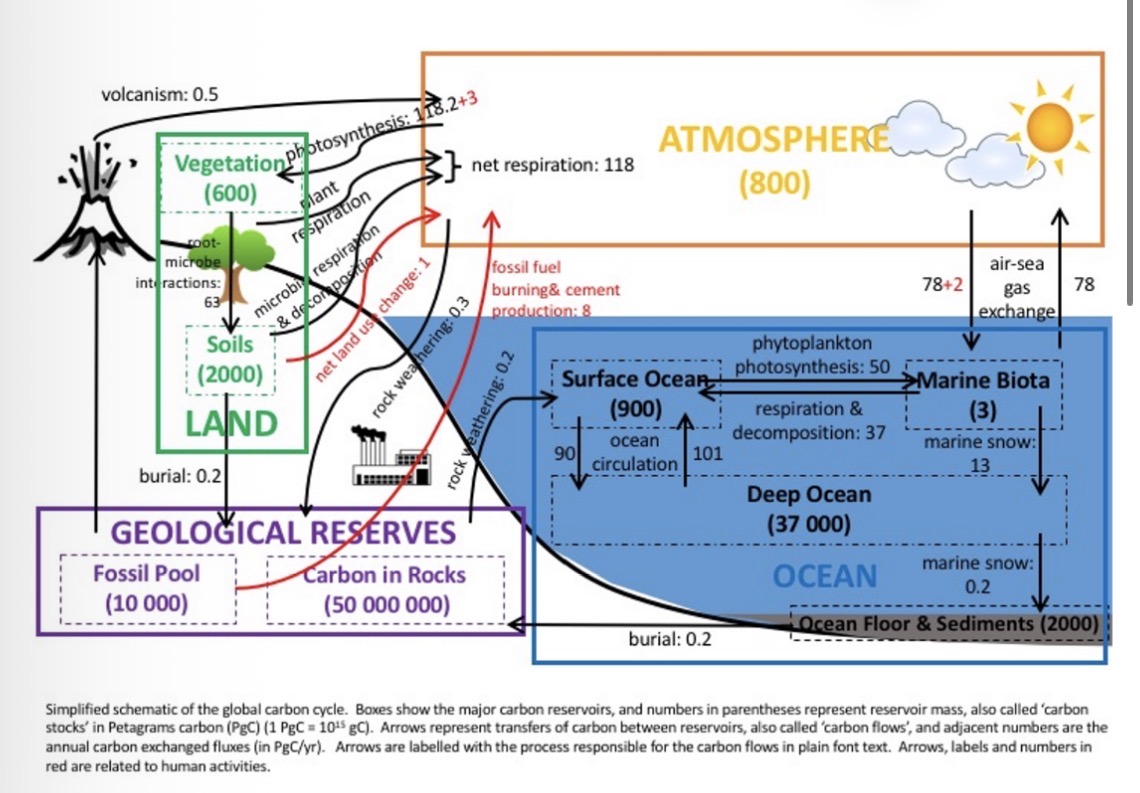
PQS6.11. DESCRIBE the processes regulating the exchange of carbon between the atmosphere, the surface ocean and the deep ocean
Which process is responsible for moving carbon directly FROM the Surface Ocean reservoir TO the Deep Ocean reservoir?
Ocean circulation
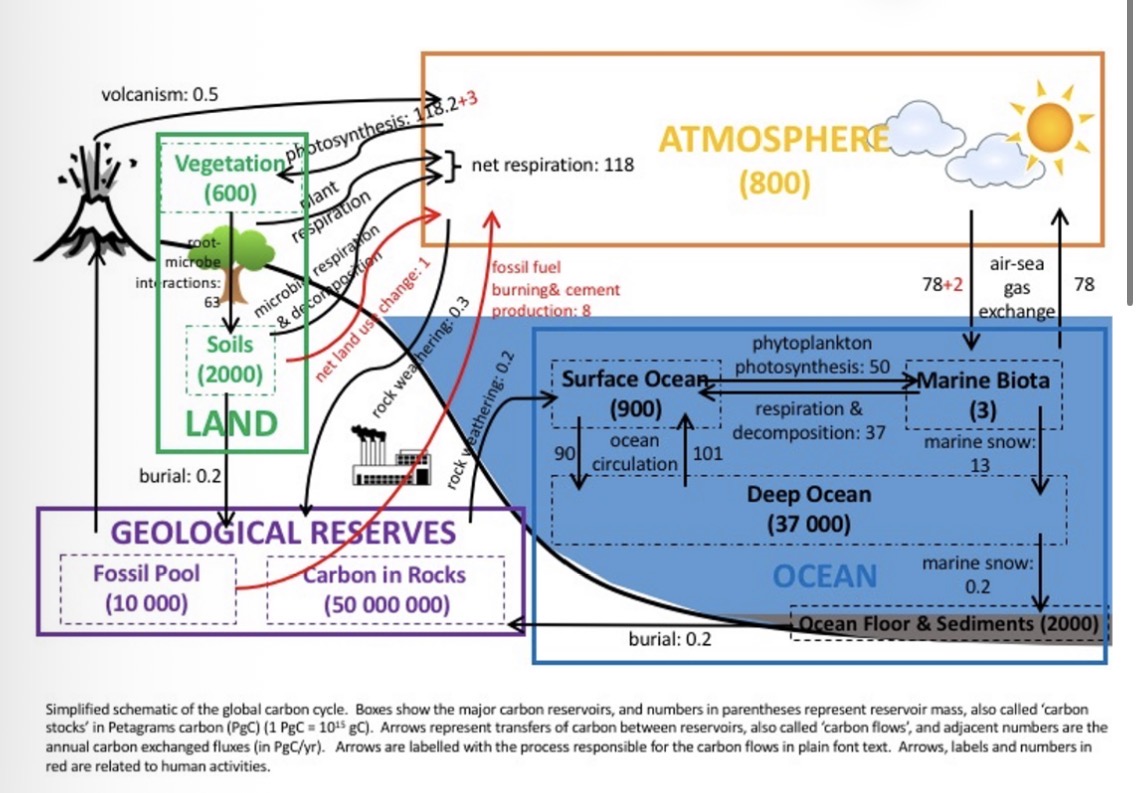
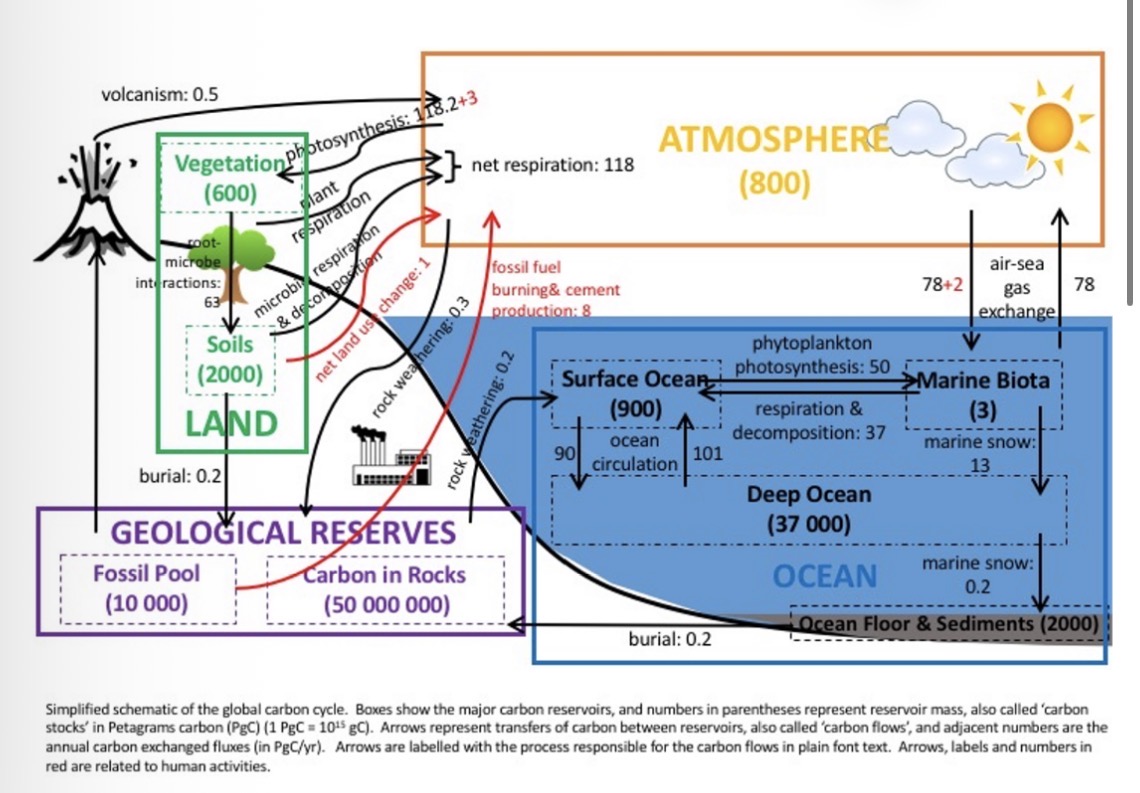
PQS6.12. DESCRIBE the processes regulating the exchange of carbon between the atmosphere, the surface ocean and the deep ocean
Which process(es) is (are) responsible for moving carbon TO the Deep Ocean? (Choose all that apply.)
Ocean circulation & marine snow
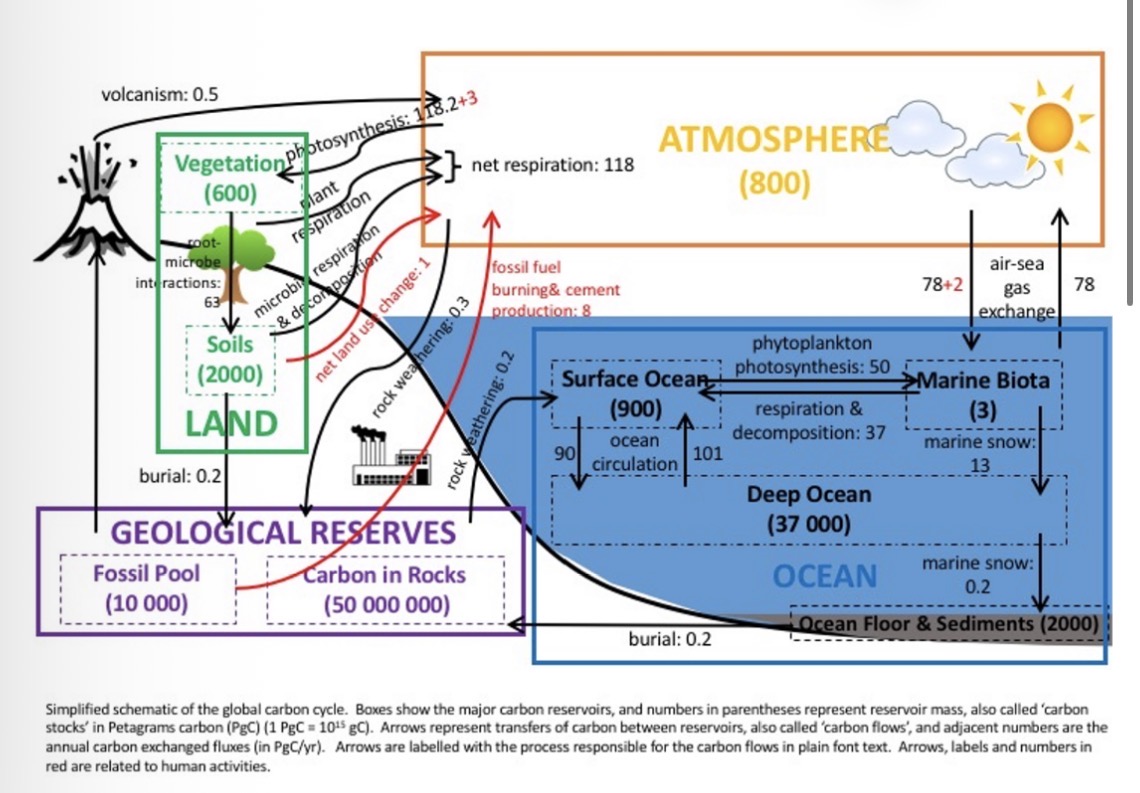
PQS6.13. DESCRIBE the processes regulating the exchange of carbon between the atmosphere, the surface ocean and the deep ocean
The biological pump moves carbon...
From the surface ocean to the deep ocean.
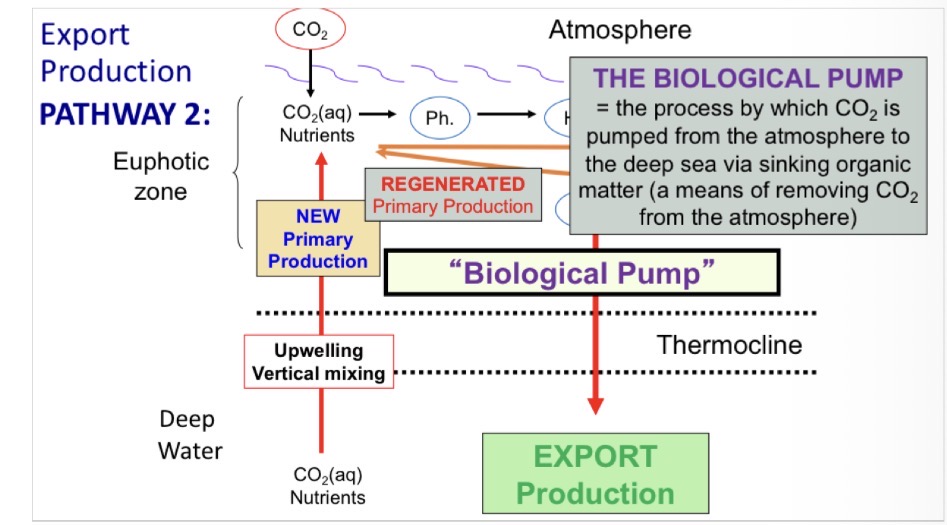
When marine snow sinks, carbon is moved from the surface ocean to the deep ocean. Which process allows the export of carbon out of the deep ocean, to maintain a steady state?
Upwelling and ocean circulation
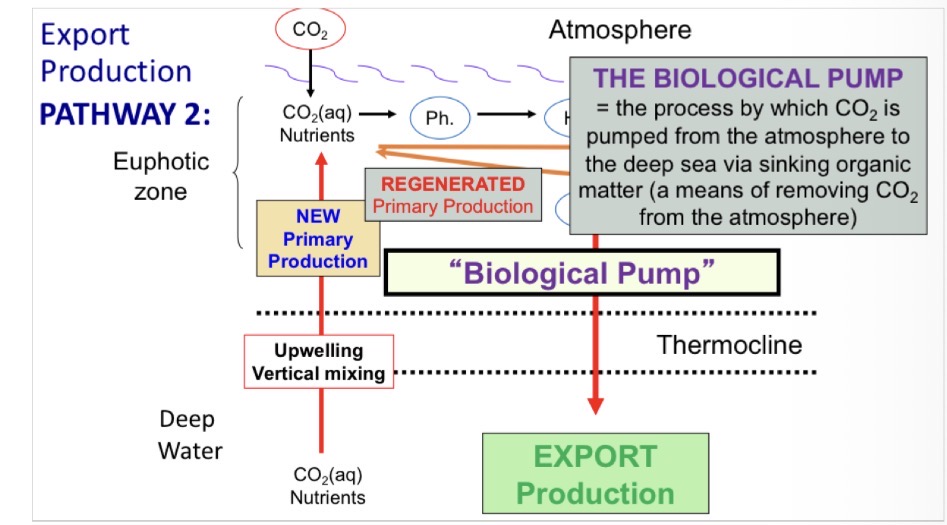
PQS6.15. DESCRIBE the processes regulating the exchange of carbon between the atmosphere, the surface ocean and the deep ocean
When there is a phytoplankton bloom, dissolved carbon in the surface ocean is consumed by the plankton, and ends up sinking as marine snow. Which processes can restore carbon in the surface ocean?
Air-sea gas exchange
Upwelling and ocean circulation
Respiration
PQS6.16. EXPLAIN how photosynthesis and respiration regulate the atmospheric CO2 concentration on seasonal timescales
Which ONE of these statements is TRUE? On a seasonal timescale, atmospheric CO2 …
Increases from May to September in the Southern Hemisphere.
PQS6.17. EXPLAIN how photosynthesis and respiration regulate the atmospheric CO2 concentration on seasonal timescales
True or false
Seasonal variations in atmospheric concentration are smaller in the Southern Hemisphere compare to the Northern Hemisphere.
(b)
It is the balance between removal via photosynthesis by autotrophs and addition via respiration by heterotrophs that produces seasonal variations in atmospheric concentration.
(c)
Atmospheric fluctuates seasonally as a result of the exchange of carbon with land biomass.
(d)
Atmospheric increases as a result of fossil fuel burning and deforestation.
True
PQS6.18. EXPLAIN how photosynthesis and respiration regulate the atmospheric CO2 concentration on seasonal timescales
Within the carbon cycle, what happens to the organic matter produced by photosynthesis?
Most of it is respired, and the remaining amount is buried.
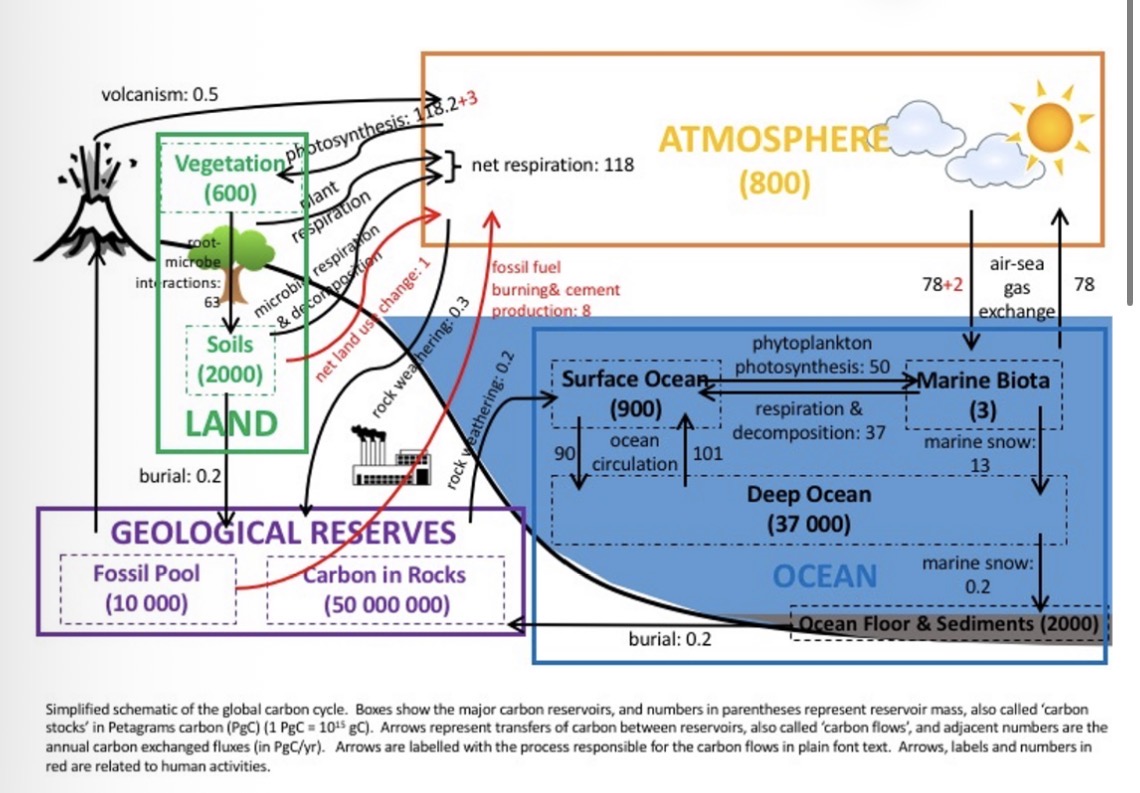
PQS6.20. PREDICT the changes in a carbon stock using a carbon cycle diagram, by comparing inflow and outflow to and from that stock over time
On a seasonal timescale, atmospheric co2 …
decreases from May to September in the Northern Hemisphere when photosynthesis by land plants exceeds respiration of organic matter on continents.
increases from May to September in the Southern Hemisphere when respiration of organic matter on continents exceeds photosynthesis by land plants.
PQS6.21. PREDICT the changes in a carbon stock using a carbon cycle diagram, by comparing inflow and outflow to and from that stock over time
You precisely measured CO2 concentration in the atmosphere on the top of Mauna Loa in Hawaii in May 1967, September 1967, May 2007, and September 2007. Sequence your four data points in order of lowest to highest concentration .
Order of lowest to highest concentration (from top to bottom):
-Sept 1967
-May 1967
-sept 2007
-may 2007
PQS6.22. PREDICT the changes in a carbon stock using a carbon cycle diagram, by comparing inflow and outflow to and from that stock over time
A reservoir is in steady state if:
the input is equal to the output.
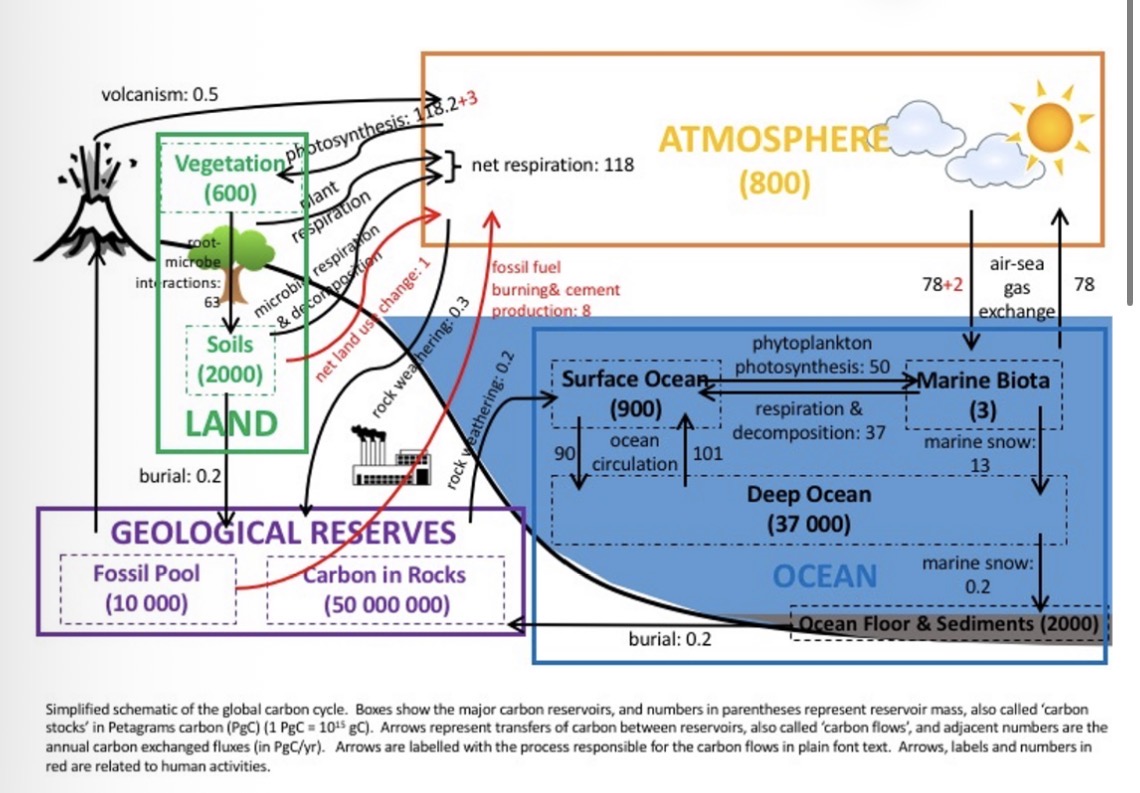
PREDICT the changes in a carbon stock using a carbon cycle diagram, by comparing inflow and outflow to and from that stock over time
According to the carbon cycle diagram, including human activities, which carbon reservoir(s) is(are) in STEADY STATE?
Ocean floor and sediments
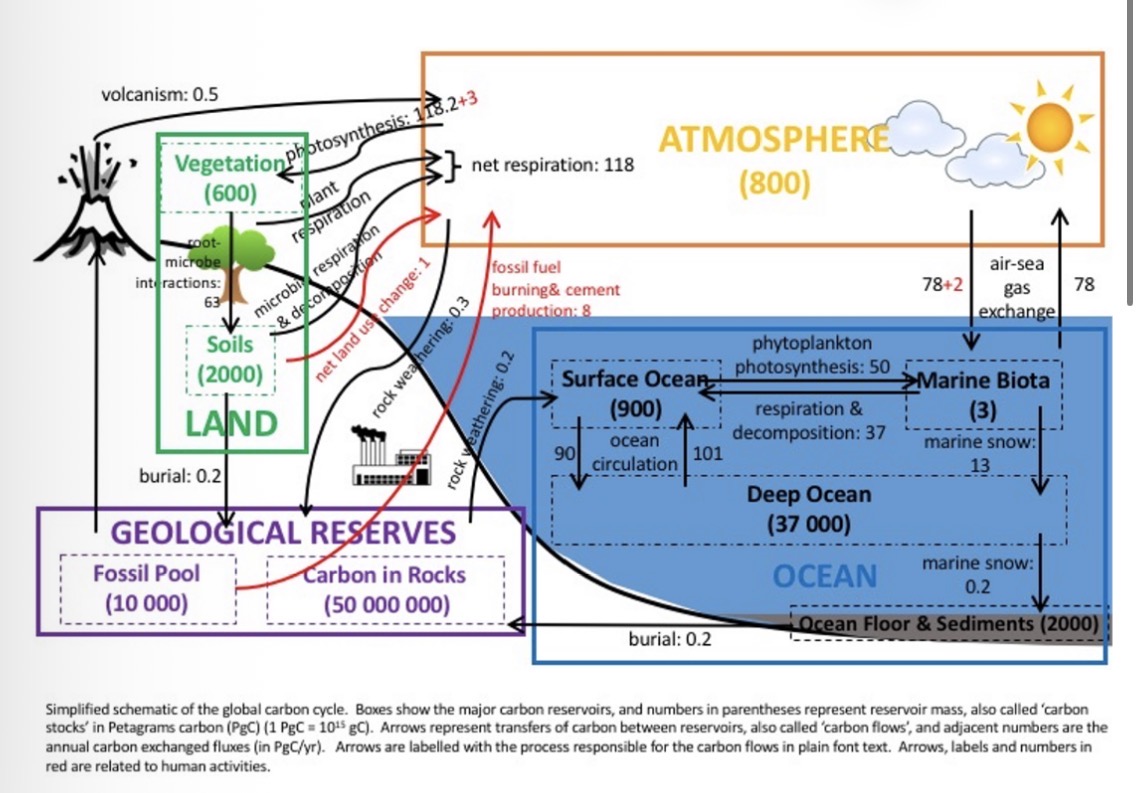
PQS6.25. DESCRIBE how human activities are influencing the carbon cycle
According to the carbon cycle diagram discussed in class, which of these processes are influenced by human activities (directly and indirectly)?
Photosynthesis
Land use
Fossil fuel burning and cement production
Air-sea gas exchange
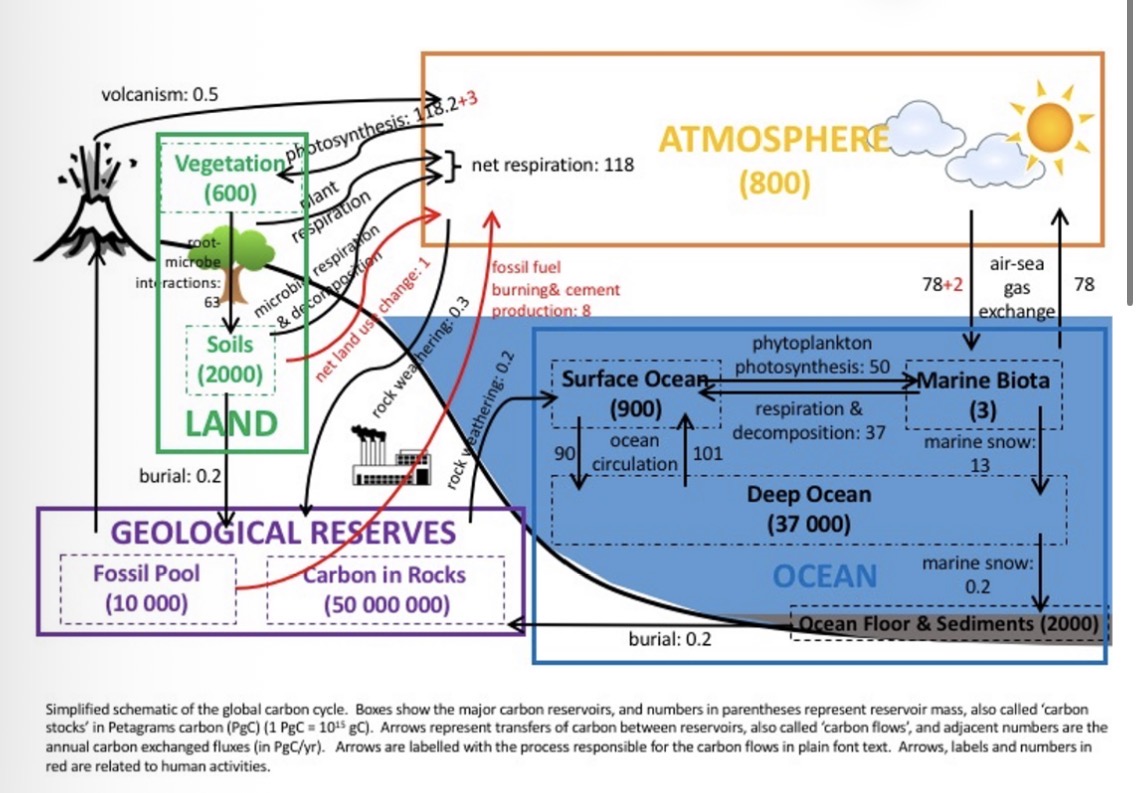
PQS6.27. DESCRIBE carbon mitigation options and RANK them by the storage time of carbon
The fertilization effect is a negative feedback loop which could help mitigate the rise in anthropogenic CO2 in the atmosphere because...
higher CO2 atmospheric increases the photosynthetic rate of land plants.
PQS6.24. PREDICT the changes in a carbon stock using a carbon cycle diagram, by comparing inflow and outflow to and from that stock over time
See if you can figure this out: You start with a system at steady state (i.e. input rate = output rate). A disturbance occurs which forces a reduction in the rate of output, but the rate of input does not change. The system includes a stabilizing feedback mechanism such that, after the disturbance, the rate of output is proportional to the size of the reservoir. The system will then slowly evolve towards a new steady state. When this steady state is regained, how will the new rate of output be compared to the initial rate?
The new rate of output will be the same as the initial rates of input/output.