quantitative pharmaceutical analysis
 Call Kai
 Learn
Learn Practice Test
 Spaced Repetition
 Match
Match Flashcards
 Knowt Play
1/152

There's no tags or description
Looks like no tags are added yet.
Name | Mastery | Learn | Test | Matching | Spaced | Call with Kai |
|---|
No analytics yet
Send a link to your students to track their progress
153 Terms
titrant
reagent with a known concentration
equivalence point
volume theoretically necessary for complete reaction with titrant
final point
actual volume of titrant necessary to complete reaction
titration error equation
vol eq. point - vol final point
molarity
number of moles per liter of solution
molecular weight
sun of atomic weights of all atoms (independent of reaction)
equivalent weight
quantity of mass capable by dissociation of 1mol of H+ or OH- ions (acid/base), supplying / consuming 1mol of e- (redox), or reacting with 1mol of a monovalent carbon (ppt/complex)
equation for equivalent weight
PE = PM / alpha
alpha
number of protons, electrons, or species based on the reaction
primary standard
solid substance that can be used for solutions of precisely known concentrations
qualifications to be a primary standard (5)
high purity
stable during weighing operations
must react with well defined stoich
molecular weight high enough to reduce error
easily available / inexpensive
ways to identify a titration endpoint (2)
chemically (indicators) and instrumentally (spectrophotometric)
direct titration
addition of a titrant to a solution until endpoint is reached
indirect titration
reaction of analyte with a reagent to obtain a titrant
reverse titration
reaction of analyte with a known titrant B in excess, then the excess is determined with titrant C
when is a reverse titration used?
when no suitable indicator
blank proof
titration without analyte to determine potential error
acidimetry
base content of a sample determined by titration with a known acid
alkalimetry
acid content of a sample determined by
precipitometry
reaction technique for precipitation of an analyte with the addition of a suitable precipitant
precipitometry end point indicators (3)
K2CrO4, ferric ammonium sulfate, and fluorescein
what type of titration is argentometry
precipitation
argentometry
titration exploiting the insolubility of silver salts
Mohr method (pptometry)
NaCl + AgNO3
K2CrO4 indicator (yellow → red)
must buffer with sod. bicarb. to be weakly basic (7-8)
non-selective method
Fajans method (pptometry)
for chlorides, bromides, and iodides
fluorescein indicator (yellow green → pink red)
uses chromatic variation on surface for endpoint
Liebig method (pptometry)
CYANIDES ONLY
indicator = clear → white cloudy
pptometry + complexometry together (rxn = complex, endpoint = ppt)
Volhard method (pptometry)
for chlorides, bromides, iodides, + thiocyanides
indicator = ferric alum (clear → red)
reverse titration
must have no cations or ox agents present (consume SCN-)
redox reaction
titration that involves the exchange of e- and changes in oxidation state
e- donor
reducing agent
e- acceptor
oxidizing agent
what does it mean to have a higher E0 value?
greater oxidizing strength / ease of being reduced
Nernst Equation
to calculate reduction potential when not in standard state

E0 conditions to proceed spontaneously?
oxidant must have much higher volt than reducing agent
types of indicators (redox)
auto (dont need one)
ox-red (independent from rxn, dependent on variation in system potential)
specific (reacts w/ participant and makes different complexes)
oxidimetry
reducing substance titrated with an oxidizing agent of known titre
reducimetry
oxidizing substance titrated with reducing agent of known titre (usually very impractical, oxidized w/ exposure to O2 )
permanganometry (redox)
oxidimetric determination of reducing substances using KMnO4 as a titrating reagent
indicator = none (indicates itself)
primary standard(s) = oxalic acid dihydrate + sodium oxalate, electrolytic iron, and arsenious anhydride + sulfuric acid
cerimetry (redox)
oxidimetric determination of reducing substances using cerium
indicator = ferroin
primary standard(s) = no common ones (very expensive)
iodimetry (redox)
oxidimetric determination of reducing substances using iodine
indicator = starch solution
primary standard(s) =
much more selective than others (can only use strong reducing agents)
iodometry (redox)
(indirect) reducimetric determination of oxidizing substances using iodine
indicator = starch solution OR chloroform + CCl4
primary standard(s) = potassium iodate, potassium dichromate, and potassium bromate
titrations are ALWAYS indirect
bromometry (redox)
oxidimetric determination of reducing substances using bromine
indicator = starch solution
indirect reverse titration (X reacts with excess Br and then concluded with iodometry)
bromatometry (redox)
oxidimetric determination of reducing substances using bromate
indicator = p-ethoxychrysoidin, methyl red/orange, or none
primary standard(s) = KBrO3 or As2O3
dichromatometry (redox)
oxidimetric determination of reducing substances using dichromate
indicator = ferroin or methylene blue
primary standard(s) = K2Cr2O7 or As2O3
nirosometry (redox)
oxidimetric determination of reducing substances using nitrite
indicator = starch-iodine paper or conductometric methods
primary standard(s) = Na2C2O4 or standard KMnO4 solution
can be used to determine primary amines at 0C
complexometry
volumetric branch of titrations that uses rapid, right-shifted complexation reactions in a 1:1 ratio
direct determination
complexometry for alkali, alkaline earth, and transition anions
indirect determination
complexometry for some other anions
complex
molecule/ion which a metal atom is bonded to a given number of molecules/negative ions by covalent bonds
coordination number
number of bonds a metal can form with a ligand
types of complexes formed (3)
monodentate, polydentate, and chelate
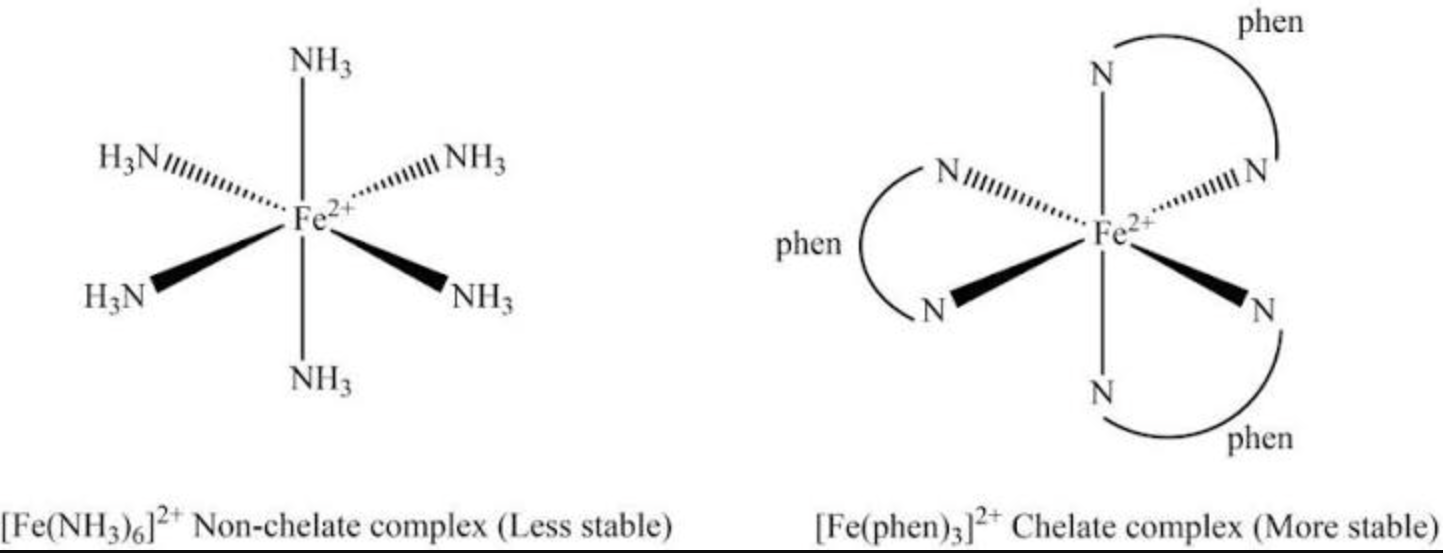
chelate
when a complex has more than one doublet to share AND creates a cyclic compound
chelation effect
increase in basic sites = fewer molecules involved = less freedom = entropy more favorable
complexometry and pH
you must have a constant that accounts for a working pH
masking agent
complexing agent that forms a complex with a high stability (Kf) with an interfering metal
ex: F- is a good masker of Al3+, Fe3+, etc
Ca2+ + Al3+ + 6F- <→ [AlF6]3- + [Ca2+ EDTA]
the F masks the Al so that the Ca can complex with EDTA
ways to determine endpoint (complex)
instrumental → UV-Vis
chromic metal indicators → eriochrome black t, calcon, etc
direct titration (complex)
add mettalochromic indicator to analyte and mix with EDTA until color changes
most useful because its the fastest
back titration (complex)
known excess of EDTA added and back titrated with a solution of ZnCl2/ZnSO4 of known concentration until the color changes
useful when the reaction has slow kinetics or pH leads to OH ppt
indirect titration (complex)
unknown excess of EDTA complex with a metal less stable than the analyte are displaced from the complex, then titrated with EDTA
useful when theres no indicator for direct titration
temporary water hardness
when the salts are in the form of bicarbonates → when boiled, the hardness disappears
permanent water hardness
when calcium and magnesium remain after boiling due to ionization of chlorides/nitrates/sulfates
total water hardness
total content of calcium, magnesium, etc; determined before being subjected to heat
water hardness equation
temporary = total - permanent
emission method (UV-Vis)
measure the radiation emitted when the analyte is exposed to thermal/electrical energy
absorption method (UV-Vis)
measure the attenuation of the radiation beam as a result of the interaction with the analyte
wave-particle duality
the idea that radiation can be described as both a wave and a particle
wave theory
the idea that radiation is represented as a sinusoidal wave formed by electric and magnetic vectors, perpendicular and in the direction of propagation
corpuscular theory
the idea that radiation consists of discrete particles called quanta / photons
forms of internal energy in an isolated molecule (5)
translational, rotational, vibrational, electronics, and nuclear
difference in energy with different types of energy states
rotational << vibrational << electronic
which energy transition does IR measure?
vibrational
which energy transition does UV-Vis measure?
electronic (valence e-)
which energy transition does X-rays measure?
electronic (internal e-)
emission
radiation emitted when analyte returns to ground state after being excited
absorption
radiation absorbed after passing through sample (ground → excited)
fluorescence
radiation emitted followed by excitation, characterized by if wavelength is >/= to the absorbed one
spectrum
graphic representation of degree of absorption/emission as a function of frequency, wavelength, or range of frequency used
spectroscopy
study of interaction between electronic radiation and matter (describes the physical principles underlying analysis)
spectrometry
refers to the instruments or techniques used to obtain data
spectrophotometry
a specific technique that measures absorption or transmission of light by a substance as a function of wavelength (typically about UV-Vis)
molecular orbital theory
interaction between atomic orbitals leads to formation of filled and empty molecular orbitals
sigma bonds
e- density concentration along the nuclear axis, absorb <180 nm
pi bonds
e- density concentration above / below axis (double / triple bonds), absorb >180 nm
UV-Vis orbital transition
from highest occupied molecular orbital to lowest unoccupied molecular orbital (HOMO → LUMO)
chromophore
unsaturated functional group that absorbs UV-Vis
dependents of lambda max location and intensity (5)
type of chromophore
functional groups linked
solvent
pH
steric effects
auxochrome
group that doesn’t exhibit significant absorption, but when near a chromophore it determines the bathochromic and hyperchromic effects
equation for number of independent vibrations possible
3N-6
what type of molecules are NOT active in IR?
homonuclear diatoms (N2, O2, etc)
why does an IR spec have more peaks?
all functional groups absorb in IR, in UV-Vis only chromophores do
transmittance
the ratio between outgoing radiation and fraction-transmitted
Lambert-Beer’s Law
the relationship between attenuation of radiation and the concentration of the analyte (absorbance = molar absorptivity x optical path x molar concentration)
is UV-Vis better for qualitative or quantitative data?
quantitative - other molecules can have the same absorptions, but has a great sensitivity for quantitative data
is IR better for qualitative or quantitative data?
qualitative - each spec is unique for each species, so it is one of the most important qualitative tools ever
parts of a spectroscopy instrument (5)
lamp for continuous radiation
wavelength selector (filter or prism/grating)
sample container
detector
recorder
standard method used for spectroscopy
external (interpolation) - series of standards → calibration curve → unknown determined from calibration curve
matrix effect
signal variation caused by everything except the analyte
causes of the matrix effect (4)
complexation
masking compounds
change in activity
pH alteration
solid-liquid extraction
isolation of solid mix of compounds in an appropriate solvent
liquid-liquid extraction
separation implemented by a distribution of components of a mixture between 2 immiscible liquid phases