Component 2: Health and performance
 Call Kai
 Learn
Learn Practice Test
 Spaced Repetition
 Match
Match Flashcards
 Knowt Play
1/70

There's no tags or description
Looks like no tags are added yet.
Name | Mastery | Learn | Test | Matching | Spaced | Call with Kai |
|---|
No analytics yet
Send a link to your students to track their progress
71 Terms
Define health
A state of complete physical, emotional and social well-being, and not merely the absence of disease or infirmity.
State and explain what these (lifestyle related) conditions are and what causes them:
high cholesterol
stroke
CHD
type 2 diabetes
High blood pressure
Osteoporosis
Poor posture and muscle tone
How does exercise reduce the risk of these conditions?
High cholesterol: when there is too much fatty substance (LDL cholesterol) in the blood
this builds up in the walls of the arteries, forming fatty deposits called plaques
causes arteries to become narrower, increasing risk of: heart attack, strokes, CHD
Exercise increases the levels of HDL, which removes excess cholesterol from the blood and carries it to the liver where it can be broken down
Exercise stimulates enzymes in the blood that break down LDL, preventing it from building up in the arteries
Stroke: when the blood supply to part of the brain is cut off. Caused by a blocked artery as a result of high cholesterol (fatty deposits, plaque, block arteries)
““ as above, reduces cholesterol
reducing the deposits of fatty material
Coronary heart disease: coronary arteries become narrowed or blocked due to fatty deposits as a result of high cholesterol
““as above, reduces cholesterol
reducing the deposits of fatty material in the coronary arteries
Type 2 diabetes: body does not respond to insulin, causing high blood sugar (as a result of sedentary lifestyle, overfat, poor diet)
Helps to control blood sugar levels
Muscles require energy for movement, so take up glucose from the blood, preventing blood glucose levels from becoming too high
Also increases insulin sensitivity of cells, so cells can uptake glucose and use it for energy more easily
Helps to maintain a healthy body weight
Burns excess calories, preventing someone from being obese or overfat
High blood pressure: when the force of blood pushing against artery walls is too high, making the heart work harder due to high cholesterol (stress, nicotine, alcohol, overfat) — force is higher as the heart has to pump blood at a greater resistance
““ increases HDL, reduces LDL, reduces deposits and reduces resistance
Osteoporosis: condition that weakens bones, making them less dense and more likely to break. Due to sedentary lifestyle
Increases bone density
Poor posture and poor muscle tone
Strengthening abdominal and lower back muscles increases muscle tone and posture
(This is bad because it can lead to injury and strain on muscles and joints, increasing fatigue — also leads to spinal damage)
Improvements in physical health result from exercise.
Give physical health benefits and explain how these benefits are achieved.
Stronger bones/reduced risk of developing osteoporosis
Taking part in weight-bearing activities like running, walking or lifting weights, which increases bone density
Reduced risk of CHD (coronary heart disease)
Reduces LDL (stimulates enzymes in blood that break down LDL) and increases levels of HDL which reduces the deposits of fatty material (plaque) (take them to liver to be broken down), allowing appropriate blood flow through the coronary arteries
Reduced chance of stroke
Reducing cholesterol, reducing the deposits of fatty material in arteries (plaque), enabling appropriate blood flow through the body
Reduced chance of obesity
Burning excess calories while exercising
Reduced risk of type 2 diabetes
Exercise increases insulin sensitivity, allowing cells to use glucose more effectively and lower blood glucose levels, reducing the body’s need for insulin
Also controls blood sugar levels as muscles take up glucose to release energy for contraction
Helps to maintain a healthy weight, reduces insulin resistance, reducing the amount of insulin the body needs
Reduced risk of injury, increased mobility
Resistance training strengthens muscles and tendons, supporting joints; flexibility exercises increase range of motion which reduces strains
Reduced poor posture and poor muscle tone
Strengthening abdominal and lower back muscles increases muscle tone and posture
(This is bad because can lead to injury and strain on muscles and joints, increasing fatigue — also leads to spinal damage)
State how participation in physical activity and sport can improve emotional health and explain how these benefits are achieved
Stress relief
Exercise releases endorphins which improve mood, acts as a distraction from problems and people have fun when they play
Releases endorphins, which provide a ‘feel good’ factor
Exercise releases hormones which improve mood regulation and reduces low mood
Increased confidence and self esteem
Players are a part of a team so feel a part of something; performing better as a result of practising
State how participation in physical activity and sport can improve social health and explain how these benefits are achieved.
Allows people to meet new friends and build relationships
As working together on a shared goal as a team creates bonds
Opportunity to develop communication skills
Sports requires players to give instructions, share ideas and provide feedback; learning to listen and respond correctly improves skills
Opportunity to develop teamwork and coordination skills
Team sports require group collaboration and joint problem solving
Give the negative effects of fitness and exercise on physical health and wellbeing
overexertion leading to heart attack, stroke or injuries
overuse injuries, eg. strain, sprain, fractures from accidents during exercise
less effective immune system, as excessive fatigue can suppress the immune system if recovery is insufficient
Give the negative effects of fitness and exercise on emotional health and wellbeing
training could lead to an injury, and if a performer cannot train this can lead to depression
stress and emotional burnout from extreme exercise regime
low self esteem and confidence as a result of pressure from coaches and teammates
Give the negative effects of fitness and exercise on social health and wellbeing
isolation; strict training regime can reduce social interactions
conflict with teammates due to intense pressure, so loss of friendships
What are the five steps of creating a PEP, and why are all of these stages important?
ADDME
Aim, design, develop, monitor, evaluate
A clear aim provides focus and motivation as it gives a sense of purpose. It also allows the PEP to be designed well and specific to the individual person and their goals.
It is important to design it to ensure that it is safe, effective and tailored to the individual’s needs.
Developing the PEP means to refine the activities so they can continue to be appropriate to the aim (eg. progressive overload), so it prevents plateaus, so the individual can achieve their aim. It makes sure that it continues to match the individual’s needs even if the individual undergoes changes.
It is important to monitor the PEP to track progress and to be able to identify when changes needed to be made to the programme. It ensures safety, identifies strengths and weaknesses and maintains motivation
Should be evaluated regularly to see if the programme or the aims need to be modified to maximise effectiveness.
Name the four lifestyle factors
Diet
Activity level
Work/rest/sleep balance
Recreational drugs (alcohol, nicotine)
Give the positive and negative impacts of good/poor diet on wellbeing
Positive:
Maintains healthy body weight
Prevents type 2 diabetes, obesity, CHD, high blood pressure
Provides energy for daily activity and exercise
Supports good mental health
Supports growth, repair, immunity
Reduces risk of illness
Negative:
Obesity, underweight
Heart disease, obesity, type 2 diabetes
Poor concentration, fatigue
Give the positive and negative impacts of good/poor work/rest/sleep balance on wellbeing
Positive:
reduces risk of illness and injury (allows immune system and muscles to recover)
improves coordination and concentration
improves mood and emotional regulation (hormonal regulation)
reduces stress and burnout (hormonal regulation)
Negative:
increased risk of illness and fatigue
reduced physical performance
higher risk of injury
Give the negative effects of alcohol and nicotine on wellbeing and performance
Alcohol, wellbeing:
Heart failure
Increased blood pressure
Increased risk of obesity
Liver disease/ cancer
Alcohol, performance:
Slower reaction time
Loss of coordination
Loss of concentration
Nicotine, wellbeing:
BRONCHITIS
Inflammation of the bronchi and bronchioles
Inflamed airways swell and become narrowed and excess mucus is produced
Leading to less oxygen intake into the lungs
Reduced gas exchange
Strokes
Heart disease
Lung diseases
Blood clots
Lung cancer
Nicotine, performance:
Causes breathlessness
Reduces oxygen carrying capacity
What is a sedentary lifestyle?
A lifestyle with little or no physical activity
State the risks of a sedentary lifestyle and explain their causes
Heart disease
Increased blood pressure, increased blood cholesterol due to lack of exercise, stress
Type 2 diabetes
Not burning excess calories through exercise, overweight
Obesity
Not burning excess calories through exercise, reduced metabolism
Osteoporosis
Due to lack of weight bearing activity
Loss of muscle tone, poor posture
Due to weak muscles, lack of muscle use, atrophy
Poor fitness
Lack of muscle tone, atrophy, lack of cardiovascular fitness
Depression
Low self esteem due to not feeling a part of something, overweight, no endorphins released
Define overweight
Above the expected weight for an individual’s height and sex
Define overfat and state its risks
An individual having more body fat than they should have
Risks: high blood pressure, high cholesterol levels (increases risk of CHD and strokes)
Define obese and state its risks
An individual who has excess body fat and is very overfat
Risks: mobility issues/lack of flexibility, stress on bones and joints, heart disease, type 2 diabetes, depression due to low self esteem
Explain the energy balance equation
If an individual consumes more calories than they burn, they will gain weight
If an individual consumes less calories than they burn, they will lose weight
If an individual consumes an equal amount of calories to the amount they burn, they will maintain their weight
This can have different consequences (eg. a weight-class athlete, a jockey causing a horse to go slower)
Name the macronutrients and explain their purposes
Carbohydrates: primary source of energy; provide energy for use in aerobic and anaerobic activity
Fats: secondary source of energy, slow release for long, low-intensity exercise. Also provides insulation and protects organs
Proteins: used for muscle growth and repair
Explain the importance of carbohydrate loading for athletes
Increasing an athlete’s carbohydrate consumption in the days before the event to maximise glycogen stores in the muscles and liver
Higher glycogen stores delay fatigue, so an athlete won’t have to use fat stores as energy (which is harder and longer to breakdown)
So they can work at a higher performance for longer
Explain the importance of timing of protein intake for athletes
It is best to consume protein within the ‘golden hour’ of exercise
Maximises protein synthesis to maximise growth and repair of muscle tissue that has been broken down during physical activity
Name the micronutrients and explain their purposes
Vitamins: support immune system, general health and growth
Eg. vitamin C (immunity), vitamin D (bone health), vitamin A (vision)
Minerals: needed for healthy bones, blood and muscle function
Eg. calcium (bones), iron (oxygen transport around the body to muscles), potassium (muscle contraction)
Water: essential for hydration and temperature regulation
Fibre: supports the digestive system and promotes fullness (which can prevent obesity)
Define optimum weight
The ideal weight someone should be
State the factors that affect optimum weight
Muscular girth
Sex
Height
Bone structure
Why is hydration important?
Regulates body temperature
Prevents dehydration (which causes nausea, dizziness, fatigue, headaches, reduced concentration)
Prevents fatigue and muscle cramps
Maintains concentration
What does dehydration cause?
Dizziness
Nausea
Fatigue
Headaches
Lightheadedness
What are the three skill continua?
Open - closed
Basic (simple) - complex
Low organisation - high organisation
What are open skills? Give examples.
Open skills are skills that are affected by the surrounding environment.
Extreme open skills need to constantly be adapted by the performer to meet the requirements of the activity as situations around them change.
Conditions are unstable and unlikely to be the same each time the skill is performed.
Examples:
pass in hockey
dribbling in football
rugby tackle
What are closed skills? Give examples.
Closed skills are skills that are not affected by the surrounding environment
Extreme closed skills do not need to be adapted, because situations around the performer are stable.
Conditions are likely to be the same each time the skill is performed.
Examples:
penalty kick in football
pole vault
tennis serve
What are basic (simple) skills? Give examples
Basic (simple) skills are skills that are
simple,
require little thought,
require little decision making and
require little information processing
Examples:
running
cycling
swimming
chest pass
What are complex skills?
Complex skills are skills that are
difficult
require thought and concentration
require a lot of decision making and
require a lot of information processing
Examples:
trying to dribble past defenders
rock climbing
passing the baton in a relay race
lay up in basketball
What are low organisation skills? Give examples
Low organisation skills are skills that are
easy to do and
have clear separate phases (making them easier to break down and practice)
Examples:
tennis serve
triple jump
What are high organisation skills?
High organisation are skills that are
harder to do and
have phases that are not clearly broken down without affecting the skill (making them harder to practice)
Examples:
tumbling in gymnastics
golf swing
Name the different types of skill practice structures
Massed practice
Distributed practice
Fixed practice
Variable practice
What is massed practice, what is it used for and what are its advantages and disadvantages?
Massed practice is a practice structure where there are very little or no breaks in a session so the skill is continuously repeated over and over.
Mass practice is used when
the performer is:
experienced, skilled
older (less likely to get bored)
very fit
the skill is:
simple (don’t require much thinking or much information processing so are easy to repeat continuously)
closed (as continuous repetition in an unpredictable environment is impossible)
low organisation (can be easily repeated as they are easily broken down into parts or practised in isolation as they have clear separate phases)
not dangerous (players may fatigue or lose concentration)
Advantages:
The player can gain a kinaesthetic feel of the movement pattern, so it is repeated when they need to do it
Develops fitness
Disadvantages:
May be boring, so may lead to loss of motivation
Fatiguing and tiring, so may lead to a drop in performance and concentration over the training session and potentially accidents
Not good for beginners as they need frequent feedback and corrections and fatigue makes the technique worse, so they may learn it incorrectly
What is distributed practice, what is it used for and what are its advantages and disadvantages?
Distributed practice is a practice structure where there are breaks in the session providing rest periods or changes of activity.
There are fewer repetitions and several skills can be practised rather than just one.
Massed practice is used when
the performer is:
a beginner, not very skilled
young (more likely to get bored)
not very fit
the skill is:
complex (requires lots of concentration and focus, so allows them to rest to not be fatigued)
high organisation (have phases that are not clearly broken down without affecting the skill so required both mental focus and physical control, which is easier to do when not fatigued)
open (rest periods allow the performer to analyse the situation, adapt and make decisions before the next attempt, as the environment is always changing)
dangerous
Advantages:
performer doesn’t get too tired, so retains concentration and technique
it prevents boredom, keeps motivation high
good for beginners as they can receive lots of feedback and support and recover
Disadvantages:
it is a slower process, so may take the performer a longer time to gain the skill which may disrupt motivation
breaks may be disruptive to the performer’s learning and flow
What is fixed practice, when it is used and what are its advantages and disadvantages?
Fixed practice is a practice structure where the whole movement of a skill is repeatedly practised in the same way so that it is well learned; the skill is not broken down into smaller parts.
Fixed practice is used when:
the situation does not change
the routine is repeated and ‘grooved’ until it becomes automatic (allows the performer to develop a kinaesthetic feel)
the equipment stays the same
Advantages:
Builds consistency
Helps develop kinaesthetic feel/ muscle memory
Good for perfecting technique
Disadvantages:
May become boring
Not suitable for open skills
Doesn’t prepare the performer for changes in situation and environment
What is variable practice, when is it used and what are its advantages and disadvantages?
Variable practice is a practice structure when the same skill is repeated in different situations and conditions.
Learning the skills in different situations means that when the different situations arise during performance, the performer already has experience of them.
Variable practice is used when:
when a sport is mainly made up of open skills because the situation is constantly changing
the level of difficulty needs to be increased over time
Advantages:
Improves decision making
Helps transfer skills to game situations
Builds adaptability
Disadvantages:
Harder for beginners
Can be confusing
More demanding, requires more planning, requires more concentration
Name the types of guidance
Guidance is information or support provided to help a performer learn or improve a skill.
visual
verbal
manual
mechanical
What is visual guidance? Give its advantages and disadvantages
Visual guidance is when the performer is shown the skill, and can see the skill being performed
Advantages:
Can be done with large groups
Provides learner with a mental image
Performers can copy the movement
Better for less complex skills.
Disadvantages:
Needs to be accurate and clear otherwise skill can be learned incorrectly
If the skill is complex, it may demotivate the learner
Information overload for beginners
Time consuming if videos are used, video equipment may be required
Complex or quick movements are difficult to see clearly and copy
What is verbal guidance? Give its advantages and disadvantages
Verbal guidance is when the performer is told information through spoken instructions about how to complete the correct technique.
It allows the performer to
Advantages:
Verbal instructions can be given quickly
Verbal instructions can be given during performance (feedback can be given immediately)
No equipment is required
Disadvantages:
Relies on the coach’s communication skills
Information overload for beginners
Learners may lose concentration
Beginners may not understand specific terminology
Some complex movements are difficult to verbally explain
What is manual guidance? Give its advantages and disadvantages
Manual guidance is where the coach physically supports or moves the performer.
Advantages:
Performer can gain a kinaesthetic feel for the movement
Builds confidence
Eliminates danger
Can help break the movement down into phases so it is easier to understand
Disadvantages:
Kinaesthetic feel is not the same as doing it unaided
Learners may become dependent on the support as it interferes with kinaesthetic awareness
Learners may be uncomfortable with the proximity
Can only be used 1:1, so will take a long amount of time to get around to everybody in a large group
What is mechanical guidance? Give its advantages and disadvantages
Mechanical guidance is where equipment is used to support the learner while practising the skill
Advantages:
Performer can gain a kinaesthetic feel for the movement
Builds confidence
Reduces danger
Disadvantages:
Performer can become dependent on the support
Kinaesthetic feeling is not the same as doing it unaided
Requires equipment
Learner doesn’t get the opportunity to correct mistakes within the technique
Name the types of feedback
Intrinsic
Extrinsic
Concurrent
Terminal
What is feedback used for? For feedback to be effective, what must it be?
Feedback is used to:
provide information about the skill being performed
help improve the skill
reinforce good practise
To be effective feed back must be:
not too long as not to cause information overload
be given as soon as possible, while the memory of performance is still fresh
be relevant for the performer
What is intrinsic feedback and why is it important?
Feedback from within the performer, using their senses.
This is important as it allows the performer to not be too reliant on others.
What is extrinsic feedback and why is it important?
Feedback from outside of the performer (eg. a coach).
This is important as someone watching the skill can observe problems and explain what needs to be done to correct them.
What is concurrent feedback and why is it important?
Concurrent feedback is feedback given during a performance.
It is important as it allows problems to be corrected and not repeated during the performance.
What is terminal feedback and why is it important?
Terminal feedback is feedback given after the performance.
Sometimes feedback cannot be given during the performance as it may distract or overload performers, so allows performers to reflect and improve technique after for the future.
Give examples of mental preparation for a performance
Warm up
Mental rehearsal
What is mental rehearsal and what are its benefits?
Mental rehearsal is when a performer mentally practises and visualises themselves performing a skill successfully in their mind before doing it physically.
A performer may go through a skill or sequence of events they are about to perform in their mind to help clarify the skill they are about to perform, so that they are confident that they are ready.
Benefits of mental rehearsal:
be used to develop an existing skill
help to focus the mind on the task
reduce anxiety (due to focus)
build confidence (due to mentally seeing successful performances)
Name the personal factors that affect participation rates and activities participated in
Gender
Age
Socio-economic group
Ethnicity
Disability
Why may an individual’s socio-economic group affect participation rates and the activities participated in?
Cost
Equipment
Club or lesson fees
Specialist clothing
Availability
People that work long hours may be unable to travel
Time
Some activities take a long time, and people have work commitments
Why may an individual’s age affect participation rates and the activities participated in?
Children / Young people
Often have more free time outside school to take part in sport and physical activity.
Generally have high energy levels and faster recovery, encouraging frequent participation.
Adults
Participation may decrease due to work commitments, family responsibilities, and less free time.
May have more disposable income, allowing participation in activities requiring fees or equipment (e.g., gym, golf).
Fitness levels and energy may decline with age, influencing the intensity or type of activity chosen.
Older Adults / Elderly
Participation may decline further due to reduced mobility, health issues, and slower recovery.
Why may an individual’s gender affect participation rates and the activities participated in?
Societal stereotypes about the nature of sports
Some sports are seen as feminine or masculine, which can prevent people from participating as they do not want to be perceived as ‘soft’ or ‘too masculine’
Cost
Women generally earn less than men, so cannot afford to compete
Time
Traditionally women will have restricted time as they are socially expected to look after the household and work, so have less time for sport
Less role models in the media for women
Young girls are not encouraged to participate as much as young boys
Why may an individual’s ethnicity affect participation rates and the activities participated in?
Ethnic minorities have fewer role models in the media
Are not encouraged as much
Cost
Due to social inequalities, ethnic minorities may face financial barriers that prevent them from being able to participate
Stereotyping
People may prefer to participate in sports that are already popular with people of their own ethnicity or culture
Cultural and religious beliefs
Some religions require modest clothing, which can make participation in sports like swimming or gymnastics difficult
Some activities may conflict with cultural values (eg. contact sports or mixed gender sports)
Why may disability affect participation rates and the activities participated in?
Availability
Lack of specialised facilities or clubs in an area
Cost
Specialist equipment can be expensive
Access
Physical barriers such as a lack of wheelchair ramps or pool hoists
Stereotyping
People may assume that disabled people are less able to participate in sport, which impacts opportunities; fear of judgement
Define commercialisation of sport
The process of managing, marketing and treating sport as a business to generate profit
Describe the relationship between commercialisation, the media and physical activity + sport
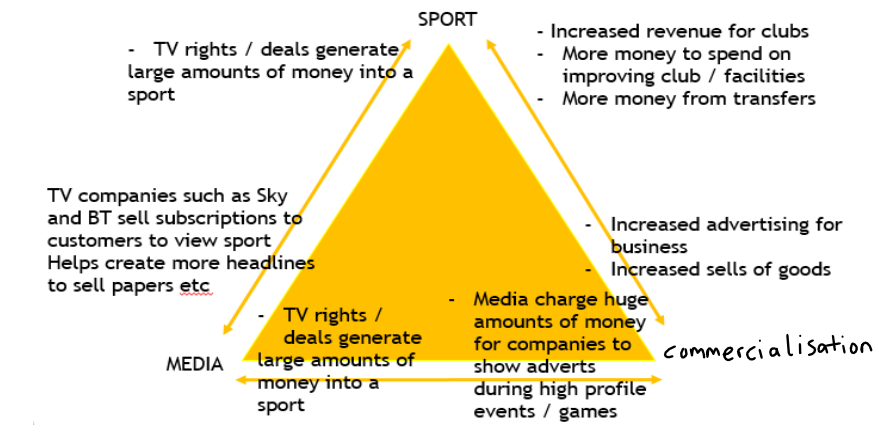
Known as the golden triangle because of the benefits each gives the others; they all are interrelated and benefit each other
Describe the golden triangle
The golden triangle describes the interrelationship between commercialisation, the media and physical activity + sport
Describe the advantages of commercialisation for:
The sponsor
The sport
The player/ performer
The spectator
The sponsor
Raises awareness of the company or brand, leading to increases sales
Advertises their products and services
Product associated with high-quality performance or health and fitness, giving the brand high status
Increased sales or revenue through increased media exposure
The sport
More media coverage →raised awareness of sports →encourages participation →higher profile of sport →more commercial interest →increased funding from sponsors, used to:
Run events
Develop better facilities
Invest in equipment, coaches, players
Can develop grassroots so can increase participation
Positive association → participation
Awareness + knowledge; people know how to play, people want to play
The player/ performer
Can be paid millions to endorse products
Can train full time and not have to work another job to survive, so can focus on becoming the best at their sport
Can receive top quality products to use to help performance
The spectator
More coverage, so improved access for viewing
Funding can improve stadiums and seating, creating better facilities and experiences
Higher quality events as money is invested in production, athletes and teams
Access to replays and increased choice of sports for viewing
Describe the disadvantages of commercialisation for:
The sponsor
The sport
The player/ performer
The spectator
The sponsor
Very high costs; this is risky as the media may not get a high number of viewers
Risk of bad publicity if the team does not play well or a performer behaves poorly, which can damage the sponsor’s reputation
The sport
Clothing and rule changes to make the game more appealing to viewers
Fixture times and length of season changed to maximise viewing opportunities
Breaks in play for advertising purposes
If minority sports are not shown by the media, it can lead to a decrease in participation
Negative reporting can give the sport a bad reputation
The player/ performer
Changes to fixture time and lengths of season can make conditions less favourable for performers
Product may have a bad image or be unethical, giving a bad reputation for the performer
Required appearances take time away from training
Pressure and stress to perform consistently to satisfy sponsors
Restricted to only sponsored clothing/equipment
Lack of privacy due to constant media coverage
The spectator
High subscription cost for sports channels
High cost of merchandise
Excessive advertising can disrupt the viewing experience
Minority sports may not be shown, meaning that individuals cannot view them
Explain the two different types of sporting behaviours
Sportsmanship
Playing fairly, respecting the rules, opponents and officials and showing good conduct in both winning and losing - not trying to win by unfair means
Gamesmanship
Bending the rules to try to gain an unfair advantage, without deliberately breaking the rules
Give examples of sportsmanship and gamesmanship
Sportsmanship
Shaking hands with opponents and officials
Being honest if the ball is out or if a rule is broken
Helping an opponent up if they fall
Gamesmanship
Time wasting
Deliberately distracting an opponent
Faking an injury to slow the game or gain a substitution
What do sportsmanship and gamesmanship create?
Sportsmanship
Good role models
A positive image of the sport
Satisfaction/ pride
Gamesmanship
Bad role models
A negative image of the sport
Dissatisfaction, guilt
Define deviance in sport and give examples
Behaviour that goes against the rules or commonly accepted norms of the sport
Cheating
Taking PEDs
Violence
Racism
Sexism
What are the reasons for deviance at elite levels?
Prizes
Fame
Sponsorship
Money
Promotion to a higher team
Pressure from coaches/ peers
What are the consequences for deviance? What is being done to prevent it?
Red card/ being sent off
Fines
Banned from playing
Loss of sponsors
Loss of reputation
Prison (illegal drugs, bodily harm)
Prevention:
Random drugs testing
Fair play awards
Anti-drug, anti-racism campaigns
Explain why too much physical activity can have a negative effect on an elite sports performer’s emotional wellbeing.
Too much physical activity can cause overtraining and overuse injuries
So may be unable to train and play
Causing them to miss training or competitions
Which can lead to stress// anxiety// depression and motivation loss
Explain how two side effects of drinking alcohol could negatively affect performance in sport and physical activity.
Can lead to dehydration
reducing performance as individual will suffer headaches// feel dizzy and be unable to concentrate on the game
Can cause a loss of coordination and increased reaction time
More likely to get injured
Can lead to a drop in blood glucose
performance will suffer as athlete will fatigue quicker // be unable to work as hard