9. France
 Call Kai
 Learn
Learn Practice Test
 Spaced Repetition
 Match
Match Flashcards
 Knowt Play
1/9

There's no tags or description
Looks like no tags are added yet.
Name | Mastery | Learn | Test | Matching | Spaced | Call with Kai |
|---|
No analytics yet
Send a link to your students to track their progress
10 Terms
Continental Industrialization in the Nineteenth Century
Simple catch-up after Napoleonic wars. Adopt British technology.
Institutional changes
Institutional Changes.
French revolution and Napoleonic conquest of most of Europe.
End of internal tariffs; serfdom.
Legal system: Code Napoleon.
Improved educational system: primary and secondary schools, universities, scientific societies.
Patent laws.
Contrast with Britain.
Develop large internal market by eliminating internal tariffs and improving transport networks.
Use import tariffs to protect infant industries from British competition. Friedrich List
Develop large banks to fund industry.
Introduce universal primary education.
Prussia: universal primary education from late eighteenth century.
Dominant in Zollverien (Customs union of German states) after 1818.
Large railway network across Germany by 1850s.
Large industrial banks established by 1870s.
Share of World Manufacturing.
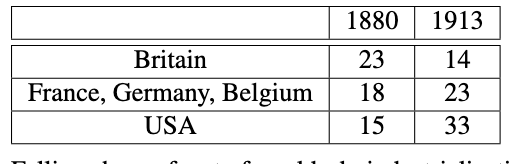
Falling share of rest of world: de-industrialization.
France in the Nineteenth Century.
Traditional view of Nineteenth century France as economic failure.
Large, low productivity peasant agriculture with excessive attachment to land ownership.
Small, conservative, family firms reluctant to innovate.
Change in 1960s. Levy-Leboyer
O’Brien and Keyder Economic growth in Britain and France, 1780-1914: two paths to the twentieth century (1978).
O’Brien and Keyder
French industry had higher levels of capital per worker and productivity than did England in the nineteenth century.
Overall levels of consumption within 15 per cent of English levels.
Weakness of French economy was agriculture. Large peasant sector failed to release labour into industrial sector and had wrong pattern of demand for industrialization.
Differences with England go back to Black Death.
French population recovered faster: more grain, fewer animals.
French peasants acquired rights to land, unlike England where they became wage labourers
Crafts (1983)
Serious problems with O’Brien numbers. Underestimates labour force in industry, and ignores service sector which was much smaller in France than in England.
Look at economies when they reached income of Britain in 1840: France and Germany in 1870

Per capita GDP (1990 dollars)
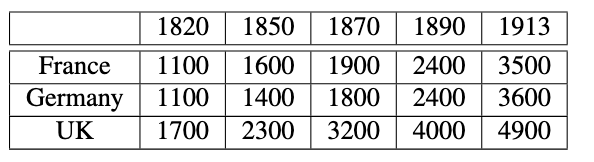
French output grew around same rate as British: around 1 per cent per year.
Respectable but no convergence
Agriculture
Heywood: “Did peasantry impede French industrialization?”
80 per cent of farms small, but accounted for only 20 per cent of land area.
Small farmers relied on wage labour on larger farms or proto-industrial activities.
High quality goods produced in towns, lower quality in rural areas.
Failure of agriculture to release labour? No demand from industry. Small difference between urban and rural wages.
Slow expansion of agricultural output reflected slow demand from limited population increase.
However, little mechanization of agriculture and high tariffs, causing high food prices
Optimistic view of nineteenth century France.
Agriculture performed adequately.
Industrialization followed a different path than Britain or Germany reflecting constraints on French economy—two severe military defeats and a shortage of coal—rather than deficiencies of entrepeneurship.
Vigorous steel industry lost to Germany in 1871
Quality of life may have been increased through absence of industrial cities.
Coal: In 1900 French coal output per capita was one third of Germany’s and one seventh of the UK’s.
Extremely low use of steam power until 1890s
Heavy reliance on water power. French invention and development of water turbine in 19th C.
In 1899, 56 per cent of newly installed prime movers, by power, were water powered.
Implied small factory size and geographical dispersion.
Specialization in labour intensive, high skill production. Silk and worsted rather than cotton
Pessimistic View.
French economy performed well until 1870s.
Share of world exports fell from 13 per cent in 1860 to 7 per cent in 1913.
Stagnation of traditional industries.
1892: raising of tariffs to high level and accelerated growth in cotton, metallurgy, power use.
New industries—electricity and chemicals—relied on foreign technology although cars and aircraft were impressive, and industry performed well during WW1.
Ultimately, modest growth rate was only possible with severe population limitation.
Between 1850 and 1913 population of England and Wales doubled from 17.8 m to 36.3m.
Population of France rose 10 per cent from 35.6 to 39.7 m
Low population growth a response to poor economic prospects and caused France to turn from continental super-power to become second to Germany.