WFC 110 Midterm 2 Study Guide
 Call Kai
 Learn
Learn Practice Test
 Spaced Repetition
 Match
Match Flashcards
 Knowt Play
1/103

There's no tags or description
Looks like no tags are added yet.
Name | Mastery | Learn | Test | Matching | Spaced | Call with Kai |
|---|
No analytics yet
Send a link to your students to track their progress
104 Terms
What two layers make up the skin?`
Epidermis
Dermis
What is the epidermis made of?
Epithelial cells (basal living, superficial, keratinized [fibrous protein, keratin], continuously flake off)
What do modified epithelial cells result in?
Scales, hair, horns, claws, etc..
What is the dermis made up of?
Living vascularized connective tissue, containing blood vessels and sensory receptors
The sense of touch happens in the ____, and is then transmitted through the ______.
dermis, epidermis
What is the function of the dermal bone?
Provided an important protective layer in early vertebrates — e.g., “shell” coverings in ancient fishes
True or false: All other bone aside from dermal bone is formed by the ossification of a cartilaginous template.
True
True or false: Teeth are thought to be derived from dermal bone.
True
Dermal scutes
Only seen in armadillos (where they are covered by epidermal scales as well)
Formed in the dermis
Function of hair
Retaining heat
Dissipating heat (less common)
Each hair radiates heat from the skin to the atmosphere (similar to leaf hairs, cactus spines)
Thermoregulation
Concealment
Communication
Annual molting is common in mammals in what environment?
Mammals living at higher latitudes (where animals need to keep warm in the winter and drop their coat to keep cool in the summer)
What is the advantage of undergoing a seasonal molt? (x2 a year)
Concealment (ex: snowshoe hare is brown in summer and white in winter)
What is a post-juvenile molt? Is it common?
Where juveniles have one pelage, then replace it with an adult pelage. Less common (more seen avian species —> think of feathers)
Gloger’s Rule
Individuals in more humid climates tend to have darker pelage, whereas those in more xeric climates tend to have lighter pelage.
3 kinds of integumentary glands
Sweat glands, sebaceous glands, and mammary glands
Two kinds of sweat glands
Apocrine glands (associated w/hair follicles)
Eccrine glands (produce most of the fluid in sweat)
Function of sebaceous glands
Lubricate hair and skin with high lipid materials (associated hair follicles)
True or false: Scent and musk glands are likely derived from sweat glands.
False; they are likely derived from sebaceous glands.
Function of mammary glands
Nourish young (number correlates with litter size)
What are the the two hypotheses for the origin of mammary glands?
Evolved from apocrine sweat glands (structurally similar)
Evolved from sebaceous glands (share some characteristics)
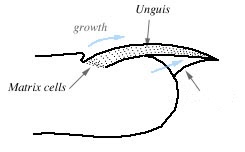
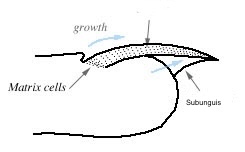
Function of claws/nails/hooves
Serve to protect extremities of digits; in many cases, modified for defense or offense as well as traction
Unguis
Subunguis
True or false: Female and juvenile platypus have a hollow spur on each hind leg — a characteristic unique to them in Mammalia.
False; Male and juvenile
True horns are found in what order & family?
Order Artiodactyla, Family Bovidae
Anatomy of true horns
Bony core, wrapped dermis, then epidermis, then keratinized epidermis; an extension of the frontal bone
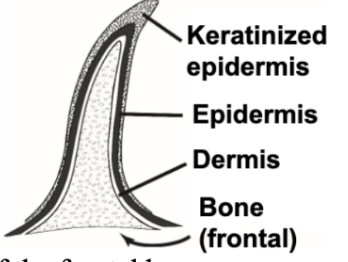
True or false: True horns grow from the base throughout life.
True
Pronghorns are found in what order and family?
Order Artidactyla, Family Antilocapridae
What is the main difference between true horns and pronghorns?
Pronghorns have a small anterior prong, which true horns do not. Additionally, pronghorns are shed annually, whereas true horns are not shed.
Pronghorns are usually larger in (males/females), while (males/females) may lack a pronghorn and often lack the prong.
males, females
What order and family do antlers belong to?
Order Artidactyla, Family Cervidae
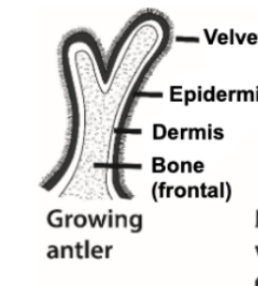
Anatomy of antlers (growing antler)
Bone core surrounded by dermis, epidermis, and velvet
Anatomy of antlers (mature antler)
Bone connected to the pedicel (base) via a burr
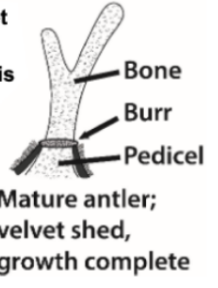
Where do antlers break?
At the burr
How often are antlers shed?
Annually
Antlers are generally only found in (males/females), except for caribou, where both sexes have antlers.
males
Antler seasonality (springtime)
Longer days to stimulate the pituitary gland to produce antler-growth hormone
Later, pituitary gonadotropin stimulates the growth of testes and the production of androgens (from testes)
AGH promotes ______.
antler growth
Androgens maintain the connection between the _____ bone and living antler. However, at high levels, androgens (inhibit/promote) AGH.
frontal, inhibit
Antler seasonality (late summer/fall)
Blood androgen levels rise to levels that inhibit AGH
Blood circulation to antlers reduces (at the burr), velvet sheds
Androgens continue to maintain connection between frontal bone and now-dead antler
Antler seasonality (winter [post-mating])
Shorter days —> drop in androgen secretion (smaller testes)
Lower levels of androgens lead to decalcification in the pedicel, a plane of weakness develops, and abscission occurs at the burr
Why are antlers secondary sex characteristics? (6 reasons)
Males only
Used primarily in male-male combat for females
Not developed for other uses
Size related to nutrition, which is a surrogate of fitness
Development under hormonal control
Largely symbolic: generally too large and complex for use in “real” fighting
Only rarely to animals fight to the death
Ossicones
Head ornamentation of giraffes
(Male/female) giraffes have a bald ossicone, and (male/female) giraffes have a furry ossicone.
Male, female
True or false: Male giraffes have a longer neck but smaller ossicones.
False; they both have a longer neck and larger ossicones than a female giraffe.
Rhino “horn” ornamentation
The only non-artiodactyl w/head ornamentation
Agglutinated, keratinized fibers (fused/glued hairs)
What order and family do rhinos belong to?
Order Perissodactyla, Family Rhinocerotidae
Homodont dentition
All teeth are structurally similar (semi-common; e.g., some whales)
Heterodont dentition
Two or more morphologically distinct types of teeth (most common; incisors, canines, etc.)
Monophyodont
Retaining a single set of teeth throughout their life (semi-common)
Diphyodont
Having baby teeth that are later replaced by adult teeth relatively early in development (Most common)
Thecodont
Well-rooted in the jaw (most mammals)
True or false: Enamel is the hardest substance in mammals.
True
(Premolars/Molars) have deciduous precursors and have 1-2 roots, whereas (premolars/molars) have no precursors —-AKA grow once—- and are extra well-rooted.
Premolars, molars
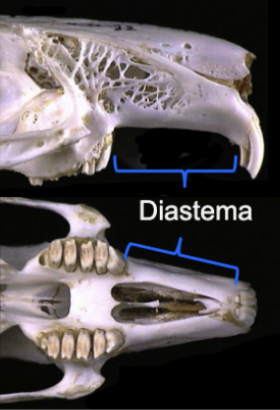
Diastema
Gap between teeth visible in mammals; often herbivores
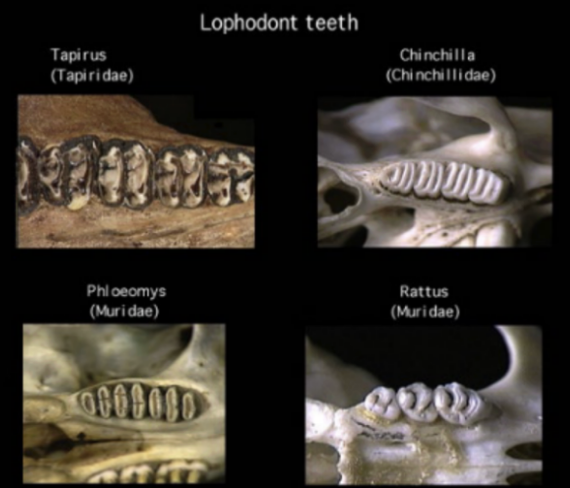
Lophodont
Mammals characterized by ridges, or lophs (like loaves), connecting bridges between cusps (ex: chinchilla)
Three versions of lophodonty
Bilophodont (simplified, gives teeth a figure 8 appearance; ex: rabbits)
Loxodont (extreme case— lophs develop transversely and give the impression of an old washboard)
Selenodont (elongated primary cusps, forming moon-shaped ridges called selenes [think selene = goddess of the moon]; ex: deer and cattle)
What is the advantage to having elongated primary cusps?
The size and number of cutting or grinding surfaces increase
Hyposodont
High-crowned and generally unrooted (ex: lophodont and selenodont [kangaroo rat, deer, horse]; “hypso-” = height, elevation)
Brachydont
Low-crowned and generally rooted (ex: humans, bears, pigs; “brachy-” = short)
Bunodont
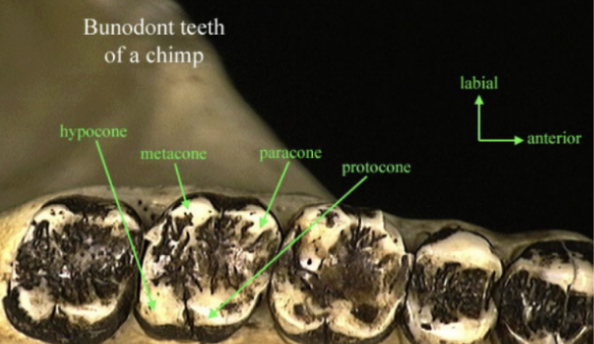
Squarish cheek teeth with low, rounded cusps for crushing molar power; often reflects a broad diet (humans, pigs, bears, raccoons, etc.)
Secodont
Shearing cheekteeth of many predacious species which are high-crowned and bladelike (ex: bats, insectivorous species, carnivores; “seco-” = to fly/cut through)
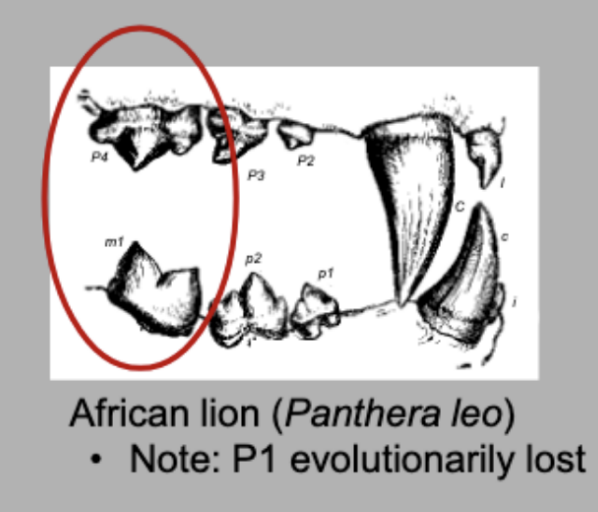
A particular pair of secodont teeth, the ________ pair, consists of the last upper premolar and the first lower premolar.
Carnassial
True or false: elephant tusks are enlarged molars.
False; they are enlarged incisors.
Many pigs (Suidae) and some deer (Cervidae) have tusks. These are enlarged ______.
canines
The rusk of the narwhal is the upper left _____.
canine
True or false: Hippopotamus have enlarged incisors and normal canines.
False; both incisors and canines are enlarged.
Gape is maximized in carnivores by emphasizing the _____ muscle in jaw mechanics. This allows them to have a (larger/smaller) masseter mm but is constrained to operate via the articulation.
temporal, smaller
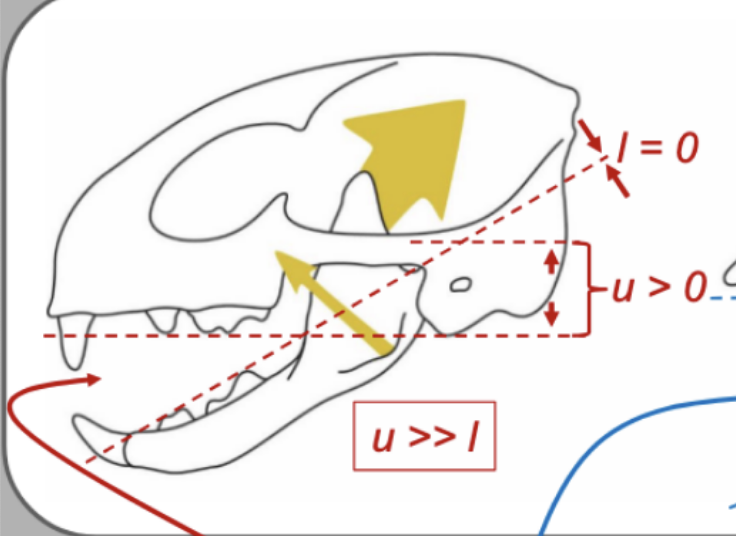
Toothrows will (shear/grind) if the perpendicular distances between toothrows and the jaw joint are not equal, or if one toothrow is above and/or the other below the joint.
shear
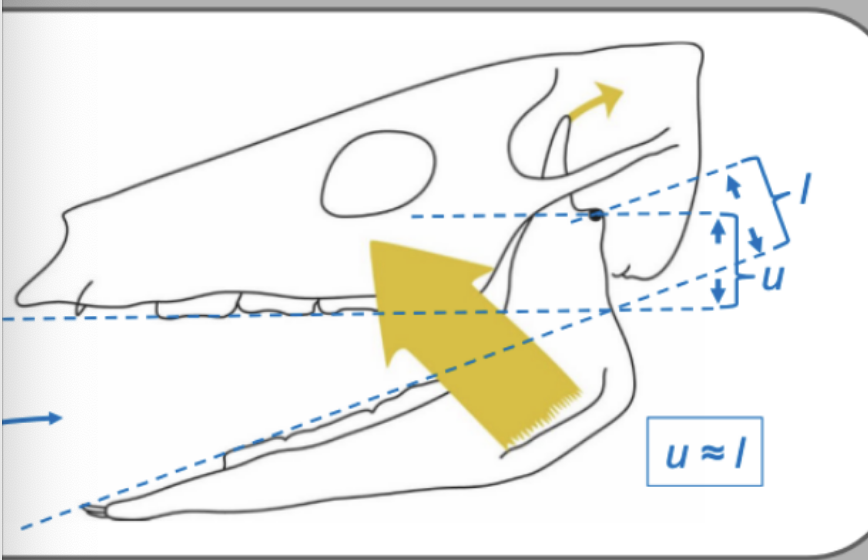
Teeth will (shear/grind) if the distance between toothrows and joint are equal and both toothrows are in line with, or equally distant from, the joint.
grind
Why are herbivore faces generally longer than carnivores?
For longer toothrows and diastema.
3 types of teeth-grinding
Fore-aft-teeth with transverse ridging (usu. lophodont)
Side-to-side teeth with longitudinal ridges (usu. selenodont or lophodont)
Rotational (pigs) teeth (usu. bunodont)
The action of shearing teeth is largely (vertical/horizontal).
Vertical
Vicariance
The geological separation of a population, species, or group of organisms by a new physical barrier (such as mountains, rivers, or tectonic plate movement)
Dispersal
The movement of organisms away from their birthplace or parent population to new, often distant locations
Reduces competition among kin, prevents inbreeding, escaping unfavorable conditions
Marsupials first evolved in _______. Many migrated to _____ and diversified there. The diversity of marsupials in Australia is an example of (vicariance/dispersal).
South America, Australia, dispersal
The Great American Biotic Interchange
An important biogeographical event that occurred at the end of the Cenozoic, during which animals and plants that evolved in isolation dispersed from North America to South America and vice versa
True or false: Lions and brown bears colonized North America in multiple synchronous waves of dispersal across the Bering Land Bridge.
True
More than 30 million years ago, monkeys rafted across the _____ to South America.
Atlantic
Elevational gradient in species diversity
Lower diversity as elevation increases (but roughly bell curve)
Latitudinal gradient in species diversity
Greatest diversity ~ 10 N & S (tropics)
The greater the distance of an island from mainland, the (greater/less) number of species.
Less
The greater the area of an island, the (greater'/less) number of species.
Greater
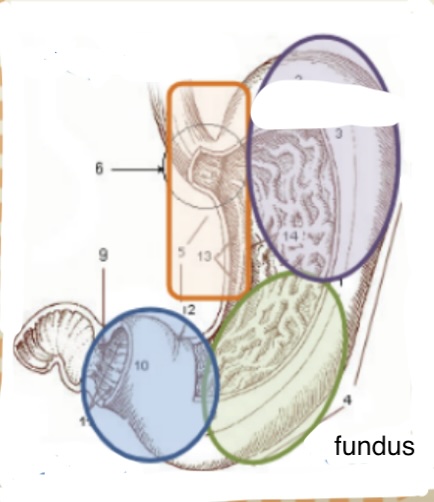
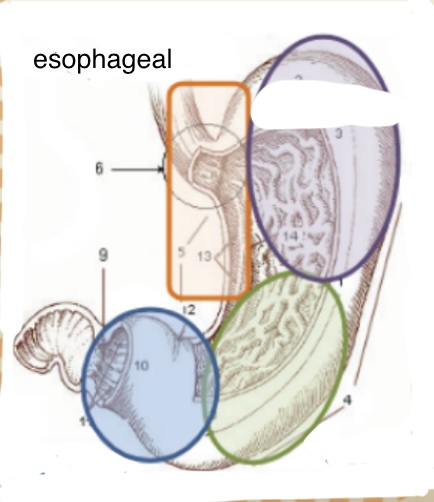
Function of the esophageal region
Secretes mucus
What is the esophageal region made of?
Stratified squamous epithelium
Escophageal region (stomach)
Not likely esophageal in origin (in spite of name)
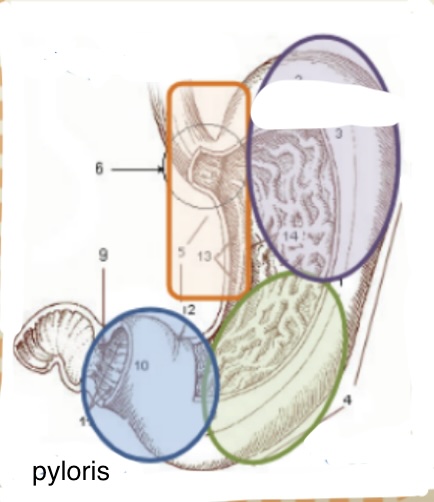
Pyloris region (stomach)
tubular glands secreting mucus
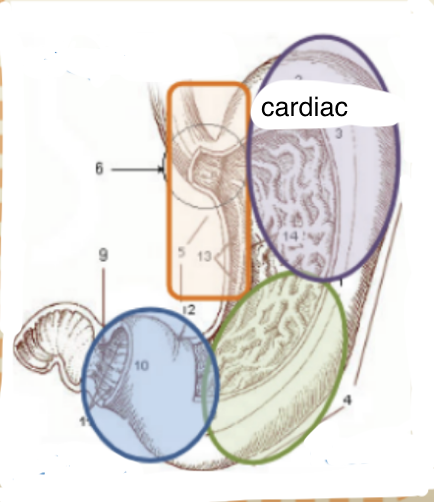
Cardiac region (stomach)
found in mammals only
columnar epithelium
mucus only; no digestive glands
Fundus region (stomach)
digestive region
parietal cells —> HCl —> very acidic environment
large number of glands —> protoeolytic enzymes
sometimes fat-splitting enzymes
rennin — enzyme that facilitates digestion of milk