PSY1303_L4: Research Methods in Clinical Psychology
 Call Kai
 Learn
Learn Practice Test
 Spaced Repetition
 Match
Match Flashcards
 Knowt Play
1/61

Earn XP
Description and Tags
Name | Mastery | Learn | Test | Matching | Spaced | Call with Kai | Chat |
|---|
No analytics yet
Send a link to your students to track their progress
62 Terms
appeal to authority
it allows us to escape the realm of pure speculation or
_______________________.
(Importance of Research in Clinical Psychology)
parsimony
it helps us extend and modify our theories as well as establish their ___________ and utility.
(Importance of Research in Clinical Psychology)
ability to predict
the ultimate reason for research is the enhancement of our ______________ and understand the behavior, feelings, and thoughts of the people served by clinical psychologists.
(Importance of Research in Clinical Psychology)
Observation
most basic and pervasive of all research methods
experimental, case study, and naturalistic approaches all use this
Unsystematic Observation
“casual observation”
does little by itself, can even lead to erroneous conclusions.
BUT can lead to development of a hypothesis that can eventually be tested more systematically
Naturalistic Observation
carried out in real-life settings, but more systematic and rigorous
no real control exerted by observer, but observation is carefully planned
limited to a relatively few individuals and situations
Controlled Observation
carefully planned observations are made in reallife settings
the investigator exerts a degree of control over the events being observed
Case Study
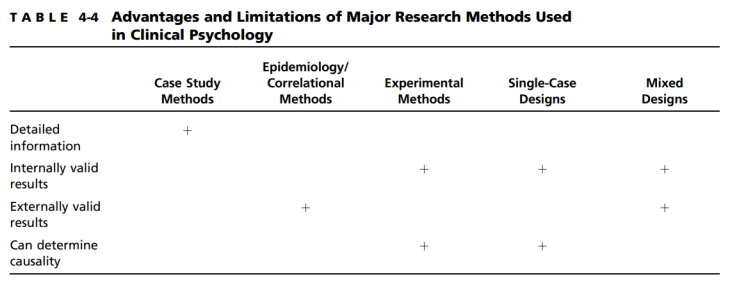
involves the intensive study of one person - a client or patient who is in treatment.
include material from interviews, test responses, and treatment accounts
Epidemiological Studies
the study of the incidence, prevalence, and distribution of illness or disease in a given population.
can give insight in identifying who are a risk.
king of generalization
Epidemiological Studies are known as the ________________________ due to their use of statistics in determining the incidence and prevalence of the total cases.
surveys or interviews
Much epidemiological research is based on ___________________.
Raises a problem in representation and generalizability.
social desirability
Epidemiological research presents issues in:
true incidence and prevalence
_________________ bias
inaccuracy of retrospective data
Incidence
refers to the rate of new cases of illness that develop within a given period of time
Prevalence
refers to the overall rate of cases (old or new) within a given period.
Correlational Studies
determining whether variable X is related to variable Y
sets of observations
to correlate two variables, we first obtain two _____________________
Pearson product-moment correlation coefficient
(r) = -1.00 to 1.00
straight line
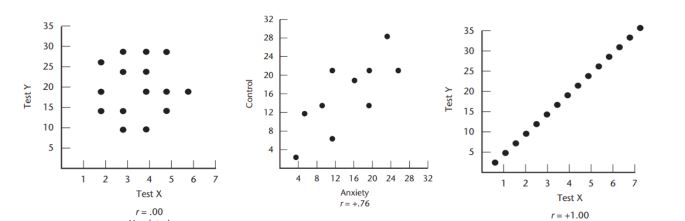
the more nearly perfect a relationship, the closer to a ______________ the data points in a scatterplot will be.
Unrelated
What is the relationship between the variables in the first scatterplot? (r = .00)
cause and effect
correlational methods cannot answer the question of __________________
third-variable problem
possibility that a correlation between variables A and B is due to the influence of an unknown third variable rather than to a causal relationship between A and B
Factor Analysis
statistical method for examining the interrelationships among many variables at the same time.
uses many separate correlations to determine which variables change together and thus may have some underlying dimension in common.
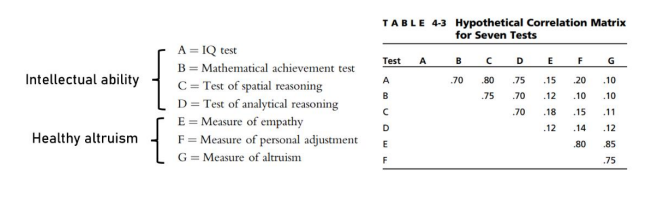
underlying dimension
A is correlated to B, C, and D and vice versa.
E is correlated to F and G and vice versa.
However, since A and E are not correlated, they do not have ________________ in common.
Cross-sectional Design
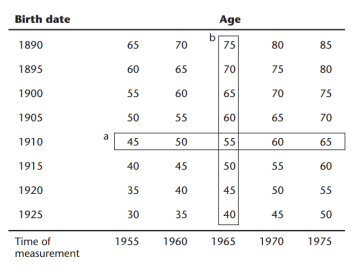
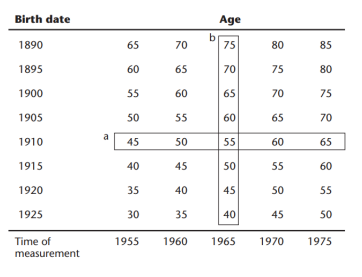
a design that evaluates or compares individuals, perhaps of different age groups, at the same point in time.
we cannot assume age changes, only differences among age groups
Longitudinal Design
a design that follows the same subjects over time.
allows us to gain insight into age changes; reduces third-variable problem;
requires higher budget and more resources
Longitudinal
In the table, “a” is an example of a ___________ design.
Cross-sectional Design
In the table, “b” is an example of a ___________ design.
Experimental Method
allows the researcher to determine cause-and-effect relationships between variables or events.
experimental group
receives the treatment in an experimental research design
control group
does not receive the treatment in an experimental research design
Independent Variable (IV)
It is to be under control of the investigator
It is expected to have causal effect on participant’s behavior
Dependent Variable (DV)
It is the participant’s behavior that is expected to be impacted by the variable manipulated by the experimenter.
Between-group
In this design, we have two separate sets of participants, each of which receives a different kind of treatment or intervention.
Within-group
In this design, comparisons are made on same patients at different points in time.
baseline → interaction → results
pretest and posttest
A within-group design makes use of _________ (and) _________.
practice effect and order effect
An advantage of a within-group design is that there is more control over extraneous variables due to the participants being the same people. However, its disadvantages encompass __________ (and) __________.
different groups and different treatments
A between-group design makes use of _________ (and) _________.
Internal validity
the extent that the change in the dependent variable is attributable to the manipulation of the independent variable
confound
when extraneous variables are not controlled or cannot be shown to exist equally in experimental and control groups, these variables may __________ the results.
Placebo effect
where the expectations for the experimental manipulation cause the outcome rather than (or in addition to) the manipulation itself
Double-blind procedure
neither the participant nor the experimenter knows what treatment or procedure is being used
External validity
the extent that its results are generalizable beyond the narrow conditions of the study
Analog Studies
In this type of experimental study, better internal validity is possible because of the superior control we can exert in the laboratory.
Experiments can mimic real-life or outside settings
Ex:
Little Albert & Phobia
Playing sad music to induce the feeling of sadness
degree of similarity
the Achilles heel of the method is the _____________________ between the analog and the real thing.
Single-Case Designs
designs that focus on the responses of only one participant.
allow the experimenter to establish cause–effect relationships and see effectivity of the treatment
(unofficial name) “within-a-person design”
baseline and postintervention
Usually, an intervention is introduced after a reliable baseline is established, and the effects of the intervention are determined by comparing the _________ (and) _________ levels of behavior.
The ABAB Design
permits measurement of a treatment’s effectiveness by systematic observation of changes in the participant’s behavior as treatment and no-treatment conditions alternate.
feasible and healthy
In an ABAB Design, an initial baseline period (A) is followed by a treatment period (B), a return to the baseline (A), and then a second treatment period (B).
The disadvantage of this design is that it is not always _____________ (and) ____________ to do or remove a treatment.
Multiple Baseline Designs
Designs used when it is not possible or ethical to employ a treatment reversal period.
baselines are established for two (or more) behaviors, treatment is introduced for one behavior, and then treatment is introduced for the second behavior as well.
no withdrawal, measures in diff. contexts
By observing changes in each behavior from period to period, one may draw conclusions about the effectiveness of the treatments.
Mixed Methods
research designs that combine both experimental and correlational methods
group classification
In the Mixed Methods design, participants from naturally occurring groups of interest (e.g., people with panic disorder and people with social phobia) are assigned to each experimental treatment, allowing the experimenter to determine whether the effectiveness of the treatments varies by _______________.
internally valid and externally valid
An advantage of a mixed methods design is that it can yield ______________ (and) _______________ results.
gain approval
Plan and conduct research according to recognized standards of scientific competence and ethical principles. Psychologists must ______________, if required by institutions, before conducting research.
informed consent
Obtain _________________ from participants in research. Inform them of the research procedures, their right to withdraw, potential risks or discomforts, possible benefits, limits to confidentiality, incentives for participation, and whom to contact for questions about participation and participants’ rights.
deception
Use _______________ as part of their procedures only when it is not possible to use alternative methods.
offering inducements
Take great care, in __________________ for research participation, that the nature of the compensation (such as professional services) is made clear and that financial or other types are not so excessive as to coerce participation.
fabricate data
Do not ________________ and give proper credit to others for their contributions. Discuss publication authorship early in the research process, and base authorship on the relative contributions of the individuals involved.
anticipated use of the data
Inform research participants of the _________________________ and of the possibility of sharing the data with other investigators or any unanticipated future uses.
information at the close
Provide participants with _________________________ of the research to erase any misconceptions that may have arisen.
Treat animal subjects humanely
_________________________________ and in accordance with federal, state, and local laws as well as with professional standards. Several of these points warrant further comment.
Psychological Association of the Philippines (PAP)
published the Code of Ethics for Philippine Psychologists
debrief
After the use of deception, the experimenters must ________ the participants.