NVSC 402 Final
 Call Kai
 Learn
Learn Practice Test
 Spaced Repetition
 Match
Match Flashcards
 Knowt Play
1/46

There's no tags or description
Looks like no tags are added yet.
Name | Mastery | Learn | Test | Matching | Spaced | Call with Kai |
|---|
No analytics yet
Send a link to your students to track their progress
47 Terms
Corporateness
A sense of organic unity and consciousness of themselves as a group apart
Shared identity and control over membership
Expertise
Unique and necessary skills that members are granted authority to practice
Competence
The quality or state of having sufficient knowledge, judgement, skill, or strength for a particular duty or in a particular respect
Discipline
Control gained by enforcing obedience or order
Orderly or prescribed conduct or pattern of behavior
Consistency of action within a set of values and standards
Virtues → values/beliefs model
Organizational and individual values and beliefs → Value and belief reconciliation (Adoption/integration or Conformity/compliance) → Behavior demonstration through desired virtues
Responsibility
The condition of being responsible — that of an obligation or power to act or respond. Responsibility carries the additional subtext of claim, credit , or blame, and sometimes trust
Accountability
Being accountable or to give an account entails the need to explain one’s actions or to provide the balancing of sums
Culpability
The state of being culpable and often defined as being responsible for a fault or deserving blame. Culpability is solely associated with blame.
Good Order & Discipline (Tippett)
Individual and collective consistency of action within a set of established values and standards for the purpose of enabling a team to effectively and efficiently accomplish their assigned tasks and missions.
Socialization and Discipline
Socialization tactics (Co-optation, Incrementalism, Compromise) can be used to instill ethical or unethical behavior
Pride and Shame (Obedience)
Incentivize behavior through praise to generate pride
Disincentivize behavior through condemning/rebuking to generate guilt or shame
Good Order & Discipline Cake
Trust
Discipline, Justice
Morale/Esprit de Corps, Commitment, Unity of Command/Direction, Effective Communication, Respect, Fairness
Justice
The maintenance or administration of what is just especially by the impartial adjustment of conflicting claims or the assignment of merited awards or punishments
The quality of being just, impartial, or fair
The principle or ideal of just dealing or right action
Military Justice
Retributive or Procedural
Retributive Justice
Seeks to punish wrongdoers objectively and proportionately
Procedural Justice
Refers to implementing legal decisions in accordance with fair and unbiased processes
Application of responsibility, accountability, and culpability
What is going on/What happened?
What do I have to do about it?
What should I do about it?
UCMJ Chart
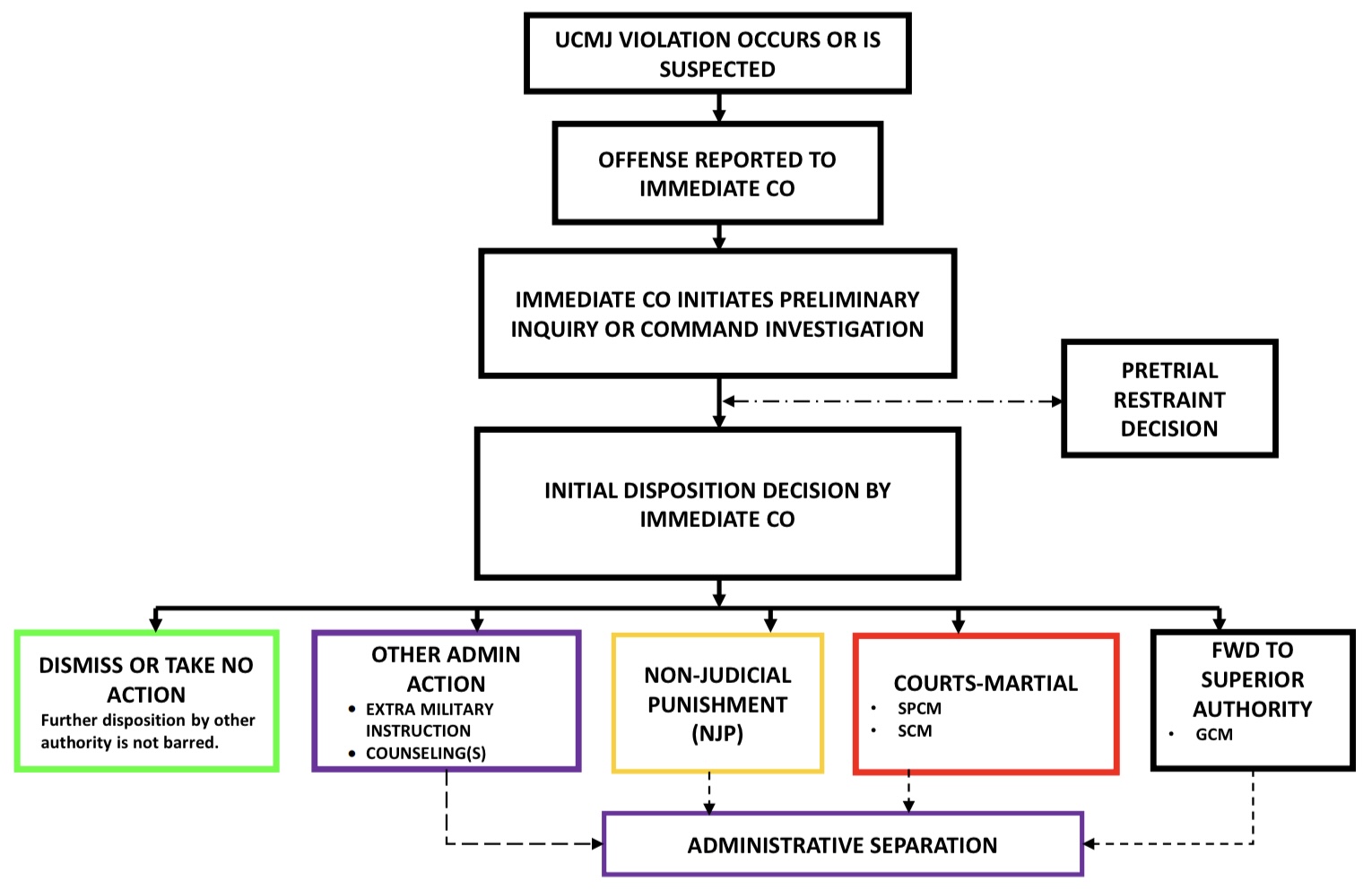
Inquiry & Investigation
Tools for gathering information to determine the type of military justice necessary
Preliminary Inquiry
Most Frequent investigation, conducted by Junior Officers
72 Hrs to complete
Military rules of evidence apply
Should answer “What happened?” so the CO can decide what to do
Line of Duty/Misconduct Investigation
Required when injury or disease occurs that prevents the service member from performing their duties for >24 hours (Includes Death)
Determination informs survivor benefits & disability pay
1st priority: was the injury/illness sustained in the line of duty, or as a result of misconduct? When in doubt, it was in line of duty
Standard of proof = clear and convincing
For line of duty, were they UA?
For misconduct, was it the proximate cause of the injury/illness?
3 Results:
In line of duty, not due to misconduct
Not in line of duty, not due to misconduct
Not in line of duty, due to misconduct
Inspection
Examination of whole or part of a unit to determine security, military fitness, or good order & discipline
Search
An examination made for the primary purpose of obtaining evidence
Seizure
Taking into possession an item in conjunction with an investigation of criminal activity
Contraband
Anything that is illegal to possess
Requirements for Search
Must have jurisdiction (over person, place, offense)
Must have Probable Cause (reasonable belief of violation of UCMJ AND that evidence will be at search location)
Must have authorization (CO or Military Judge with Jurisdiction)
Types of Searches
Entry/Exit Searches (Vessels when abroad or installations)
Search of Government Property (reasonable expectation of privacy in barracks)
Consent Searches (Voluntary)
2 Common Searches
Command Authorized Searches
probable cause exists
authorizing authority must be neutral and detached
Must have specificity and scope (What and where)
Exigent Searches (When time is of the essence to prevent destruction or concealment of evidence)
Seizures (Evidence)
Admissible if:
Based on probable cause
Abandoned Property
With consent or during consent search
Government Property
During Exigency Search
Plain View
Can be seized by Law Enforcement Officers, CPO/PO & SNCO/NCO
Apprehension
The act of taking a person into custody
Any person subject to UCMJ
Clearly notify person they are in custody
Use of reasonably necessary force is authorized
LEO, Officers, CPO/PO, SNCO/NCO
Entry to private dwellings requires a warrant
Restraint
Limiting free movement of an individual
Types of Courts Martial
Summary Courts Martial
No BCD Special Courts Martial “Short Martial”
Special Courts Martial
General Courts Martial
Summary Court Martial
Convened by OIC or higher (Accused must consent to this type of court-martial
Court Officer is Commissioned Officer, O-3 or above, same service
Standard of Proof = beyond reasonable doubt\Not judicial or criminal
No double jeopardy
Enlisted only
No BCD Courts Martial “short martial”
Convened by Battalion COs or higher (can be without consent of accused)
Military Judge only
Offenses
Carrying a maximum sentence of less than 2 years
Drug offenses
no sex offender offenses
Standard of Proof = beyond reasonable doubt
Criminal Conviction
Special Courts Martial
Convened by Battalion COs or higher (can be without consent of accused)
Military Judge, Trial/Defense Counsels, 4 member Panel (enlisted can request 1/3 enlisted members on panel), can request trial by MJ alone
Standard of Proof = beyond reasonable doubt (3/4 Majority)
Criminal Conviction
General Courts Martial
Convened by Flag/General Officers
Article 32 Preliminary Hearing utilized
Military Judge, Trial/Defense Counsels, Officer Panel (enlisted may request 1/3 enlisted panel) 12 panel capital GCM, 8 panel non-capital GCM, can request MJ alone for non-capital GCM
Standard of Proof = Beyond reasonable doubt, ¾ majority for conviction, unanimous for death sentence
criminal conviction
Punitive Discharges
Bad Conduct Discharge
Dishonorable Discharge
Administrative Discharges
Honorable Discharge
General, under honorable conditions
Other-than-Honorable Discharge (OTH)
Entry-level Separation
Appeals Process
Navy/MC Court of appeals → Court of appeals for the armed forces → United States Supreme Court
NJP
Imposed by Commanders at all levels
Any member may receive NJP
Not a trial, no lawyer representative
Burden of Proof = preponderance of evidence (>50%)
inclusive of all known offenses
Accused can refuse NJP and request trial by Court Martial (Unless attached to/embarked on a vessel)
Jus ad Bellum
Justice of War
When is it justifiable to use armed force or go to war
Jus in Bello
Justice in War
Justifiable application of violence in war, and against whom violence can be applied
Justifying War: To Whom? Why?
The Nations citizens
Other nations
Our Military
Our enemies
Various reasons depending on person
Just War Principles (6)
declared by legitimate authority
Just Cause
Rightful Intentions (restore justice)
Last Resort
Probability of Success
Proportionality of ends
Preemption
Application of violence when enemy attack is imminent
Prevention
application of violence when enemy aggression is expected sometime in the future
Jus in Bello Criteria
Proportionality: Use of appropriate force to target intended to prevent execessive harm or purposeless violence and destruction (Harm itself, not means)
Necessity: violence must be for a military purpose, required to achieve that purpose
Discrimination: Every effort made to discriminate between legitimate and illegitimate targets, only applying intentional force against legitimate targets