Child Life Internship Interview Prep.
 Call Kai
 Learn
Learn Practice Test
 Spaced Repetition
 Match
Match Flashcards
 Knowt Play
1/56

There's no tags or description
Looks like no tags are added yet.
Name | Mastery | Learn | Test | Matching | Spaced | Call with Kai |
|---|
No analytics yet
Send a link to your students to track their progress
57 Terms
things you've been doing to help prepare yourself for a child life internship.
tell me about yourself
my name is Elliena Ingraham but I also go by Elli because my first name can be challenging for children to say
I am a senior at LSU graduating in Human Development and Family Science with a concentration in Child life and minor in sociology
I just recently completed a Child Life practicum at Manning Family Children’s
I have always wanted to work with children in the hospital setting in some capacity, but social work, nursing, and psychiatry never felt right because I wanted to be able to prevent traumatic memories
learned about child life program at LSU and immediately knew that it was my future career
This led me to child life which combined my interest in the medical field, passion for supporting children and families of diverse backgrounds during stressful times, and goal to prevent traumatic experiences related to the medical field before they occur
I am a very creative and social person always looking for new learning opportunities and creatively solving problems
why did you choose to pursue child life
it is a combination of many of my interests including health, medical treatments, supporting and educating children and families, and child development theory
I feared everything as a child and could not comprehend that if someone was meant to help, why were they hurting me
Due to my fears, people refused to explain what was going on
I would not wish the fear or confusion on anyone else
Even with the mantra “do no harm”, they are still harming the psychosocial well-being of children and families.
Children deserve to know what is happening to their bodies and be taught how to navigate their experiences in a developmentally appropriate way, and I believe I can be that advocate. Additionally, I want to be there to make sure everyone in the family system affected by the hospitalization of one member is thought of during the duration of treatment.
Why do you want to work for us?
find their mission statement
discuss their setting of the program (small hospital with adult, comprehensive hospital)
discuss preferences for the program (amount of interns, specific rotations included)
talk about valuing what they value
how do you handle stress
Introduce yourself as a child life intern to a patient
Hi my name is Elli and I am the child life student. I am learning how to make the hospital less scary for kids like you and help you understand what is going on.
if going in with a CCLS, I would say that I am learning how to do their job.
concrete terms and simple language
would change depending on the developmental level of the child and work that I am doing
general for toddlers - school agers
adolescents: I am learning how to help you understand what is happening and what the doctors are saying and make the hospital more comfortable because being here is can be difficult and confusing.
Introduce yourself as a child life intern to a family
Hi, my name is Elliena and I am the Child Life Intern and I am learning how to help support patients and their families in the hospital to make sure you understand what is going on and make sure you have the resources you need to support your child.
Introduce yourself as a child life intern to other healthcare workers
My name is Elliena and I am the Child Life Intern, learning to be a Child Life Specialist. Child Life internships are similar to nursing preceptorships because I am learning how to apply what I learned in school to provide procedural support, education, advocacy, and therapeutic play to patients in the hospital to improve their ability to cope with hospitalization.
We know that a student's life can sometimes be stressful when balancing academic work with activities outside the classroom. Describe a time that was particularly stressful for you and what steps you took to manage it effectively?
In my final semester at LSU, I juggled a child life practicum, a full time class schedule, being a president of a student organization, and maintaining my volunteering and job, all while applying to child life internships. I became completely overwhelmed by the amount of writing assignments and responsibilities, I realized that something had to give because I did not have the financial, psychological, or emotional resources to maintain the lifestyle. So, I sat down and determined which experiences and accomplishments were priorities, and what needed to take a back seat. I used to-do lists to get tasks done and broke down the tasks into manageable chunks that could be done. Also, I had to learn how to relinquish tasks by asking my support system for help to take things off my plate. In the end, I was able to complete my practicum with outstanding evaluations, complete multiple achievements that I have been working towards since freshman year, apply to internships, and graduate with a 4.0 GPA. Though I was still stressed, I was able to manage that pressure and turn it into a diamond with a tassel on top.
What do you see as the value of play for hospitalized children? Describe an experience with a child during which you utilized play.
Tell what kinds of children and families are hardest for you to work with. Describe your most challenging situation and what you did to make the situation have a successful outcome.
Favorite age group to work with and why
Using what you know about child development, identify what will cause stress for the patient or family in the following situation:
A 6 month old infant is having an IV placement for the first time parents are present and very anxious and worried about how the child will respond
Using what you know about child development, identify what will cause stress for the patient or family in the following situation:
An 8 year old child is having an IV placement, the previous IV start took multiple tries. The child's parents had to go to work and the child will be alone for the procedure.
Using what you know about child development, identify what will cause stress for the patient or family in the following situation:
A 4 year old child is having an IV placement, the previous IV start took multiple tries. The child's parents had to go to work and the child will be alone for the procedure.
Using what you know about child development, identify what will cause stress for the patient or family in the following situation:
A 15 year old adolescent with a history of multiple hospitalizations and numerous invasive procedures will be receiving an IV placement.
previous experiences with multiple hospitalizations
feeling constraint because they have not been able to explore themselves and their role in society (Erikson)
struggling with adolescent egocentrism (Elkind) → personal fable and imaginary audience
feeling like other people are watching them and judging their appearance and reactions
constant separation from peers
feel stuck
Feedback is an important part of the learning process. Give an example of the time in which you received constructive feedback and what you did with the information.
In my practicum, I was asked to support the CCLS in the PICU through a memory making session with two school age siblings in the concrete operational stage of Cognitive development and industry versus inferiority stage of Psychosocial development. Without
Describe a situation in which you have had a conflict with a co-worker, patient, patient family member, or supervisor. What was the situation, how did you respond to it, and what did you learn from it?
Based on your knowledge and experiences describe how child and family diversity impacts pediatric healthcare. How do your biases impact interactions with others?
Using your knowledge in child development, briefly describe the developmental stages: Infant (0-1)
Using your knowledge in child development, briefly describe the developmental stages: Toddler (1-3
Using your knowledge in child development, briefly describe the developmental stages: Preschool (3-5)
Using your knowledge in child development, briefly describe the developmental stages: School Age (5-11)
Using your knowledge in child development, briefly describe the developmental stages: Adolescence (11-18)
Common Hospital Issues: Newborn/Infants
- Reflexes provide opportunities to interact with the environment & learn
- Recognizes mother's voice, attaches to caregivers (parents). Develops trust when needs are met.
▪ Communicates thru crying, babbling, imitating sounds
▪ Develops stranger anxiety around 7-8 months
Common Hospital Issues: Toddlers
▪ Developing autonomy and is generally very curious; wants to explore
▪ Can understand more than he/she speaks-concrete explanations are best
▪ Egocentrism
Common Hospital Issues: Preschool
▪ Magical thinking, imaginative
▪ Egocentrism
▪ Literal interpretation of words
▪ Lack understanding of body integrity
Common Hospital Issues: School Age
■ Tendency to be concerned about rules and pleasing authority figures, responses based on what he/she thinks adults want to hear
■ May under-report pain and symptoms
■ May show regressive behaviors, restlessness, boredom, aggression
Common Hospital Issues: Adolescence
■ Loss of independence
■ Threatened identity / privacy
■ Altered body image / Worry about scars
■ Peers may be overwhelmed and withdraw
■ Restrictions may limit peer interaction
■ Concerns about bodily functions are heightened by continual surveillance and documentation
■ Limited opportunity for release of physical energy
■ Fears about loss of control and ability to eventually become independent from parents (e.g. Can I live on my own with these changes?)
■ Anxieties about future events (e.g. Will I be able to attract a partner? Will my body function properly to experience normal physical intimacy?)
How did you become interested in child life?
How could you engage a patient that is confined to their hospital room?
How do you prepare a child for an IV?
Why is play important?
Favorite Theorist and why
Discuss a time when you implemented an intervention that did not go as planned. How did you fix it?
You have a withdrawn patient who won't talk to any medical staff. How will you handle them?
Talk about the best or worst supervisor you have worked with.
What are you excited for about the internship? What goals do you have for the internship?
What are your strengths and weaknesses in working with children?
What is child life?
How would a typical child that you have worked with describe you?
What three words would you use to describe yourself?
What do you consider the three most important roles of a child life specialist?
You encounter two children in the playroom, one of whom is very shy and withdrawn, while the other is extremely active and potentially angry. What approach would you use when dealing with each child?
What is the importance of self-care for child life specialists? How will you ensure that you are engaging in self-care?
What is your greatest personal accomplishment?
What is your greatest professional accomplishment?
Talk about an adversity you have faced and how you worked through it.
questions to ask
On a daily basis, do interns focus more on the clinical or play side of child life?
What does a typical day for an intern consist of?
What does intern orientation consist of?
I felt that I learned quite a bit from my projects as a practicum student (nightly journals, case study, mock in-service, playroom design project). What kind of projects and presentations are included in the internship curriculum?
How do child life specialists at UCSF Benioff collaborate and function as part of the interdisciplinary team?
The child life page on UCSF Benioff's website states that interns complete two full rotations and end the internship a in pediatric prepare program. What does this week consist of?
Harlow's Monkeys
Infant monkeys reared in isolation had much poorer outcomes than infant monkeys reared with surrogate mothers. Some died, behaved strangely, and had difficulty interacting with other monkeys even as adults—found that sensitive responding and security from the caregiver promotes success
Children with healthy/secure attachments are less likely to experience anxiety, depression, difficulty in social relationship
Bowlby's attachment theory
Children are born with the predisposition to form attachments with others—helps them survive
Pre-attachment: infants do not discriminate one person from another
Attachment in the making: Infants prefer a particular person but do not protest when separated
Clear cut attachment: Separation anxiety from primary caregiver
Goal-corrected partnership: understand caregiver's schedule—less separation anxiety
Attachment figures act as a secure base for exploring the world which is crucial during the early months and years of life
Vygotsky
Children learn and develop cognitively through social interaction -they first observe in a social situation with others, then apply it to themselves internally
Furthermore, Vygotsky proposed that a child's potential for cognitive development depends on the zone of proximal development (this is attained when children engage in social behavior—they need adults to guide them in skill building and peers to collaborate with
Developmental needs of each stage and what we can do
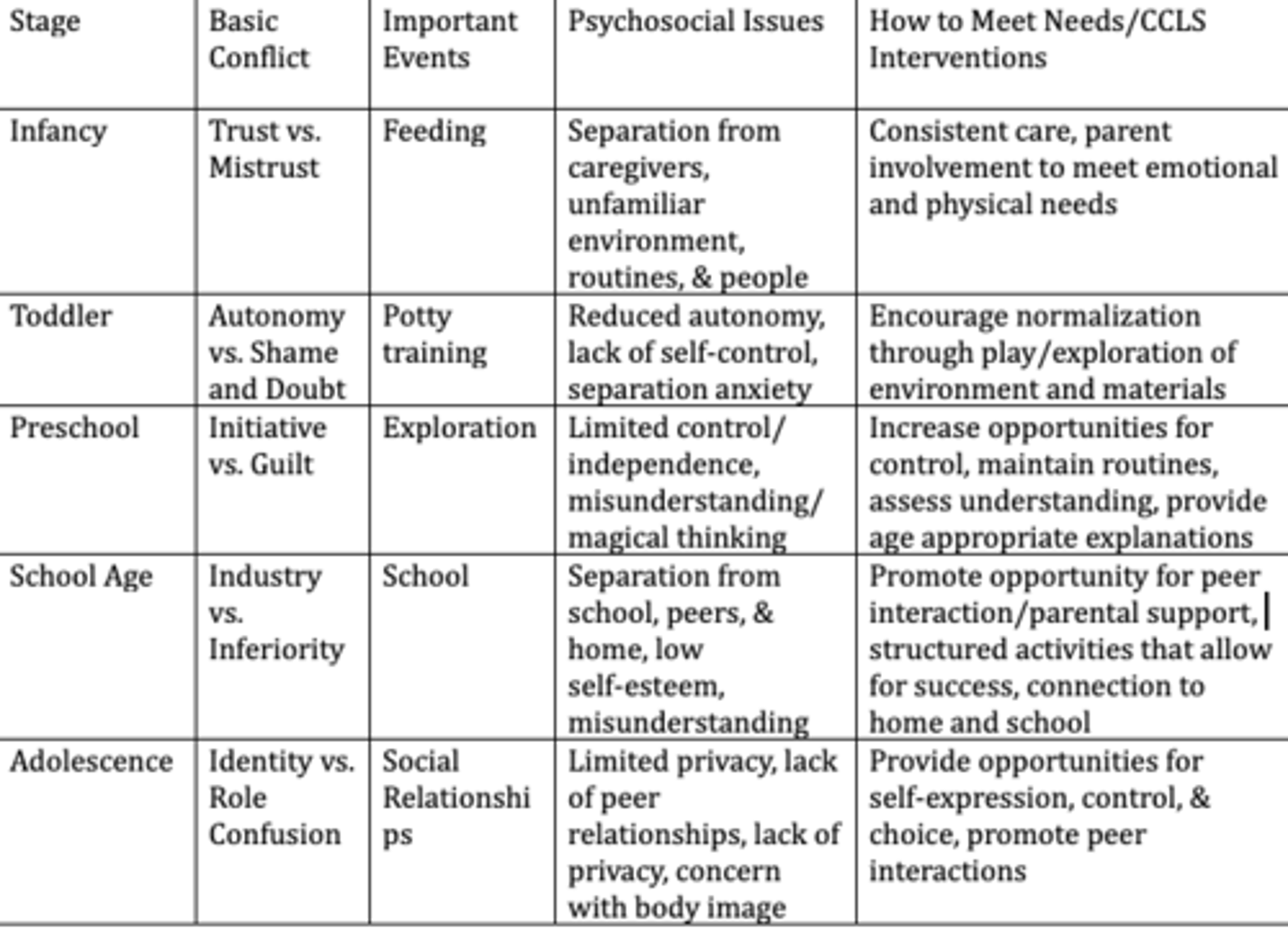
What healthcare can do to help: Infants
Respond quickly to crying or irritation-can be soothed with gentle touch/sound
▪ Interact face-to-face when baby is alert and seems ready for interaction
▪ Encourage family rooming in, break rooms, kangaroo care
▪ Maintain baby's normal eating, feeding, sleeping routine as much as possible
▪ Limit number of hospital workers in room
▪ Provide appropriate sensory experiences
▪ Make it easy for family to participate in baby's care
What healthcare can do to help: Toddlers
Encourage parental presence
▪ Offer choices to support independence
▪ Establish a 'safe zone' for procedures (e.g. using an exam room instead of patient's bed)
▪ Preparation, medical play
What healthcare can do to help: Preschool
Encourage expressive play
▪ Preparation, medical play
▪ Support family presence
- clarifying misconceptions
What healthcare can do to help: School Age
Healthcare workers should take great care using sarcasm or avoid sarcasm all together with this age group
What healthcare can do to help: Adolescents
- Explain you are not going to do things for them that they can do for themselves and why you are taking that approach
- Respect privacy by accepting a teen's decision not to talk
- Help teens find space and time for themselves
■ Accept a teen's freedom to express their views--even if you disagree with them
■ Help teenagers explore the sources of their attitudes and the consequences of them
■ Help teens develop their own healthcare goals
■ Remember that teens are more capable of responsible behavior than they are sometimes given credit for