Comprehensive Chemistry Review: Units, Atomic Structure, and Reactions
 Call Kai
 Learn
Learn Practice Test
 Spaced Repetition
 Match
Match Flashcards
 Knowt Play
1/55

There's no tags or description
Looks like no tags are added yet.
Name | Mastery | Learn | Test | Matching | Spaced | Call with Kai |
|---|
No analytics yet
Send a link to your students to track their progress
56 Terms
What are the metric units for temperature?
Degree Celsius
What are the metric units for mass?
Gram
What are the metric units for volume?
mL
What are the metric units for distance?
g/lm
What are three ways to determine the volume of an object?
Mathematical calculations, Water displacement, Direct measurement
How is matter classified?
Matter is classified into substances and mixtures.
What is a substance?
A pure substance that cannot be broken down and is made of only one type of atom.
What is a mixture?
A combination of two or more substances that can be either homogeneous or heterogeneous.
What is a homogeneous mixture?
A mixture that is uniformly mixed.
What is a heterogeneous mixture?
A mixture that is not uniformly mixed.
What is an element?
A substance that cannot be broken down into simpler substances.
What is a compound?
A pure substance made of two or more types of elements linked together.
What are the three states of matter?
Solid, Liquid, Gas
How is a solid defined in terms of shape and volume?
Shape: definite, Volume: definite
How is a liquid defined in terms of shape and volume?
Shape: indefinite, Volume: definite
How is a gas defined in terms of shape and volume?
Shape: indefinite, Volume: indefinite
What does 'aqueous' mean?
A solution formed when a substance is dissolved in water.
What is the atomic number?
The number of protons in the atomic nucleus.
What is the mass number?
The total number of protons and neutrons in an atom.
What are physical properties?
Mass, Color, Volume, Density
What are chemical properties?
Flammability, Rusting, Decomposing
What are physical changes?
Changes in shape, form, size, or phase.
What are chemical changes?
Changes in color, odor, bubbling, precipitate formation, heat, and light.
What are the main pieces of evidence that a chemical reaction has taken place?
Color change, Odor change, Bubbling, Heat, Light
Who contributed to the atomic theory?
Democritus, John Dalton, Joseph John Thomson, Ernest Rutherford, James Chadwick, Niels Bohr
Who designed the periodic table?
Dmitri Mendeleev
How is the modern periodic table organized?
Elements are arranged by increasing atomic mass with blank spaces for undiscovered elements.
What is a pure substance?
A material that is either an element or a compound.
What are the two types of mixtures?
Homogeneous and heterogeneous.
What is density?
A physical property that measures how much mass is contained within a given volume.
What is the density of CO gas if 0.196 g occupies a volume of 100 ml?
1.96 g/ml.
What is the density of a block of wood with a mass of 27 g and volume of 27 ml?
1 g/ml.
How do you calculate the density of an irregularly shaped stone that displaces 5 ml of water and has a mass of 25 g?
Density = 25g/5 mL = 5 g/mL.
What determines if an object will sink or float in water?
An object will sink if it is more dense than water and float if it is less dense.
What is the classification of sodium?
Metal, Group #1, Alkali Metal.
What is the classification of chlorine?
Non-metal, Group #17, Halogen.
What is the atomic number of nitrogen?
7.
What is the average atomic mass of nitrogen based on its isotopes?
Approximately 13.9986 amu.
What is the full electron configuration of carbon?
1s^2 2s^2 2p^2.
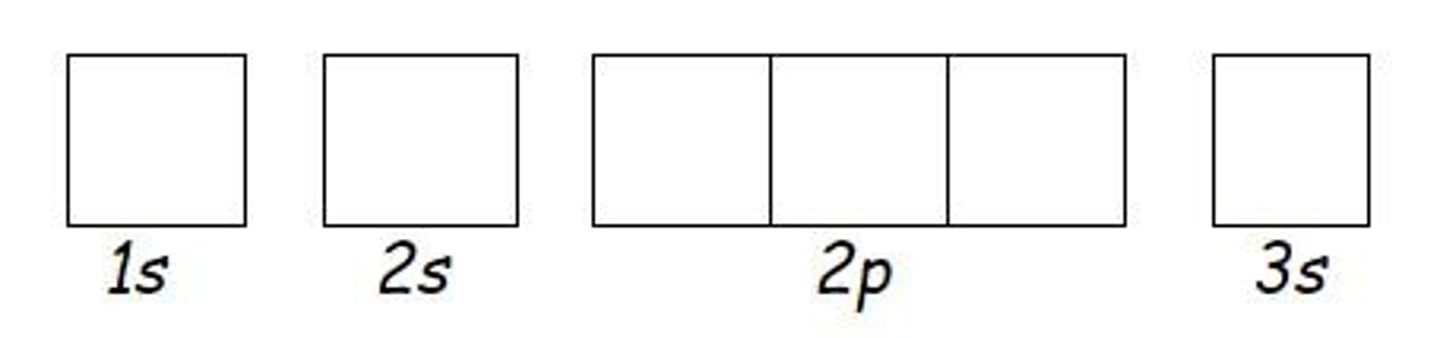
What is the noble gas shorthand electron configuration for phosphorus?
[Ne] 3s^2 3p^3.
![<p>[Ne] 3s^2 3p^3.</p>](https://knowt-user-attachments.s3.amazonaws.com/53dd13ed-2b3c-4bd5-b0df-53dea0f7c56a.jpg)
What is the molar mass of Li2O?
29.88 g/mol.
What is the balanced equation for the reaction of aluminum and iodine?
2Al + 3I2 → 2AlI3 (synthesis).
What type of reaction is SiCl4 + 2Mg > Si + 2MgCl2?
Single replacement.
How many grams of Ca(NO3)2 do you have if you have 3.5 moles?
574.35 grams.
If you have 282 grams of C6H12O6, how many moles do you have?
1.5653 moles.
What is the density of a substance if its mass is 25 g and it occupies a volume of 5 mL?
5 g/mL.
What is the charge of a cation?
A positive charge indicating the loss of electrons.
What is the charge of an anion?
A negative charge indicating the gain of electrons.
What is the Lewis dot structure for sodium?
Na with 1 dot around it.
What is the Lewis dot structure for chlorine?
Cl with 8 dots around it.
What is the electron configuration for argon?
1s^2 2s^2 2p^6 3s^2 3p^6.

What is the family name of argon?
Noble gas.
What is the family name of beryllium?
Alkaline Earth Metal.
What is the family name of nitrogen?
Group #15.
What is the family name of chlorine?
Halogen.
What is the family name of sodium?
Alkali Metal.