Concentration, Dilution, Titration & Molarity
 Call Kai
 Learn
Learn Practice Test
 Spaced Repetition
 Match
Match Flashcards
 Knowt Play
1/8

There's no tags or description
Looks like no tags are added yet.
Name | Mastery | Learn | Test | Matching | Spaced | Call with Kai |
|---|
No analytics yet
Send a link to your students to track their progress
9 Terms
Titration
Titration is a way to figure out how strong a liquid is. It is a method used to find the concentration of an unknown solution. You do this by adding a solution with a known concentration until the reaction is complete.
You have a liquid and you don’t know its concentration.
You slowly add another liquid that you do know the concentration of.
When the reaction finishes (usually shown by a color change), you stop.
The amount you added tells you how strong the unknown liquid was.
You don’t know how strong an acid is. You slowly add a base with a known concentration. When they exactly cancel each other out, you stop. Now you can calculate the acid’s concentration.
EX: you have 25.0 mL of HCl (acid) it’s concentration is unknown. You have 0.100M NaOH (base) its concentration is known. It takes 30.0mL of NaOH to completely react with the acid. Find the concentration of the HCl.
Balanced equation is: HCl + NaOH —> NaCl + H2O
(Convert your mL to liters (Molarity is based on Liters)).
0.03L NaOH x 0.100mol NaOH/ 1 L NaOH = 0.003 mol NaOH x 1 mol HCl/1 mol NaOH = 0.003 mol HCl / 0.025 L HCl = 0.12M is HCl concentration
Concentration
measures how much solute is present in a given amount of solution. (how much solute is relative to the amount of solution or sometimes solvent). It is always a ratio. EX: 1 spoon of salt in a glass = low concentration. 5 spoons of salt in 1 glass = high concentration
Diluted
less solute, more solvent. Dilution is making something that is highly concentrated less concentrated, and it is done by adding more solvent.
Concentrated
more solute, less solvent. Concentration is making something that is diluted concentrated, it is done by adding more solute.
Concentration =
Molarity. Molarity is moles of solute/ Liters of solution. It is how much solute is present per liter of a solution.
Stock Solution
a concentrated solution that you keep on hand so that you can prepare diluted solutions when needed. THINK: syrup. Syrup is your stock solution (highly concentrated). If you pour some syrup into water, you get a sweet drink (a diluted solution). Stock solution is high in concentration and stored properly so you don’t have to make a fresh solution every time.
Molarity
tells you how concentrated a solution is, because it is the moles of solute/liters of solution. So, Molarity = moles of Solute/ Liters of solution
Dilution Formula
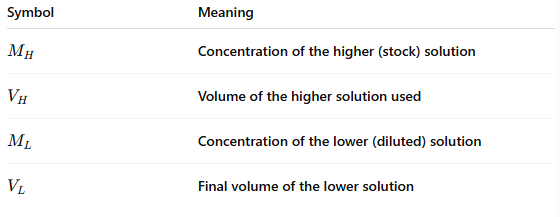
MH x VH = ML x VL . This is the dilution formula, because you’re going from highly concentrated (MH, initial molarity) and VH the volume of the concentrated solution used, to a lower concentration ML and VL, the final and total volume after dilution. This formula is ONLY used for dilution problems.
How to use Dilution Formula
Identify which is the stock solution (higher concentration) this is your MH VH
Identify the target solution (diluted) this is ML VL
Arrange them and solve for your unknown.
EX: You have 3.0M Hydrochloric acid. You take 50 mL of it and dilute it with water until the total volume becomes 300 mL.
3.0 (MH) x 50mL (VH) = ML x 300mL (VL)
150 = 300ML (divide both sides by 300) and 0.5 is your ML