Bio 161 W2 - Nucleic Acids
 Call Kai
 Learn
Learn Practice Test
 Spaced Repetition
 Match
Match Flashcards
 Knowt Play
1/89

There's no tags or description
Looks like no tags are added yet.
Name | Mastery | Learn | Test | Matching | Spaced | Call with Kai |
|---|
No analytics yet
Send a link to your students to track their progress
90 Terms
What is a nucleic acid?
a macromolecule that stores and transmits genetic information (DNA & RNA)
a string of nucleotides
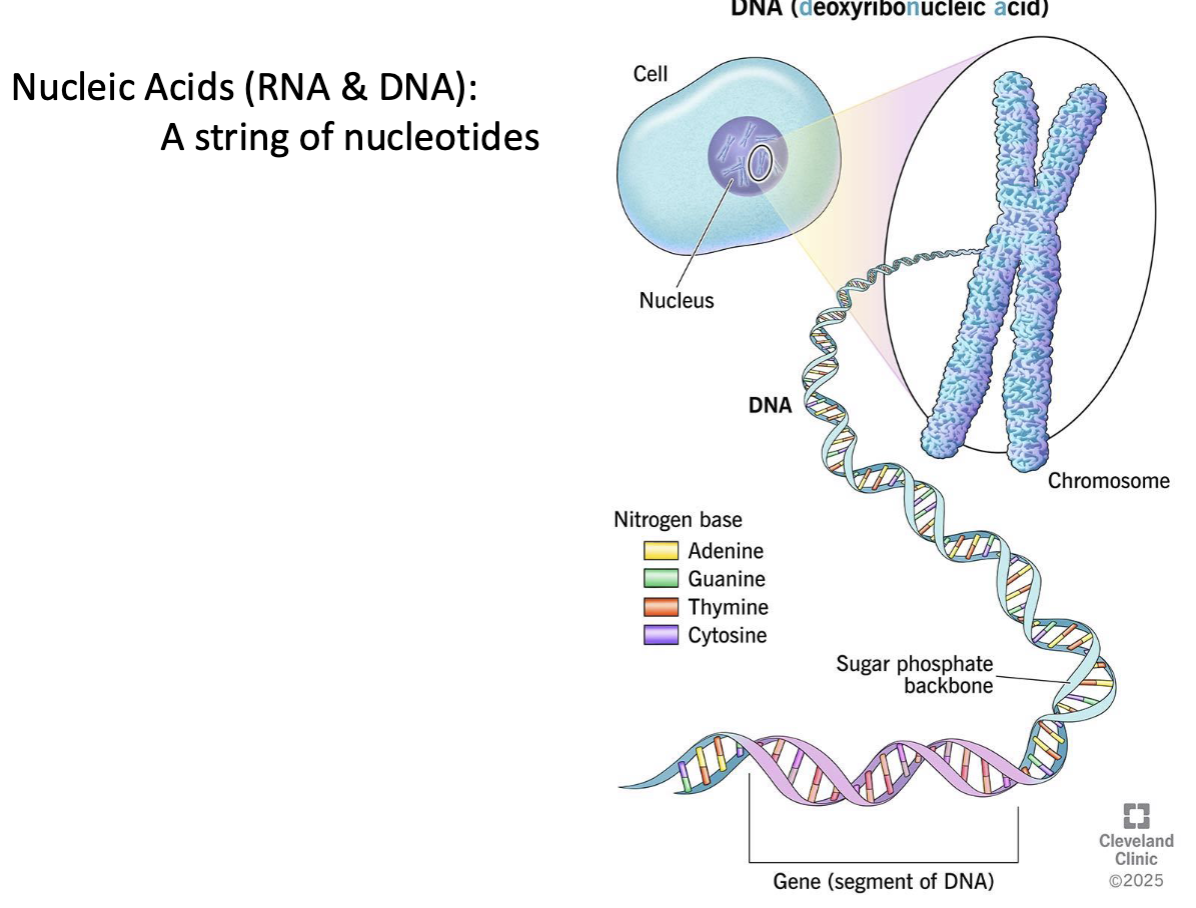
DNA & RNA make up
the human genetic material for life
DNA & RNA can be found in nucleus
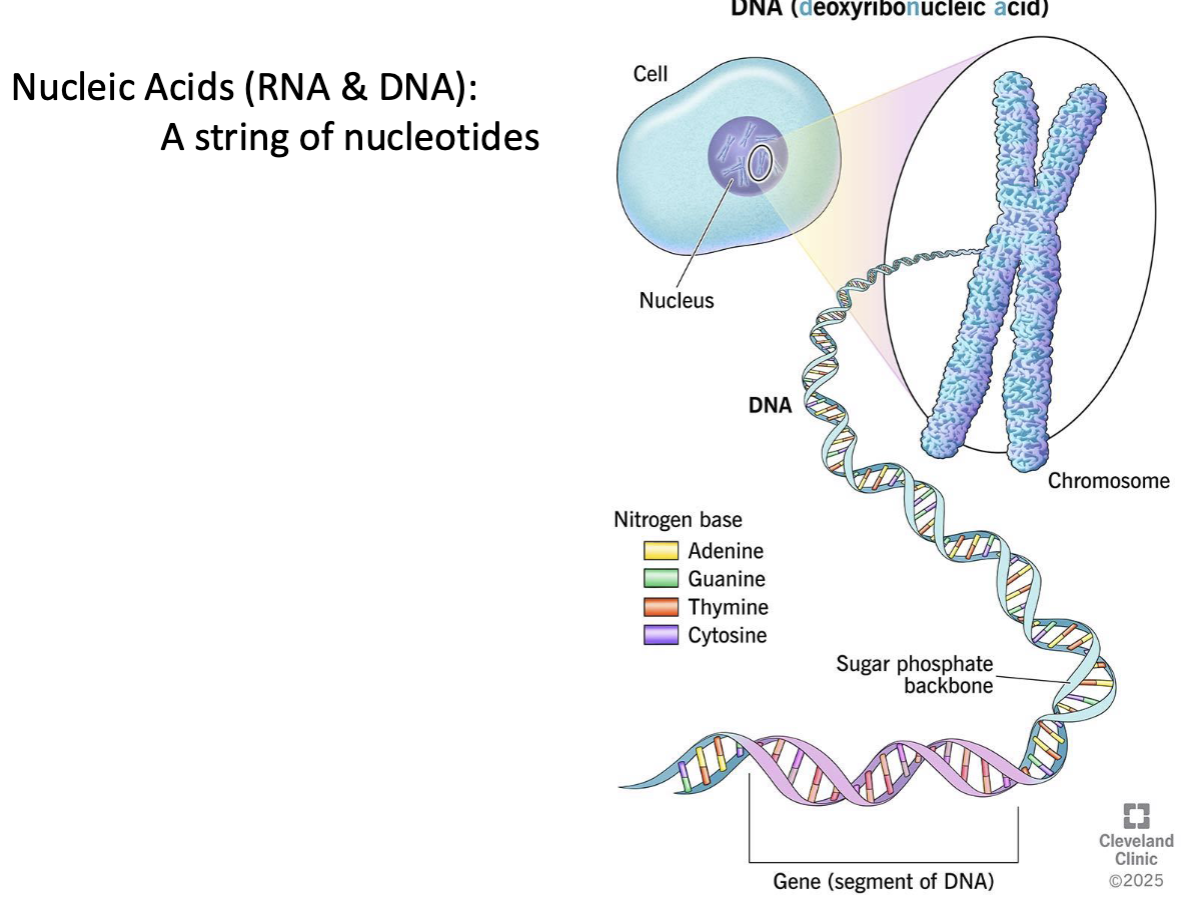
What are the two main nucleic acids found in humans?
DNA & RNA
What is the function of DNA
long term storage of genetic information
What is the function of RNA
involved in gene expression
What is a karyotype?
organized display of chromosomes
we have 23 pairs of chromosomes
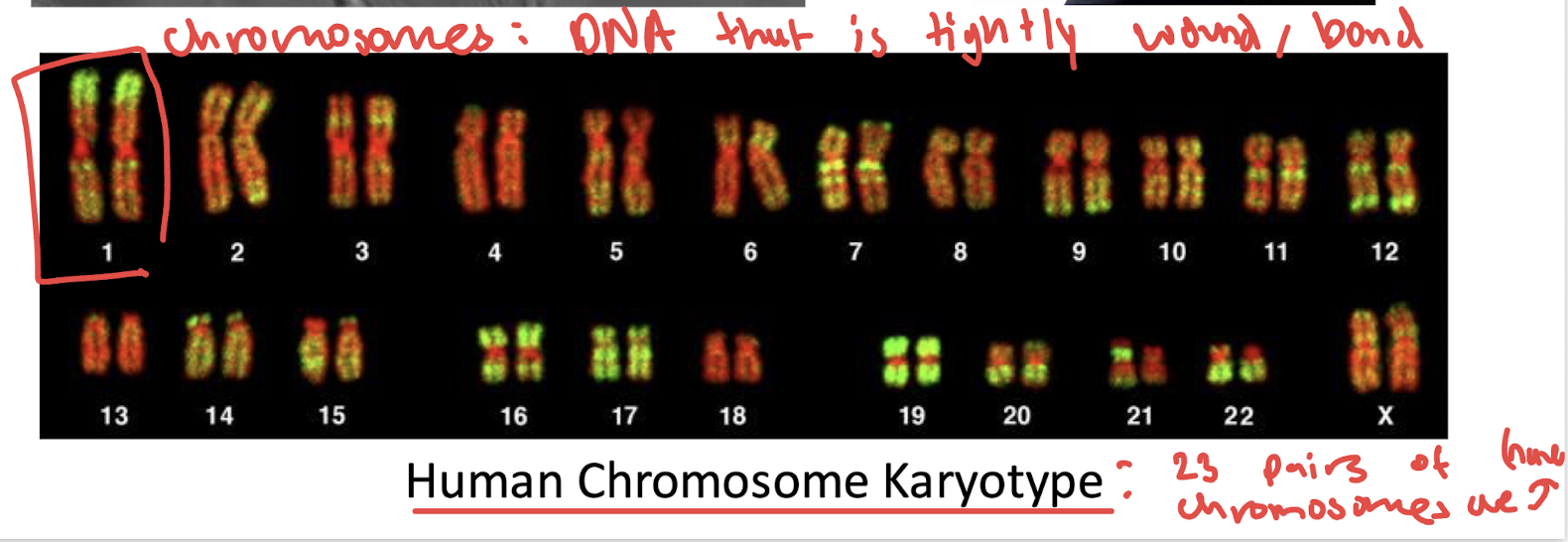
What is the utility of a karyotype?
Detect genetic disorders, determine sex, identify chromosomal abnormalities
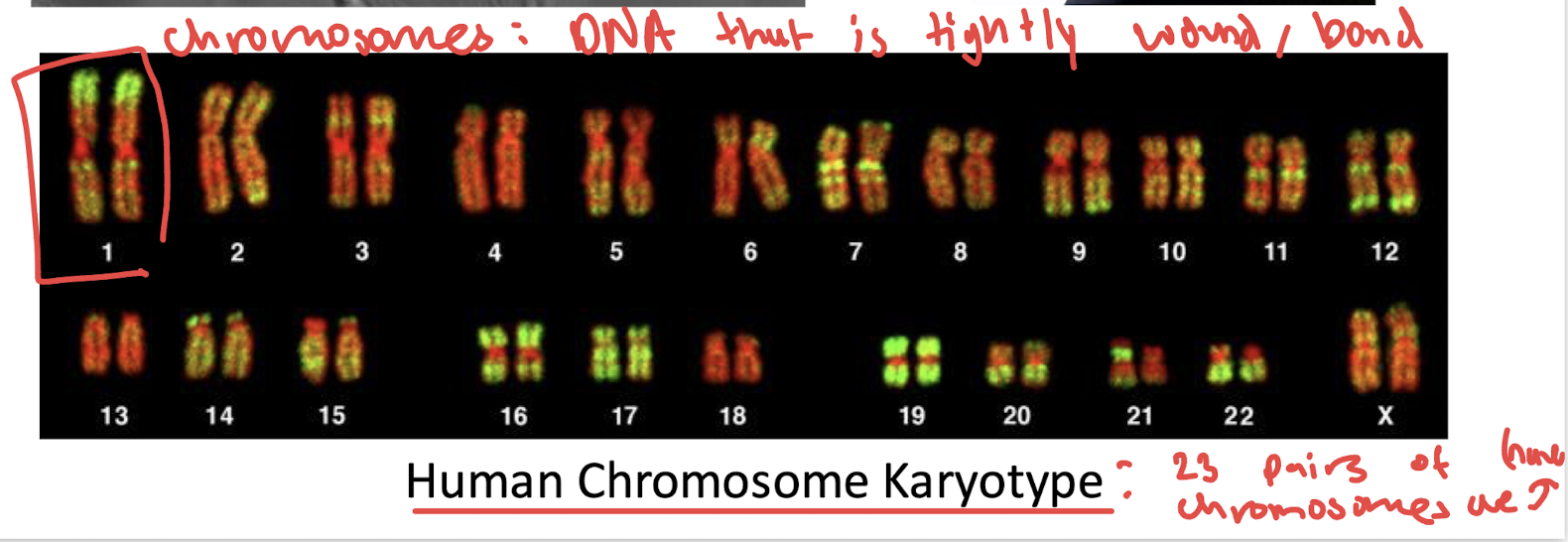
Nucleic acids can
un-spool chromosomes
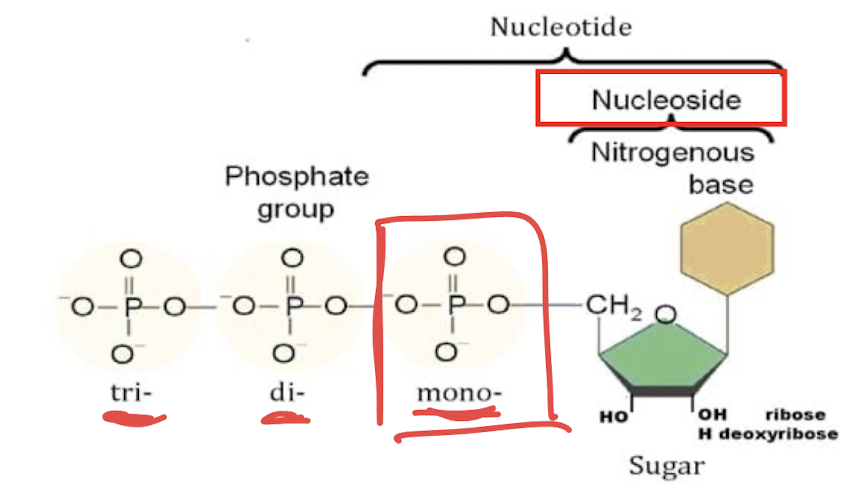
What is a nucleotide?
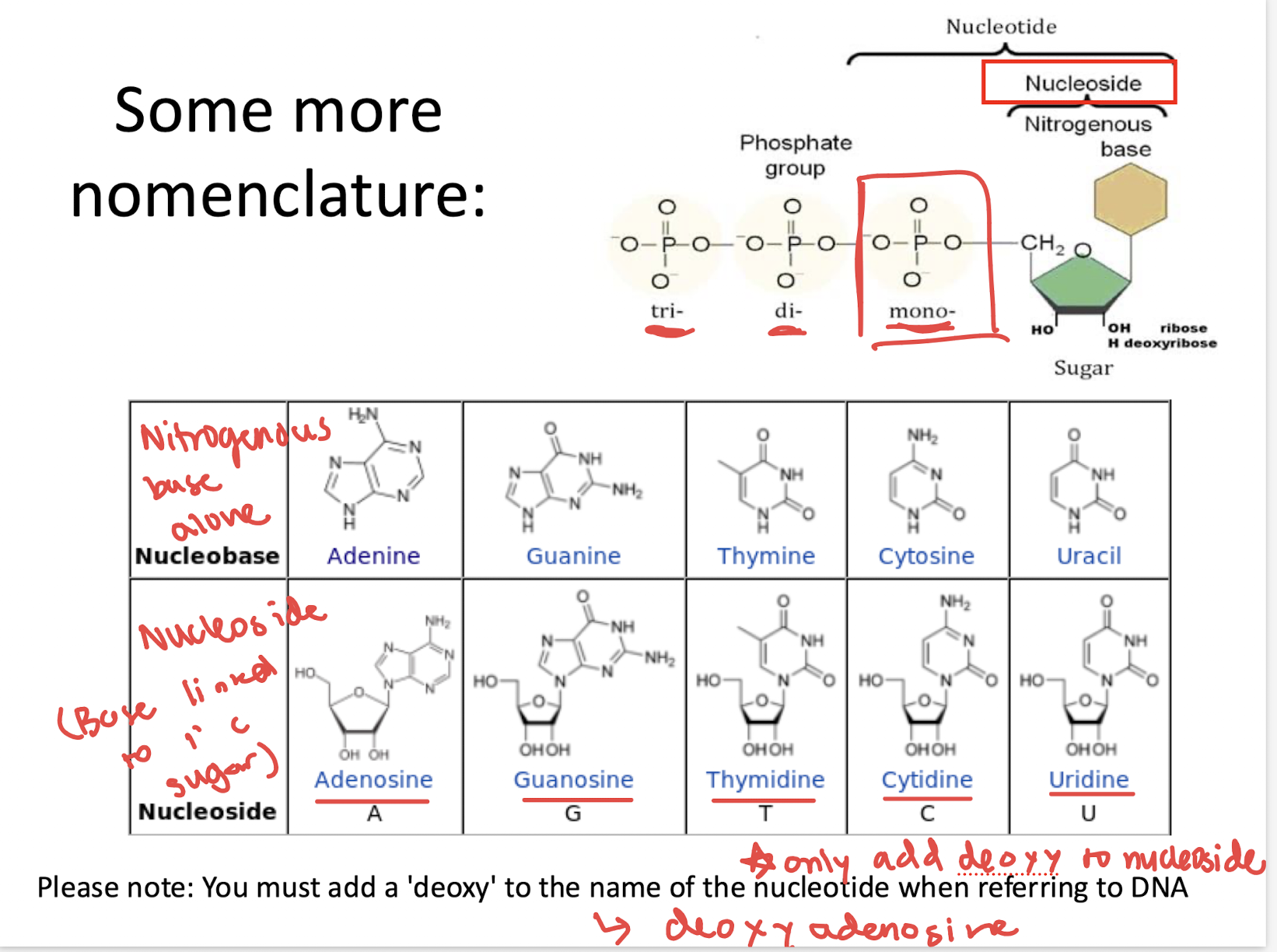
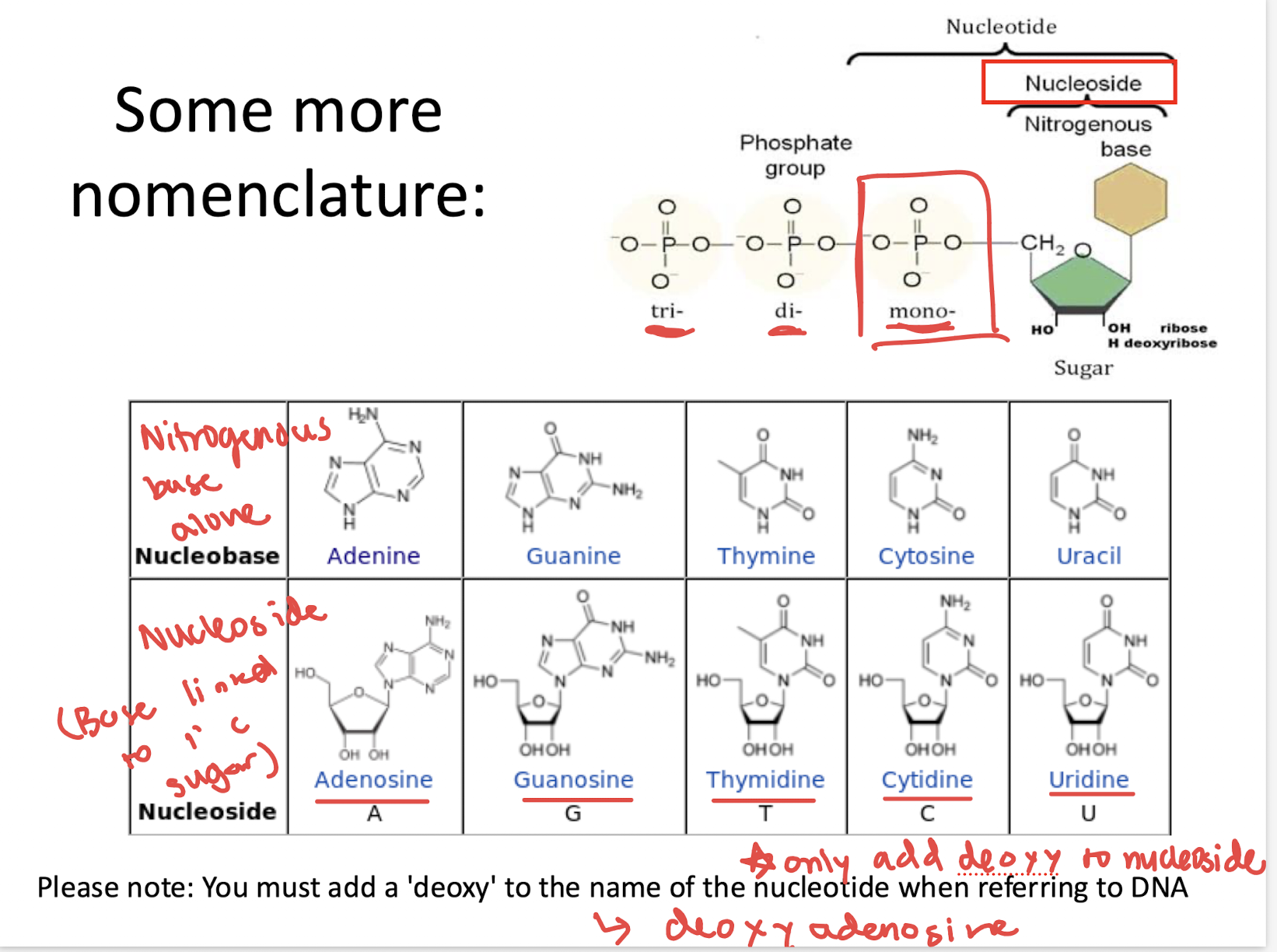
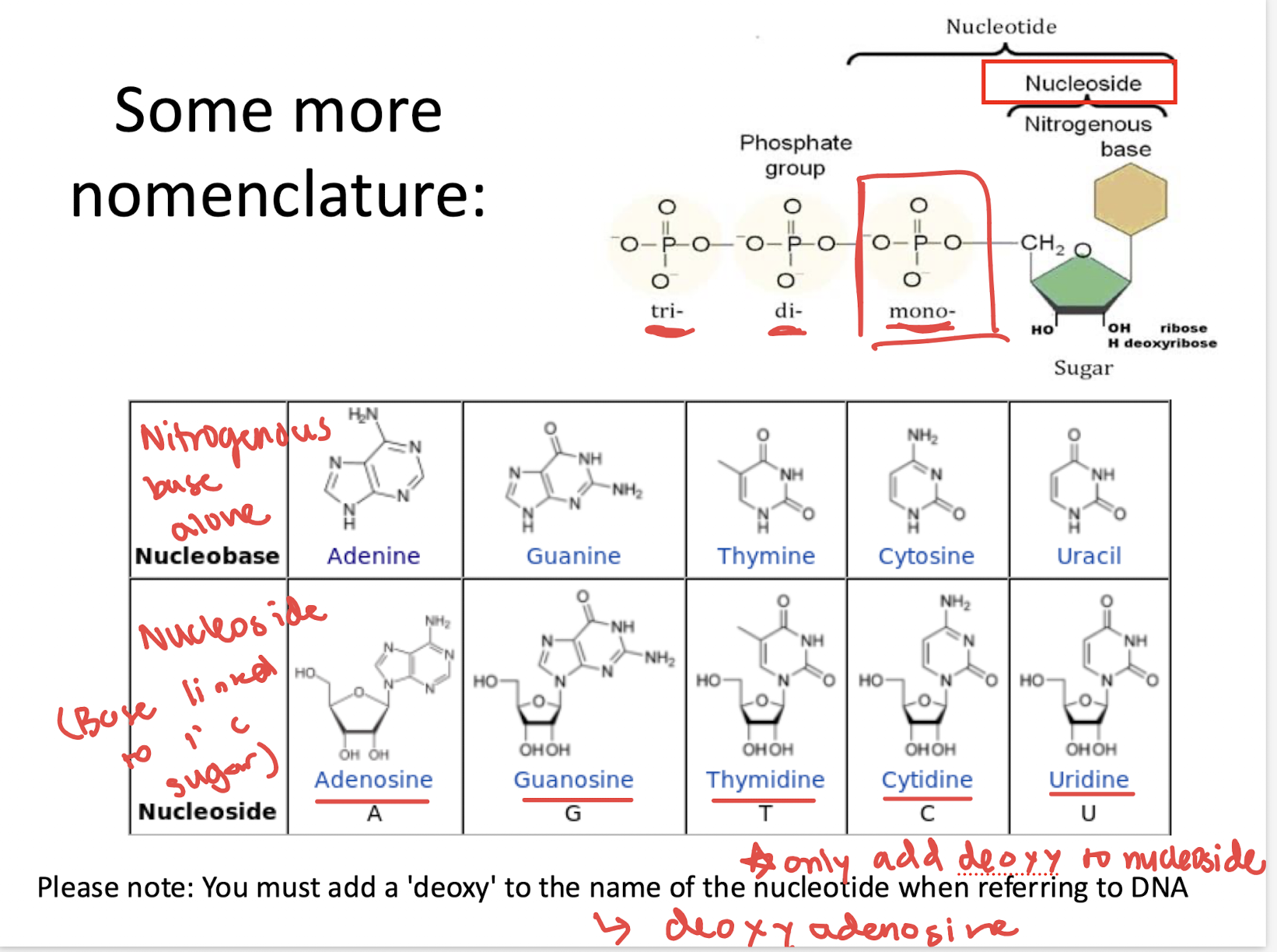
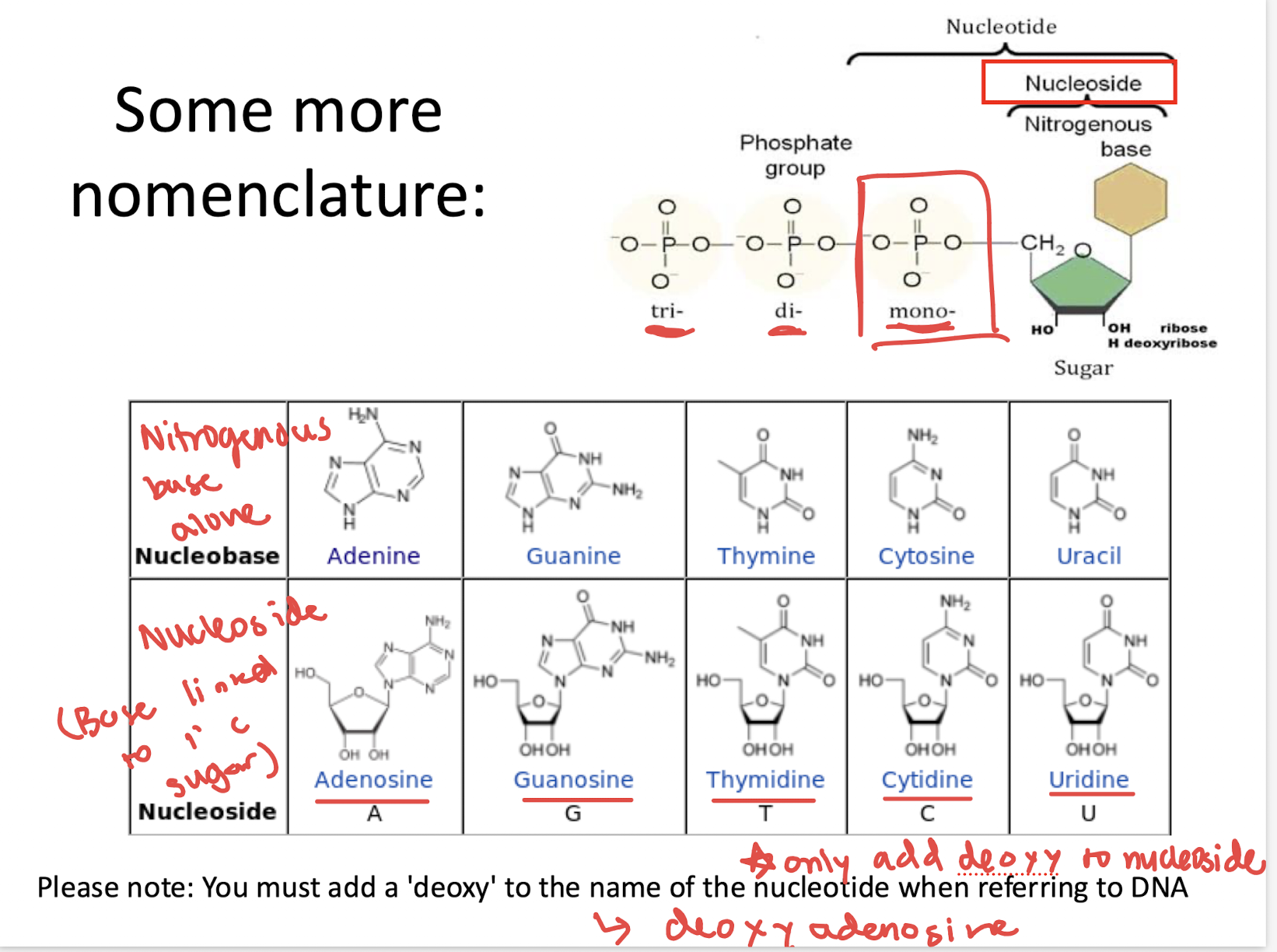
base subunit of nucleic acids
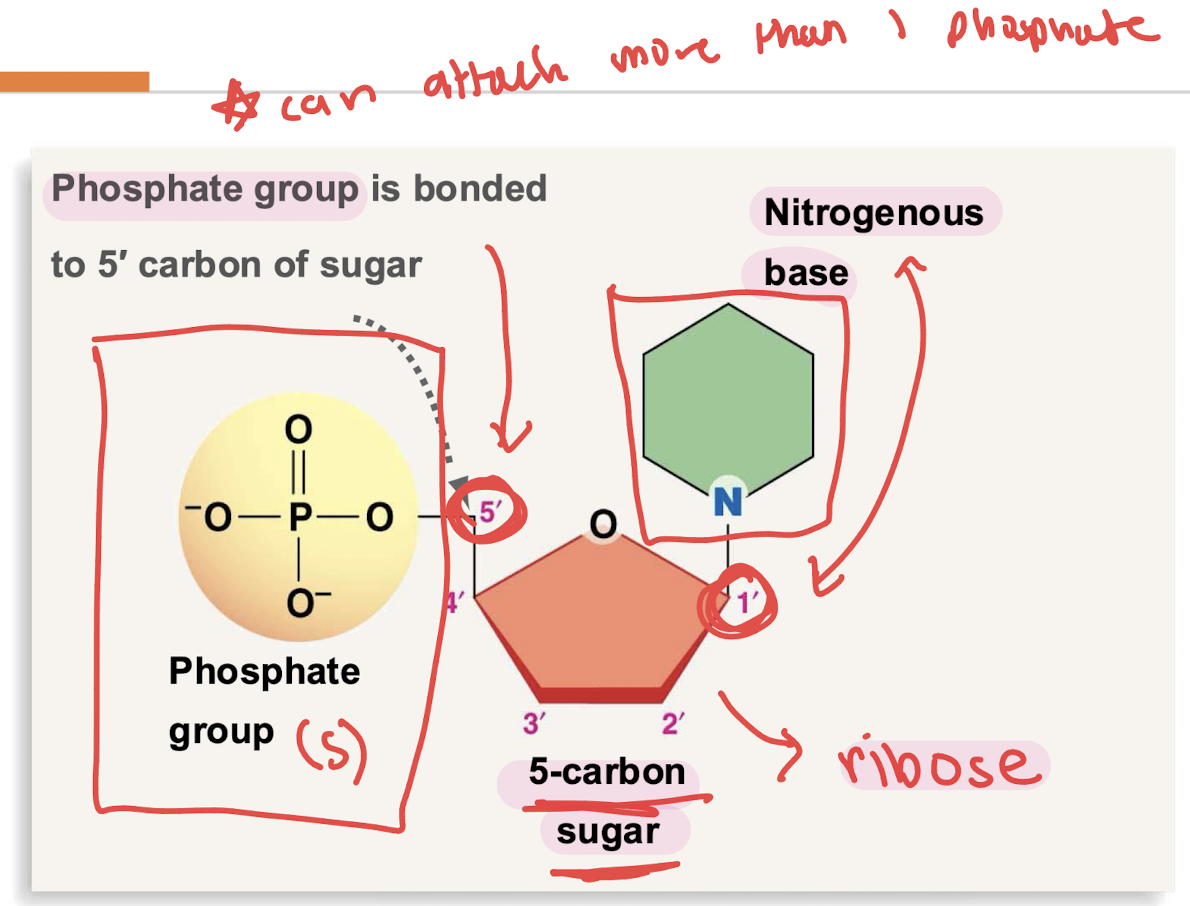
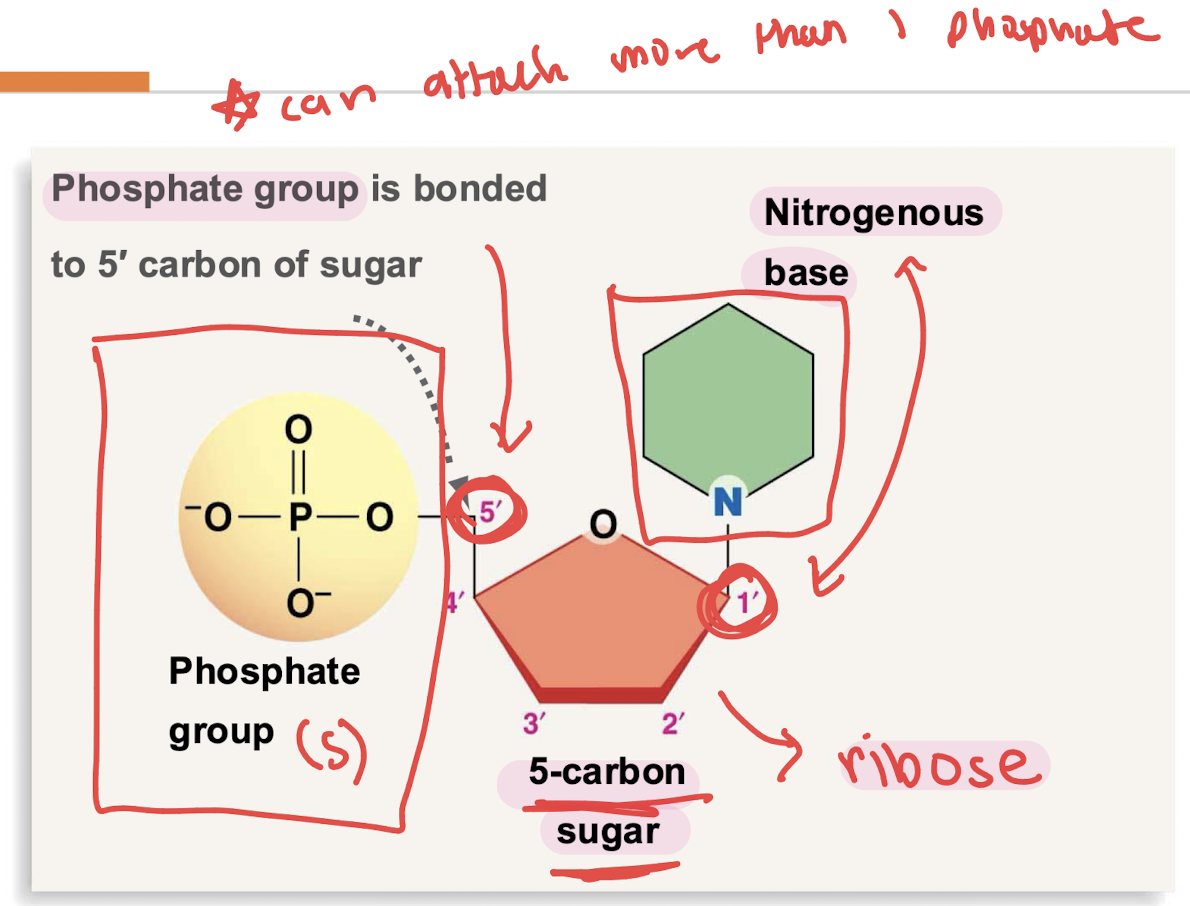
What are the three components of a nucleotide?
Phosphate group
5 carbon sugar (ribose or doexyribose)
Nitrogenous base
What is a nitrogenous base?
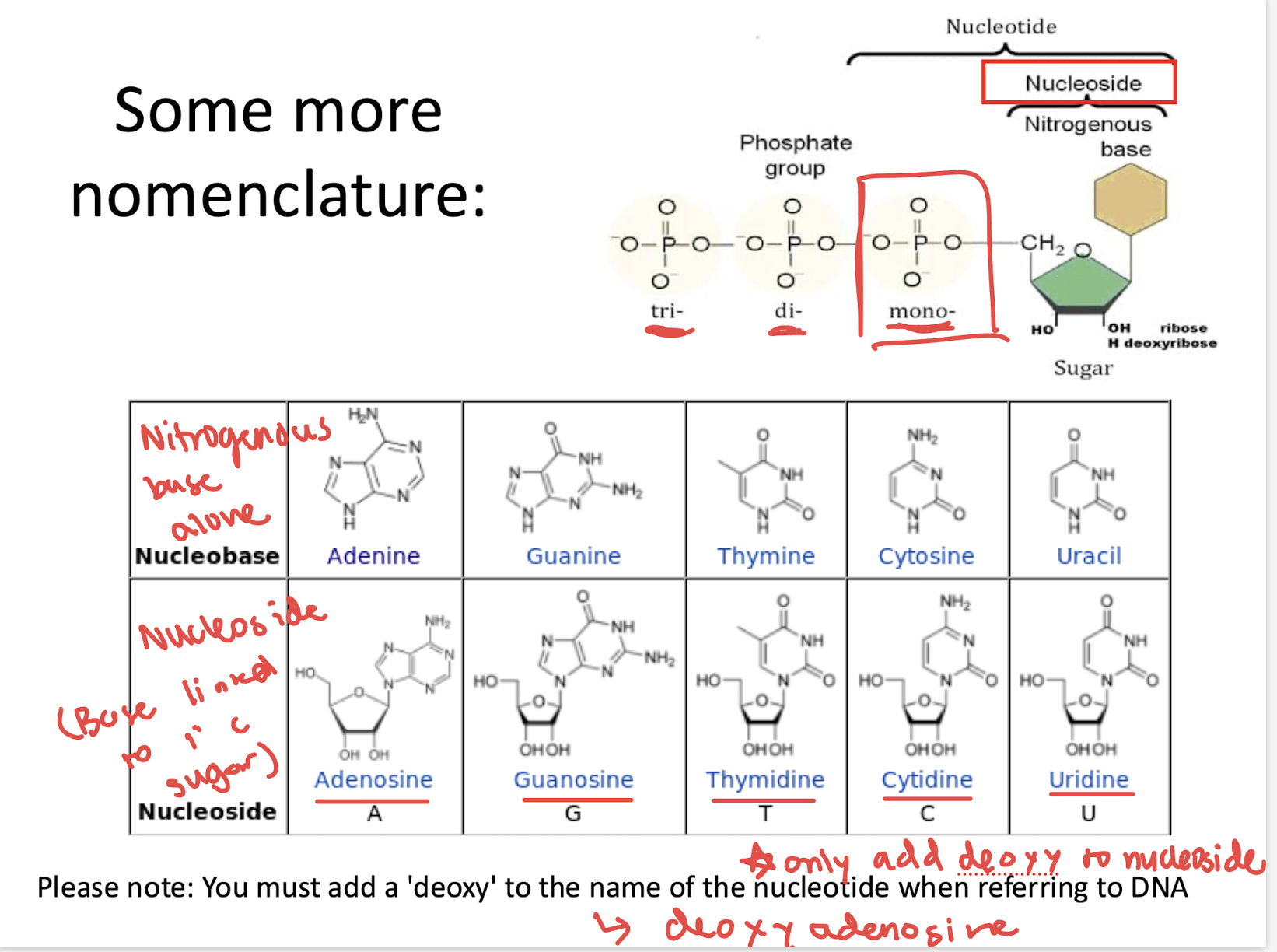
the base component (A, T, C, U, G)
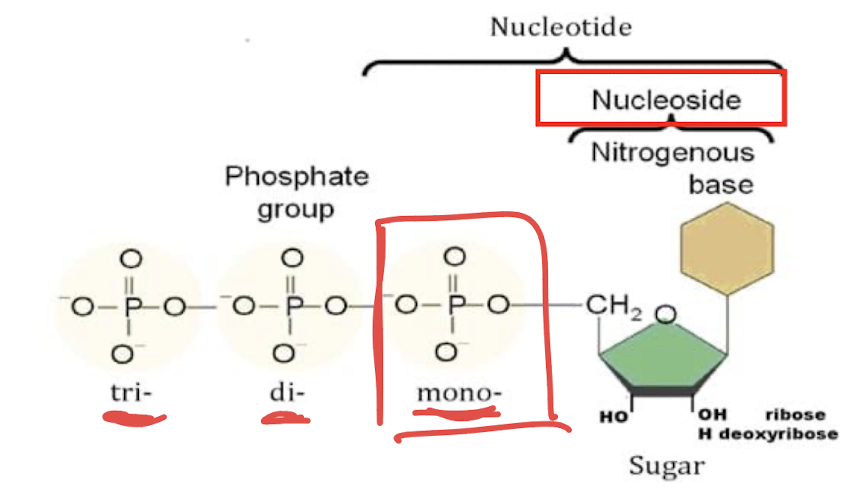
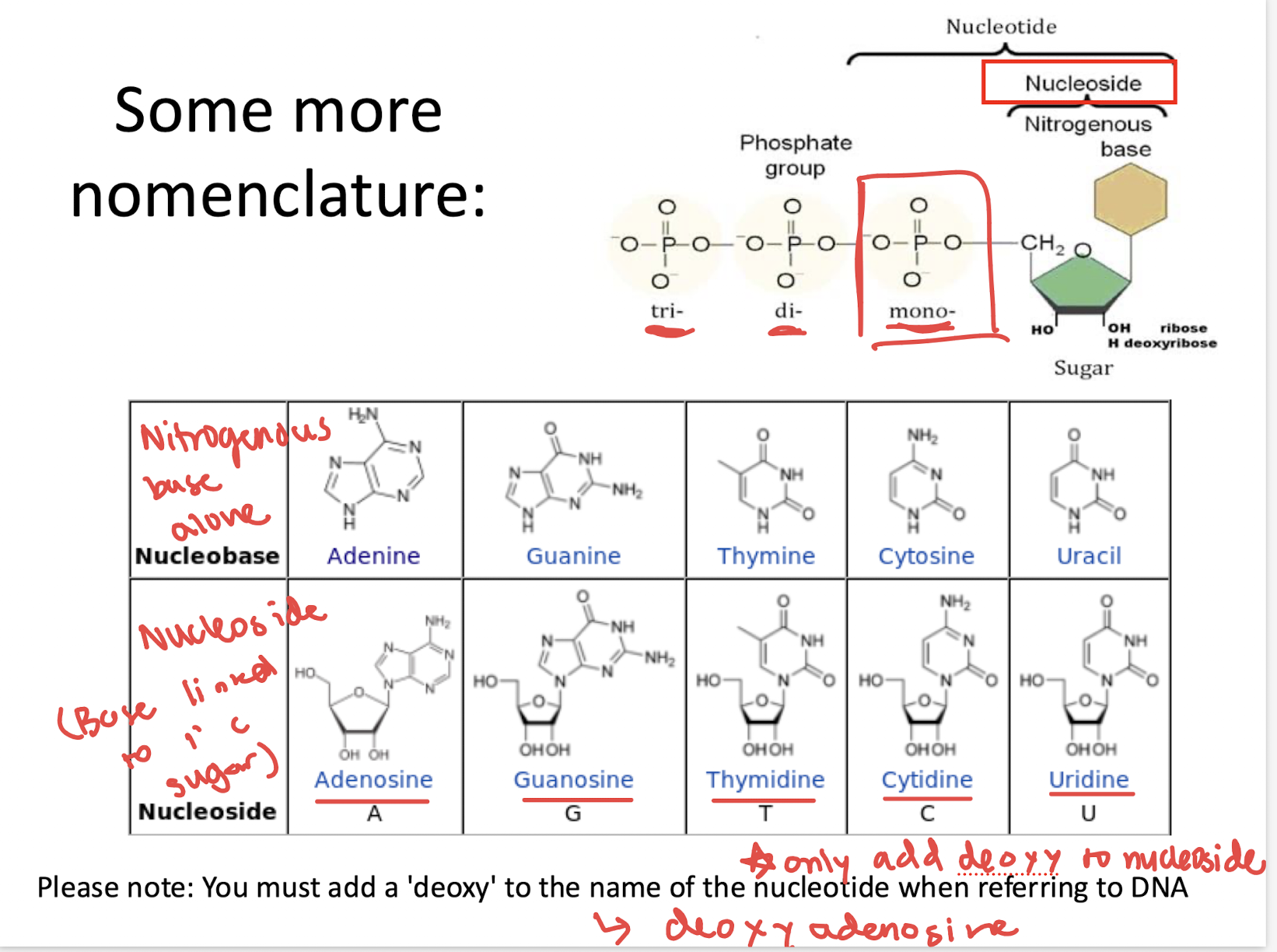
What is a nucleoside?
nitrogenous base + 1’ carbon sugar (ribose/deoxyribose)
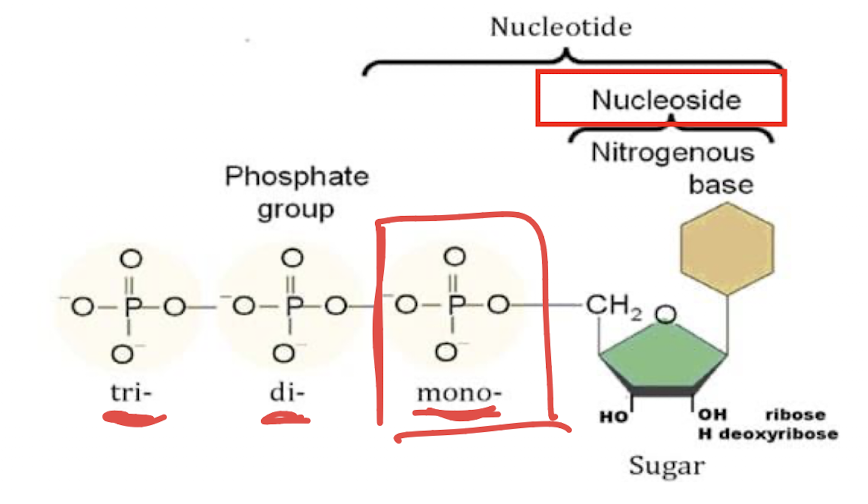
What is a nucleotide?
nitrogenous base + sugar + phosphate group(s)
What attaches to the 1’ carbon?
nitrogenous base
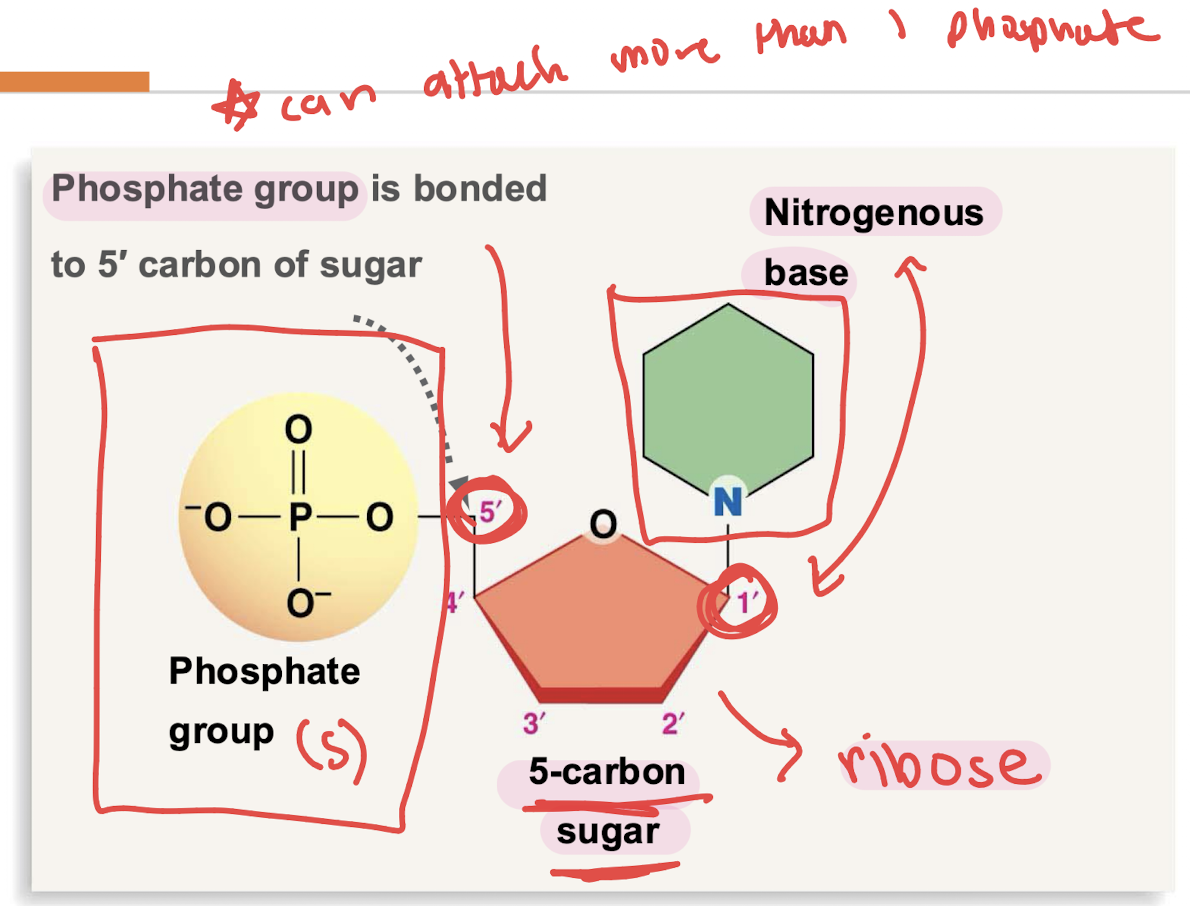
What attaches to the 5’ carbon?
phosphate group
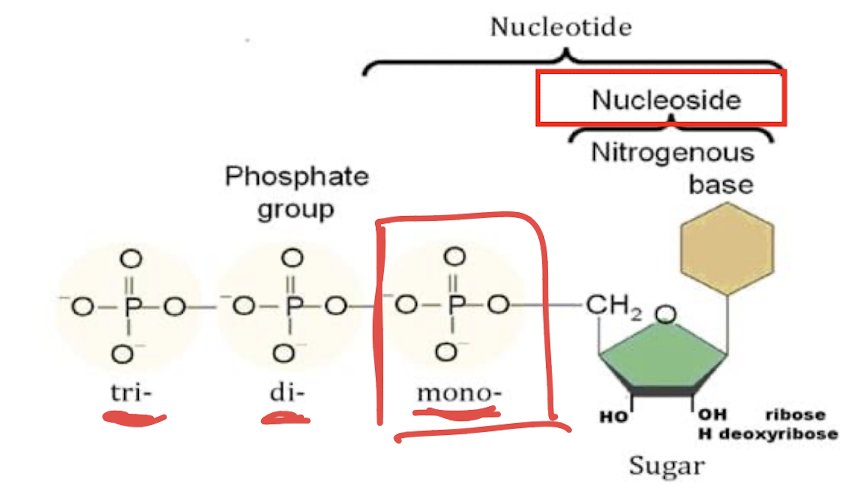
What is special about the 3’ carbon?
has -OH group used in polymerization
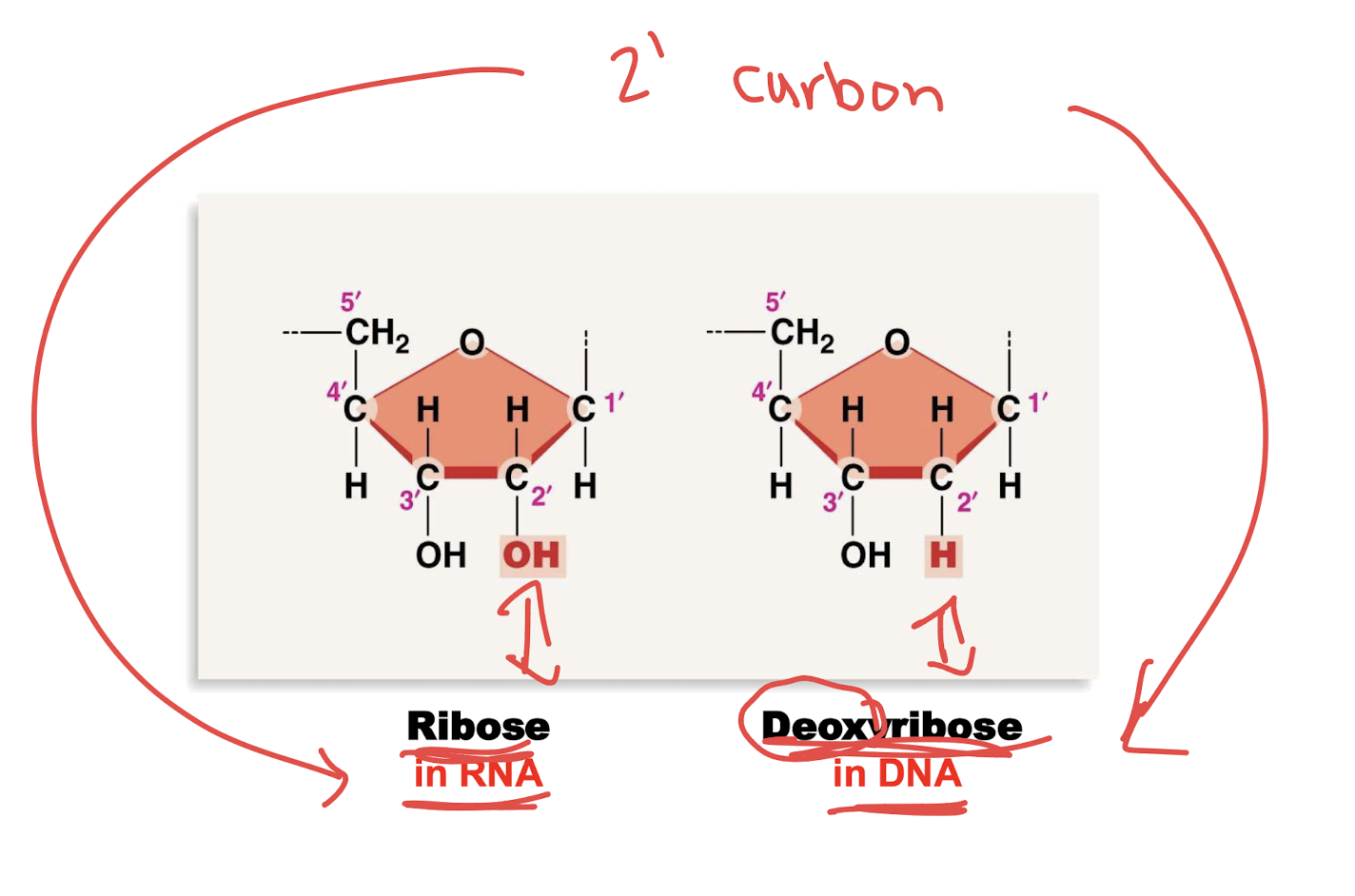
difference in ribose & deoxyribose?
Ribose (in RNA) has OH at 2′; deoxyribose (in DNA) has H at 2′
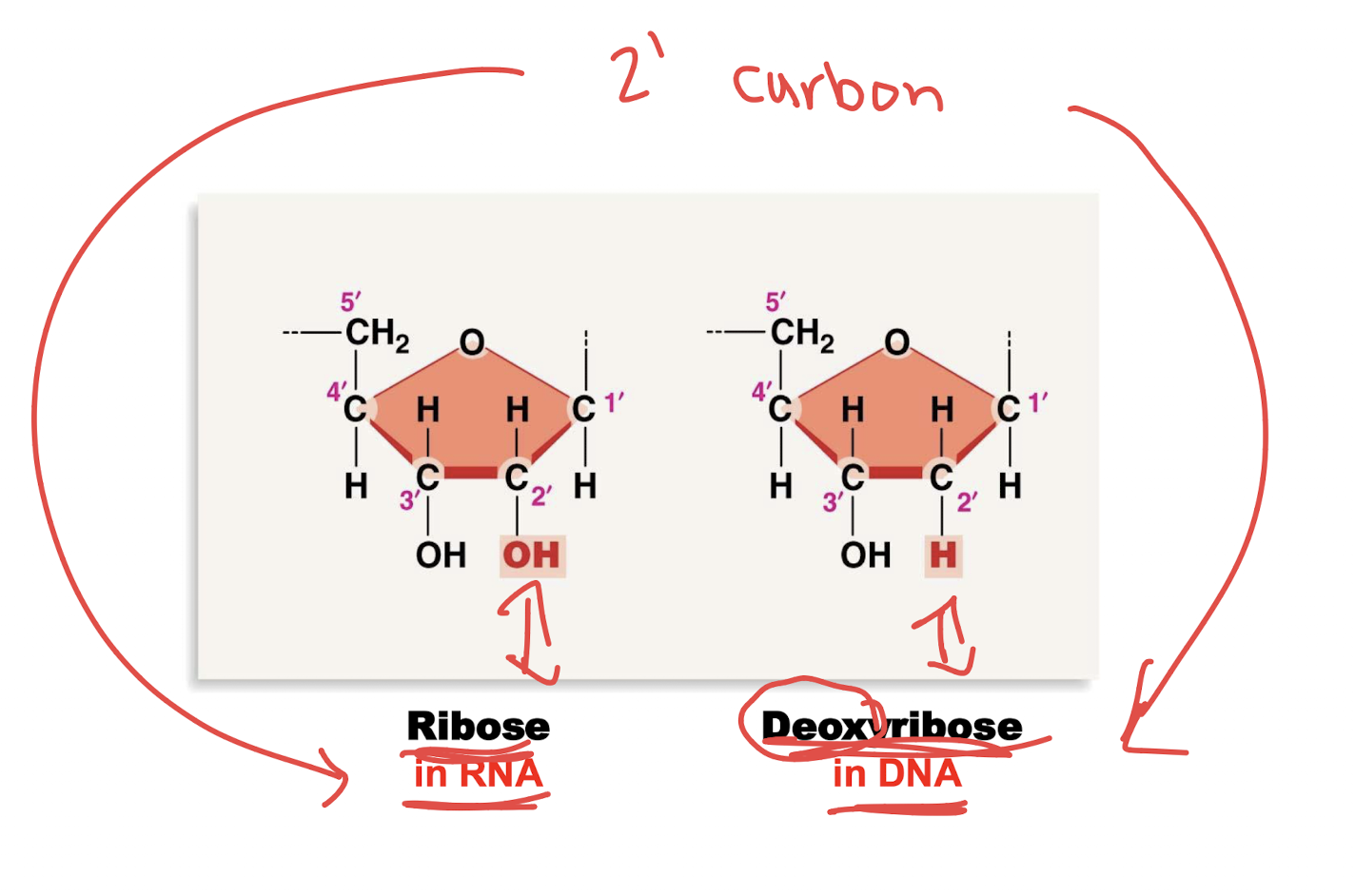
ribose has
(in RNA) an OH at the 2’ carbon
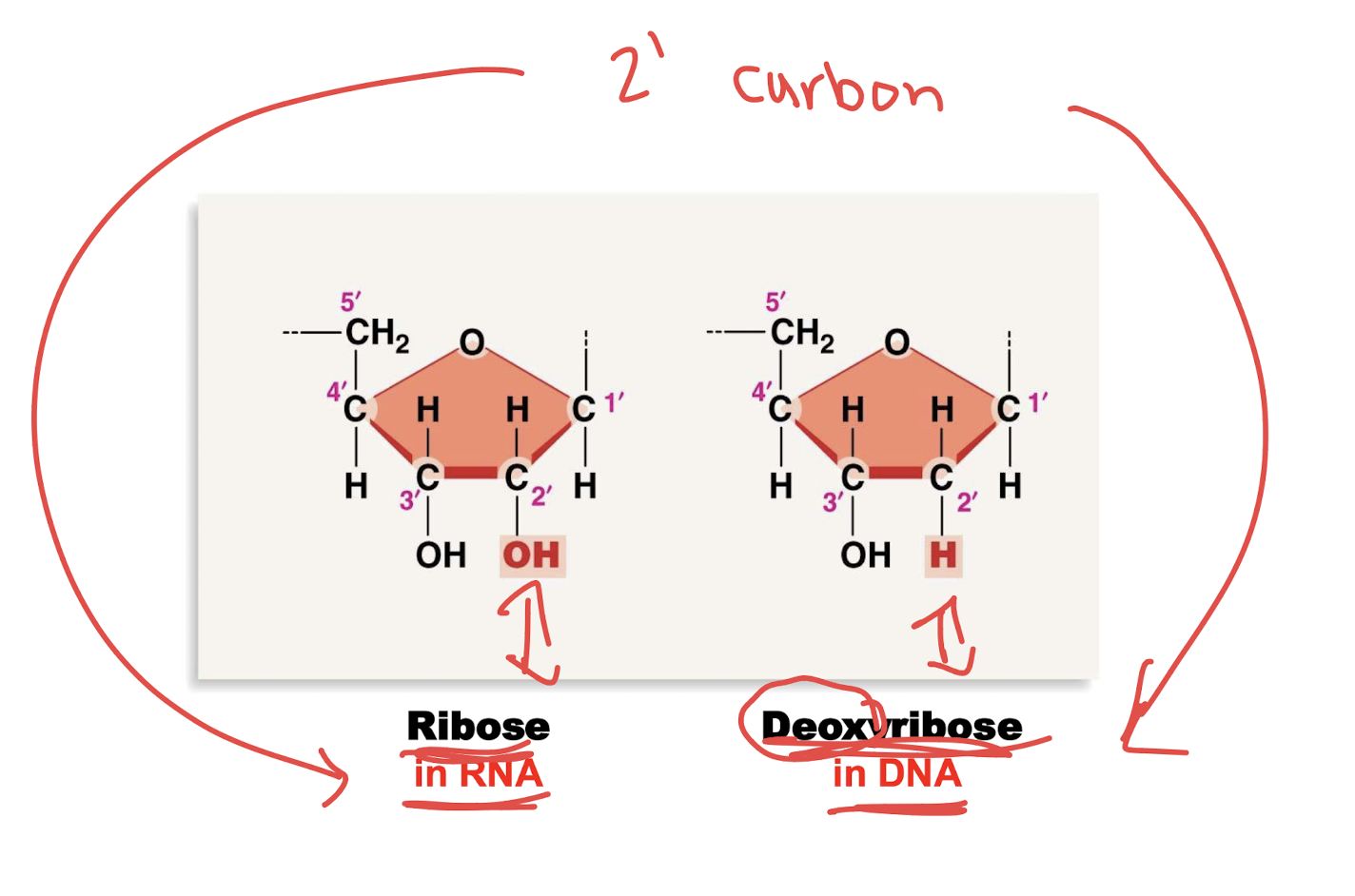
deoxyribose
(in DNA) an H at the 2’ carbon
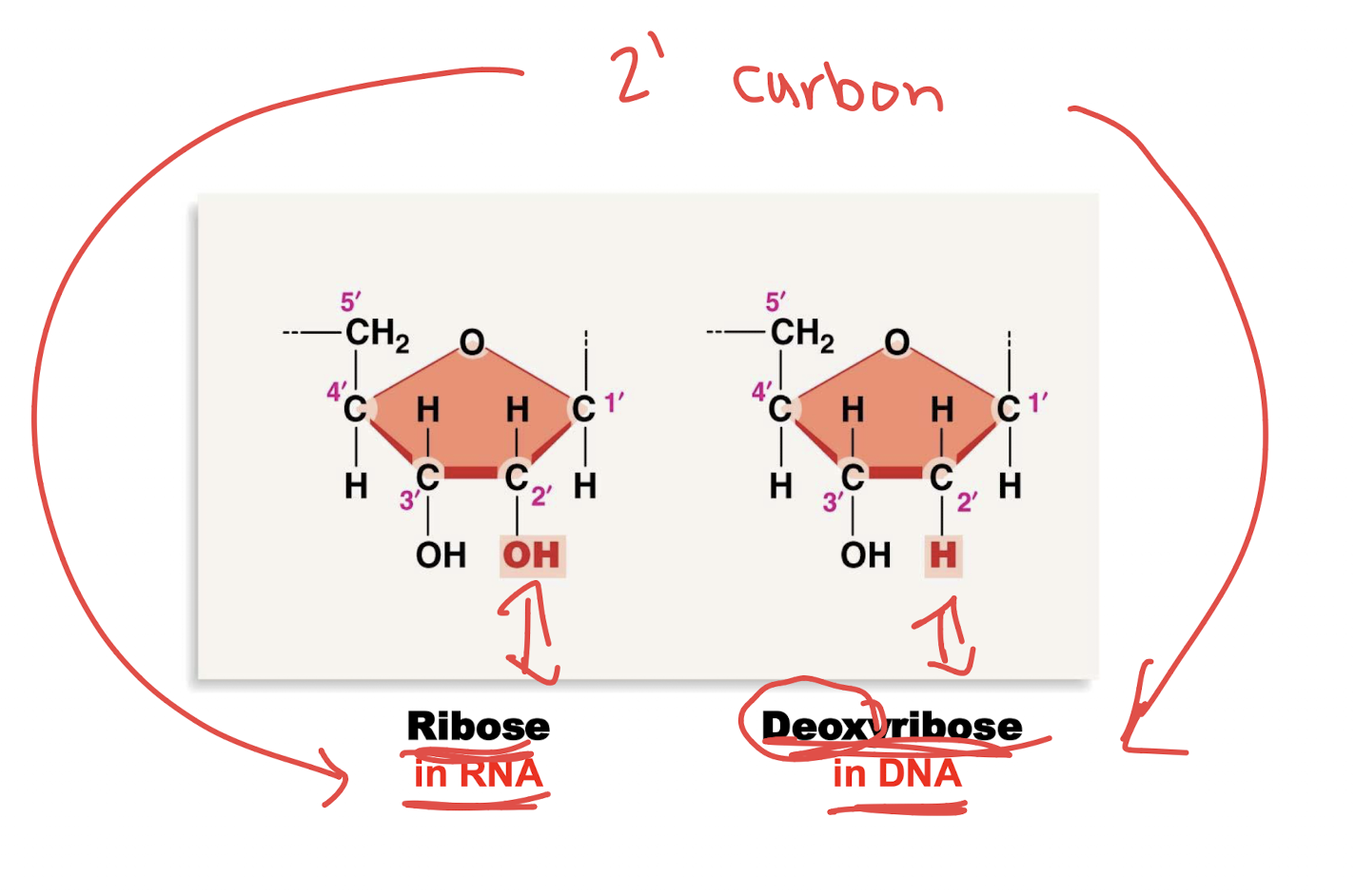
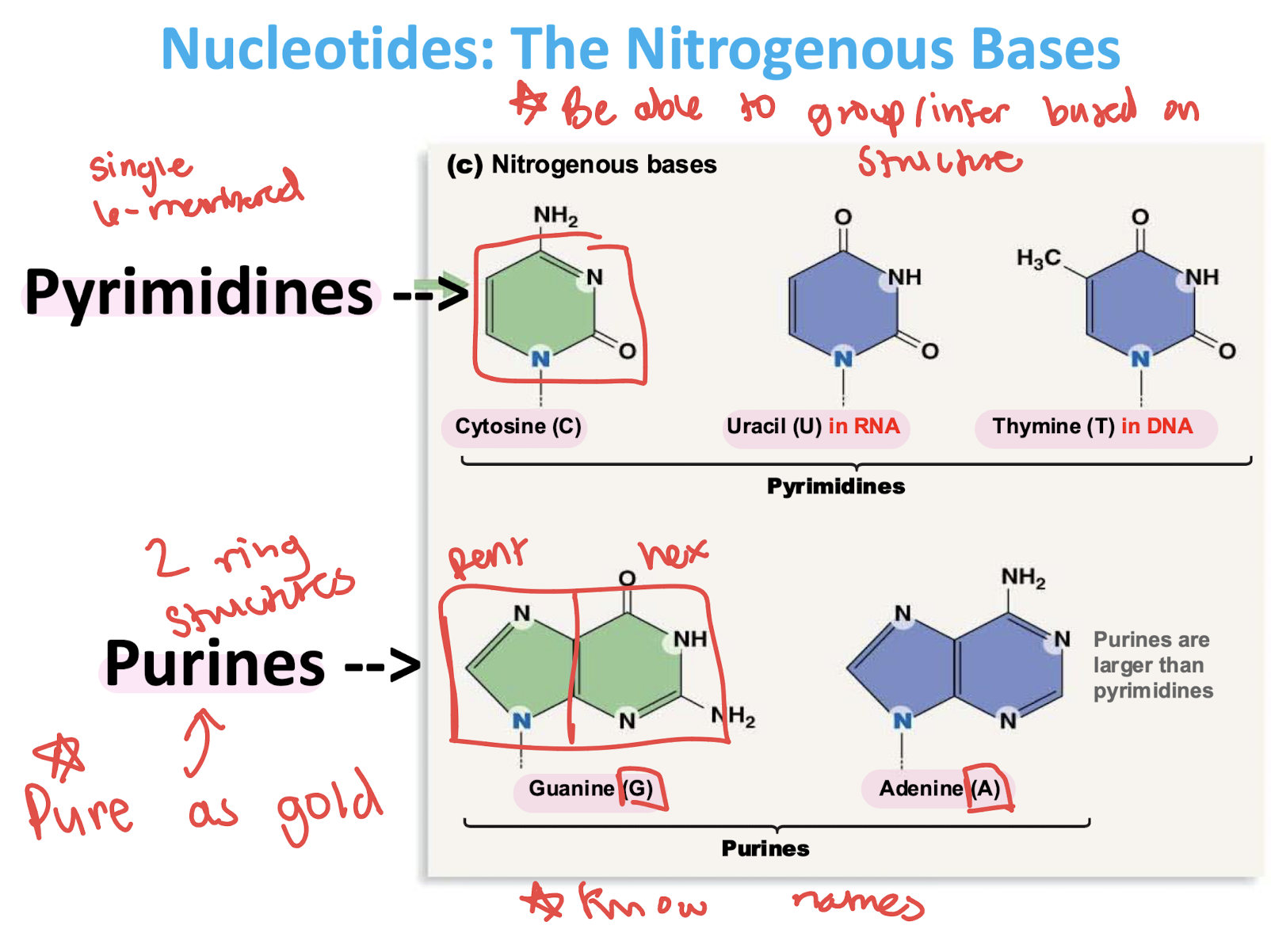
What is a purine?
Double ring nitrogenous bases
Adenine (A) & Guanine (G)
Pure As Gold
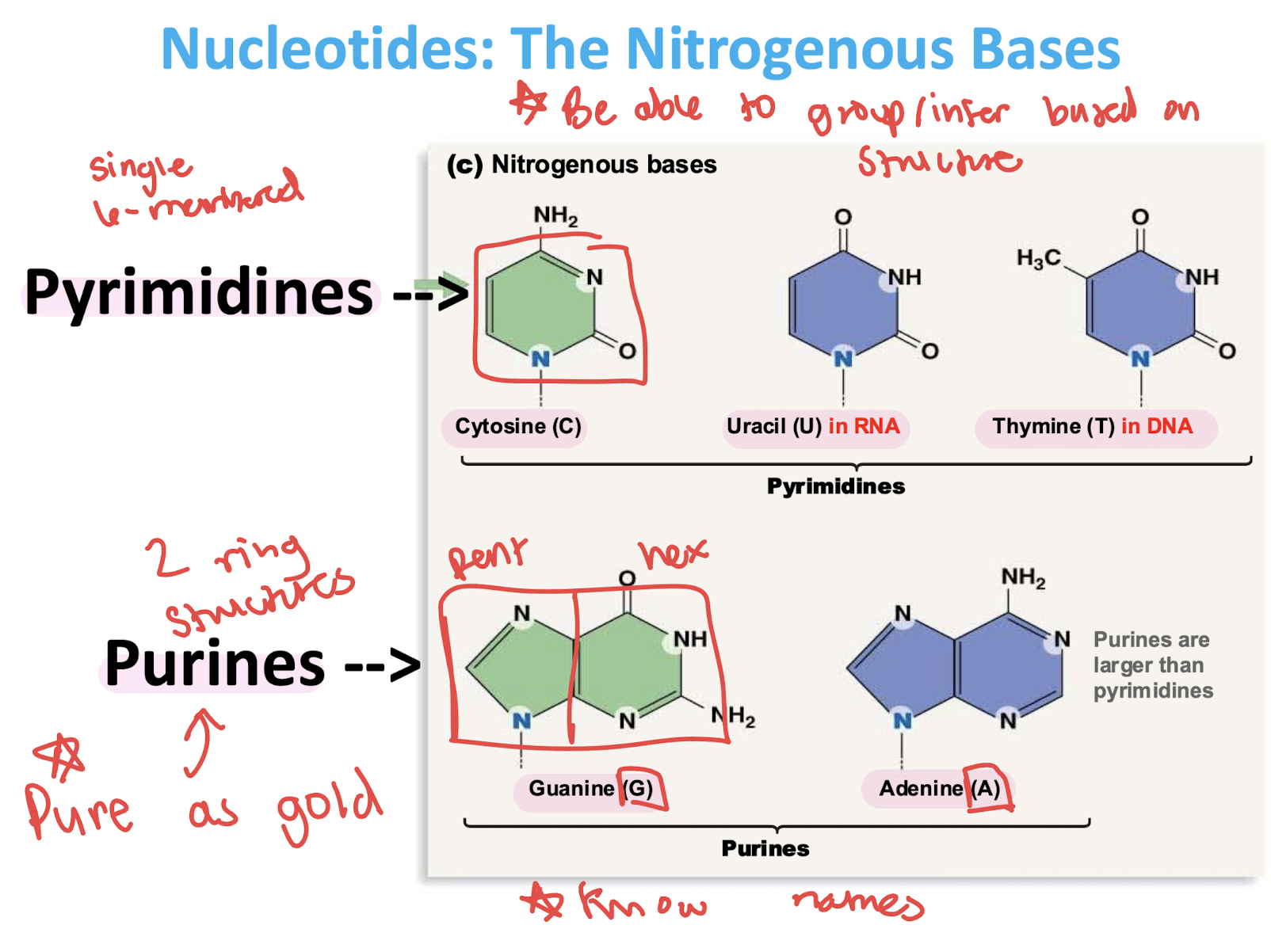
What is a pyrimidine?
Single ring nitrogenous bases
Cytosine (C), Uracil (U), Thymine (T)
Which bases are in DNA?
Adenine (A), Guanine (G), Cytosine (C), & Thymine (T)
Which bases are in RNA
Adenine (A), Guanine (G), Cytosine (C), Uracil (U)
What is a nucleobase
nitrogenous base alone
Adenine, Guanine, Thymine, Cytosine, Uracil
What is the naming pattern from nucleobase —> nucleoside —> nucelotide
base alone —> base + sugar —> base + sugar + phosphate group(s)
How are purine nucleosides named?
end in -osine (adenosine, guanosine)
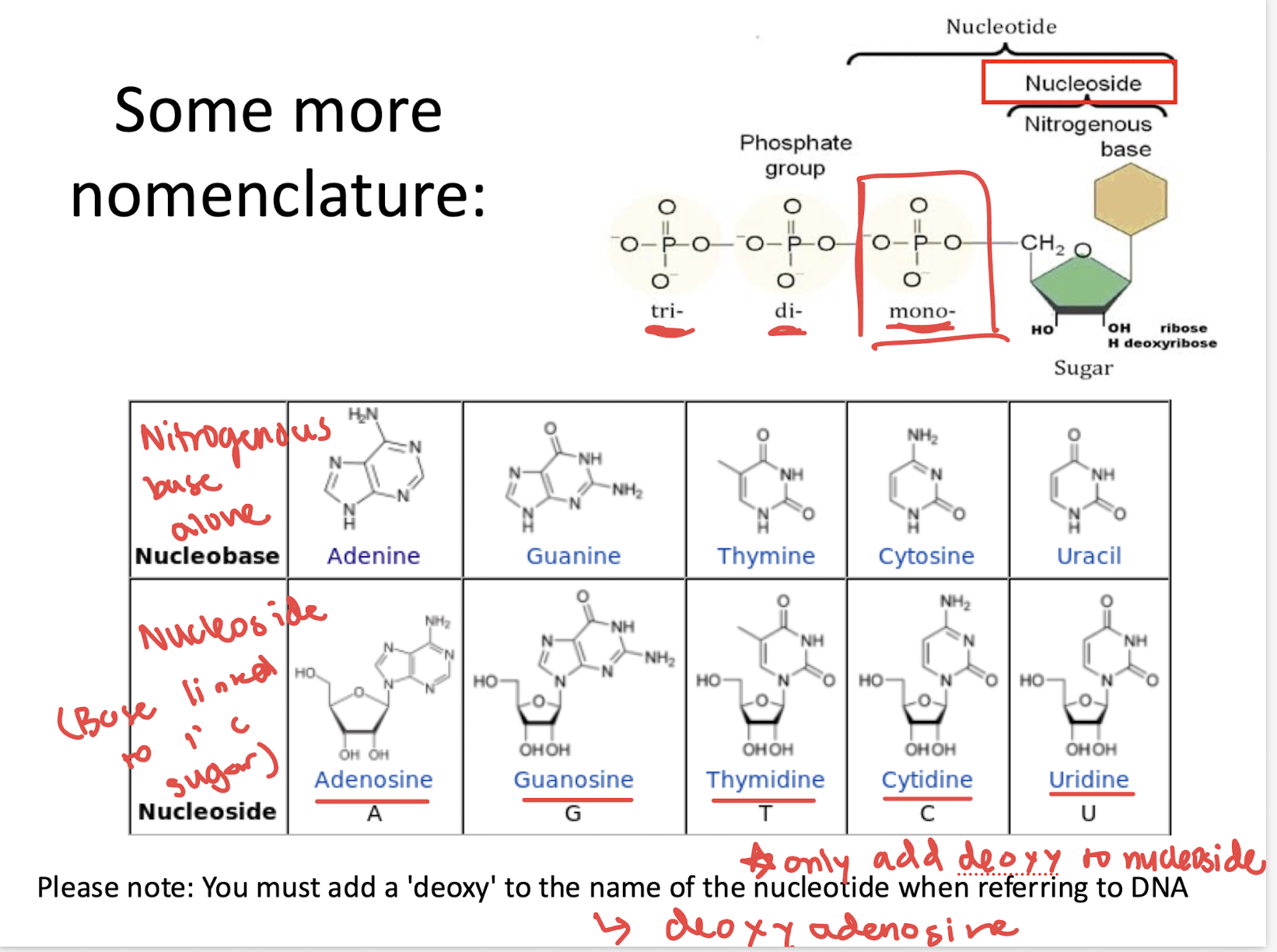
How are pyrimidine nucleosides named?
end in -idine (cytidine, thymidine, uridine)
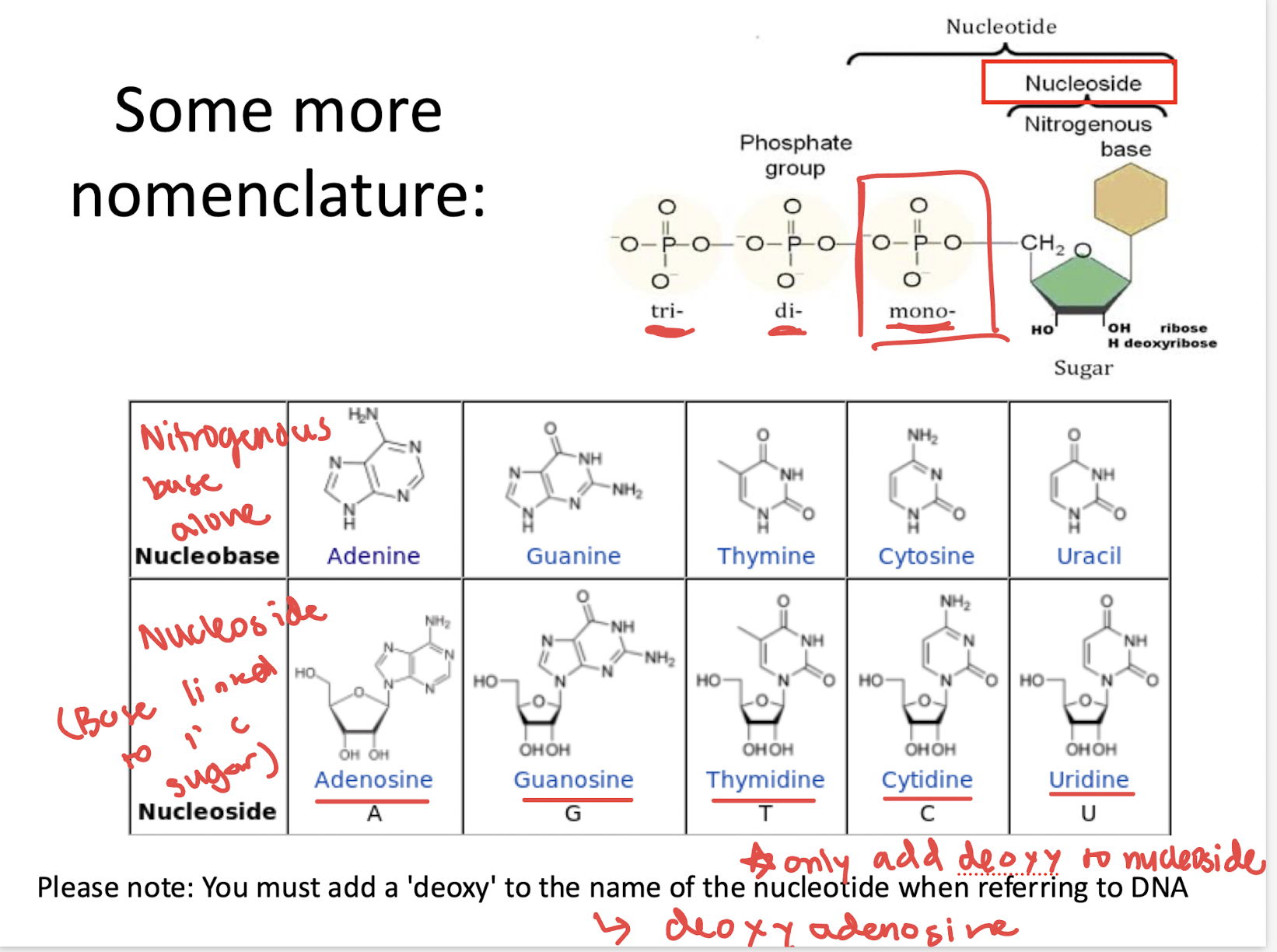
What is adenine (nucleobase) called when it becomes a nucleoside? (based linked to 1’ sugar)
Adenosine
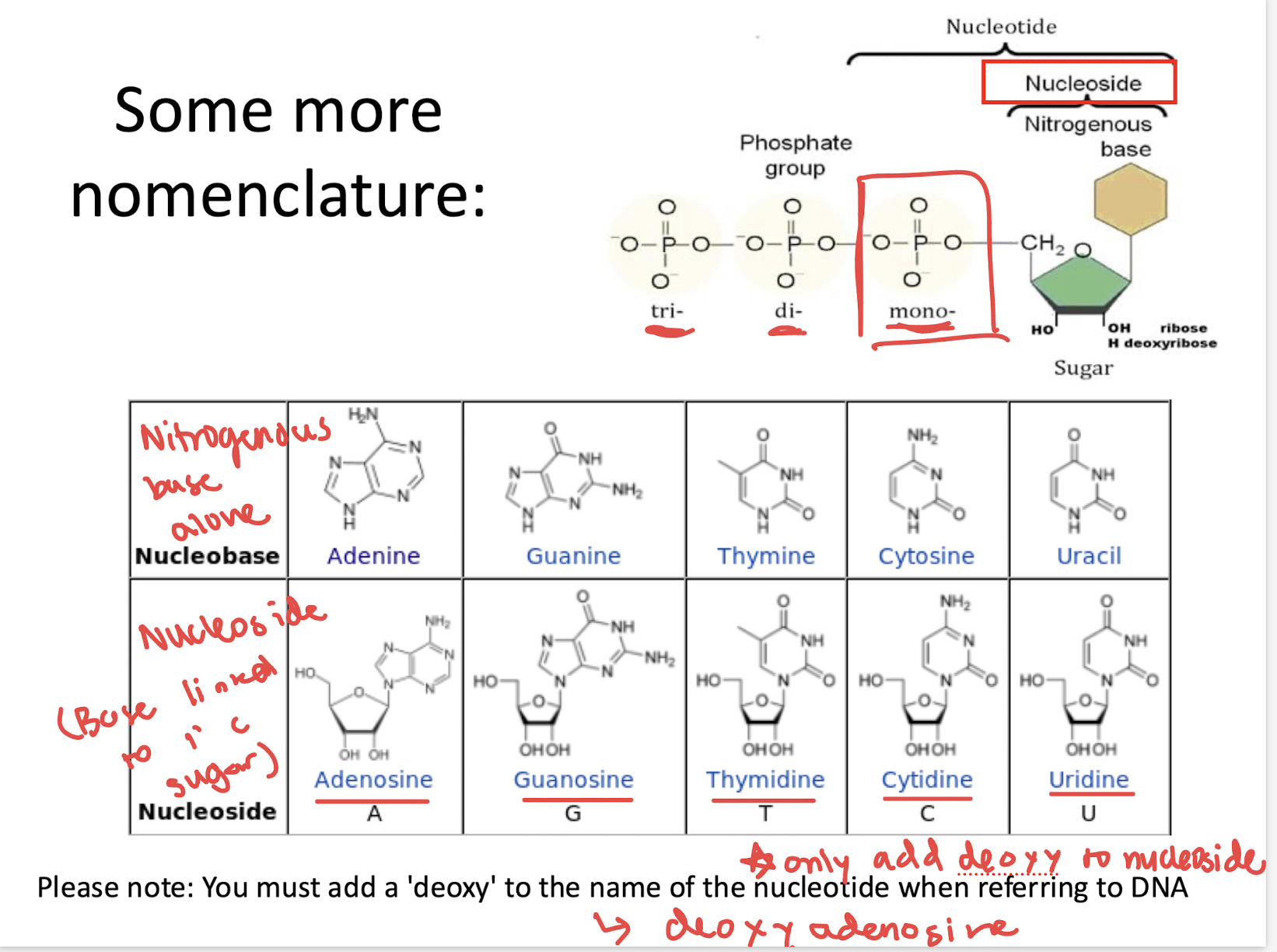
What is guanine (nucleobase) called when it becomes a nucleoside? (based linked to 1’ sugar)
guanosine
What is cytosine (nucleobase) called when it becomes a nucleoside? (based linked to 1’ sugar)
cytidine
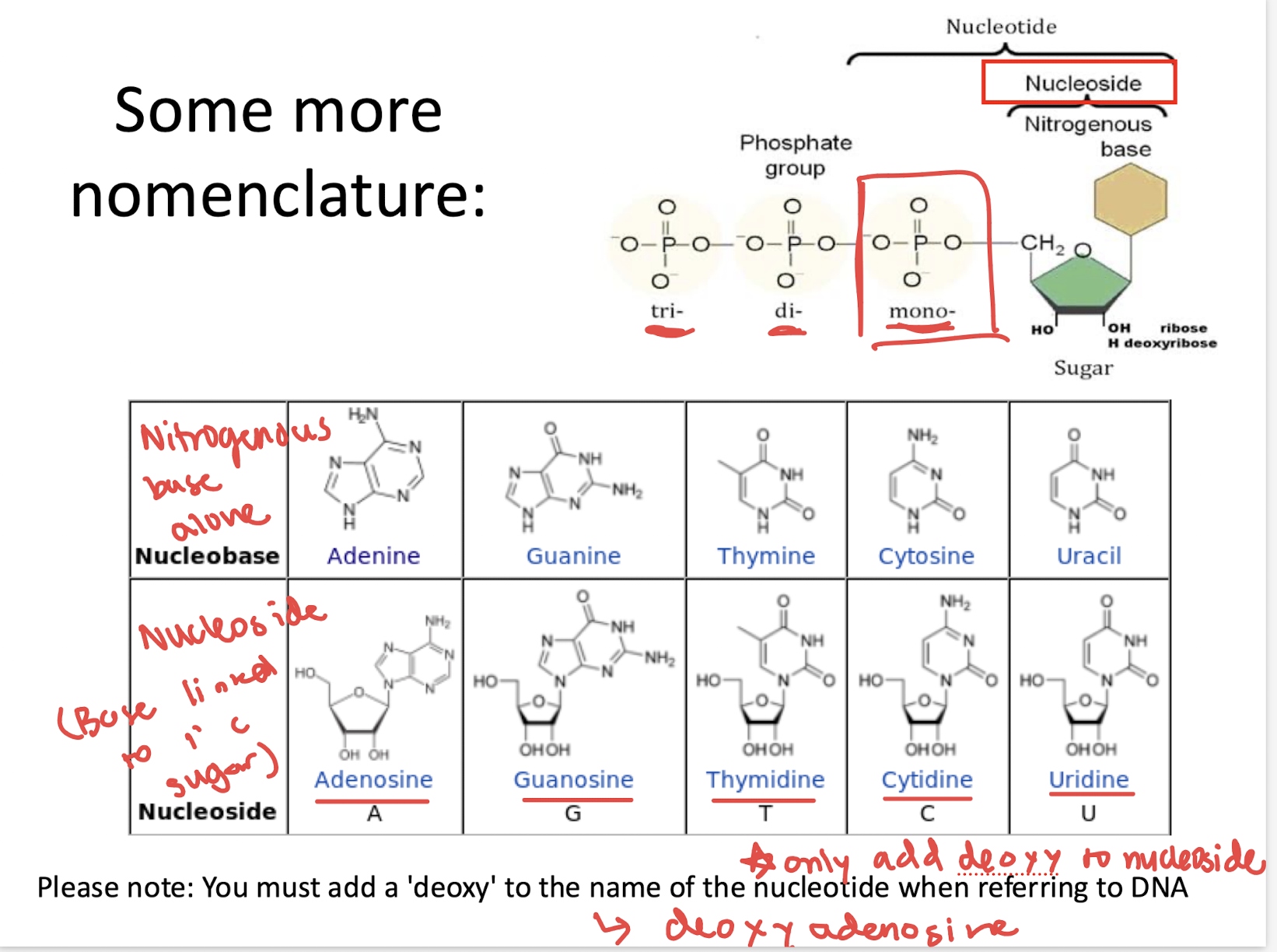
What is thymine (nucleobase) called when it becomes a nucleoside? (based linked to 1’ sugar)
thymidine
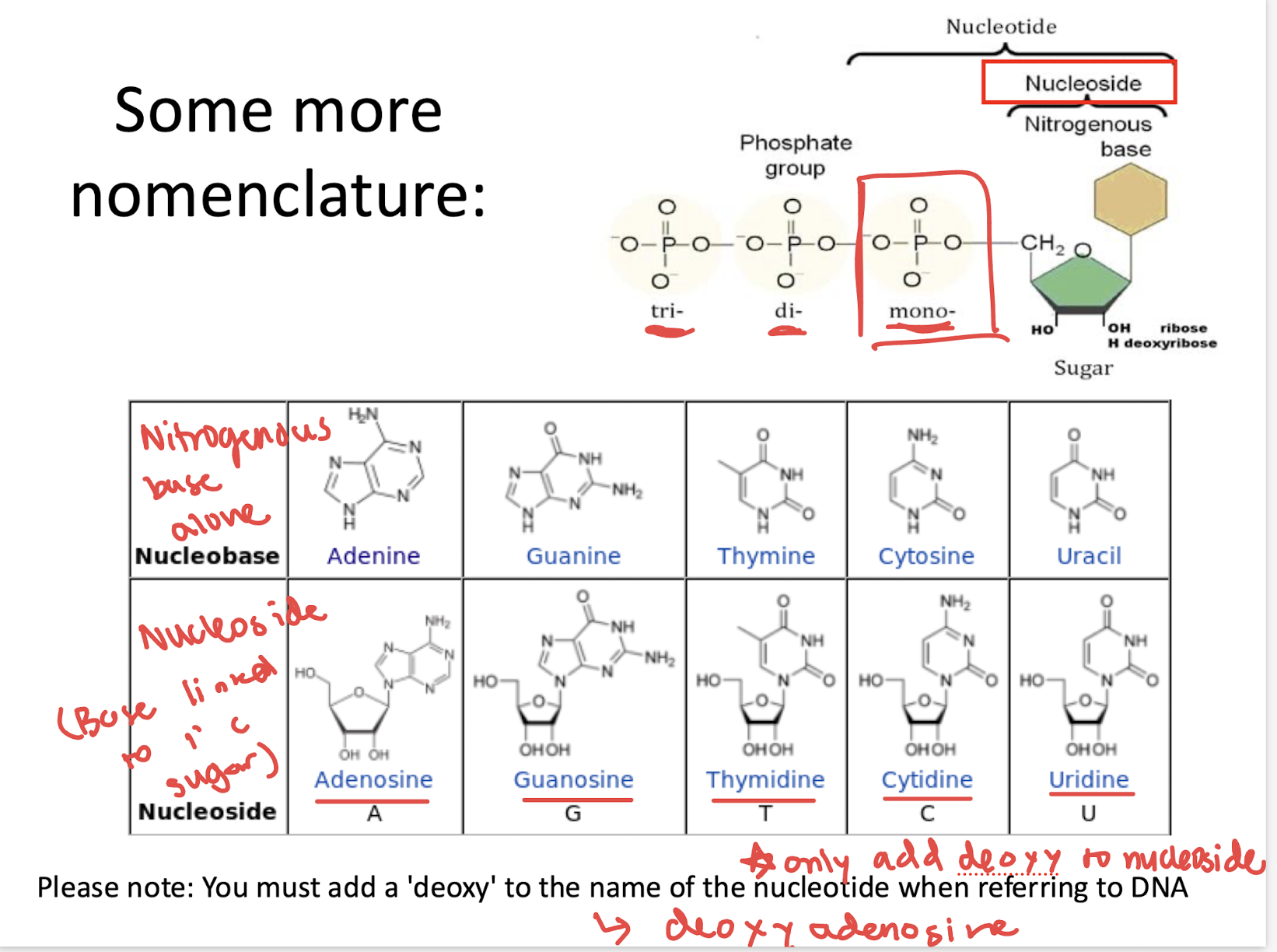
What is uracil (nucleobase) called when it becomes a nucleoside? (based linked to 1’ sugar)
uridine
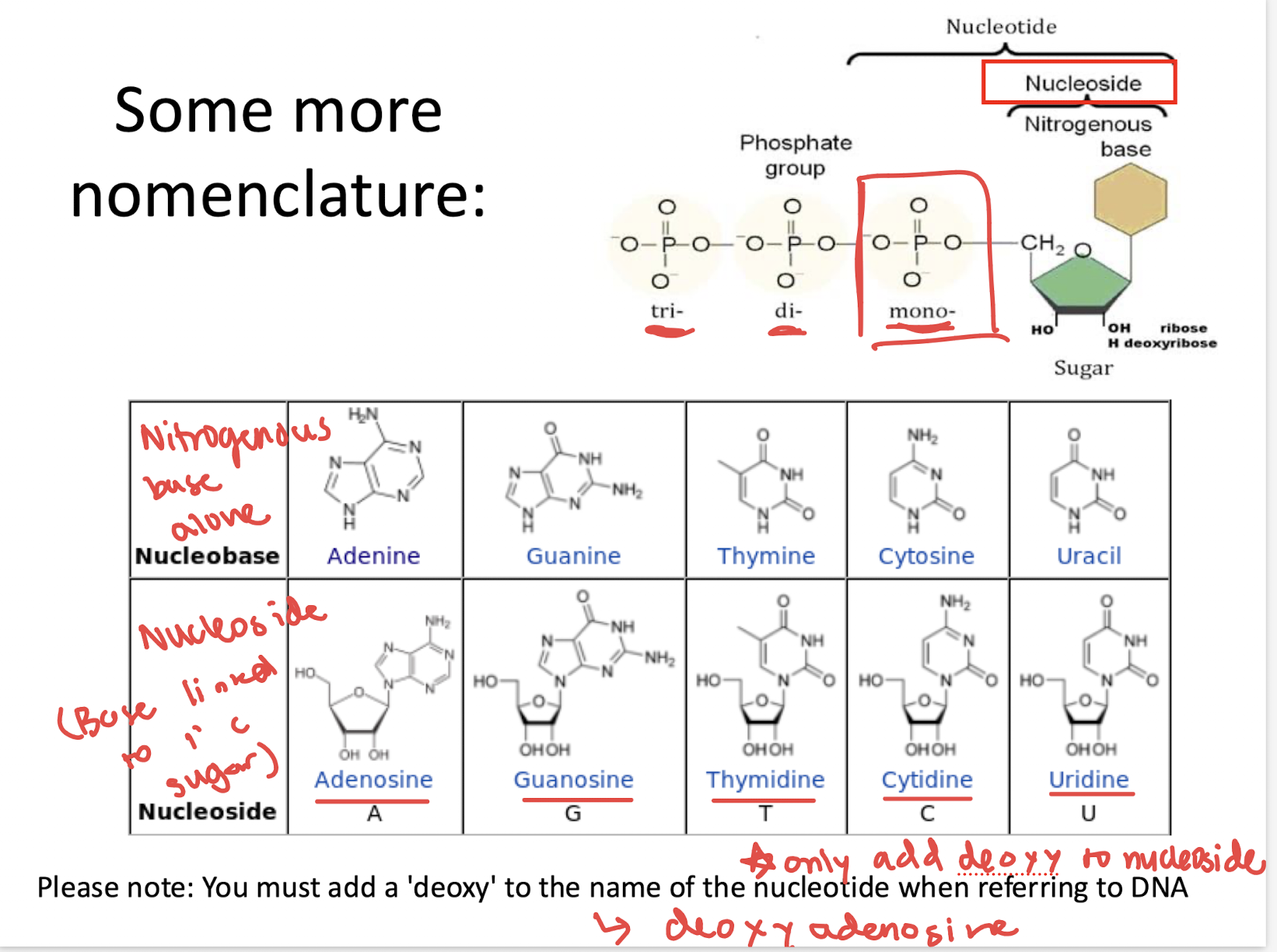
What does AMP stand for?
Adenosine monophosphate (nucleotide)
What does ADP stand for?
Adenosine diphosphate (nucleotide)
What does ATP stand for?
Adenosine triphosphate (nucleotide)
How are DNA nucleotides distinguished in naming?
Include “deoxy” (e.g., deoxyadenosine)
What does dATP stand for?
Deoxyadenosine triphosphate
What is the difference between ATP and dATP?
ATP has ribose (RNA, -OH 2’C); dATP has deoxyribose (DNA, -H 2’C)
If you see “adenosine,” what components are present?
Adenine + ribose (no phosphate)
If you see “adenosine triphosphate,” what components are present?
Adenine + ribose + three phosphates
What are the 5 nucleoside? (nucleobase linked to 1’ C sugar)
Adenosine, Guanosine, Cytidine, Thymidine, Uridine
What bond links nucleotides?
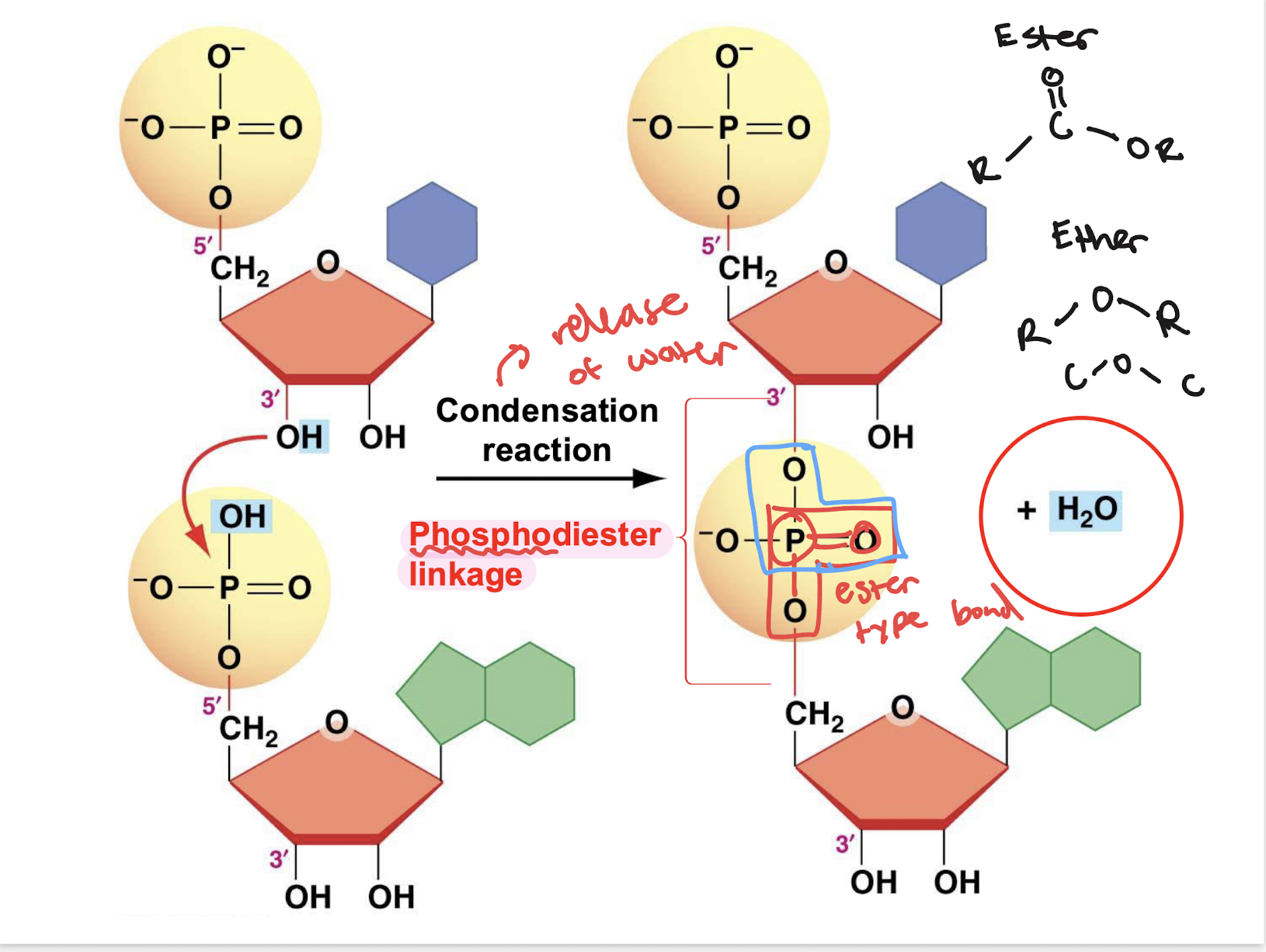
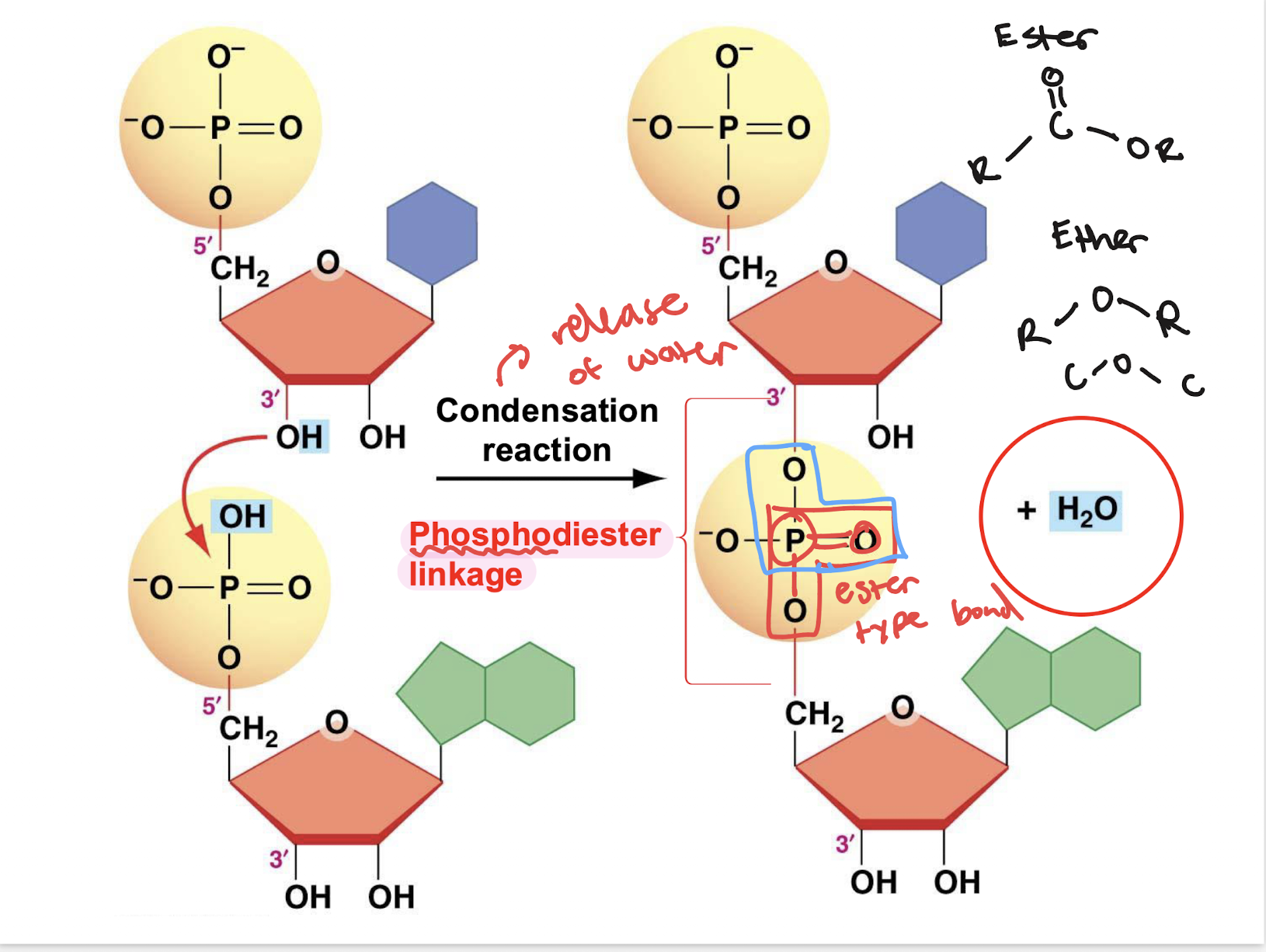
Phosphodiester bond/linkage
through condensation reaction (water released)
Between which carbons does a phosphodiester bond/linkage form?
3′ OH and 5′ phosphate
What is the direction of nucleic acid synthesis?
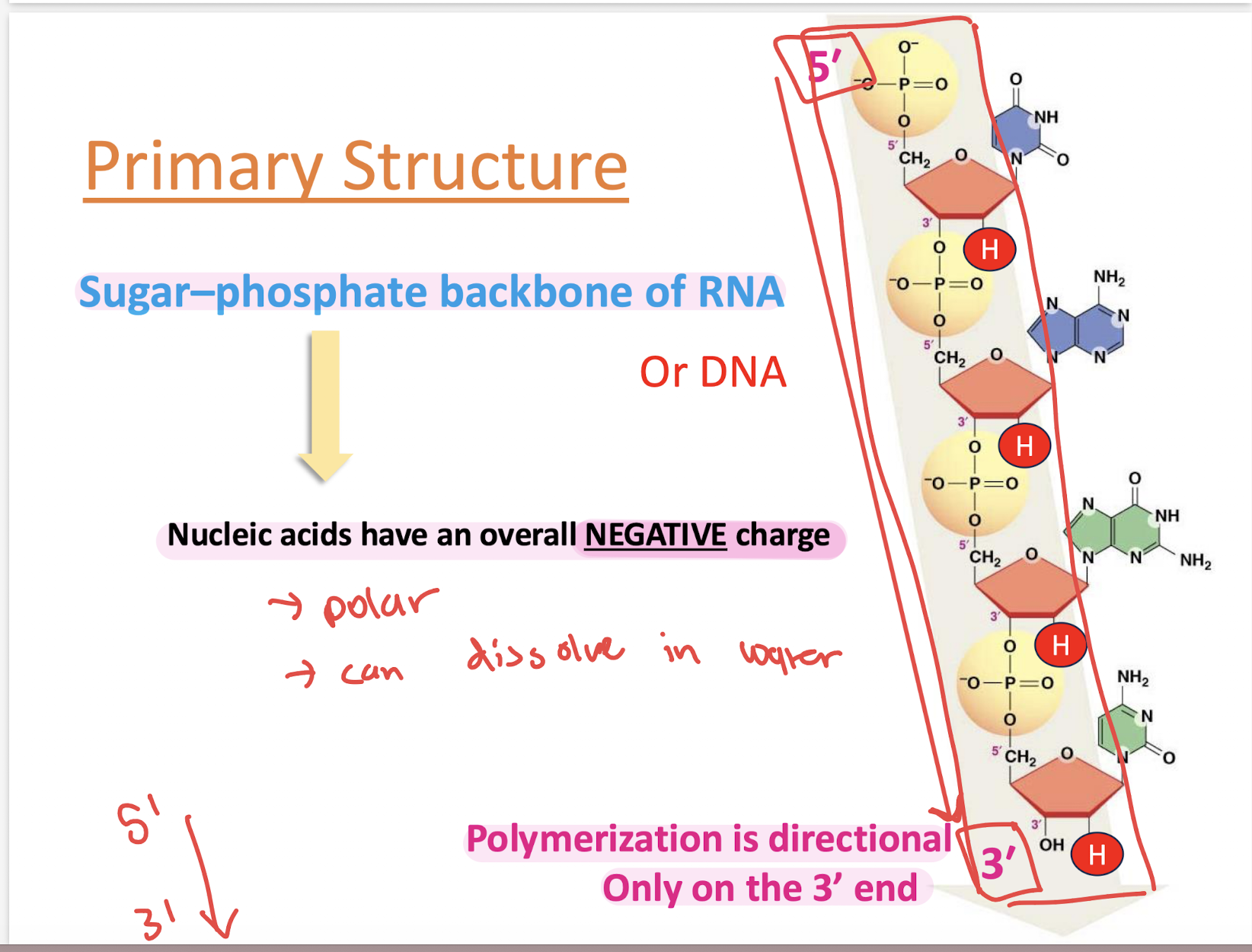
5′ → 3′
polymerization is directional only on 3’ end (adding to this end)
polymerization
small molecules, called monomers, react and link together to form long, chain-like, or network molecules known as polymers
Nucleic acids have an overall…
NEGATIVE charge
polar, can dissolve in water
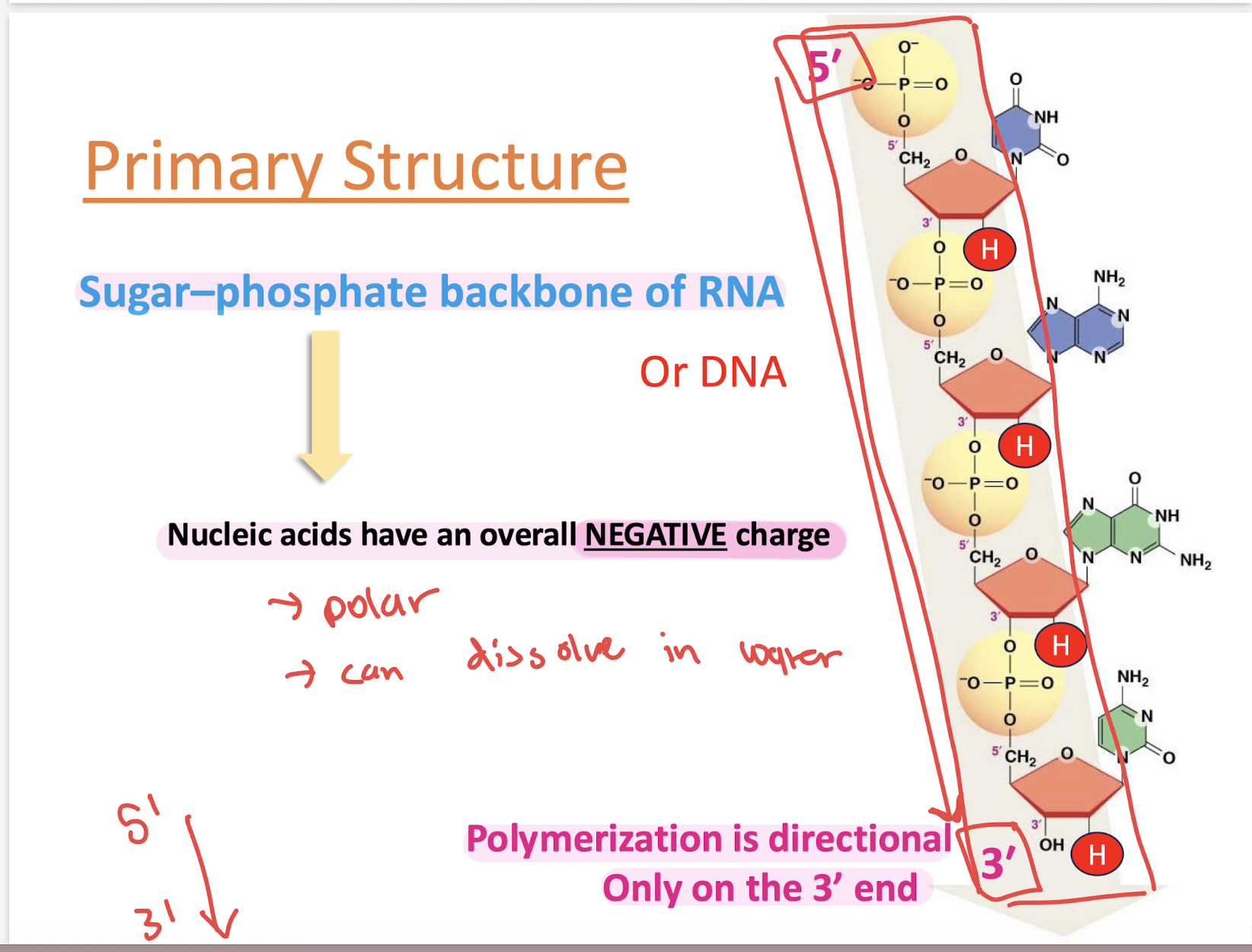
What makes up the backbone of nucleic acids?
Sugar-phosphate backbone
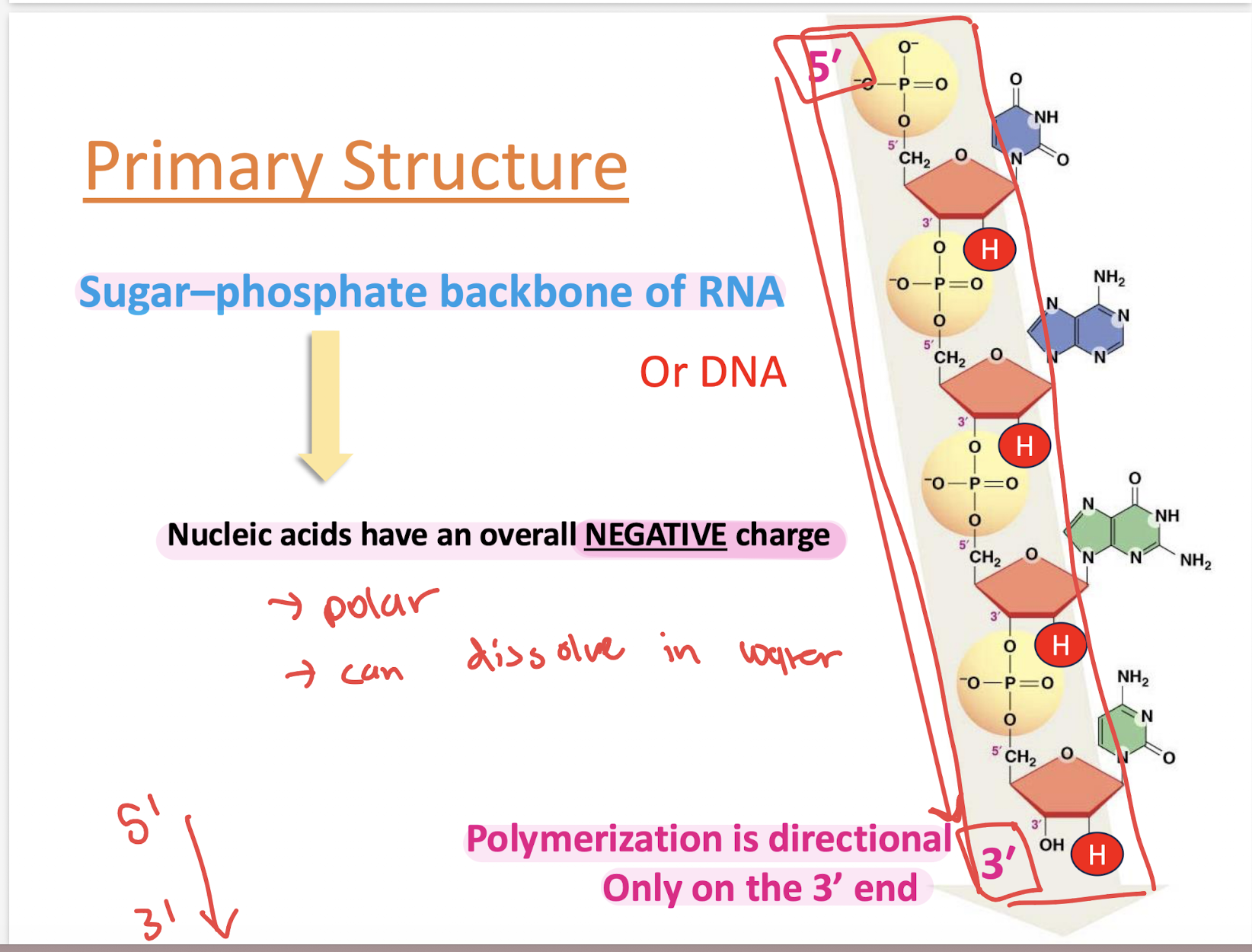
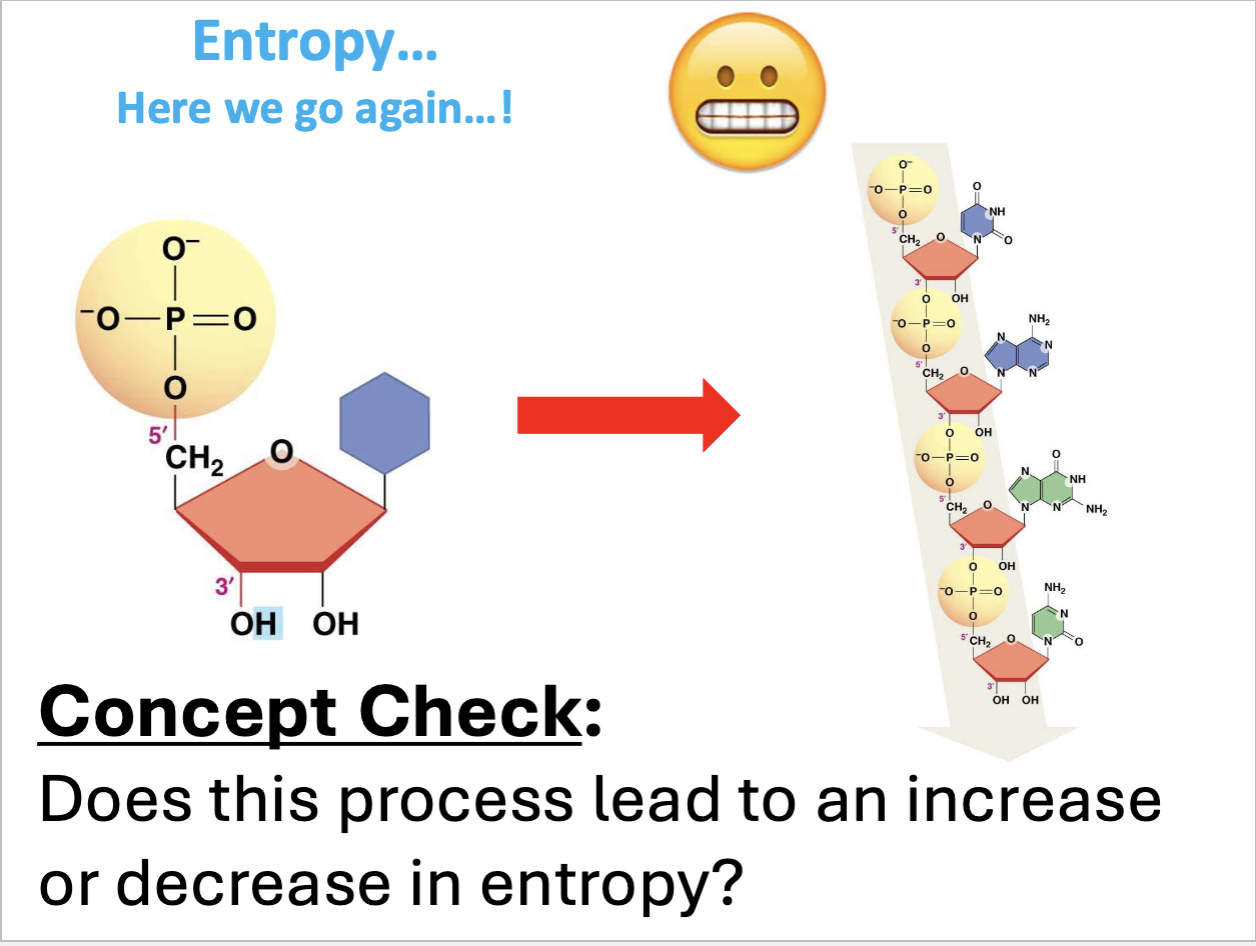
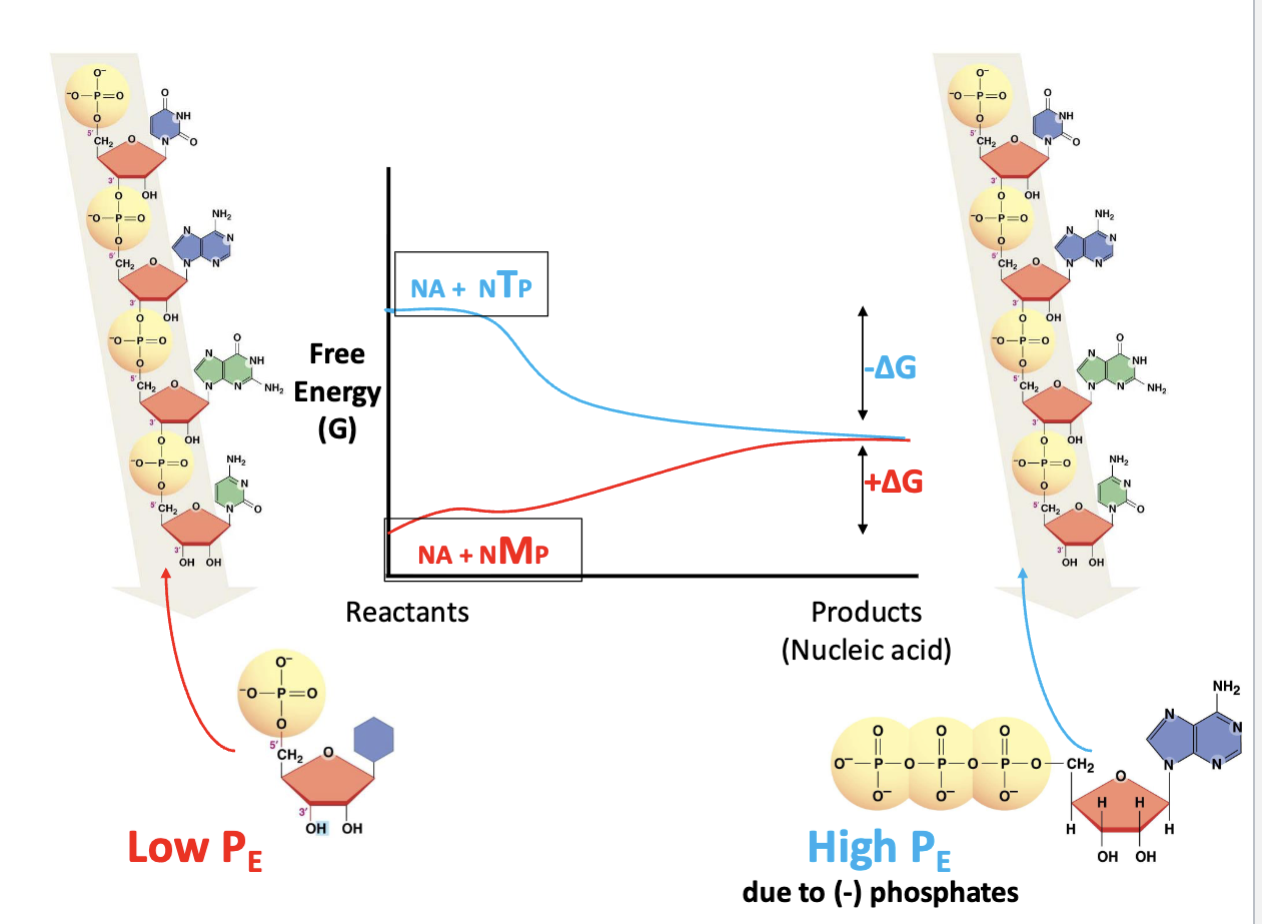
Does this polymerization of nucleotides linked to form polynucleotide chain lead to an increase or decrease in entropy?
DECREASES’
many individual free floating molecules bonded together & lose ability to move independently, polymer more ordered & overall change in entropy is negative
What provides energy for nucleotide polymerization?
Nucleoside triphosphates (ATP, GTP, etc.)
Why are phosphates important?
Their removal releases energy to drive reactions
Triphosphates have..
Triphosphates have increased Potential Energy!
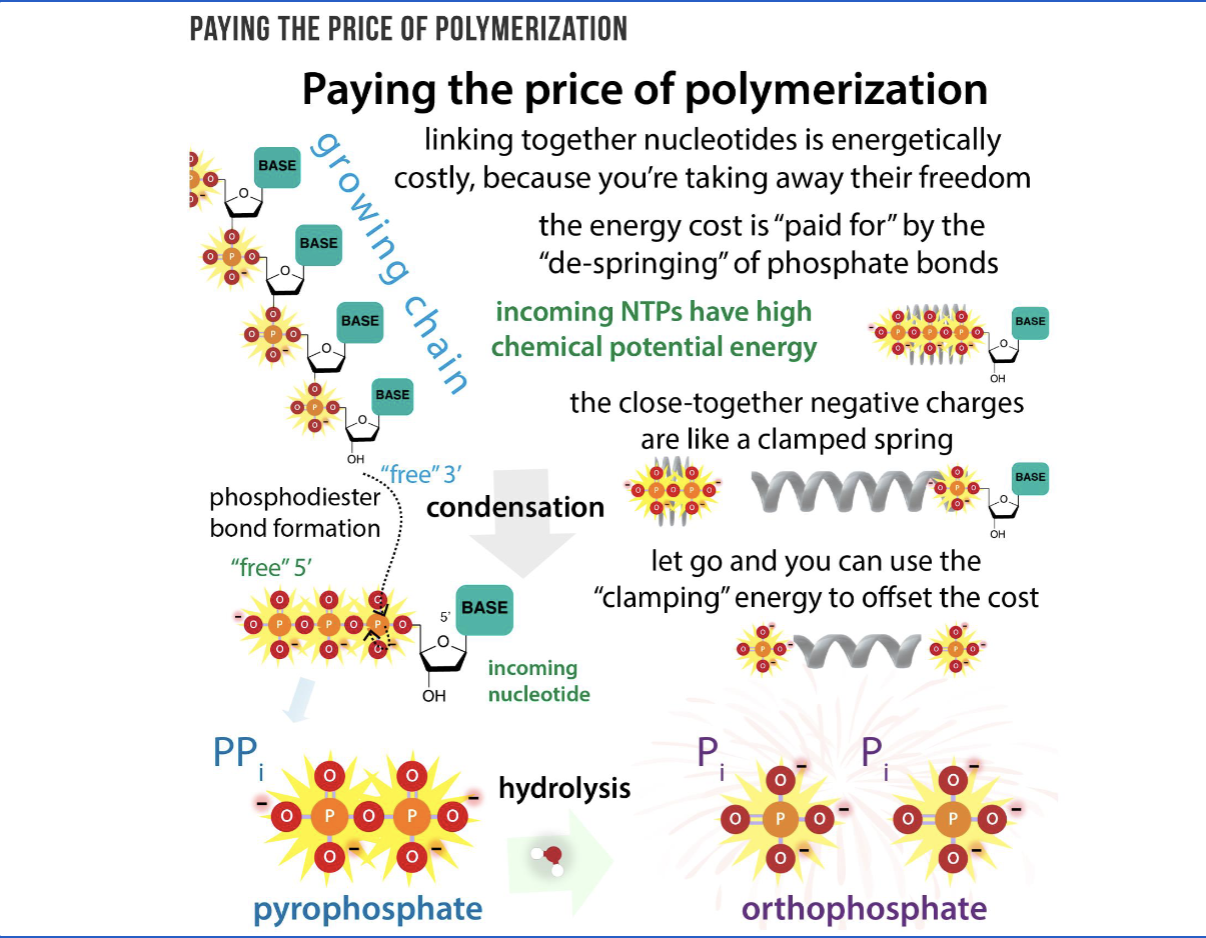
Entropy of Polymerization: Does the process of linking nucleotides into DNA/RNA chain represent increase or decrease in entropy?
decrease in entropy
free-floating independent molecules move to single/organized rigid chain —> reduces disorder
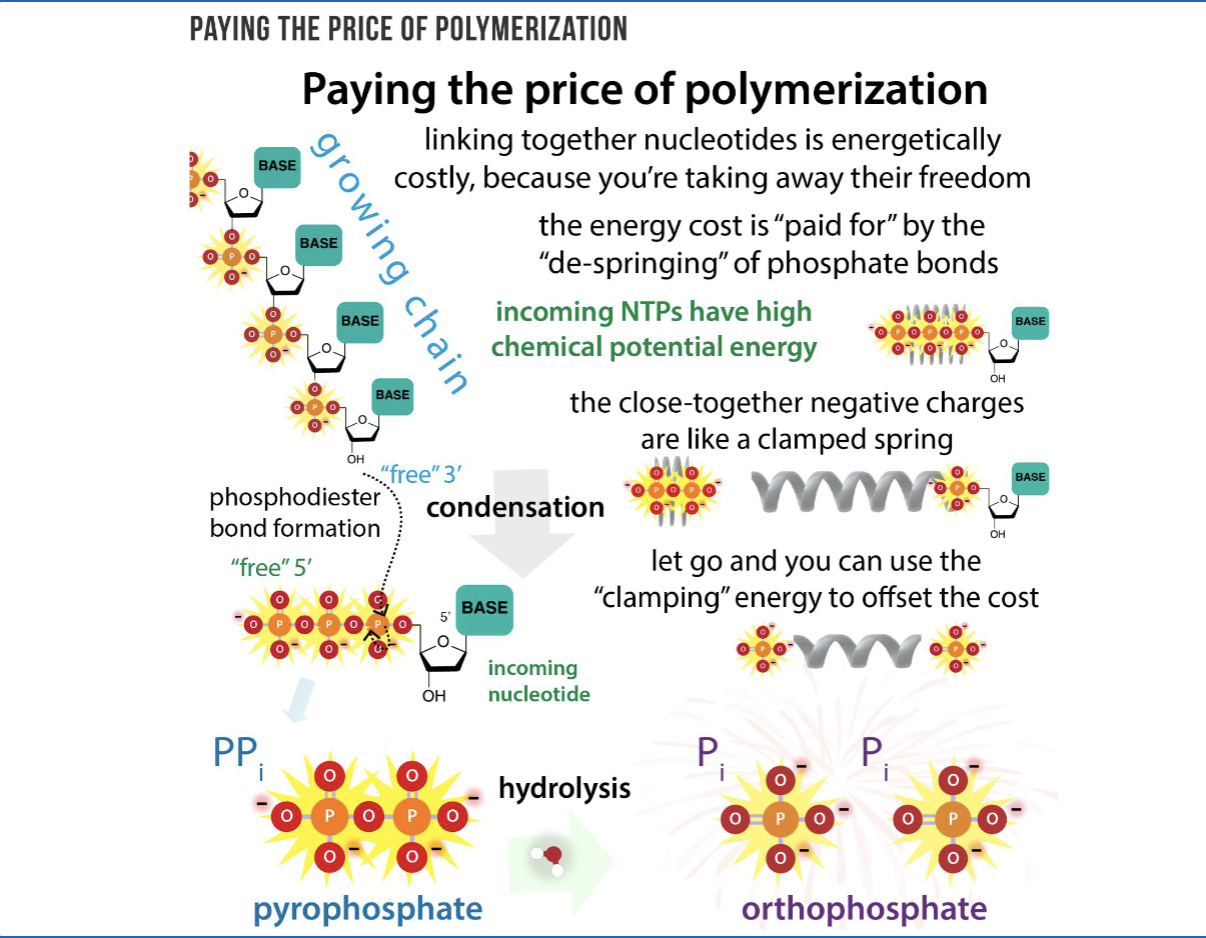
Entropy of Polymerization: In context of nucleotide triphosphates, what represents clamped spring & why?
the three phosphate groups
all negatively charged, repel each other strongly
holding them together stores high chemical potential energy —> released when bond is broken
What did Chargaff discover?
A = T and G = C
What did Franklin & Wilkins discover?
DNA is helical with specific dimensions
Who proposed the double helix model?
Watson and Crick
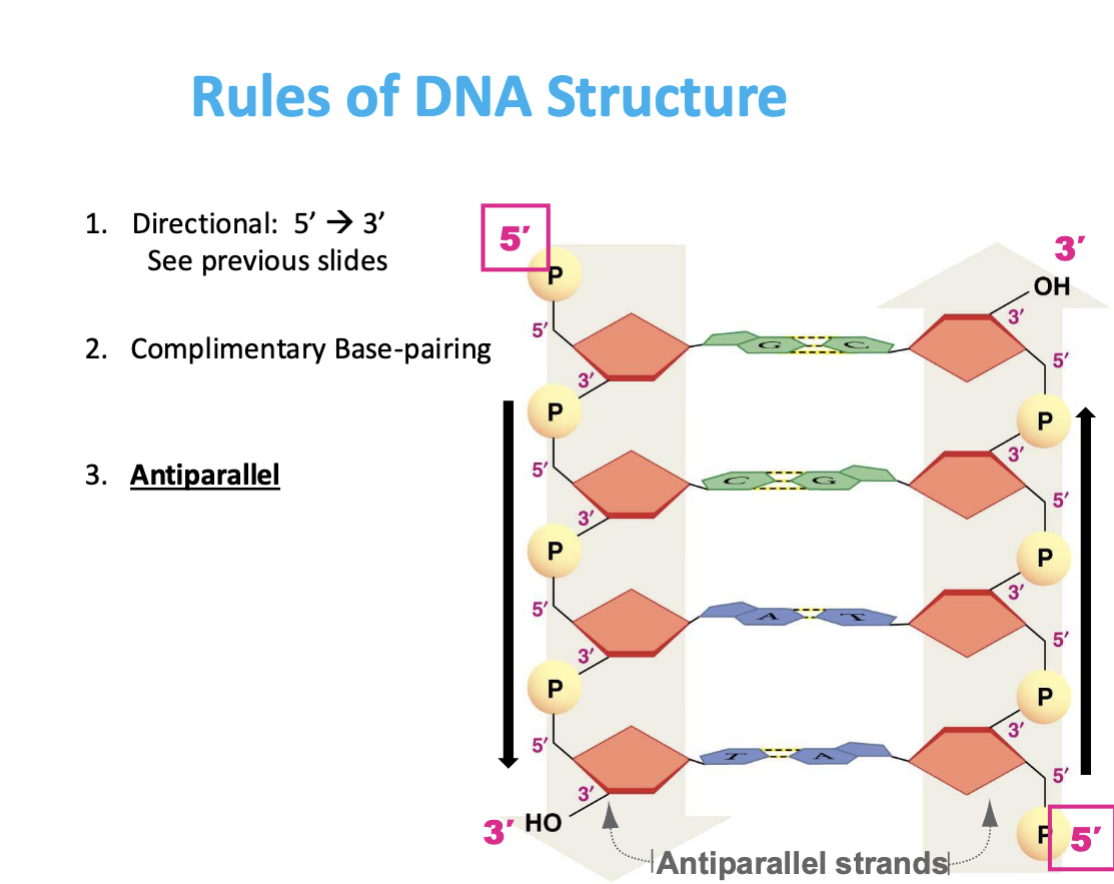
What does antiparallel mean?
Strands run in opposite directions (5′→3′ and 3′→5′)
Why is antiparallel important?
Allows proper base pairing and stability
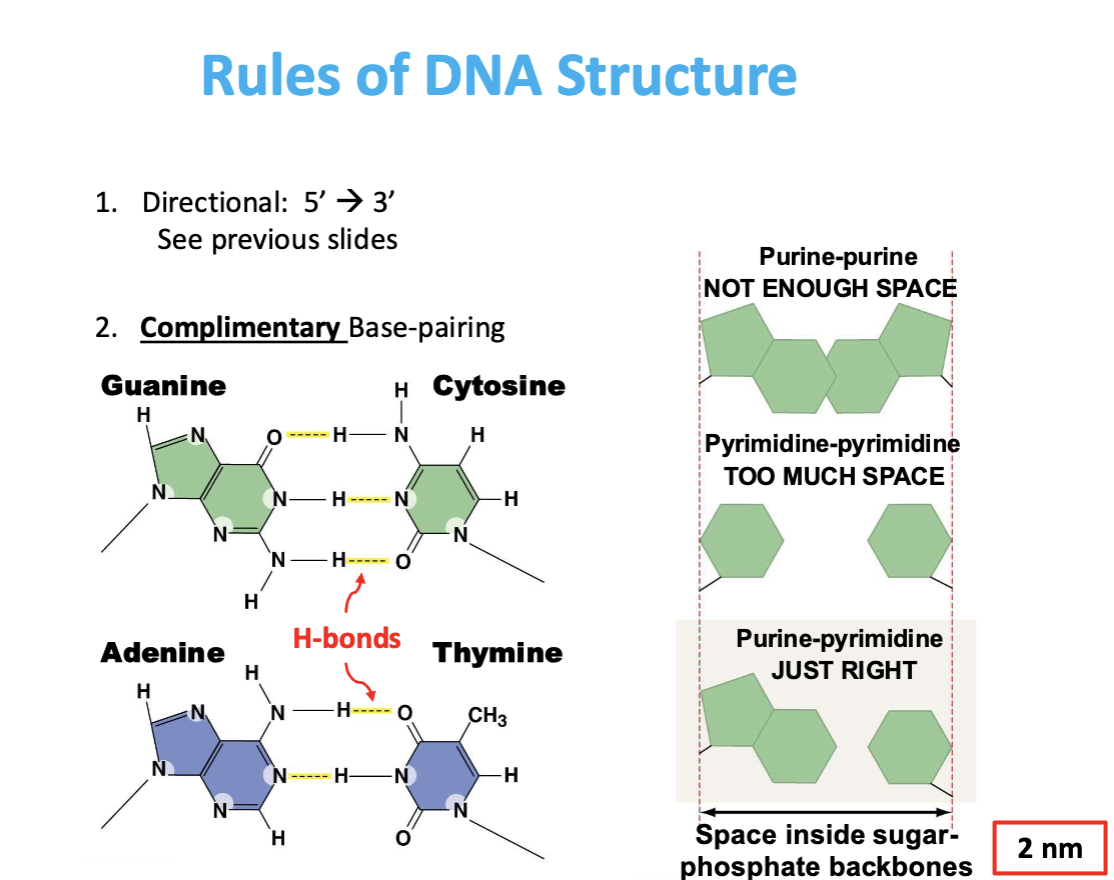
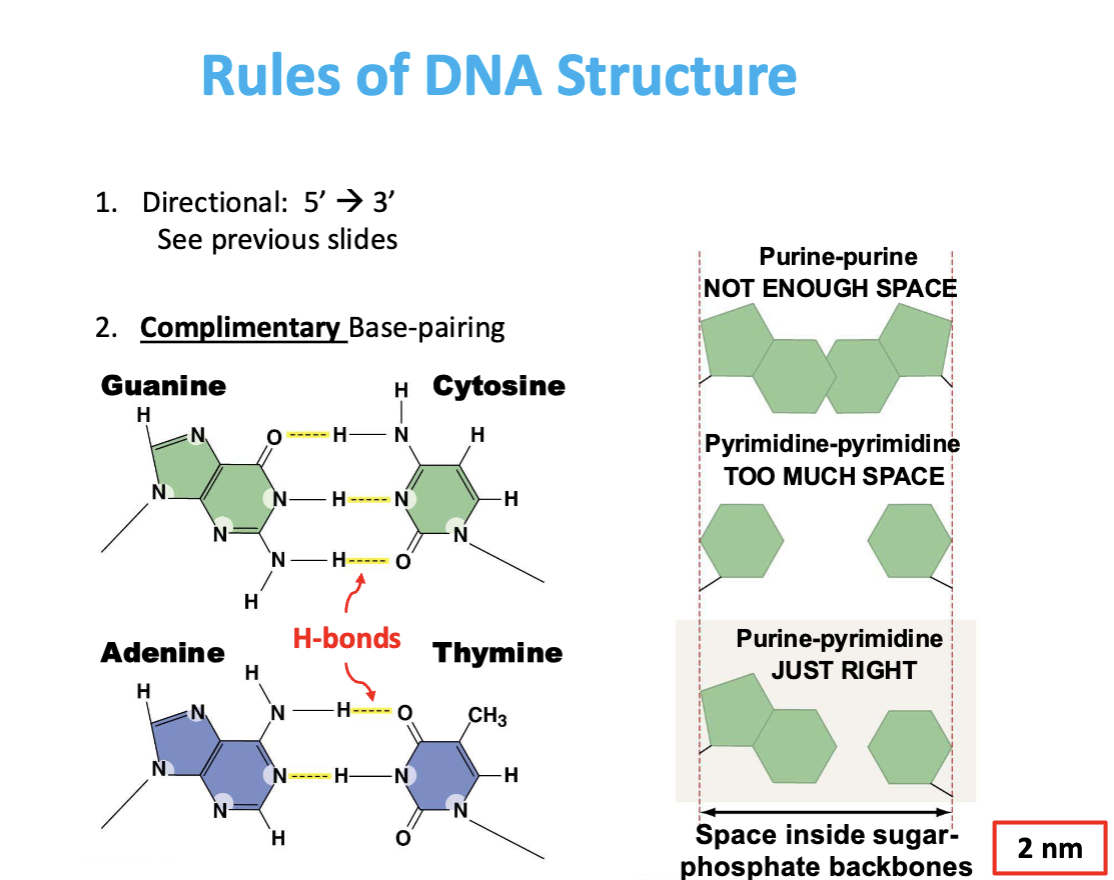
What are base-pairing rules?
1) Directional 5’—>3’
2) A–T (2 H-bonds), G–C (3 H-bonds)
3) Antiparallel
What is the primary structure of nucleic acids?
The linear sequence of nucleotides connected by phosphodiester bonds
What specifically is included in the primary structure of nucleic acids?
The order of bases (A, T/U, G, C) along the 5′ → 3′ backbone
Why is primary structure of nucleic acids important?
It stores genetic information and determines higher-level structures
What type of bonds stabilize primary structure of nucleic acids?
Covalent phosphodiester bonds
What does 5′ → 3′ directionality refer to in primary structure?
The orientation of the sugar-phosphate backbone from 5′ phosphate to 3′ OH
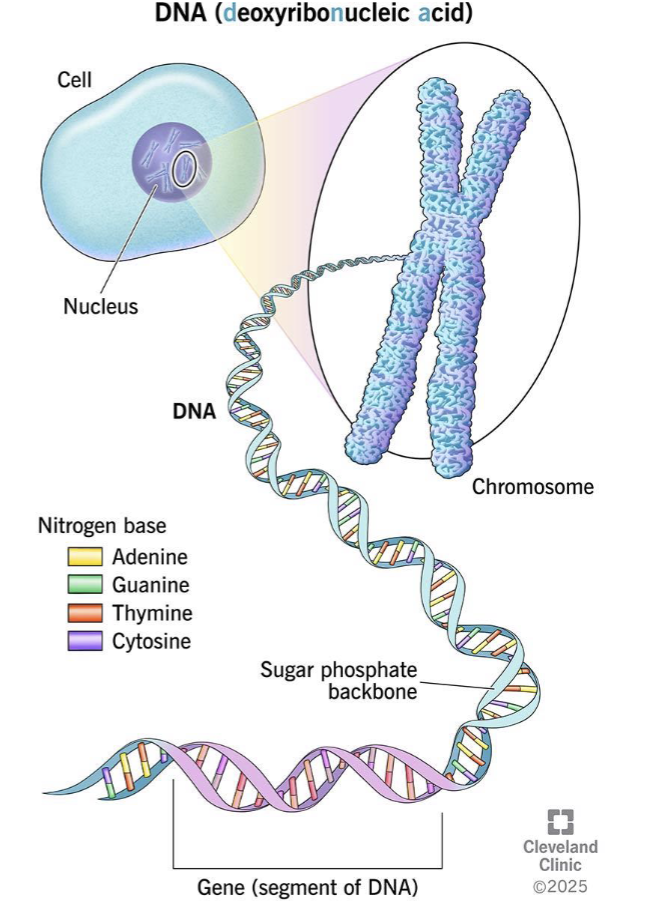
What is the secondary structure of DNA?
A double helix formed by two antiparallel strands with complementary base pairing
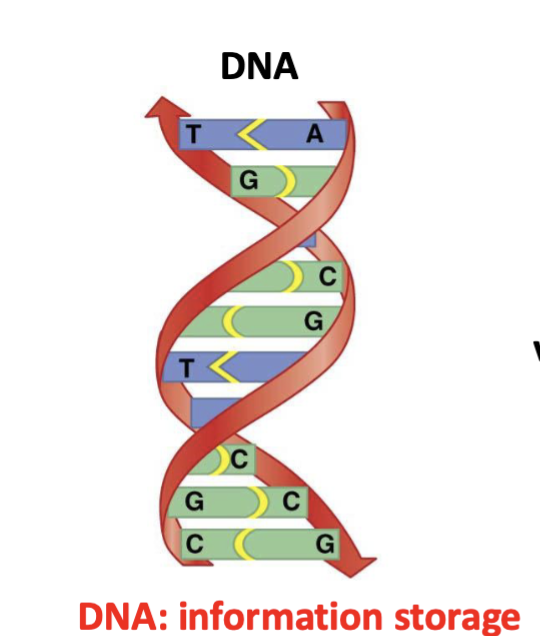
What interactions stabilize DNA secondary structure?
Hydrogen bonds between bases and base stacking interactions
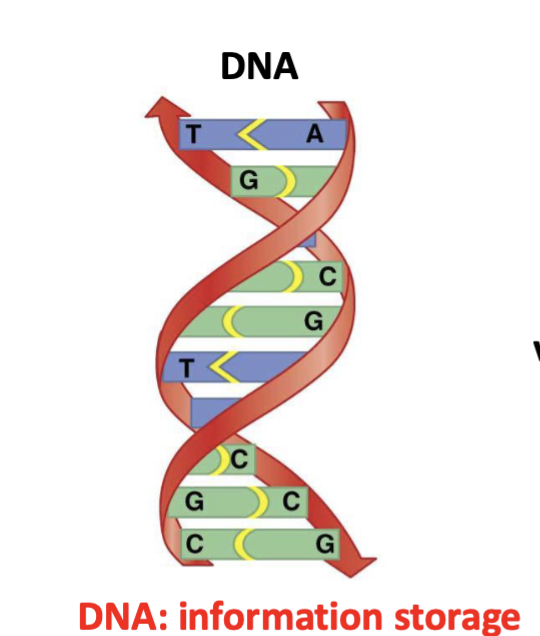
What is complementary base pairing?
Specific pairing: A–T (or A–U in RNA), G–C
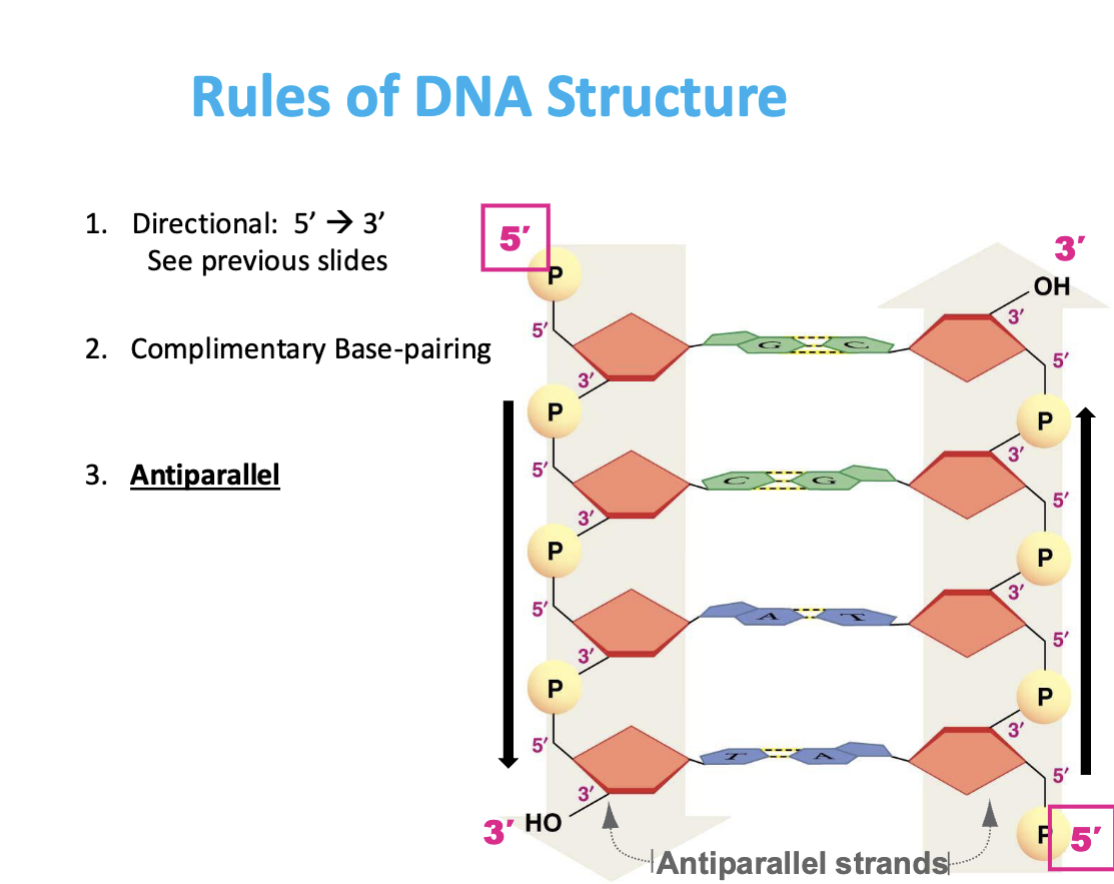
What does antiparallel mean in DNA?
The two strands run in opposite directions (5′→3′ and 3′→5′)
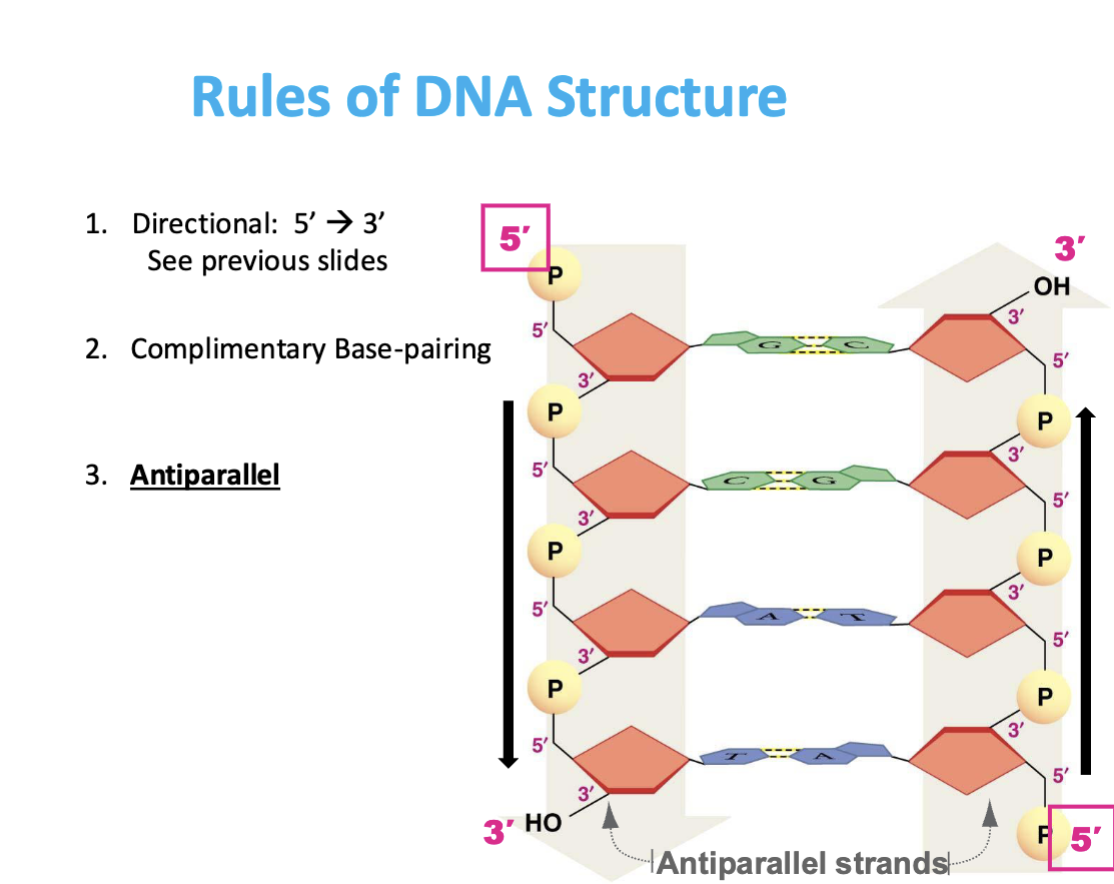
Why is antiparallel orientation necessary?
It allows proper hydrogen bonding and stable helix formation
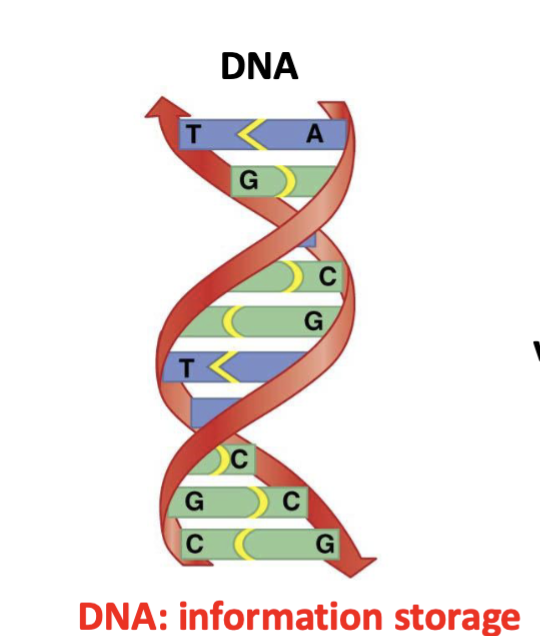
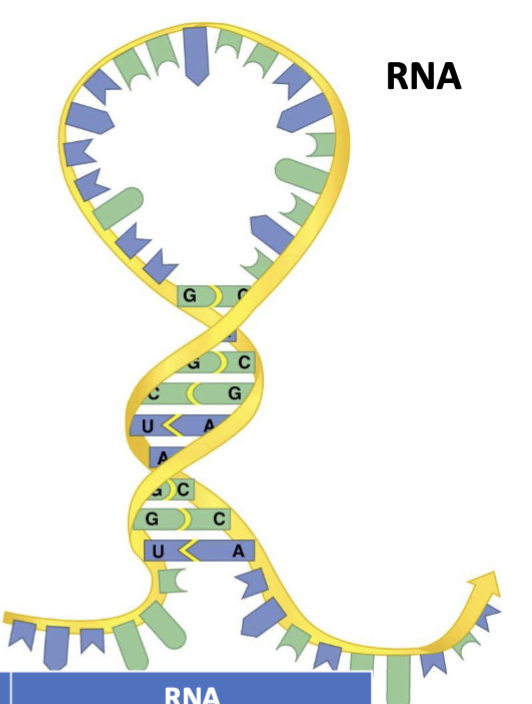
What is the secondary structure of RNA?
Single stranded, folding with itself: stem-loop
Intramolecular base pairing forming structures like hairpins and stem-loops
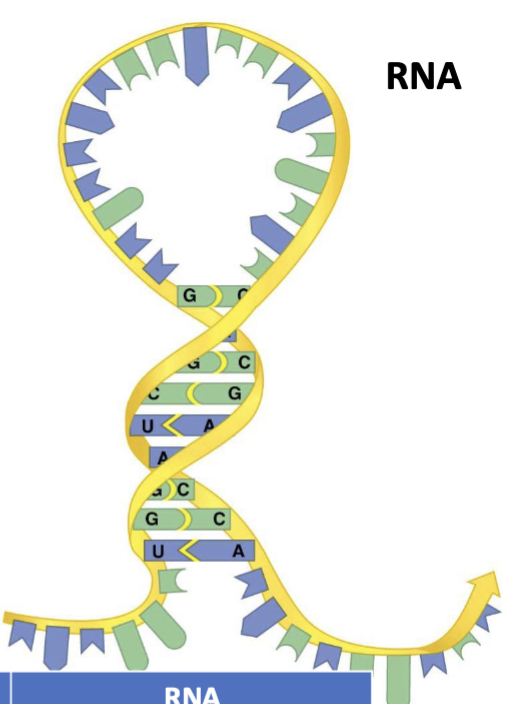
Why can RNA form secondary structures within a single strand?
Because complementary bases can pair within the same molecule
What is the tertiary structure of DNA?
The 3D folding and supercoiling of the double helix into compact forms
How is DNA packaged in cells (tertiary structure)?
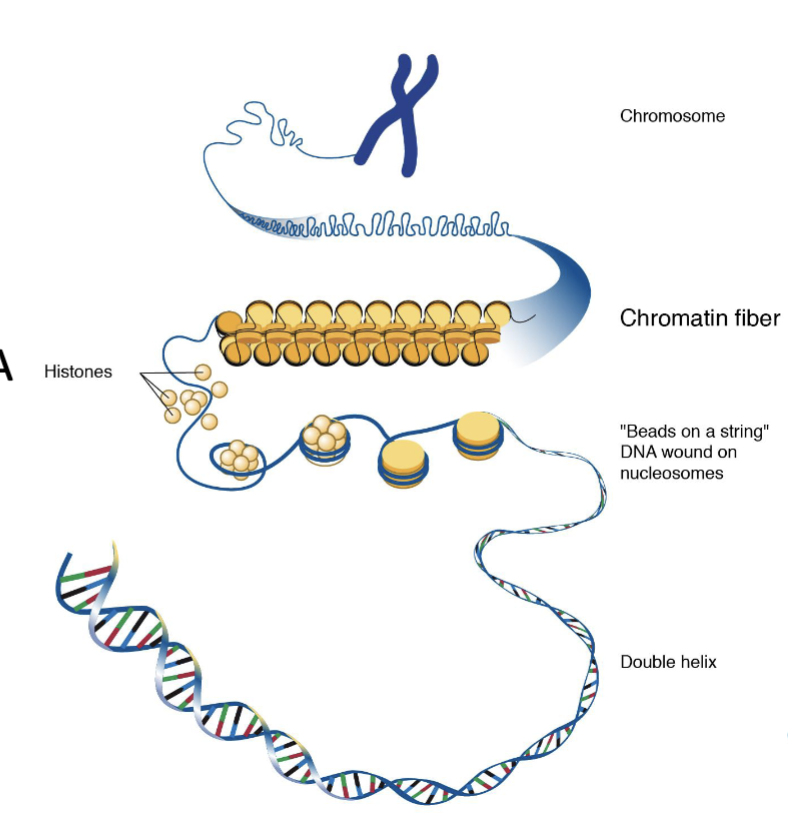
DNA wraps around histone proteins = nucleosomes → chromatin → chromosomes
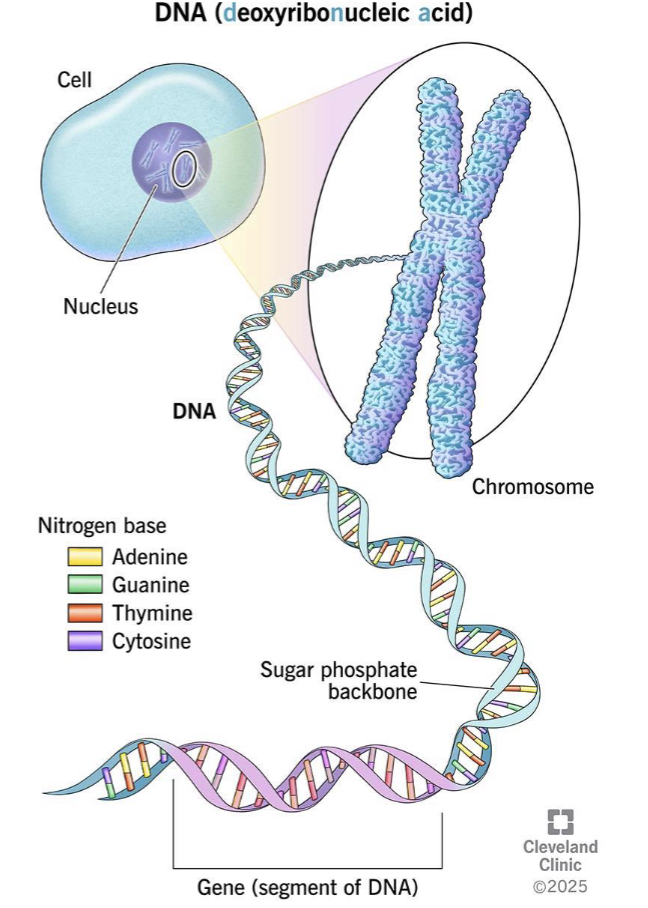
Tertiary Structure: Chromosomes
composed of condensed chromatin, a complex of DNA,RNA & proteins
DNA is wrapped around histones (protein) in a ‘bead- on-a-string’ format, yielding multiple nucleosomes
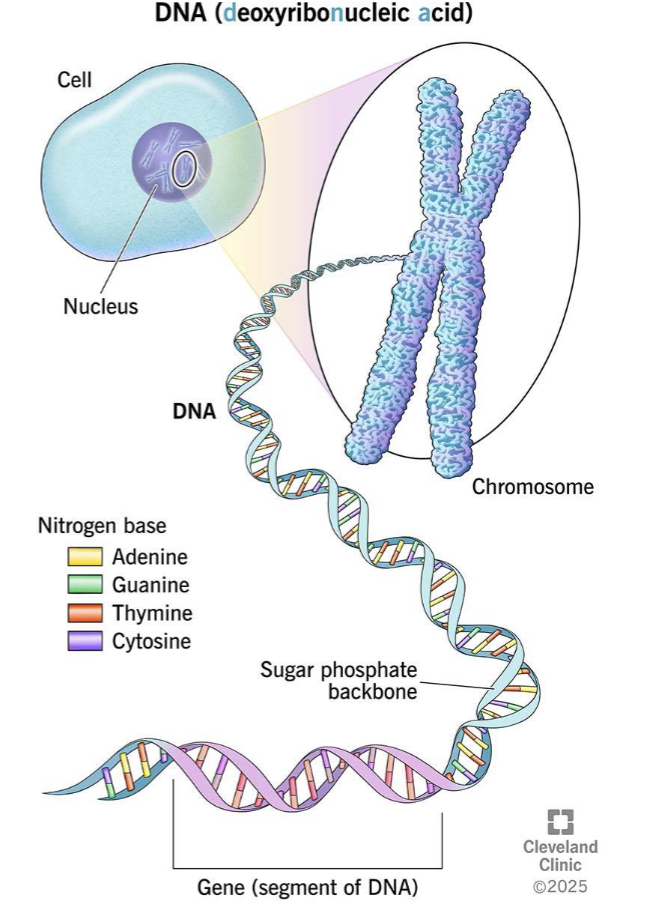
What is a nucleosome?
DNA wrapped around histone proteins
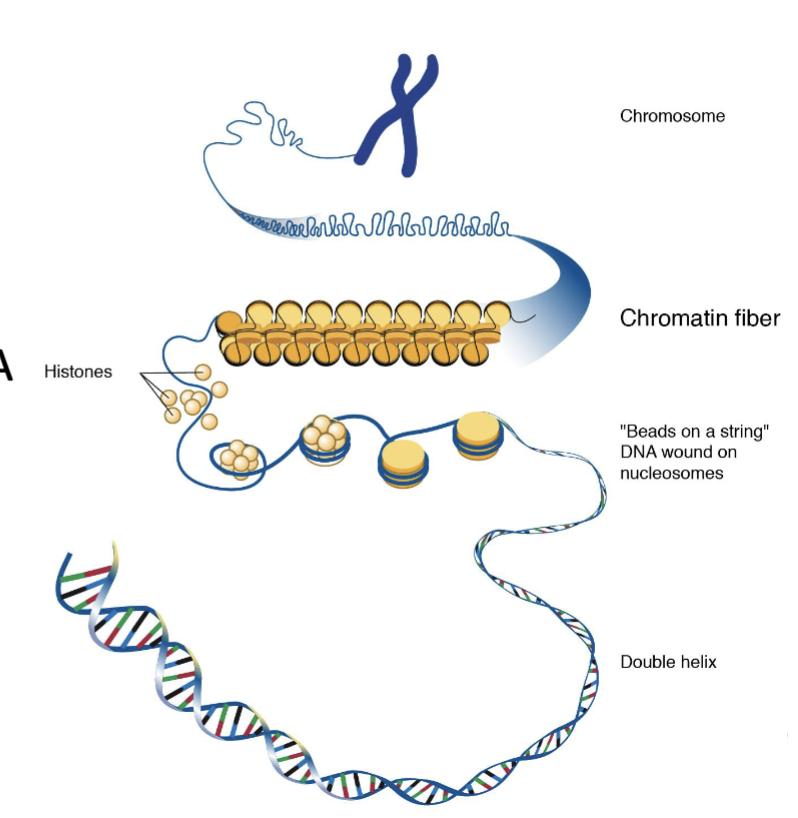
what is chromatin
a complex of DNA,RNA & proteins
How is RNA different from DNA structurally?
Single-stranded, ribose sugar, uracil instead of thymine
Why is RNA less stable than DNA?
Has OH group at 2′ carbon
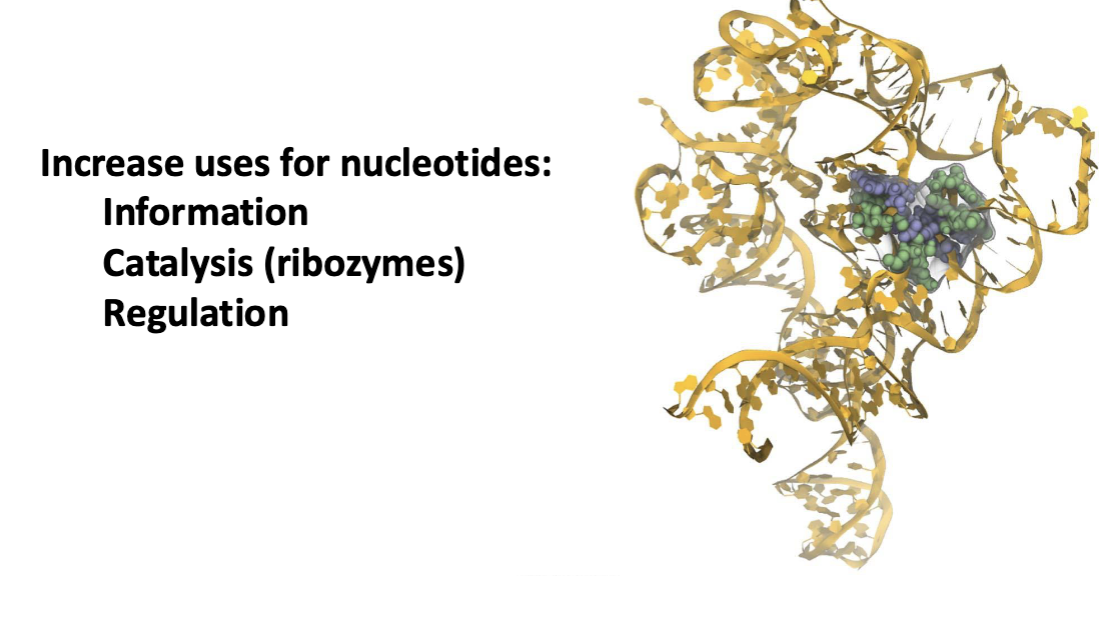
RNA: Tertiary Structures
Increase uses for nucleotides: —> Information Catalysis (ribozymes) Regulation
What does mRNA do?
Carries genetic code to ribosome (protein)
What does tRNA do?
Brings amino acids to ribosome (protein)
What does rRNA do?
Forms ribosome and catalyzes peptide bonds
What is a ribozyme?
RNA molecule that acts as an enzyme
How do RNA enzymes differ from protein enzymes?
RNA uses base pairing
proteins use diverse side chains and are more efficient
How does nucleic acid tertiary structure compare to protein tertiary structure?
Both involve 3D folding, but DNA is more uniform while proteins have diverse shapes based on amino acid interactions
Which level of structure of nucleic acids directly determines genetic information?
Primary structure
Which level of structure of nucleic acids involves base pairing?
Secondary structure
Which level of structure involves overall 3D folding and packaging of nucleic acids?
Tertiary structure
Why is DNA more structurally stable than RNA?
Double-stranded structure and lack of 2′ OH group
Why is RNA more versatile structurally?
Single-stranded → can fold into many shapes (functional diversity)