CVA Chapter 13 - The Respiratory System
 Call Kai
 Learn
Learn Practice Test
 Spaced Repetition
 Match
Match Flashcards
 Knowt Play
1/106

There's no tags or description
Looks like no tags are added yet.
Name | Mastery | Learn | Test | Matching | Spaced | Call with Kai |
|---|
No analytics yet
Send a link to your students to track their progress
107 Terms
What are gills used for in fishes and aquatic/aquatic stage amphibians?
Respiration.
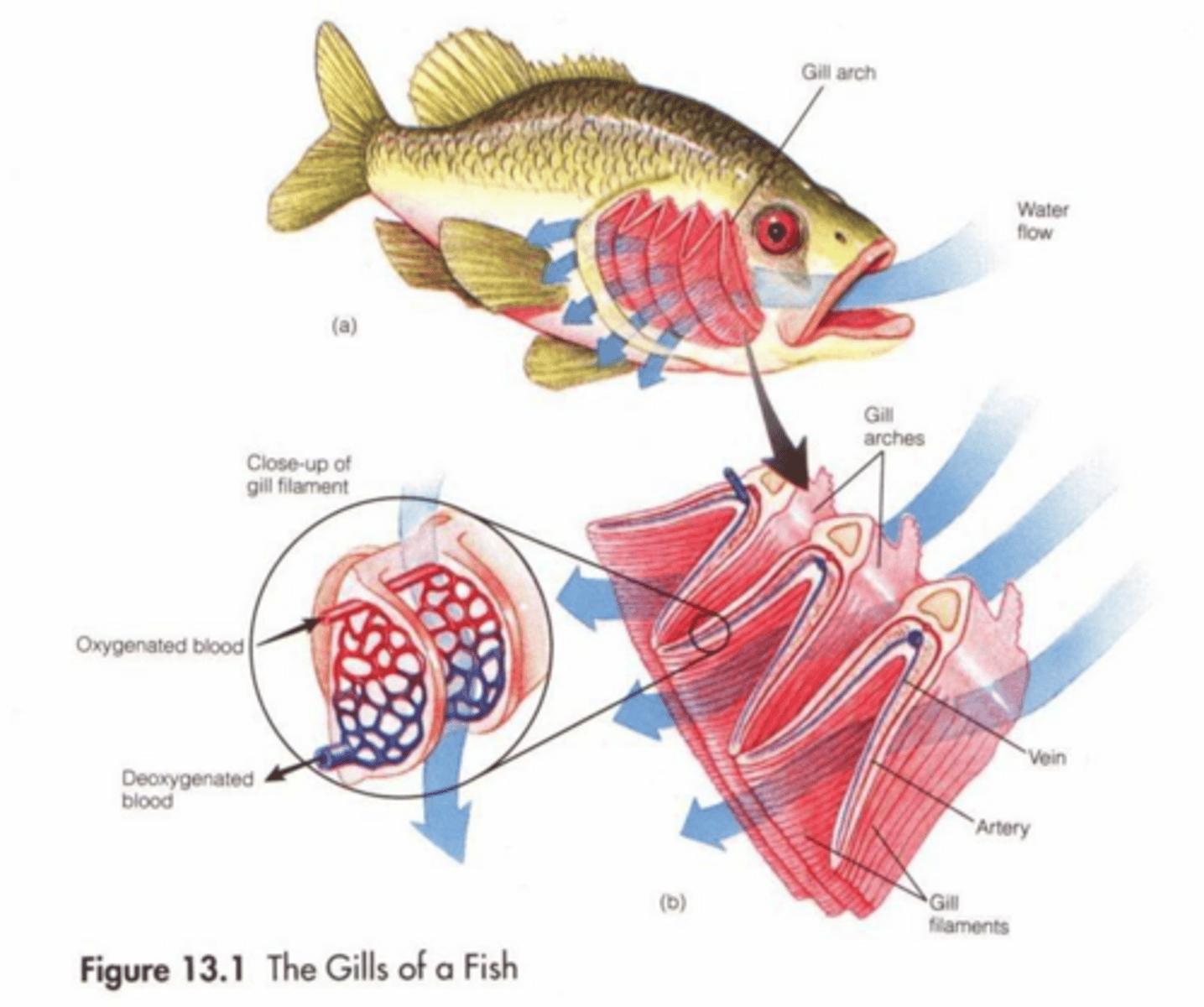
Where do the internal gills of fishes arise from?
The walls of the pharyngeal pouches.
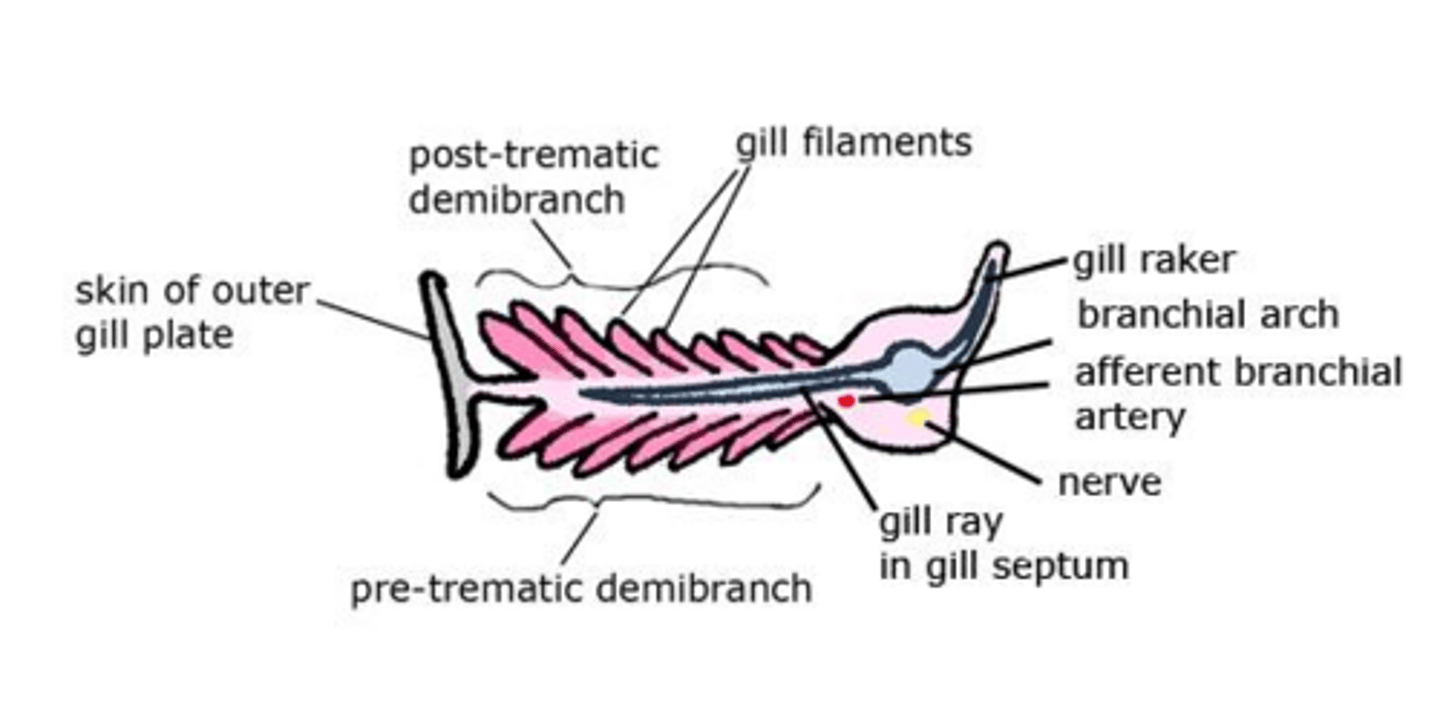
What are pharyngeal pouches?
Paired evaginations of the embryonic pharynx.
What are pharyngeal grooves?
Invaginations of the surface ectoderm that lie external to the pharyngeal pouches.
What is the Branchial Plate?
A thin membrane located between the pharyngeal pouch and the pharyngeal groove.
What happens if the branchial pouch ruptures?
The pharyngeal pouch and groove will be connected, allowing water to exit the pharynx.
What is the function of Afferent Branchial Ducts?
They conduct respiratory water from the pharynx into the pharyngeal pouches.
What is the function of Efferent Branchial Ducts?
They lead from the pharyngeal pouches to the external environment.
How do hagfishes differ in gill structure from most fish species?
Hagfishes have efferent branchial ducts that unite to form a single opening on each side while in most fish species each pouch has its own efferent branchial duct.
What is the Velum in hagfishes?
A pulsating muscle supported by cartilage that pumps water from the velar chamber into the pharynx and gill pouches. This creates vacuum pressure that draws in more water from the naris and nasopharyngeal duct.
How do lampreys respire?
They move respiratory water in and out of external gill slits. Water enters and exits the pharyngeal pouches by pulsations of pouch musculature.
What is the respiratory tube In lampreys?
A blind ending tube located ventral to the esophagus. It is formed as a division of the pharynx to allow for parasitic feeding and breathing to occur simultaneously.
What is the purpose of the velum in lampreys?
It acts as a valve to keep out food while allowing respiration.
How many pairs of pharyngeal pouches do lampreys have?
7, and they communicate with both the respiratory tube and external gill slits. They are large and lined by well vascularized gill lamellae.
What condition are elasmobranch gill pouches found in?
Pentanchid, meaning they have 5 pairs. They are exceptions of six- and seven-gill sharks.
What are spiracles in elasmobranchs?
One-way intake valves used to bring in water, especially in rays and skates. They are said to be "naked" since they are not covered by a valve or an operculum.
What is found in the first four chambers in the anterior and posterior walls in elasmobranchs? (The fifth chamber only has one on the anterior wall)
A demibranch, a well vascularized gill surface.
What is a Pretrematic Demibranch?
The demibranch on the anterior wall.
What is the Posttrematic Demibranch?
The demibranch on the posterior wall.
What lies between the posttrematic demibranch of one gill slit and the pretrematic demibranch of the next gill slit?
The interbranchial septum, which is supported by gill rays radiating from gill cartilages.
What is the function of the gill mucosa?
It is a well vascularized region that increases surface area for gas exchange between water and blood.
What is a Holobranch?
It is composed of two demibranchs of a single gill arch, including associated structures.
How many holobranchs does the typical shark have?
4
What are gill rakers?
Stubby, projecting structures radiating from the pharyngeal border that protect the gills from mechanical trauma.
How does respiratory water enter and exit in elasmobranchs?
It enters by the mouth and spiracles and exits through the gills.
What distinguishes Holocephalians from elasmobranchs?
Holocephalians have 4 pairs of gill pouches, lack spiracles, and have a fleshy operculum that covers the gill slits.
What makes the gill apparatus in cartilaginous and bony fishes similar?
Both are a series of pharyngeal arches supporting holobranchs and a stream of respiratory water flows over the demibranchs as it travels from the pharyngeal cavity to the external environment. As the water passes over the gill mucosa gases are exchanged between the water and blood stream.
What is the operculum in bony fishes and what does it originate from?
A bony flap that covers the gill slits. It originates on the hyoid arch and extends caudally to cover the gill chambers.
What is the Branchiostegal Membrane?
It extends from the ventral edge of each operculum. In teleosts it is supported by branchiostegal rays. In ancient fishes it is supported by gular plates.
What encloses the opercular chamber?
The right and left branchiostegal membrane join midventrally to enclose it.
How do bony fishes differ in gill structure from cartilaginous fishes?
Bony fishes have an operculum, opercular chamber, and shorter interbranchial septa.
What does the opercular chamber receive?
Water that has passed through the gills and is about to exit the body through a cleft at the caudal margin of the operculum.
What is the result of the shorter interbranchial septa in bony fishes?
Two adjacent demibranchs will not be separated by an interbranchial septum. This allows for more contact between respiratory water and the capillaries of the gill mucosa.
How many holobranchs and gill chambers do most bony fishes have?
Most bony fishes have 4 holobranchs and 5 gill chambers. They have no "First demibranch" as seen in sharks. It has been lost.
What happens to the spiracle during fetal development in most fishes?
The spiracle closes off.
How is water drawn into the pharynx in bony fishes?
By dropping the floor of the oropharynx when the operculum is closed and the mouth is open.
How does water exit the opercular chamber?
By opening the operculum, closing the mouth, and raising the pharyngeal floor.
What is the significance of demibranchs in gills?
They provide a well-vascularized surface for gas exchange.
What is the function of the external gill apertures in hagfishes?
They allow water to exit after gas exchange in the gill pouches.
What role do gills play besides respiration?
Gills also play a role in excretion.
How do marine species excrete salt?
Marine species have salt-excreting glands in their gills.
How do freshwater species regulate salt levels?
Freshwater species use their kidneys to regulate salt levels.
What do species that migrate between salt and freshwater do to maintain homeostasis?
They excrete chloride in salt water and absorb chloride in freshwater.
How do fishes excrete nitrogenous wastes?
Almost all fishes excrete nitrogenous wastes through their gills.
What gas do gills release as a waste product of respiration?
Gills release carbon dioxide.
What is aerial respiration?
Aerial respiration is the ability to obtain oxygen from the atmosphere. It developed in some Devonian era fishes.
Which modern fish can still perform aerial respiration?
Some modern teleosts, dipnoans, gars, amia, and actinopterygians can perform aerial respiration.
What is the evolutionary significance of the swim bladder?
The modern tetrapod lung evolved from the swim bladder.
What are air sacs (swim bladder and/or lungs) in fishes used for?
Air sacs can serve as both hydrostatic organs and respiratory organs. Swim bladders can also serve in sound detection in some fish species.
What are the nares and nasal cavities in fishes used for?
In fishes, the nostrils (or external nares) are used for scent detection and not for breathing.
What is each nostril divided into in fish?
An incurrent apperature and excurrent apperature. In lobefins there is an extra opening into the oropharyngeal cavity called internal nares.
What is the tetrapod nare and nasal cavity condition?
Air enters through external nares, passes through the cavity, and enters the pharynx through internal nares.
What does the tetrapod pharynx communicate with?
The trachea and esophagus posteriorly and anteriorly to the oral and nasal cavities.
What are the openings associated with the pharynx?
The glottis, opening of the esophagus, eustachian tubes, fauces, and internal nares.
What is the function of the glottis in the pharynx?
The glottis is the opening into the trachea. In mammals it is guarded by the epiglottis. In other tetrapods it is guarded by fleshy folds.
What are the three subdivisions of the mammalian pharynx?
The three subdivisions are the nasopharynx (interal nares to soft palate), oropharynx (soft palate to hyoid), and laryngopharynx (hyoid to glottis).
What is the role of the larynx?
The larynx is a short passageway between the glottis and trachea, supported by cartilage to withstand air pressure.
Describe the primitive larynx structure in urodeles.
It is a single pair of cartilages and the glottis.
What are the pairs of laryngeal cartilages in tetrapods?
Cricoids and Arytenoids. Mammals also have Thyroids and sometimes Cuneiforms, Corniculates, and Procoracoids.
What is the function of the vocal folds in the larynx?
Vocal folds are folds of mucus membrane that can alter the stream of air passing through them. Some vertebrates have an additional pair containing muscle.
What are mammals with the extra pair of vocal folds said to have?
False and true vocal cords.
What is the trachea's function?
The trachea carries air from the larynx to the lungs. It is reinforced by cartilage or C-shaped bony plates.
At what point does the trachea end in tetrapods (other than urodeles)?
When it branches into the right and left primary bronchi which enter into the right and left lung respectively.
What is the carina in the respiratory system?
The carina is the branching point where the trachea divides into the right and left primary bronchi.
What is the syrinx in birds?
The syrinx is a specialized structure located at the carina that serves as the larynx in birds.
What are the three kinds of syrinxes found in birds?
Bronchotracheal, Tracheal, and Bronchial.
What are the bronchi's role in the respiratory system?
The bronchi conduct air into the various subsegments of the lungs. They are structurally similar to the trachea.
What are the mammalian bronchi divides into?
Primary, Secondary, and Tertiary. Tertiary are split further into air-providing bronchioles.
What are lungs?
Paired, sac-like structures that serve as the sight of external respiration.
What is the respiratory membrane in the lungs?
The respiratory membrane is thin, moist, well vascularized, and has a large surface area to increase the efficiency of external respiration.
How do amphibian lungs differ in appearance?
Amphibian lungs can be elongated in urodeles and bulbous in anurans. Internal lining may be smooth or have outpocketings.
What is the function of the Eustachian tubes?
Eustachian tubes connect the pharynx to the middle ear to equalize air pressure in the head.
How do aquatic amphibians primarily respire?
Through the pharyngoesophageal lining and skin. Lungs serve as hydrostatic organs.
What respiratory organs do terrestrial amphibians primarily use?
Lungs, supplemented by the pharyngoesophageal lining and skin.
How do reptiles, birds, and mammals draw air into their lungs?
Using negative pressure.
What is the primary respiratory organ for amniotes?
Lungs.
How do the lungs of sphenodon and snakes differ from those of lizards and crocodilians?
Sphenodon and snakes have simple sac-like lungs, while lizards and crocodilians have lungs with septa that create multiple chambers.
What do the multiple lung compartments cause?
Residual air being held in the lungs.
What are air sacs in reptiles used for?
To inflate the body as a scare tactic against predators.
What separates the lungs from the rest of the pleuroperitoneal cavity in some reptiles?
The oblique septum.
What muscles do squamates use for ventilation?
Intercostal muscles which move the ribs to alter intrapleural pressure.
What is the role of diaphragmatic muscles in crocodilians?
They create negative pressure in the pleural cavities for inspiration.
How do turtles achieve negative pressure for inspiration?
By using movements of the pectoral girdle to create negative pressure for inspiration.
What is unique about avian lungs compared to other vertebrates?
Air travels through the lungs by way of the primary bronchus without stopping to the air sacs.
How does air travel from the lungs to the air sacs in Aves? How does it exit the air sacs?
The mesobronchi and the excurrent bronchi.
What are the air sacs in Aves?
Thin walled, voluminous, expandable diverticuli of the lungs.
What are the types of air sacs found in birds?
Cervical (neck), interclavicular (dorsal to furcula), anterior thoracic (lateral to heart), posterior thoracic (oblique septum), abdominal (abdominal viscera), and axillary sacs (between supracoracodieus and pectoralis major).
How do pneumatic foramina contribute to bird anatomy?
They extend diverticuli from air sacs into the bones, giving birds "hollow bones."
What happens to air pressure in the coelom during expiration in birds at rest?
Air pressure increases, forcing air into the bronchial tree and the excurrent bronchi.
What is the ventilation mechanism in birds in flight?
Appendicular muscles will cause inspiration and expiration. Chest muscles will contract and expand the coelom, the resulting air pressure forces air onto the air sacs via the mesobronchi. Contraction of the antagonistic set of muscles compress the air sacs, forcing air into the bronchial tree by way of excurrent bronchi.
What are the main excurrent bronchi in birds?
Dorsal and Ventral.
What are parabronchi?
Thin walled structures that connect the dorsal and ventral bronchi surrounded by anastomizing capillary beds. They serve as the site of external respiration.
Where does the exchange of gases between the atmosphere and lungs occur in flying birds?
As the air is exiting the lungs.
What is the primary muscle driving mammalian inspiration?
The diaphragm.
What is the pleural cavity in mammals?
The chamber where each lung resides, separated by the mediastinum and pericardial cavity.
What is the structure of mammalian lungs?
They are highly compartmentalized, being broken up into asymmetrical lobes, lobules, segments, and bronchioles.
What are alveoli and their function in mammals?
Thin-walled, sac-like structures that serve as the site of external respiration. The smallest bronchioles terminate here.
What types of cells are found in alveoli?
Type 1 cells (for respiration), Type 2 cells (secrete surfactant), and alveolar macrophages (clear particulate matter).
What is the function of surfactant secreted by Type 2 alveolar cells?
To keep the alveoli open.
What is the composition of the alveolar-capillary membrane?
Type 1 cells, basal laminae, and endothelial cells of capillaries.