5.5b Treatment of Psychological Disorders: Behavioral, Cognitive, and Group Therapies
 Call Kai
 Learn
Learn Practice Test
 Spaced Repetition
 Match
Match Flashcards
 Knowt Play
1/43

There's no tags or description
Looks like no tags are added yet.
Name | Mastery | Learn | Test | Matching | Spaced | Call with Kai |
|---|
No analytics yet
Send a link to your students to track their progress
44 Terms
Behavior therapists
Therapy that uses learning principles to reduce unwanted behaviors
Counterconditioning
Behavior therapy procedures that use classical conditioning to evoke new responses to stimuli that are triggering unwanted behaviors; include exposure therapies and aversive conditioning
Exposure therapies
Behavioral techniques, such as systematic desensitization and virtual reality exposure therapy, that treat anxieties by exposing people (in imaginary or actual situations) to the things they fear and avoid
Systematic desensitization
A type of exposure therapy that associates a pleasant relaxed state with gradually increasing anxiety-triggering stimuli; commonly used to treat specific phobias
Virtual reality exposure therapy
A counterconditioning technique that treats anxiety through creative electronic simulations in which people can safely face specific fears, such as flying, spiders, or public speaking
Aversive conditioning
Associates an unpleasant state (such as nausea) with an unwanted behavior (such as drinking alcohol)
Token economy
An operant conditioning procedure in which people earn a token for exhibiting a desired behavior and can later exchange tokens for privileges or treats
Cognitive therapies
Therapy that teaches people new, more adaptive ways of thinking; based on the assumption that thoughts intervene between events and our emotional reactions
Rational-emotive behavior therapy (RBT)
A confrontational cognitive therapy, developed by Albert Ellis, that vigorously challenges people’s illogical, self-defeating attitudes and assumptions
Cognitive-behavioral therapy (CBT)
A popular integrative therapy that combines cognitive therapy (changing self-defeating thinking) with behavior therapy (changing behavior)
Group therapy
THerapy conducted with groups rather than individuals, providing benefits from group interaction
Family therapy
Therapy that treats people in the context of their family system; views an individual’s unwanted behaviors as influenced by, or directed at, other family members
Psychodynamic therapy presumed problem
Unconscious conflicts from childhood experiences
Psychodynamic therapy aim
Reduce anxiety through self-insight
Psychodynamic therapy technique
Interpret clients’ memories, dreams, and feelings
Person-centered therapy presumed problem
Barriers to self-understanding and self-acceptance
Person-centered therapy aim
Enable growth via unconditional positive regard, acceptance, genuineness, and empathy
Person-centered therapy technique
Listen actively and reflect clients’ feelings
Behavior therapy presumed problem
Dysfunctional behaviors
Behavior therapy aim
Learn adaptive behaviors; extinguish problem ones
Behavior therapy technique
Use classical conditioning (via exposure or aversion therapy) or operant conditioning (as in token economies)
Cognitive therapy presumed problem
Negative, self-defeating thinking
Cognitive therapy aim
Promote healthier thinking and self-talk
Cognitive therapy technique
Train people to dispute their negative thoughts and attributions
Cognitive-behavioral therapy presumed problem
Self-harmful thoughts and behaviors
Cognitive-behavioral therapy aim
Promote healthier thinking and adaptive behaviors
Cognitive-behavioral therapy technique
Train people to counter self-harmful thoughts and to act out their new ways of thinking
Group and family therapy presumed problem
Stressful relationships
Group and family therapy aim
Heal relationships
Group and family therapy technique
Develop an understanding of family and other social systems, explore roles, and improve communication
How does the basic assumption of behavior therapy differ from the assumptions of psychodynamic and humanistic therapies? What classical conditioning techniques are used in exposure therapies and aversive conditioning?
Behavior therapies are not insight therapies, but instead assume that problem behaviors are the problem. Their goal is to apply learning principles to modify these problem behaviors
Classical conditioning techniques, including exposure therapies (such as systematic desensitization and virtual reality exposure therapy) and aversive conditioning, attempt to change behaviors through counterconditioning — evoking new responses to old stimuli that trigger unwanted behaviors
What is the main premise of behavior therapy based on operant conditioning principles, and what are the views of its proponents and critics?
Operant conditioning assumes that voluntary behaviors are strongly influenced by their consequences. Therapy based on operant conditioning principles therefore uses behavior modification techniques to change unwanted behaviors by positively reinforcing desired behaviors and ignoring or punishing undesirable behaviors
Critics maintain that (1) techniques such as those used in token economies may produce behavior changes that disappear when rewards end, and (2) deciding which behaviors should change is authoritarian and unethical
Proponents argue that treatment with positive rewards is more humane than punishing people or institutionalizing them for undesired behaviors
What are the goals and techniques of the cognitive therapies and of cognitive-behavioral therapy?
The cognitive therapies, such as Aaron Beck’s cognitive therapy for depression, assume that our thinking colors our feelings, and that the therapist’s role is to change clients’ self-defeating thinking by training them to perceive and interpret events in more constructive ways
Rational-emotive behavior therapy (REBT) is a confrontational cognitive therapy that actively challenges irrational beliefs
The widely researched and practiced cognitive-behavioral therapy (CBT) combines cognitive therapy and behavior therapy by helping clients regularly try out their new ways of thinking and behaving in their everyday life
A newer CBT variation, dialectical behavior therapy (DBT), combines cognitive tactics for tolerating distress and regulating emotions with social skills training and mindfulness meditation
What are the aims and benefits of group and family therapies?
Group therapy sessions can help more people at a lower cost compared to individual therapy. Clients may benefit in person or online from exploring feelings and developing social skills in a group situation, from learning that others have similar problems, and from getting feedback on new ways of behaving
Family therapy aims to help family members discover the roles they play within the family’s interactive social system, improve communication, and learn new ways to prevent or resolve conflicts
Dr. Welle helps her clients by teaching them to modify the way they think when they are under stress or when they are experiencing symptoms. What form of therapy does Dr. Welle most likely practice?
A) Behavioral
B) Cognitive
C) Group
D) Family
B) Cognitive
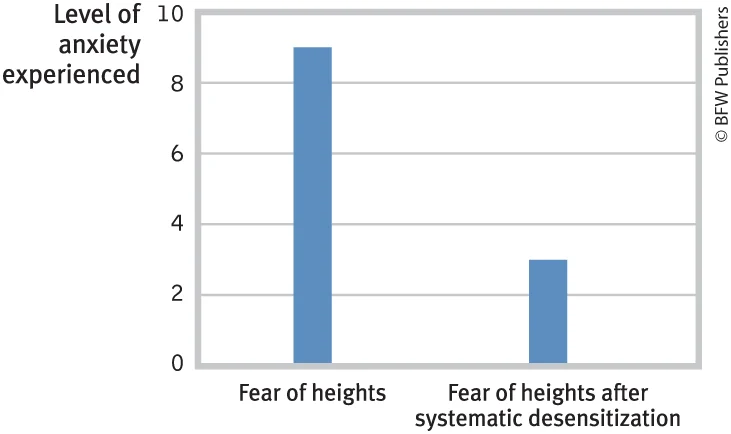
What form of therapy is depicted in the graph?
A) Cognitive
B) Group
C) Family
C) Behavioral
C) Behavioral
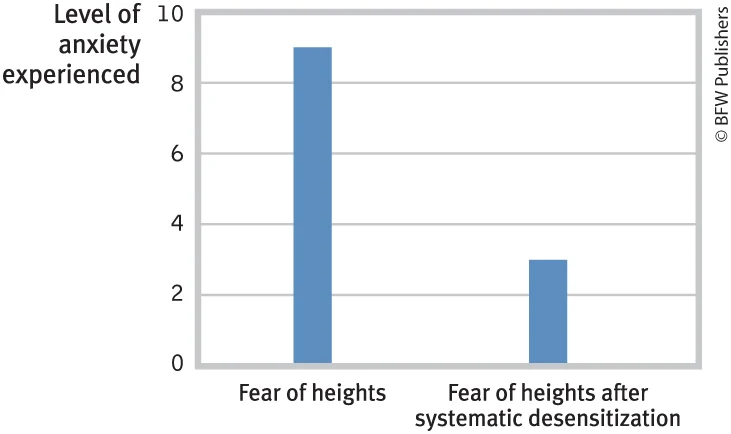
Which of the following best describes the trends in the variables as depicted by the data in the graph?
A) The participants’ anxiety decreased after they were repeatedly exposed to heights while practicing relaxation techniques.
B) The participants’ anxiety increased after they were repeatedly exposed to heights while practicing relaxation techniques.
C) The participants’ anxiety decreased after they were repeatedly exposed to heights while undergoing aversive conditioning.
D) The participants’ anxiety increased after they were repeatedly exposed to heights while undergoing aversive conditioning.
A) The participants’ anxiety decreased after they were repeatedly exposed to heights while practicing relaxation techniques.
Jayne has been diagnosed with major depressive disorder. Her therapist suggested that she interact with her friends more frequently, and she helped Jayne learn how to decrease her worries about whether her friends want to be around her. What form of therapy is Jayne’s therapist using?
A) Cognitive-behavioral therapy
B) Group therapy
C) Rational-emotive behavior therapy
D) Behavior modification
A) Cognitive-behavioral therapy
Dr. Laremy meets with adolescents and their parents together to help them develop effective communication strategies. What form of therapy does Dr. Laremy use?
A) Self-help
B) Cognitive-behavioral
C) Dialectical behavioral
D) Family
D) Family
Dr. Mehari believes that the best way to treat clients is to use active listening and to help clients gain self-acceptance, while Dr. Rodriguez believes that the best way to treat clients is to help them change their thoughts and behaviors. Which statement is most accurate about Dr. Mehari’s and Dr. Rodriguez’s preferred therapy?
A) Dr. Mehari prefers psychodynamic therapy, while Dr. Rodriguez prefers cognitive-behavioral therapy.
B) Dr. Mehari prefers person-centered therapy, while Dr. Rodriguez prefers cognitive-behavioral therapy.
C) Dr. Mehari prefers person-centered therapy, while Dr. Rodriguez prefers cognitive therapy.
D) Dr. Mehari prefers psychodynamic therapy, while Dr. Rodriguez prefers behavioral therapy.
B) Dr. Mehari prefers person-centered therapy, while Dr. Rodriguez prefers cognitive-behavioral therapy.
Javi’s parents give him a marble each day he completes his homework. He can exchange marbles for privileges, such as a later weekend bedtime or a trip to the ice-cream store. Which of the following is described in this example?
A) Aversive conditioning
B) Token economy
C) Acceptance and commitment therapy
D) Systematic desensitization
B) Token economy
Which of the following scenarios best illustrates the concept of counterconditioning?
A) Kendall’s fear of flying gradually diminishes after he takes several flights without experiencing any turbulence.
B) Roman’s dislike for broccoli increases over time because he always has to eat it as part of his meals.
C) Jerri’s fear of dogs intensifies after a negative encounter with an aggressive dog at a park.
D) Logan’s preference for chocolate decreases when he repeatedly pairs its consumption with a foul taste.
D) Logan’s preference for chocolate decreases when he repeatedly pairs its consumption with a foul taste.
After repeatedly drinking an alcoholic drink mixed with a drug that produces severe nausea, Xander, who has a history of alcohol use disorder, developed a temporary conditioned aversion to alcohol. In this example of aversive conditioning, the nausea-producing drug is the
A) UCS, because it naturally elicits the response.
B) CS, because it naturally elicits the response.
C) UCS, because the association must be learned in order to elicit the response.
D) CS, because the association must be learned in order to elicit the response.
A) UCS, because it naturally elicits the response.