Accounting Unit 1
 Call Kai
 Learn
Learn Practice Test
 Spaced Repetition
 Match
Match Flashcards
 Knowt Play
1/156

There's no tags or description
Looks like no tags are added yet.
Name | Mastery | Learn | Test | Matching | Spaced | Call with Kai |
|---|
No analytics yet
Send a link to your students to track their progress
157 Terms
Examples of a non-current asset?
Investments, Fittings, Premises and term deposits (that last more than 12 months)
Examples of a current asset?
Accounts receivable & Stationary Supplies
Give more examples of Current assets
Term deposit/Investment (if less than 12 months), Accrued income (owing to us)
What are examples of expenses?
Interest on loan
Insurance
Stationary (balance sheet)
Sales Commission
Marketing
What is the difference between GST credit and GST payable?
GST credit is GST you get back; GST payable is GST you must pay to the ATO..
What is a term deposit?
money invested with a bank for a fixed period that earns guaranteed interest
What is accrued income?
Income earned but not yet received in cash by the business
What the difference between accounts receivable and accounts payable?
Accounts receivable is money customers owe the business; accounts payable is money the business owes suppliers.
What is a premises?
The building or place where a business operates or conducts its activities.
What are fittings?
Fixtures or items attached to a building, such as shelves, counters, or light fittings.
Examples of non-current Liability?
Mortgage &, loan from bank
What is a mortgage?
A loan used to buy property, secured against the property until it is repaid.
Examples of a current Liability?
Creditors, bank overdraft, & Accrued expenses.
What are creditors?
people or businesses you owe money to for goods or services bought on credit.
What is a bank overdraft?
When a business withdraws more money than it has in its bank account.
What are accrued expenses?
Costs already incurred but not yet paid or recorded in cash.
What are retained earnings?
Profits the business keeps and reinvests instead of paying out to owners as drawings or dividends.
What are reserves?
Portions of profits set aside for specific future purposes or to strengthen the business.
What is the accounting equation?
ASSETS = LIABILITIES + EQUITY
What documents are used to make entries in the accounting system?
Order forms - documents, but not source documents
Invoice
Receipt
Quotations - documents, but not source documents
Cheque
Cash register roll
What does the income statement/ statement of financial performance show?
Profit or loss - by comparing a business’s income with its expenses for a specific period.
What does the balance sheet statement of financial position show?
The assets, liabilities and equity on one day.
The conceptual framework of accounting includes and sets out things like…?
Definitions of different types of accounts
What account takes place when applying for a loan to buy a building, house, act
Mortgage
What will trading business classify operating expenses into?
Selling and distribution expenses
General and administration expenses
Financial expenses
What is selling and distribution expenses?
The costs involved in preparing the goods for sale
e.g. adverting, freight outwards, sale’s wages, any vehicle expenses, and sales commission
What is General and administration expenses?
Costs that relate to the management and/or administration of the business or that are of a general nature
e.g. insurance, rent expense, stationary, repairs for office equipment, telephone, depreciation on equipment, rates, water, electricity & bad depts
What is Financial expenses?
Costs of raising finance for the business or costs charged by the bank for maintaining the business’ accounts e.g. bank fees, interest on loan, interest expense.
What is sales?
What is less sales?
What is discount allowed?
Amount sold for
sent back to us
When customer pays less (25% off)
What is gross profit?
the money a business makes after subtracting the cost of producing or buying the goods it sells.
Cartage inward meaning?
the delivery cost paid to transport purchased goods from the supplier to business.
Cartage outward meaning?
delivery cost paid by a business to transport goods from the business to customers.
What order is the 5-step cycle next to the 4-step accounting cycle?
Source documents → Documenting
Journal → Recording
Ledger, Trial Balance → Processing
Financial Statements → Reporting
Examples of a right:
Receives cash from another party
Receive goods or services from another party
Exchange economic recourses with another party on favorable terms
Rights over physical objects e.g. property, equipment, inventories
Rights to use intellectual property
Examples of potential to produce economic benefits
Receive contractual cash flow or another economic resource
Exchange economic recourses with another party
Produce cash inflows or avoid cash outflows
What is the purpose of a trial balance?
To detect errors made in posting information in the general ledger
To provide a list of general ledger account balances from which accounting reports are prepared e.g. income statement and balance sheet
What are the errors not found when disclosing a trial balance?
• Error of omission – failing to record a transaction in the general journal and ledger
• Error of commission – Entering the transaction in the wrong ledger account but on the correct side
• Making compensating errors – making 2 independent errors of equal amounts
. Error of Original Entry - Wrong amount recorded in both debit and credit entries.
Example: Invoice of $540 entered as $450 on both sides.
What is the purpose reporting events?
to provide financial information to users for decision-making
Name 2 items that are cash payments but not expenses
asset purchases and liability repayments
What equation is the framework definition applied with?
A - L = E
Difference between documents and source documents
Documents are any written business records; source documents are original records proving transactions.
(Receipt is the SOURCE DOCUMENT
Because it is the original proof that the purchase happened.)
(That spreadsheet/report is a DOCUMENT
Because it contains information, but it is not the original proof.)
On which principle are entries in the General Ledger based?
DOUBLE ENTRY PRINCIPLE
What is the purpose in processing events/ general ledger?
To classify and organize transactions into accounts
What are the analysis steps for assets?
Control - Yes, the owner of ABC traders is able to decide what to do, who can use, where to store and how to use the motorcycle.
Right - Yes ABC traders owns and can use the motor vehicle will have proof (invoice & receipts) showing that they bought the motor vehicle
Potential to produce economic benefits - Yes, the motor vehicle will be used in daily operation of the business which will help them to generate income
What are the analysis steps for Liabilities?
Obligation - Yes, ABC traders owes XYZ bank the money by law have an obligation to pay them.
Transfer of economic resource - Yes, when ABC Traders pay the loan, money will be taken from their bank account
Past events - Yes, ABC traders borrowed the money from XYZ Bank on 1st March 2022
What are the analysis steps for Income?
Increases of assets or decreases of liabilities: Yes, ABC traders will receive $900 which will increase their cash at bank (asset).
Increase in equity:
Yes, Assets $9000 = Liabilities $0 + Equity $9000, or Sales income increases profit that owner must get (equity)
Not contribution from holders of equity claims: Yes, equity increases, but is not capital contributions from the owner.
What are the analysis steps for expenses?
Derecognition of assets or recognition of liabilities: Yes, ABC traders will pay $5000 which will decrease their cash at bank (asset)
Decrease in equity:
Yes Assets ↓ $5000= Liabilities 0 + Equity ↓ $5000
Not distribution to holders of equity claims:
Yes, the amount is $5000 and this information is complete and free from error and can therefore be entered in the financial records as such.
Give an example of the recognition criteria of liabilities
Relevance- Yes, the loan could influence the decision-making of users of the balance sheet, e.g. investors, and there will be an outflow of economic benefits when they pay the loan
Faithful representation - Yes, the value of the loan is $10 000, and this information is complete and free from error and can therefore be entered in the financial records as such.
Give an example of the recognition criteria of assets
Relevance- Yes, the laptop could influence the decision-making of users of the balance sheet, has a physical existence, and it is probable that an inflow of economic benefits will occur from this use
Faithful representation- Yes, the value of the laptop is $1 500, and this information is complete and free from error and can therefore be entered in the financial records as such.
Give an example of the relevance recognition criteria of income
Relevance- Yes, the sales will affect the profit, and decision-making being made relating to the profit, and there was an inflow of economic benefits, they received money for sales.
Give an example of the recognition criteria of expense
Relevance- Yes, the wages will affect the profit and decisions being made relating to the profit, and there was an outflow of economic benefits, paid the wages (decrease cash at bank)
Advantages of periodic inventory system
Simple system to use
Advantages of perpetual inventory system
. Short term income statement (e.g. monthly) can be prepared as Cost of Sales is known at all times
. Owner knows how much stock is left after each sale, so it’s unlikely to run out of stock
. Fast and slow moving inventory lines can be easily identified
Disadvantages of perpetual inventory system
More expensive to set up perpetual inventory system than periodic inventory system
Disadvantages of periodic inventory system
. Must do physical stock take to determine inventory figure
. Periodic inventory system does not provide as much information to owner as the perpetual inventory.
What does the AASB 102 Inventories define inventory as?
Assets held for resale,
partly finished goods
and supplies that will be consumed in the manufacture of a product or in providing a service.
What are the accounts used in the following transaction?
M. Action returned inventory to the value of $110 inclusive of GST.
The cost of the goods returned was $80.
Sales Return
GST Payable
Accounts receivable
Inventory
Cost of Sales
What are the accounts used in the following transaction?
Received a cheque from Sarah Singleton, a debtor, in payment of her account, $200
Cash at bank
Accounts Receivable
What are the accounts used in the following transaction?
A debtor, IM, disappeared. Write his dept of $13 750 inclusive of GST off as irrecoverable
Bad Depts
GST payable
Accounts Receivable
Explain the difference between the perpetual and periodic inventory systems when buying inventory
Perpetual uses an inventory account, while periodic uses the purchase account
Explain the difference between the perpetual and periodic inventory systems when selling inventory
Perpetual has a second part where cost of sales is debited and inventory is credited. Periodic does not have this entry
what document are proof that a transaction is bought on credit
Invoice / Tax Invoice → credit purchase ✔
Purchase Order (PO) → order placed, not proof of purchase by itself
Credit Note → for returns/allowances
What is corporate social responsibility?
How the business goes about its operations while ensuring that is has an acceptable impact on the community and the environment
What concerns do businesses build into their activities?
Social - Employment opportunities, sponsorships/charities, investing back into local community
Environmental - Recycling, reducing carbon emissions, water tanks/ energy saving equipment
Ethical - Equal opportunities - respect, non-discrimination, not exploiting employees, committed to employee safety (OHS)
What is sustainability concerned with?
The ability of the world’s resources to meet the needs of current and future generations.
What has growing concern about sustainability resulted in?
Increased legislative requirements to protect the environment and the community.
Define sustainability.
Doing something with long term in mind.
What is the main goal of sustainability?
Meeting needs of present without compromising ability of future generations to meet their needs.
What are the three pillars/components of sustainability?
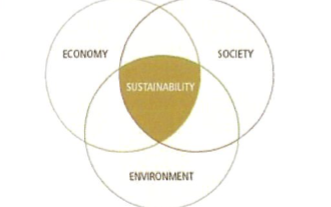
How has the main objective of businesses changed over time?
Businesses used to focus mainly on maximising profits and financial performance, but now also consider social, environmental, and ethical impacts.
Why are stakeholders important in modern businesses?
Stakeholders have different interests and are increasingly concerned about a business’s environmental impact, social responsibility, and ethical standards.
What do suppliers want to know about a business?
Suppliers want confidence that the business will keep buying from them, as this affects their operations and future success.
What is the main interest of suppliers as stakeholders?
Suppliers want businesses to continue buying from them because it affects their operations and future income.
What is the main interest of owners/shareholders?
Owners/shareholders are interested in receiving a return on their investment (ROI).
What is the main interest of employees as stakeholders?
Employees depend on business success for wages, job security, and continued employment.
What is the main interest of customers as stakeholders?
Customers want assurance that the business will continue supplying goods and services.
What is the government’s interest as a stakeholder?
The government is interested in collecting taxes and ensuring businesses follow laws and regulations (e.g. ATO).
What is the main interest of the general public as stakeholders?
The general public is concerned with environmental issues, business performance, fair trading, equal opportunities, and community support/sponsorships.
What are the direct costs of CSR?
Implementation costs
Sourcing environmentally friendly products
Educating consumers on impact of purchasing decisions (e.g. advertising)
What are the indirect costs of CSR?
Loss of competitiveness due to factors such as higher prices
How can the costs of CSR be measured?
Financially
Non-financially (e.g. reputation)
How can CSR reduce costs and improve efficiency?
Greater efficiencies due to better management and cost savings (e.g. energy/water) → gains in income.
How can CSR help businesses avoid costs?
Avoid costs linked to poor environmental performance such as customer boycotts, fines, and breaches of regulations.
How does CSR affect employees?
CSR can lead to higher staff morale, which improves productivity and increases employee retention.
Why can CSR benefits be difficult to measure?
CSR is largely voluntary, often based on estimates, costs occur immediately, but benefits may take many years to appear.
How can CSR improve a business’s reputation and credibility?
CSR can improve reputation through positive media coverage and increase transparency, trust, confidence, comparability, and credibility.
How does CSR help businesses become more competitive?
CSR can make businesses more competitive and improve products/services, creating future business opportunities.
How does CSR benefit relationships with society and stakeholders?
CSR helps align corporate goals with society and creates favourable perceptions among employees, customers, and the public.
How can CSR support compliance and business awareness?
CSR shows compliance with government regulations (possible funding opportunities) and increases awareness of social and environmental issues throughout the business.
Why may businesses be reluctant to commit to CSR because of profit and costs?
Businesses may feel CSR limits profit maximisation, can be expensive, and customers may care more about price than CSR compliance.
How can competitors affect a business’s decision to adopt CSR?
If competitors do not follow CSR (as it is voluntary), businesses may lose competitiveness.
Why might existing business performance reduce the need for CSR?
Businesses may already have a good social/environmental reputation or CSR may draw attention to previously unnoticed issues (e.g. OHS/environmental problems).
What is ethics?
Ethics are moral principles and standards used to make decisions and determine what is right and wrong.
What are ethics based on?
Ethics are based on a system of right and wrong and rules of conduct that encourage people to “do the right thing.”
What is ethical behaviour?
Ethical behaviour is fair, objective, and consistent, considers those affected by actions, and focuses on doing what is right, not just what is legally required.
What personal and social factors may influence ethical behaviour?
Family practices/personal values, community standards, religious beliefs, and national/ethnic beliefs.
What experiences and people may influence ethical behaviour?
Educational experiences and friends/co-workers through peer pressure.
How can consequences affect ethical behaviour?
A lack of consequences may influence people to behave unethically.
What do ethics help individuals decide?
Ethics help people decide whether actions are moral or immoral and socially desirable or undesirable.
What are business ethics?
Principles/standards which guide behavior in business - determined by key stakeholders in business e.g. owners/managers