Chapter 2- The chemical level of organization
 Call Kai
 Learn
Learn Practice Test
 Spaced Repetition
 Match
Match Flashcards
 Knowt Play
1/147

There's no tags or description
Looks like no tags are added yet.
Name | Mastery | Learn | Test | Matching | Spaced | Call with Kai |
|---|
No analytics yet
Send a link to your students to track their progress
148 Terms
chemistry
Science that deals with the structure of matter
– Including
• Structure of atoms
• Basic chemical building blocks
• How atoms combine to form increasingly complex
structures
matter
– Anything that takes up space and has mass
– Made up of atoms
• Atoms join together to form chemicals with different
characteristics
• Chemical characteristics determine physiology at
molecular and cellular levels
subatomic particles
– Protons
• Positive charge, 1 mass unit
– Neutrons
• Neutral, 1 mass unit
– Electrons
• Negative charge, low mass
atomic structure includes
atomic number
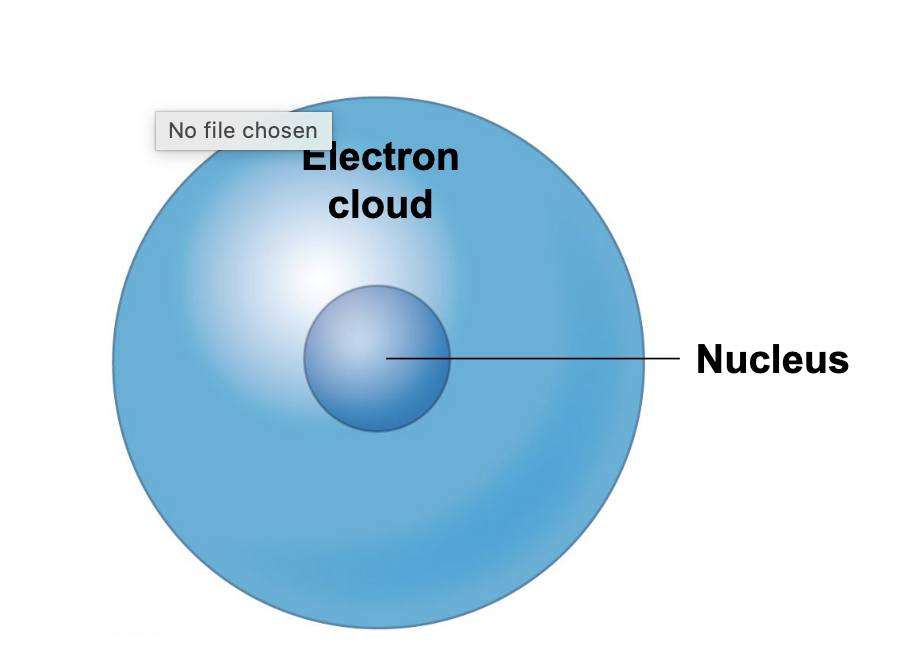
nucleus
electron cloud
electron shell
atomic number
number of protons
nucleus
contains protons and neutrons
electron cloud
spherical area that contains electons
electron shell
two- dimensional representation of electron cloud
what is the relation of the nucleus to the electron cloud
% of total body weight and significance for oxygen
65%
-a component of water and other compounds, gaseous form is essential for respiration
% of total body weight and significance for carbon
18.6%
-found in all organic molecules
% of total body weight and significance for hydrogen
9.7%
-a component of water and most other compounds in the body
% of total body weight and significance for nitrogen
3.2%
-found in proteins, nucleic acids, and other organic compounds
% of total body weight and significance for calcium
1.8%
-found in bones and teeth; important for membrane function, nerve impulses, muscle contraction, and blood clotting
% of total body weight and significance for phosphorus (P)
1.0%
-found in bones and teeth, nucleic acids, and high-energy compounds
% of total body weight and significance for potassium (K)
0.4%
-important for porper membrane function, nerve impulses, and muscle contraction
% of total body weight and significance for sodium (Na)
0.2%
-important for blood volume, membrane function, nerve impulses, and muscle contraction
% of total body weight and significance for Chlorine (Cl)
0.2%
-important for blood volume, membrane function, nerve impulses, and water absorbtion
% of total body weight and significance for magnesium (Mg)
0.06%
-a cofactor for many enzymes
% of total body weight and significance for sulfur (S)
0.04%
-found in many proteins
% of total body weight and significance for iron (Fe)
0.007%
-essential for oxygen transport and energy capture
% of total body weight and significance for iodine (I)
0.0002%
-a component for hormone of the thyroid gland
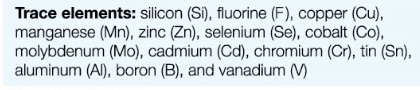
trace elements and significance
some fucntion as cofactors; the functions of many trace elements are poorly understood
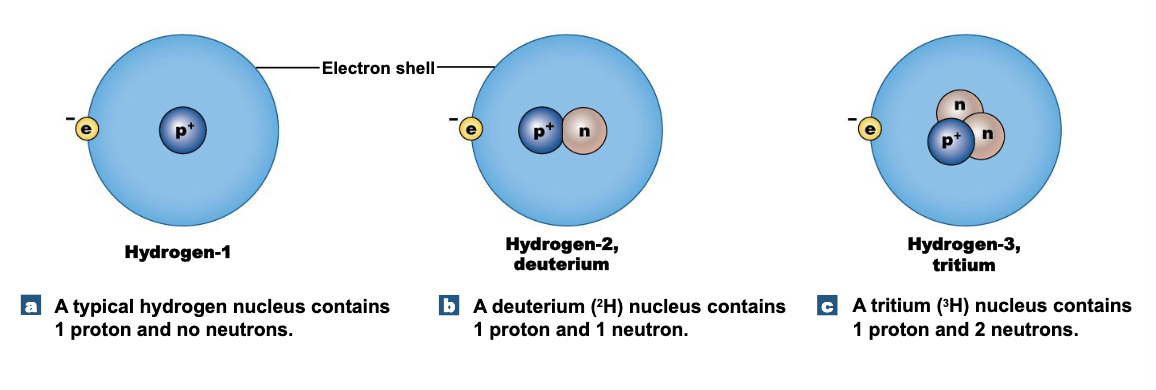
typical hydrogen nucleus, deuterium nucleus, tritium nucleus
element
is a pure substance composed of atoms of
one kind
what is an atomic number and what does it determine
(number of protons) in an atom
determines its chemical properties
isotopes
are version of elements based on mass number
mass number
number of protons plus the number of neutrons
radioisotopes have
radioactive nuclei
decay rate is
expressed as half-life
atomic weight
average of the different atomic masses and proportions of different isotopes
mole (mol)
has a weight in grams equal to the atomic weight of the element
what does electron in the elctron cloud determine
the reactivity of an atom
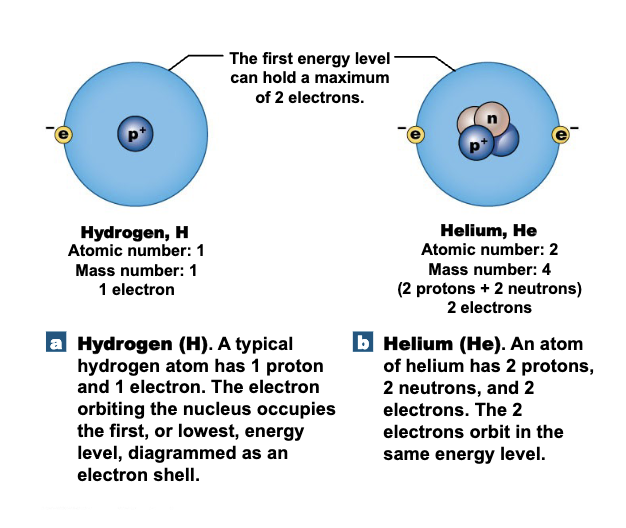
what does an electron cloud contain
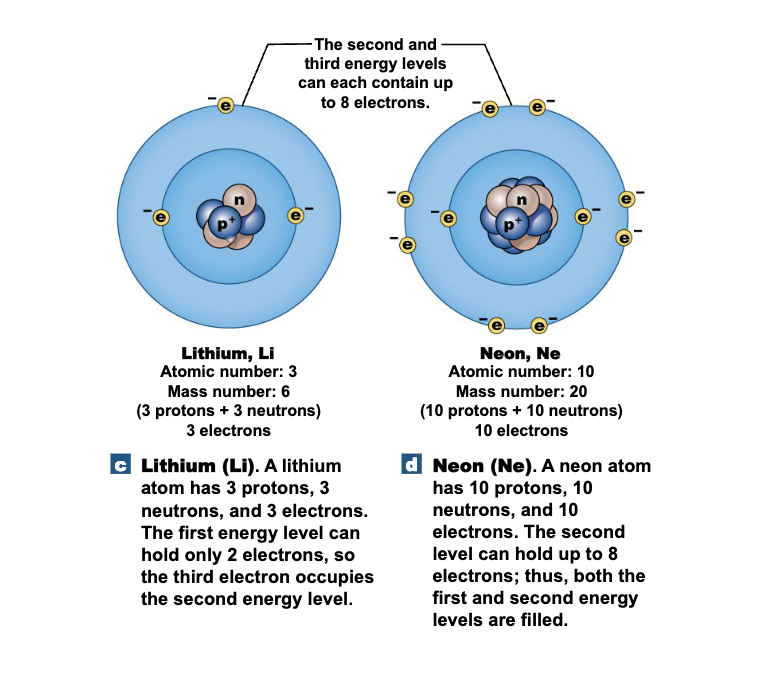
shells, or energy levels, that can hold a limited number of electrons
• Lower shells fill first
• Outermost shell is the valence shell, and it determines bonding
how many electrons can the first energy level hold
2 electrons max
how many electrons can the second and third level hold
8 electrons max
what does chemical bonds form
molecules and compounds
molecule
two or more atoms joined by strong bonds
compounds
two or more atoms of different elements joined by strong or weak bonds
molecule and compound relation
Not all molecules are compounds and not all compounds consist of molecules
molecular weight of a molecule or compound is
the sum of the atomic weights of its atoms
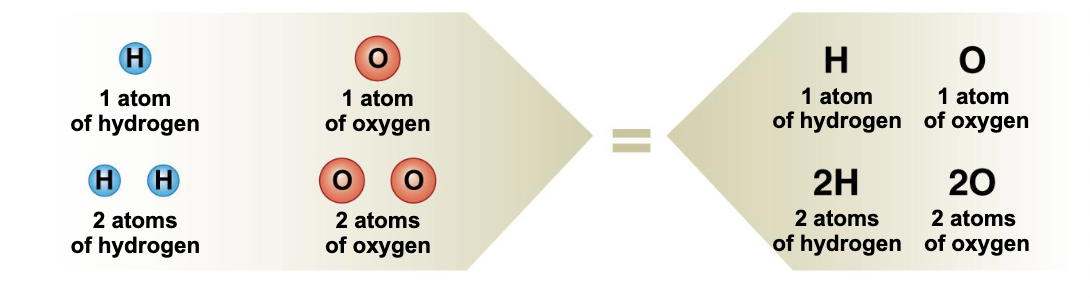
chemical notation of atoms
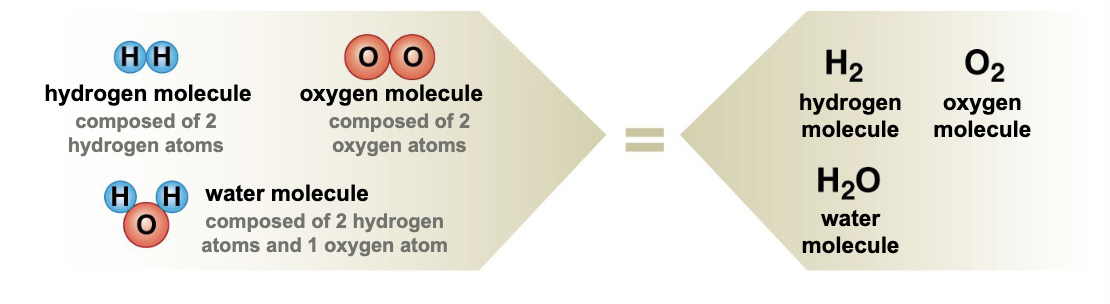
molecules in chemical notation
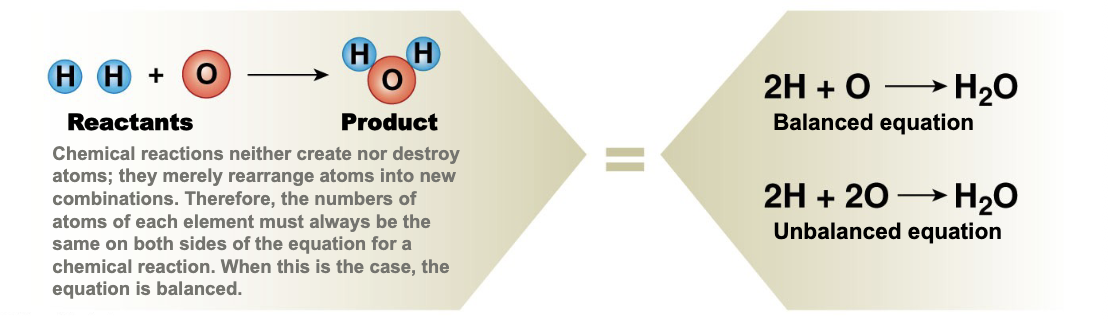
reactants and product in chemical notation
ions with chemical notations
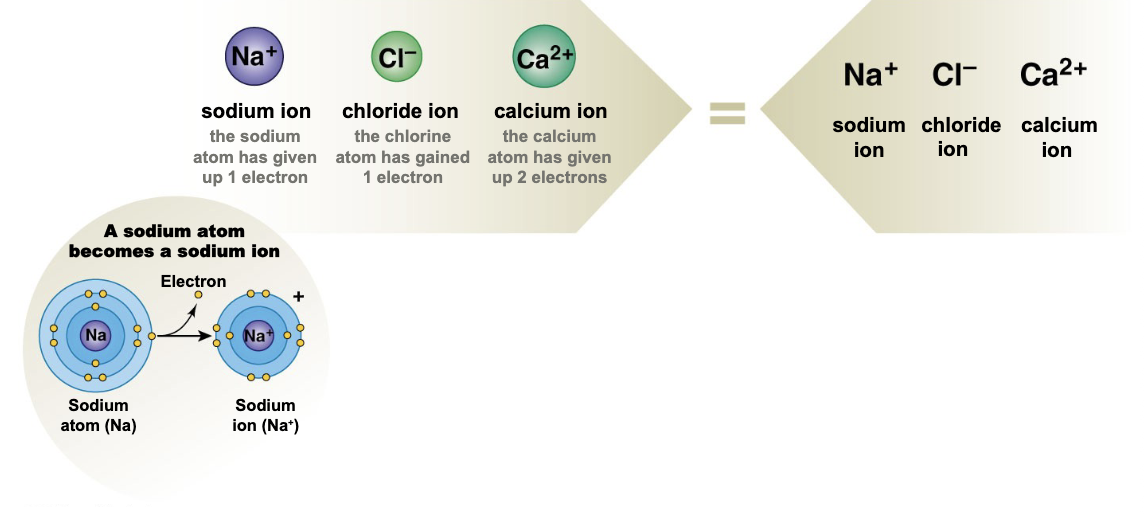
chemical bonds involve
sharing, gaining, and losing electrons
three major types of chemical bonds
1. Ionic bonds
2. Covalent bonds
3. Hydrogen bonds
ionic bonds
– An ion is an atom with an electric charge
– One atom—the electron donor—loses one or more
electrons and becomes a cation
– Another atom—the electron acceptor—gains those
same electrons and becomes an anion
– Ionic bonds are attractions between cations (positive
ions) and anions (negative ions)
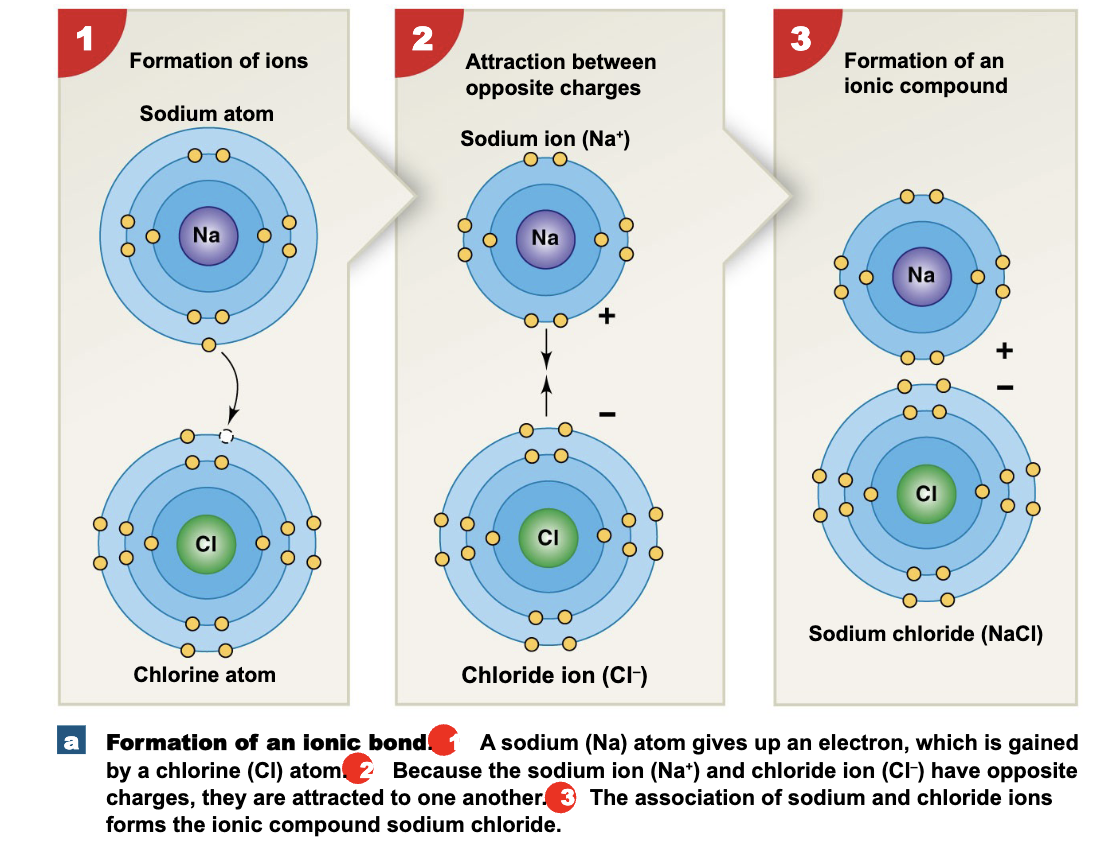
how does the formation of an ionic bond happen
formation of ions- a sodium atom gives up an election to chlorine
attraction between opposite charges - the sodium ion has a positive charge and chloride ion has a negative charge, they are attracted to one another
formation of an ionic compound- the association of sodium and chloride ions forms the ionic compound
covalent bonds
strong bonds involving shared electrons
• One electron is donated by each atom to make the
pair of electrons
• Sharing one pair of electrons is a single covalent
bond
• Sharing two pairs of electrons is a double covalent
bond
• Sharing three pairs of electrons is a triple covalent
bond
nonpolar covalent bonds
Equal sharing of electrons between atoms that have equal pull on the electrons
polar covalent bonds
• Unequal sharing of electrons because one atom has a disproportionately strong pull on the electrons
• Form polar molecules—like water
hydrogen bonds
– Weak polar bonds between adjacent molecules based on electrical attractions
– Involve attractions between a slight positive charge and a slight negative charge
– Hydrogen bonds between H2O molecules cause surface tension
states of matter
solid
liquid
gas
solid
constant volume and shape
liquid
constant volume but changes shape
gas
changes volume and shape
chemical reaction
either new bonds are formed or existing bonds are broken
reactants
materials going into reaction
product
materials coming out of a reaction
metabolism
all of the reaction that are occurring at one time
energy
the capacity to do work
work
movement of an object or change in matter
kinetic energy
energy of motion
potential energy
stored energy
chemical energy
potential energy stored in chemical bonds
types of chemical reaction
1. Decomposition
2. Synthesis
3. Exchange
4. Reversible
decomposition reaction (catabolism)
– Breaks chemical bonds
– AB → A + B
– Hydrolysis reaction AB + H2O → AH + BOH
synthesis reaction (anabolism)
– Forms chemical bonds
– A + B → AB
– Dehydration synthesis (condensation) reaction
AH + BOH → AB + H2O
exchange reaction
– Involves decomposition first, then synthesis
– AB + CD → AD + CB
reversible reactions
– A + B ↔ AB
– At equilibrium, the amounts of chemicals do not change even though the reactions are still occurring
• Reversible reactions seek equilibrium, balancing opposing reaction rates
• When reactants are added or removed, reaction rates adjust to reach a new equilibrium
are biochemical reactions in cells occurring spontaneously or nonspontaneously?
do not occur spontaneously
Activation energy
• it is the amount of energy needed to start a reaction
• Enzymes are protein catalysts that lower the activation energy of reactions
exergonic reactions
release energy
endergonic reactions
absorb energy
nutrients
essential molecules obtained from food
metabolites
molecules made or broken down in the body
inorganic compounds
carbon dioxide, oxygen, water, and inorganic acids, bases, and salts
organic compounds
– Molecules containing carbon and hydrogen
– Carbohydrates, proteins, lipids, and nucleic acids
water (H2O)
– Accounts for up to two-thirds of total body weight
– Produces solutions—uniform mixtures of two or more substances
• A solution consists of a solvent, or liquid, and
solutes
• Solutes are the dissolved substances
universal solvent of water
many molecules are water soluble
reactivity of water
water serves as a reactant in some reaction
high heat capacity
heat capacity is the heat required to raise the temperature of a unit mass of a substance 1 degrees C
lubrication
to moisten and reduce friction
properties of aqueous solutions
– Water is a polar molecule
– Many inorganic compounds split into smaller molecules via dissociation in water
– Ionization is dissociation into ions
– Polar water molecules form hydration spheres around ions and small polar molecules that keep them in solution
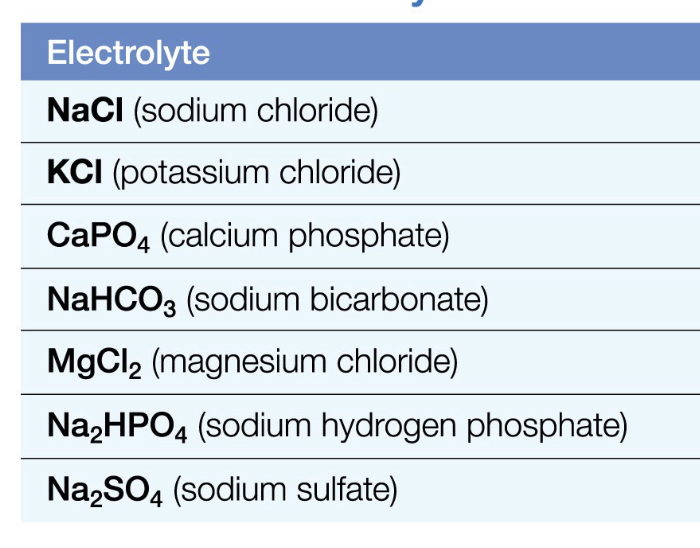
ions released
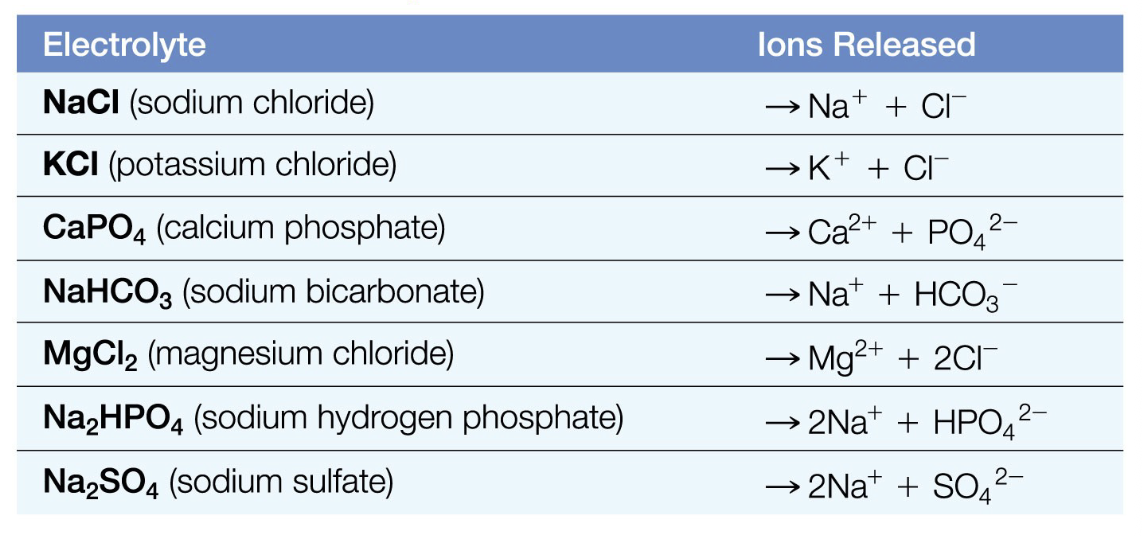
electrolytes
– inorganic ions that conduct electricity in solution
– Electrolyte imbalance seriously disturbs vital body functions
hydrophilic
• hydro- = water, philos = loving
• Includes ions and polar molecules
• Interact with water
hydrophobic
• phobos = fear
• Includes nonpolar molecules, fats, and oils
• Do not interact with water
colloid
• A solution containing dispersed proteins or other large molecules
• Example: blood plasma
suspenion
• Contains large particles that settle out of solution
• Example: whole blood
pH
– The negative logarithm of the hydrogen ion concentration of a solution in moles per liter
Neutral pH
– A balance of H+ and OH–
– Pure water = 7.0
Acidic pH
(lower than 7.0)
– High H+ concentration
– Low OH– concentration
Basic
(or alkaline) pH (higher than 7.0)
– Low H+ concentration
– High OH– concentration
pH of human body
– Ranges from 7.35 to 7.45
pH scale
– Has an inverse relationship with H+ concentration
• More H+ ions means lower pH, fewer H+ ions means higher pH
acid
(proton donor)
– A solute that adds hydrogen ions to a solution
– Strong acids dissociate completely in solution
base
(proton acceptor)
– A solute that removes hydrogen ions from a solution
– Strong bases dissociate completely in solution
weak acids and weak bases
– Fail to dissociate completely
– Help to balance the pH