Disorders of hematopoietic function-JZ
 Call Kai
 Learn
Learn Practice Test
 Spaced Repetition
 Match
Match Flashcards
 Knowt Play
1/48

There's no tags or description
Looks like no tags are added yet.
Name | Mastery | Learn | Test | Matching | Spaced | Call with Kai |
|---|
No analytics yet
Send a link to your students to track their progress
49 Terms
Red Blood Cells (RBCs)
responsible for oxygen delivery & CO2 removal
aka erythrocytes
life span: 120 days
normal RBC: 4.5-6.0 million cells/L
hematocrit: 37%-52%
RBC Production = erythropoiesis
RBC are produced in bone marrow
erythropoietin stimulates bone marrow to produce RBCs
erythropoietin - produced by the kidneys
Hemoglobin (Hgb)
RBCs primarily made of hemoglobin
~ 250 million hemoglobin molecules per RBC
hemoglobin is how RBC carry O2 to CO2
1 hemoglobin molecule can carry 4 O2 or CO2 molecules
RBC destruction
facilitated by spleen, liver, bone marrow, lymph nodes
hemoglobin
heme
iron
bilirubin
globulin
amino acids
RBC disorders
anemia
Anemia
RBC disorders = anemias
blood loss
iron-deficiency
pernicious
Cause of Anemia
dependent on the type of anemia
Dev. of Anemia
decreased circulating RBCs
decreased hemoglobin (Hgb)
abnormal Hgb
or
impaired production
increased destruction
blood loss
resulting in:
decreased oxygen carrying capacity
Signs & Symptoms of Anemia
weakness
fatigue
pallor
syncope
dyspnea
tachycardia
Diagnosis of Anemia
lab testing
complete blood count (CBC)
Treatment of Anemia
dependent on the type of anemia
Cause of Blood Loss Anemia
bleeding - chronic or acute
Signs & Symptoms of Blood Loss Anemia
orthostatic hypotension
increased HR, decreased BP
decreased LOC
decreased urine output
melena
hematemesis
Treatment of Blood Loss Anemia
stop bleeding
blood transfusion (if Hgb <7)
iron supplementation
increasing dietary iron
Cause of Iron Deficiency Anemia
decreased Hgb production d/t lack of iron (Fe)
common in women of childbearing age, children <2, & elderly
inadequate intake of iron
Signs & Symptoms of Iron Deficiency Anemia
hair loss
cheilitis
glossitis
pica
splenomegaly
Treatment of Iron Deficiency Anemia
iron supplementation
increasing dietary iron
Cause of Pernicious Anemia
vitamin B12 deficiency
inadequate intake of B12
lack of intrinsic factor
Signs & Symptoms of Pernicious Anemia
same as general anemia
weakness
fatigue
pallor
syncope
dyspnea
tachycardia
Platelets
responsible for hemostasis (blood clotting)
aka thrombocytes
normal platelet count: 150,000-450,000 cells/mL
Hemostasis 3 types
physiological process that stops bleeding at site of injury
3
vasoconstriction
platelet plug formation
coagulation
Vasoconstriction
initiated by endothelial injury
vessel spasm = vasoconstriction
decreased blood flow
increased BP
Platelet Plug Formation
activation
collagen & von Willebran factor
change from smooth disk to spiny spheres
adhesion
to vessel wall
aggregation
clumping together
Coagulation
intrinsic pathway
damage to vessel wall
slow process
extrinsic pathway
trama to vessel
faster process
common
prothrombin to thrombin
fibroingen to fibrin
Clot Dissolution
clot retraction
occurs 20-60 min after clot formation
platelets squeeze serum from clot
pulling vessel edges together
fibrinolysis
aka dissolution
plasminogen in converted to plasmin
plasminogen activators
digests fibrin strands & clotting factors
Platelet Disorders
thrombocytosis
thrombocytopenia
Thrombocytosis
disorder of too many platelets
hypercoagulability, increased clotting risk
Cause of Thrombocytosis
primary (essential) - increased platelet production
secondary (reactive) - caused by another condition (ie: infection / infection)
Dev. of Thrombocytosis
platelets < 450,000
Signs & Symptoms of Thrombocytosis
deep vein thrombosis (DVT)
pulmonary embolism (PE)
Diagnosis & Treatment of Thrombocytosis
lab testing
CBC
medications
plateletpheresis (donation)
Thrombocytopenia
too few, not enough, platelets
bleeding risk, also considered a coagulation disorder
Cause of Thrombocytopenia
decreased production
increased destruction
drug induced (heparin, aspirin)
immune induced - ITP
Dev. of Thrombocytopenia
platelets < 150,000
Signs & Symptoms of Thrombocytopenia
fatigue
petechiae
purpura
ecchymosis
bleeding - nose, mouth, GI tract
Diagnosis & Treatment of Thrombocytopenia
lab testing
CBC
medications
Coagulation Disorders
factor V liden
hemophilia & von Williebran disease
Factor V Liden
thrombophilic genetic disorder that causes hypercoagulability
genetic mutation, increased risk of thrombosis/clot formation
Cause of Factor V Liden
genetic mutation
increases clotting risk x7
Dev. of Factor V Liden
impacts the factor V in the clotting cascade causing more coagulation
thrombi form most commonly in the venous system
resulting in DVT or PE
Signs & Symptoms of Factor V Liden
deep vein thrombosis (DVT)
pulmonary embolism (PE)
Diagnosis & Treatment of Factor V Liden
lab testing
genetic screening
anticoagulant therapy
Hemophilia & von Williebrand Disease
genetic coagulation disorder that causes bleeding
genetic mutation, bleeding risk
Cause of Hemophilia & von Williebrand Disease
genetic mutation
different types (A, B…)
lack of clotting factors needed to form clots
Dev. of Hemophilia & von Williebrand Disease
w/ out all clotting factors blood clots are unable to form
resulting in bleeding that does not stop
Signs & Symptoms of Hemophilia & von Williebrand Disease
bleeding
trauma/injury
GI
bruising
Diagnosis & Treatment of Hemophilia & von Williebrand Disease
lab testing
genetic screening
medication
factor replacement
desmopressin (DDAVP)
Bleeding Complications
Systemic Symptoms of Bleeding
Tachycardia
Hypotension
Pallor
Syncope
Changes in LOC (hypoxia)
Disseminated Intravascular Coagulation (DIC)
Disorder of both clot formation and bleeding that is seen in critically ill patients
Caused by: high volume blood loss, sepsis, trauma (burns)
Can lead to organ failure
Patho: abnormal production of clotting factors and fibrinolysis factors
Clinical Manifestations:
Signs of bleeding: oozing around IV sites, petechiae, bleeding gums, spontaneous GI bleeding
Development of microthrombi: disrupting blood flow to heart, lungs and kidneys
Treatment: blood products, fluids, critical care
Prognosis: 20% - 50% mortality rate
Lab values
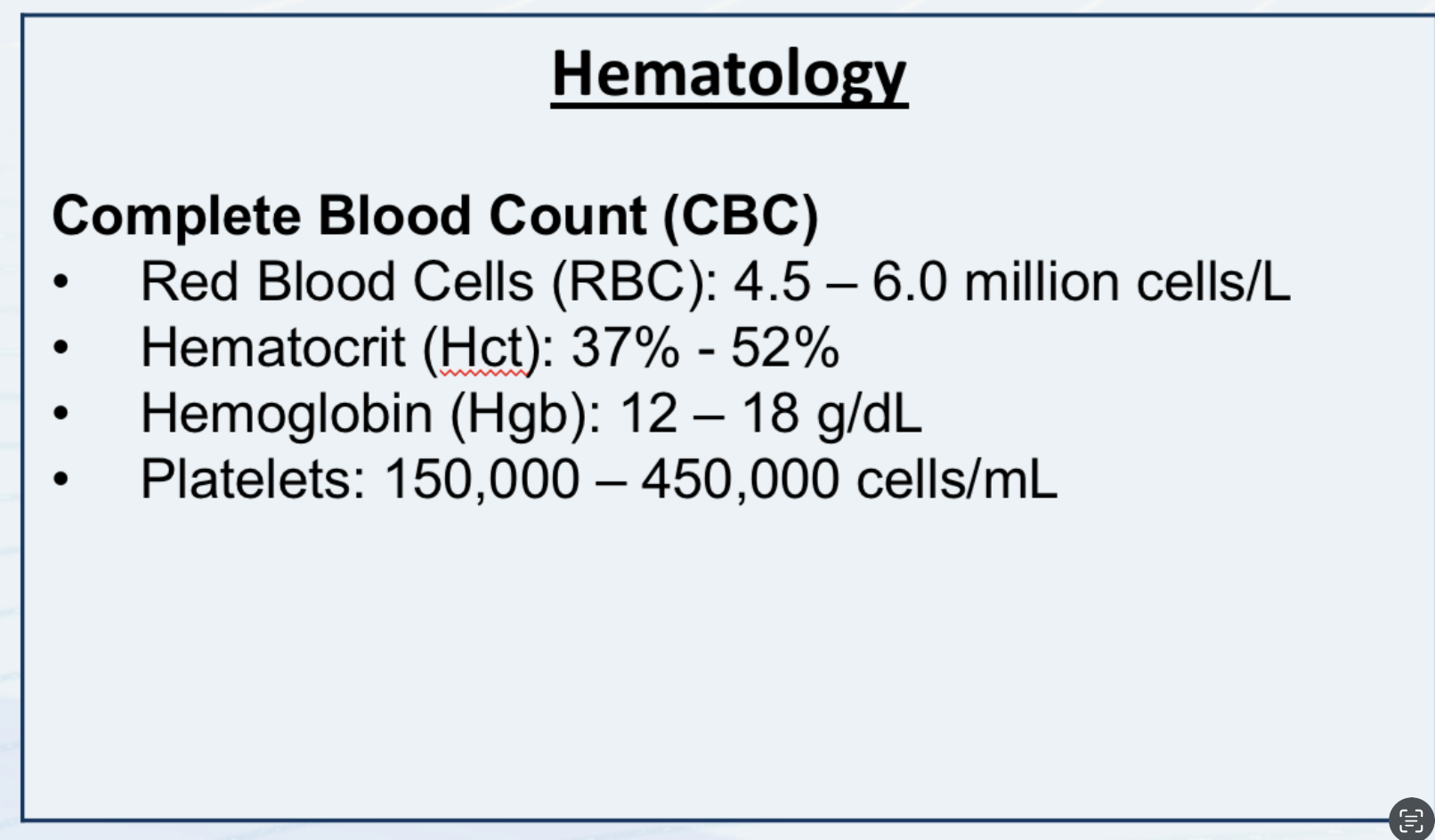
Hematology:
Complete Blood Count (CBC)
Red Blood Cells (RBC): 4.5-6.0 million cells/L
Hematocrit (Hct): 37&-52%
Hemoglobin (Hgb): 12-18g/dL
Platelets: 150,000-450,000