12-Arranging Artificial Teeth in RPDs
 Call Kai
 Learn
Learn Practice Test
 Spaced Repetition
 Match
Match Flashcards
 Knowt Play
1/15

There's no tags or description
Looks like no tags are added yet.
Name | Mastery | Learn | Test | Matching | Spaced | Call with Kai |
|---|
No analytics yet
Send a link to your students to track their progress
16 Terms
The artificial posterior teeth on the CD/, which oppose lower natural teeth are set in
Hyperocclusion; the teeth cause the incisal guide pin to be lifted off the incisal table of the articulator 1-2mm, then ground down until the pin touches
Why might artificial posterior teeth on a mandibular RPD opposing a CD/ may not need to be adjusted occlusally?
Becuase their position may be adjusted antero-posteriorly until the correct interdigitation of cusps is achieved
How can you adjust teeth that line up cusp-to-cusp (when viewed buccally) due to an unusual jaw relationship?
By widening and eliminating transverse ridges
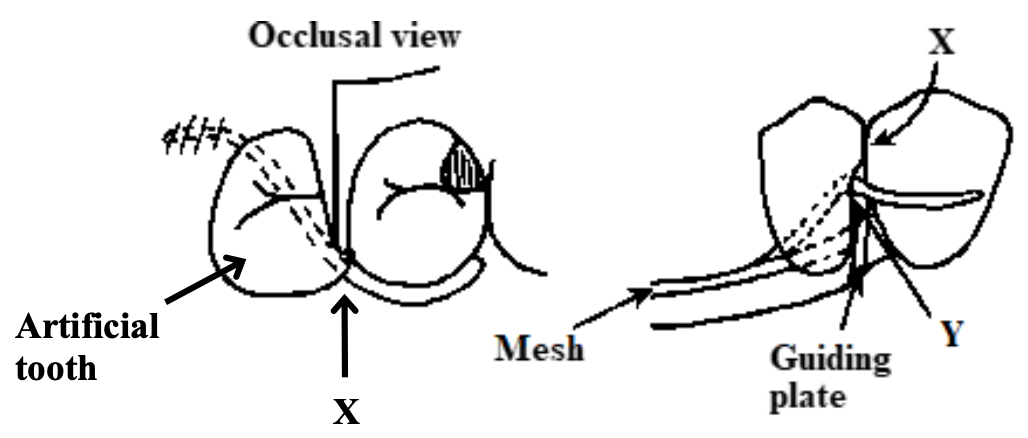
What should you do to have good adaptation of the artifical tooth adjacent to the abutment tooth
Grind the artifical tooth to the guiding plate
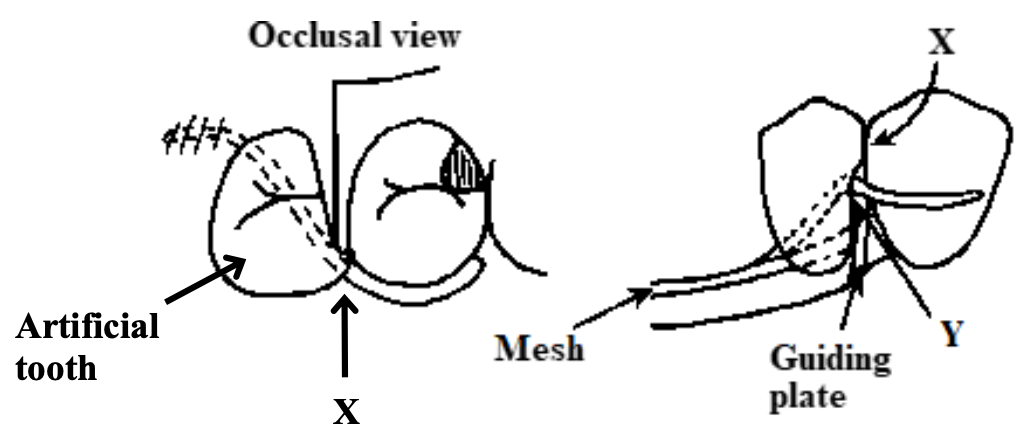
For best appearance, the natural and artifical teeth at “X” should contact, but not be tightly adapted under a wire clasp “Y” why?
Because the wire would be distorted during processing of the resin base (the artifical teeth are pulled off the wax base when the processing flask is opened and a plastic tooth hooked under the wire clasp may bend the wire)
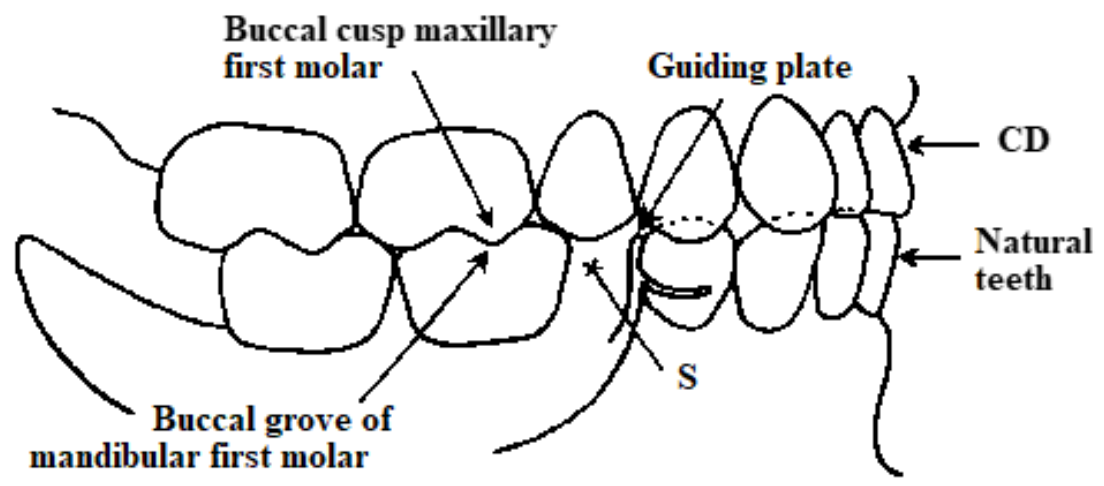
Sometimes, the space “S” is SO narrow that you may have to grind away 50% of a plastic premolar to allow the tooth to fit. How are the teeth set?
The maxillary anterior teeth are set a little anterior for lip support and/or to provide clearance in CO. And the max posterior teeth are set more forward
How are teeth set in a NAT/RPD case?
The artificial teeth are set in hyperocclusion (VD increased 1-2mm) and ground down until correct VD is reestablished
What is the sequence for arranging teeth in a CD/RPD?
Maxillary anterior teeth
Maxillary posterior teeth
Mandibular posterior teeth
Complete wax-up
Why do you set maxillary anterior teeth first?
To establish esthetics, overjet, overbite, and incisal guidance
Why should you leave ~1 mm clearance between maxillary and mandibular anterior teeth
To protect the maxillary anterior ridge from excessive forces
After setting anterior teeth, why do you adjust the articulator?
Because the posterior teeth must harmonize with the anterior guidance
Why must artificial posterior teeth contact opposing natural teeth in centric?
To provide an occlusal stop if the RPD is removed
What is the foundation for good eccentric balance?
Accurate centric occlusion
Why should you allow plenty of buccal overjet
To prevent crossbite interferences and help achieve balanced articulation
Don't force a tooth into a space that doesn't exist (sometimes, there isn’t room for #20).
Maintaining occlusion and alignment is more important than replacing every tooth
What is a common error that causes poor articulation and results in poor appearance?
Leaving the gingival aspect of the tooth in a buccal position rather than adapting it around the framework elements