3.2 Monoclonal Antibodies
 Call Kai
 Learn
Learn Practice Test
 Spaced Repetition
 Match
Match Flashcards
 Knowt Play
1/11

Earn XP
Description and Tags
These flashcards cover specification point 4.3.2 Monoclonal Antibodies (Biology Only) in Topic 3 - Infection & Response for AQA GCSE Biology. This includes: 4.3.2.1 Producing Monoclonal Antibodies and 4.3.2.2 Uses of Monoclonal Antibodies.
12 Terms
What are monoclonal antibodies produced from?
Single clone of cells
How are monoclonal antibodies able to target a specific chemical or specific cells in the body?
Antibodies specific to one binding site on one protein antigen
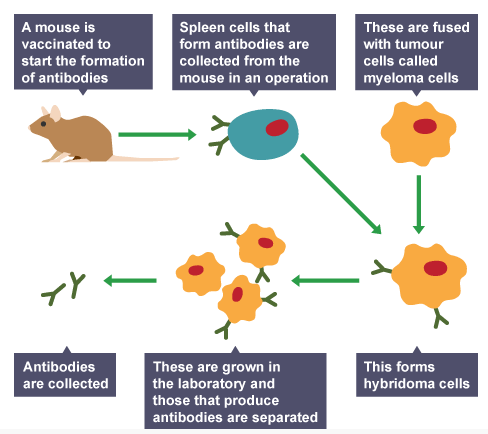
Fully explain the process of producing monoclonal antibodies.
Stimulating mouse lymphocytes — makes particular antibody
Lymphocytes + tumour cell → hybridoma
Hybridoma can:
divide rapidly
make antibody
Single hybridoma cells cloned — produces many identical cells → all produce same antibody
Large amount of antibody collected and purified
Why are tumour cells used when making monoclonal antibodies?
Divides rapidly
What are four uses of monoclonal antibodies?
Diagnosis — e.g. pregnancy tests
Measure levels of hormones and chemicals in blood or detect pathogens
Locate or identify specific molecules in cell/tissue — binding them with fluorescent dye
Treat diseases — e.g. cancer
Explain how a pregnancy test works — in relation to monoclonal antibodies.
hCG hormone in pregnant women’s urine
Two sections of stick
First section — mobile antibodies complementary to hCG hormone — attached to blue beads
Second section — stationary antibodies complementary to hCG hormone — stuck down to stick
Individual urinates on first section
hCG is present = binds to mobile antibodies — forms hCG complexes
Carried in flow of liquid to second section
Stationary antibodies bind to hCG complexes
Blue dye appears in both control and results zones — shows positive result
Explain how monoclonal antibodies can be used in research to find or identify certain molecules on a cell or tissue.
The monoclonal antibodies are modified so that they will bind to the molecule you are looking for.
The antibodies are also bound to a fluorescent dye.
If the molecules are in the sample then the antibodies bind to it, and the dye can be observed.
Explain how monoclonal antibodies could be used to treat cancer.
The monoclonal antibody can be bound to a radioactive substance, a toxic drug or a chemical which stops cells growing and dividing.
It delivers the substance to the cancer cells without harming other cells in the body.
What are the advantages of using monoclonal antibodies? (3)
They only bind to specific cells, meaning healthy cells are not affected.
They can be engineered to treat many different conditions.
They can be produced quickly.
What are the disadvantages of using monoclonal antibodies? (3)
Expensive to develop
Difficult to attach monoclonal antibodies to drugs
As they were produced from mice lymphocytes, they often triggered an immune response when used in humans.
Figure 1 shows a test strip that can detect the presence of an anabolic steroid in an athlete’s urine.
The end of the test strip is dipped in urine.
The urine moves up through the test strip.
The test area and the control area contain a dye.
The dye turns blue when monoclonal antibodies bind to it.
Suggest the purpose of the control area in the test strip. [1 mark]
To show that the test is working.

A monoclonal antibody has been produced to treat pancreatic cancer.
Explain how the monoclonal antibody works to treat pancreatic cancer. [3 marks]
Monoclonal antibody attached to chemical
Will only target antigen on tumour
So chemical binds to cancer cells → stops them dividing