Topic 8- Genome & Chromatin Structure
 Call Kai
 Learn
Learn Practice Test
 Spaced Repetition
 Match
Match Flashcards
 Knowt Play
1/39

There's no tags or description
Looks like no tags are added yet.
Name | Mastery | Learn | Test | Matching | Spaced | Call with Kai |
|---|
No analytics yet
Send a link to your students to track their progress
40 Terms
What is supercoiling?
+ supercoiling?
- supercoiling?
Twisting of DNA (compacts DNA, Affects gene expression)
+ → more rotations, less bp/ rotation (tighter)
- → less rotations more bp/ rotation (looser)
What is different between Eukaryotic and Bacterial DNA
Bacterial DNA is not assocciated with histones
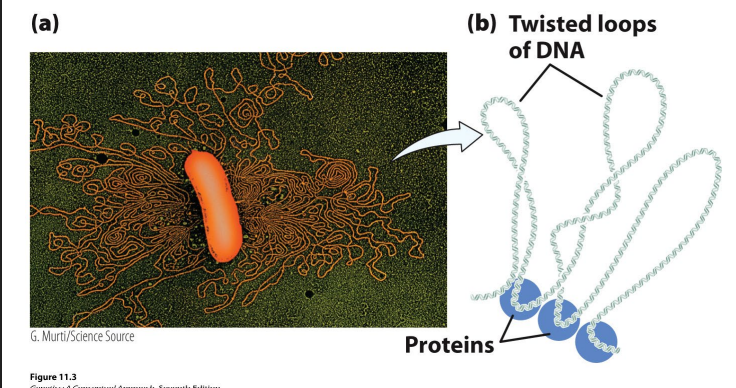
Bacteria DNA is segmented into twisted loops
Topoisomerase I?
Topoisomerase II?
Both function to relieve supercoiling tension
I) cuts1 strand of the duplex, relieving tension, no ATP
II) cuts 2 strands, uses ATP, can untangle intertwined DNA (for pulling out specific sequences)
What is chromatin?
Heterochromatin?
Euchromatin?
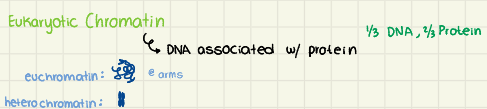
DNA associated with protein (1/3 DNA, 2/3 protein)
Heterochromatin:
densely packed
Transcriptionally silent
Often repetitive
@ telomeres and centromeres
(% varies among cells, increases as cells become more differentiated)
Euchromatin:
Loosely packed
Transcriptionally active
Genes expressed
When is heterochromatin replicated?
@ the end of S-phase.
(because it needs to unfold 1st)
What is a nucleosome?
What is a histone?
8 histone proteins wrapped by DNA 1.65x
+ charged proteins, DNA wraps around them
- H1, H2, H3, H4 (2 of each)
What are Polytene Chromosomes
Found in Drosophila salivary glands.
They form when DNA replicates repeatedly, cell doesnt divide
Result:
Giant chromosomes
Visible banding pattern
“Puffs” = regions actively being transcribe
What is the role of Histone 1
It clamps the DNA on the nucleosome.
What is the ENCODE project?
Large research project to identify all functional elements in the human genome
INCLUDING:
Regulatory regions
Noncoding functional DNA
Pseudogenes
Nonfunctional copies of DNA (dont produce functional protein)
Not expressed, rotting away

How do unique, moderately and highly repetitive DNA differ?
Unique DNA
Single-copy sequences
Most protein-coding genes
Moderately repetitive
Present dozens–thousands of times
rRNA genes, transposons
Highly repetitive
Short sequences repeated millions of times
Often structural (centromeres, telomeres)
What are Satellites
what are they, what do they do, where are they found?
Highly repetitive segments of DNA
found at centromeres
structural role
What are microsatellites?
AKA Short Tandem Repeats
1–8 base pair repeats (ex: CACACACA)
No known function
Highly variable between individuals
Used in DNA fingerprinting (counts # repeats)
How is DNA fingerprinting conducted?
Process:
Extract DNA
PCR amplify repeat regions
Separate by size
Compare patterns
What is a Telomere?
what happens when they wear down?
what kind of cell has the longest telomere
Caps on DNA to prevent loss of genes (at the end of a chromosome.)
non-coding
shorter withe each division
when the wear down the cell becomes SCENESCENT
sperm and egg have LONGEST telomeres
What is a Centromere?
Region where spindle fibers attach, ensures proper chromosome segregation
LARGE array of repetitive DNA
The sequence is unimportant, but SHAPE = CRUCIAL, very conserved
What is Alu DNA
10% of genome
Cancerous DNA, working against organism
we are also 17% viral DNA
What is a NOR
What is CODUS
Combined DNA Index System (CODIS)
forensic DNA database operated by the FBI
stores DNA profiles based on STRs
Genetically, CODIS works because:
CODIS uses allele length variation at 13/20 core STR loci to uniquely identify individuals.
What is the C-value paradox
There is a high correlation between Prokaryote genome size and organism size,
BUT
the same is NOT true for Eukaryotes.
What is the C-value
haploid amount of DNA
differs by organism
What type of organism would have a higher amount of G & C than A & T
high temperature organism
prevents against melting and denaturation
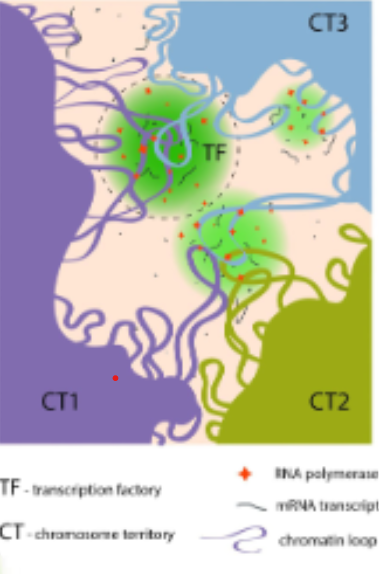
What are Transcription Factories
in oil bubbles keeps condensin loops
DNA is moved and brought to RNA polymerase
(all DNA required for s specific job)
Transcription factories are nuclear clusters of RNA polymerase and transcription machinery where multiple genes are transcribed simultaneously as DNA loops into these active transcription hubs.
What is Condensin
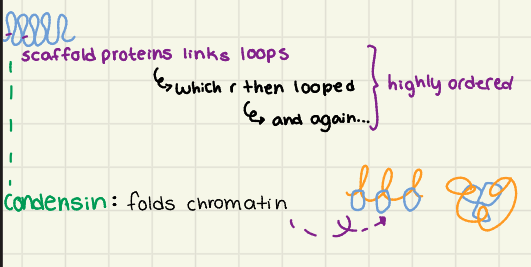
Condensin is a protein complex that organizes and FOLDS chromosomes during mitosis and meiosis.
positive supercoils and
stabilizes loops
ensures accurate chromosome segregation.
Why are phosphorylation and dephosphorylation important for chromosome condensation?
Phosphorylation = “Turn On”
Adds a phosphate group to proteins (like condensin or histones).
Causes chromosomes to condense during mitosis.
Dephosphorylation = “Turn Off”
Removes the phosphate group.
Causes chromosomes to relax after mitosis, so the cell can read genes again.
Why it matters:
Makes sure chromosomes condense only during cell division.
Prevents mistakes in gene expression or chromosome separation.
What is a Retrovirus
A virus that has RNA as its genetic material
Uses reverse transcriptase RNA → DNA
Integrates its DNA into the host’s genome.
Hijacks the host cell’s machinery to make more viruses.
lots of MUTATIONS
Ex: HIV
What is an ERV
Endogenous Retrovirus
Entered germline cells → passed to offspring (permanently integrated into host genome)
Needs host to live, ensures survival
Mostly silent
Ex: HERV-W
What is HERV-W
An ERV that produces protein that fuses cells together:
THIN PLACENTA
Fuses cells to form syncytiotrophoblast
Shows how humans co-opted a viral gene for essential reproduction.
What are Microevolutionary changes
Small-scale changes in allele frequencies within a population over a short time (years to centuries).
ex- Antibiotic resistance in bacteria, peppered moth color change
Macroevolution
large-scale evolutionary changes over long periods (thousands to millions of years) that can create new species or higher taxa.
changes to gene regulation
ex- divergence of Darwin’s finches.
What are DNA transposons (Class II)
“cut-and-paste” transposable elements
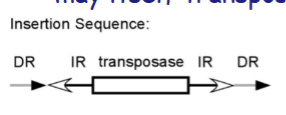
Insertion sequences
Carries only the genetic information needed for
transposition
Composite transposons
Flanked by two copies of an insertion sequence that
may itself transpose
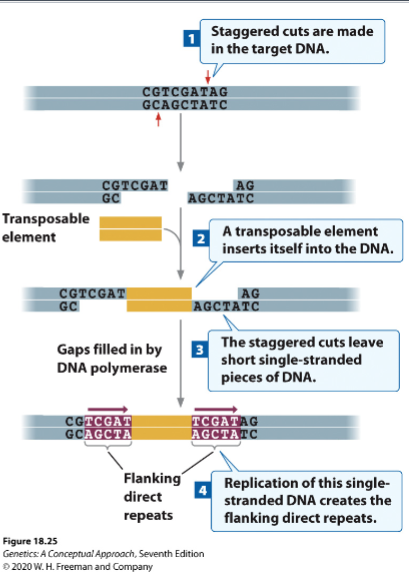
What is a flanking direct repeat
A short identical DNA sequence found on both sides of a transposon after it inserts into the genome.
Created when transposase makes staggered cuts in the target DNA.
DNA polymerase fills the gaps, duplicating the target sequence.
The duplicated sequences appear on both sides of the transposon
What is Transposase?
Cleaves the ends of the transposon, freeing it from its initial location.
Cleaves target sites where the element is to be inserted.
What are Inverted repeats?
Inverted repeats are short DNA sequences at the ends of a transposon that are reverse complements of each other.
Key points:
Part of the transposon itself
Located at both ends of the element
Recognized by the enzyme transposase
Help the transposon be excised and inserted into a new location
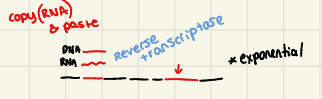
Reverse Transcriptase
Enzyme used by retrotransposons
Converts RNA → DNA
Allows the element to copy itself and insert a new copy
What are LINES
Retrotransposons
copy & paste
use reverse transcriptase
RNA → DNA
What are LINEs (Long Interspersed Nuclear Elements)?
JUNK GENES
retrovirus genomes, repeated ~140,000 times; comprise 20.7% of human
genome-the commonest is LINE-1 (14.6%) which is the only one still active
What are SINES
Notochord?
Short Interspersed Nuclear Elements
short non-autonomous retrotransposons
cannot move on their own
rely on LINE reverse transcriptase to copy and insert into new genomic locations.
Alu SINE insertions near the notochord gene, which caused alternative splicing.
This altered gene expression and likely contributed to tail loss in apes and humans during evolution.
What are Composite Transposons