18. Features of Science
 Call Kai
 Learn
Learn Practice Test
 Spaced Repetition
 Match
Match Flashcards
 Knowt Play
1/29

There's no tags or description
Looks like no tags are added yet.
Name | Mastery | Learn | Test | Matching | Spaced | Call with Kai |
|---|
No analytics yet
Send a link to your students to track their progress
30 Terms
What are the features of science in psychology?
The features of science are characteristics that make research scientific, including objectivity, empirical evidence, replicability, hypothesis testing, falsifiability, control, theory construction, and paradigms.
What is the definition of science?
A branch of knowledge conducted on OBJECTIVE principles involving the SYSTEMATISED OBSERVATION of and EXPERIMENT with phenomena
What is objectivity?
Objectivity means research is free from bias, personal opinion, or researcher influence, relying only on observable and measurable facts.
Why is objectivity important?
It ensures findings are valid, unbiased, and trustworthy, allowing other researchers to evaluate and replicate the work.
What is empirical evidence?
Empirical evidence is data collected through direct observation or experiment rather than theory or opinion.
Why is empirical evidence important?
It ensures scientific claims are based on real‑world data, increasing reliability and credibility.
What is replicability?
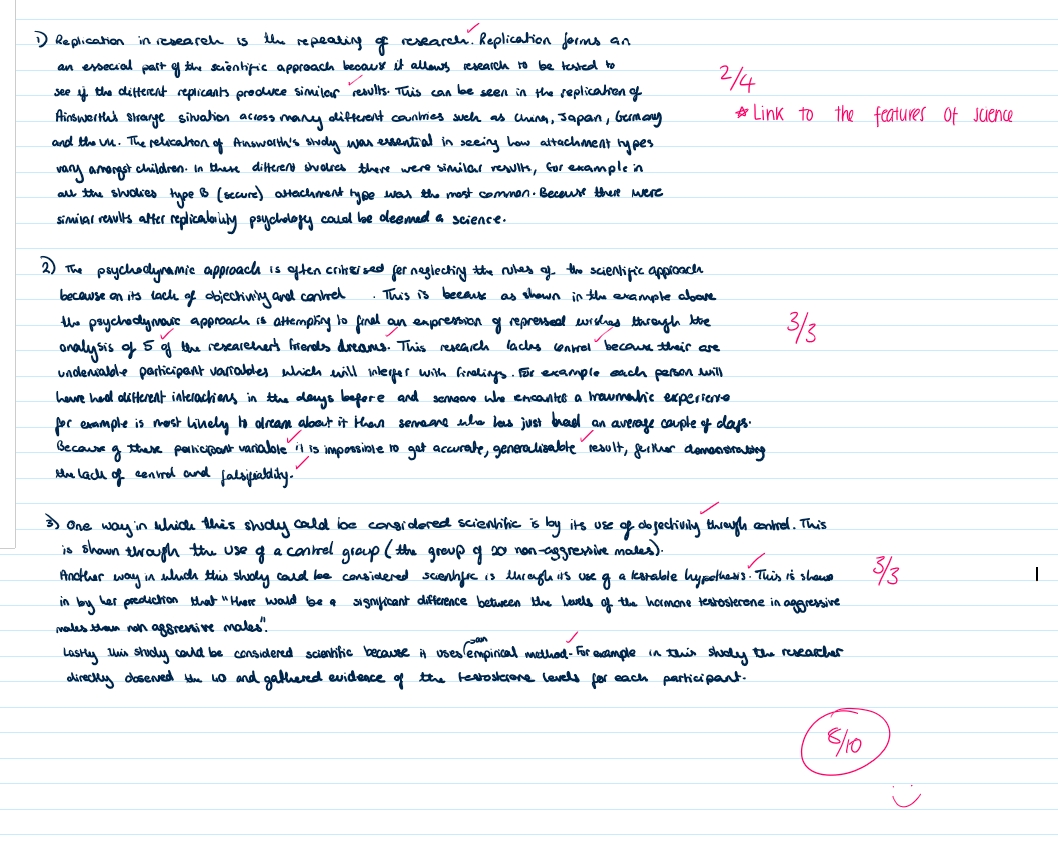
Replicability means a study can be repeated by other researchers and produce the same or similar results.
Why is replicability important?
It confirms findings are consistent and not due to chance, increasing scientific credibility.
What is hypothesis testing?
Hypothesis testing involves making predictions based on theory and then testing them through systematic research.
Why is hypothesis testing important?
It allows theories to be supported or rejected using objective evidence.
What is falsifiability?
Falsifiability means a theory must be testable and capable of being proven wrong.
Why is falsifiability important?
It ensures scientific theories are open to challenge and prevents untestable claims from being accepted as science.
What is control in scientific research?
Control refers to managing extraneous variables so that only the independent variable affects the dependent variable.
Why is control important?
It increases internal validity by ensuring the IV is the true cause of changes in the DV.
What is a paradigm?
A paradigm is a shared set of assumptions, agreed methods, and principles that define a scientific discipline. Kuhn says that in periods of normal science there is a common paradigm.
Why is a paradigm important?
It provides a common framework for research, ensuring consistency and guiding scientific progress.
What is a paradigm shift?
A paradigm shift occurs when the dominant scientific framework is replaced by a new one due to accumulating contradictory evidence. And Kuhn says this is how science progresses
Show the process of a paradigm shift
paradigm → revolution→ new paradigm → revolution
Example of a paradigm shift in psychology
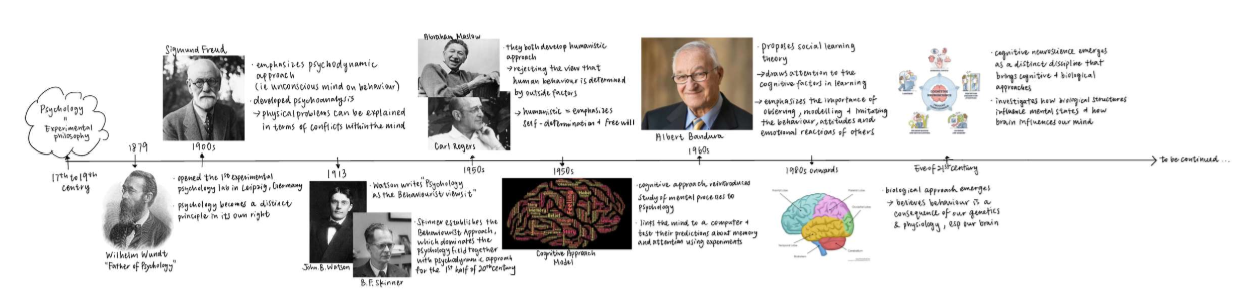
The shift from behaviourism (focus on observable behaviour) to the cognitive approach (focus on mental processes).
Does psychology have paradigms?
YES - Each approach can be seen as a paradigm shift, the approaches are the paradigms and the shift between approaches are the paradigm shifts.
NO - However, as the approaches progress they don’t complete abandon the ideals from the previous approach.
→Psychology does not have one dominant paradigm. Instead, it has multiple competing approaches such as the behaviourist, cognitive, biological, and psychodynamic approaches, each explaining behaviour differently. Because psychologists do not all work within the same framework, it can be difficult to reach a consensus on how behaviour should be studied. Kuhn argued that sciences normally progress through paradigm shifts, where one dominant framework replaces another, but psychology still contains several competing paradigms.
What is theory construction?
Theory construction involves developing explanations based on evidence, which can then generate hypotheses for further testing.
Why is theory construction important?
It organises knowledge, guides research, and allows predictions about behaviour.
What are the 2 models of the scientific process/ theory construct?
The inductive model
The deductive model
What is the inductive model? Give an example
It involves reasoning from the particular to the general.
In this approach observations come first, followed by hypnoses, testing and finally a theory.
E.g Newton made observations then produced laws that made sense of what he observed.
What is the deductive model?
It involves reasoning from the general to the particular
In this approach a theory comes first which is then tested out and can then re refined if the evidence doe not fit it.
E.g Darwin formulated a theory of evolution and then set out to test it
What makes a good scientific theory?
A good scientific theory is one which can be tested empirically, allows for a variety of testable hypotheses and also one which has the potential to be falsified (proven wrong).
How do the features of science apply to psychology?
Psychology uses controlled experiments, empirical methods, hypothesis testing, and statistical analysis, making it scientific in many areas.
Why might psychology not be considered fully scientific?
Some approaches rely on subjective interpretation, lack falsifiability, or study unobservable phenomena.
Why is psychology considered scientific in many areas?
Approaches like cognitive, biological, and behaviourist use objective, controlled, replicable methods similar to natural sciences.
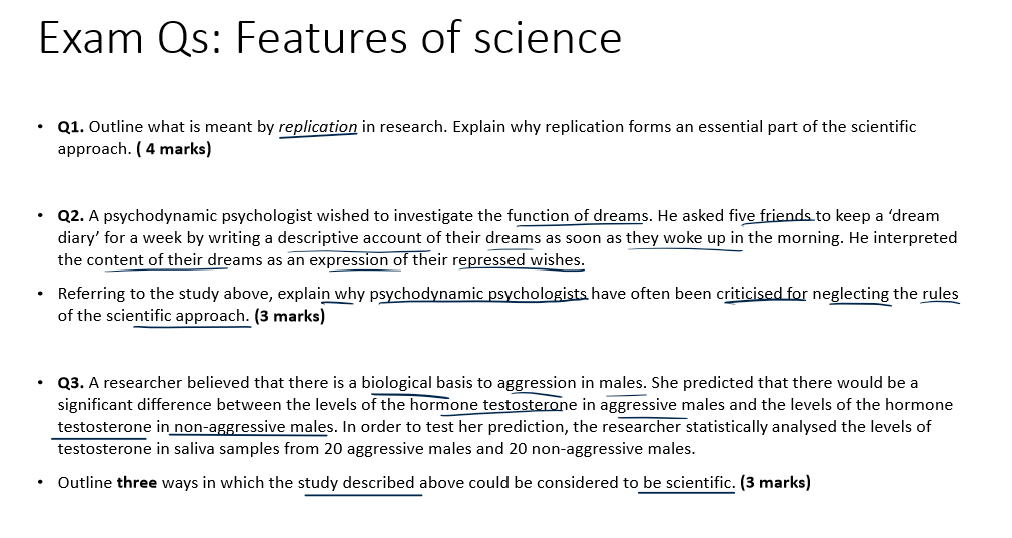
Complete the following exam questions