Earth Science: Rock Cycle, Tectonics, and Geological Time
 Call Kai
 Learn
Learn Practice Test
 Spaced Repetition
 Match
Match Flashcards
 Knowt Play
1/48

There's no tags or description
Looks like no tags are added yet.
Name | Mastery | Learn | Test | Matching | Spaced | Call with Kai |
|---|
No analytics yet
Send a link to your students to track their progress
49 Terms
What is the rock cycle?
The rock cycle is a continuous, long-term geological process whereby Earth's three primary rock types transform into one another through processes like weathering, erosion, transportation, sedimentation, burial, heat, pressure, deformation, metamorphism, and partial melting.
What are the three primary rock types?
The three primary rock types are igneous, sedimentary, and metamorphic.
What is weathering?
Weathering is the process that breaks down rocks into smaller pieces through physical, chemical, or biological means.
What are the three main types of weathering?
The three main types of weathering are physical weathering, chemical weathering, and biological weathering.
What are key erosional processes in the rock cycle?
Key erosional processes include weathering, erosion, transportation, and sedimentation.
What is mountain building?
Mountain building is a geological process known as orogeny, which involves the formation of mountains through tectonic forces.
What is the geological time scale?
The geological time scale is a system of chronological dating that relates geological strata to time, dividing Earth's history into eons, eras, periods, and epochs.
What is the significance of the Principle of Uniformitarianism?
The Principle of Uniformitarianism states that the processes we observe today have also operated in the past at roughly comparable rates, summarized as 'The Present is key to the Past.'
What is an angular unconformity?
An angular unconformity is a type of geological unconformity where younger sedimentary layers are deposited over older, tilted, and/or folded rock layers.
What is the process of tectonic uplift?
Tectonic uplift is the vertical movement of the Earth's surface from a lower to a higher elevation, often associated with mountain building.
What is diagenesis?
Diagenesis is the process by which sediments are compacted and cemented into sedimentary rocks, involving changes in mineralogy and texture.
What is the significance of Mount Everest?
Mount Everest is the highest positive elevation above sea level on land, formed through the collision of the Indian Plate with the Eurasian Plate around 45 million years ago.
What is global warming?
Global warming refers to the long-term increase in Earth's average surface temperature due to human activities, primarily the emission of greenhouse gases.
What are fluvial landforms?
Fluvial landforms are landforms created by the action of rivers and streams, including features like valleys, deltas, and floodplains.
What is ocean acidification?
Ocean acidification is the decrease in pH levels of the ocean due to the absorption of excess carbon dioxide from the atmosphere.
What are glaciers?
Glaciers are large masses of ice that form from accumulated snow and move slowly over land, shaping the landscape through erosion and deposition.
What is the role of rivers in sediment transport?
Rivers and streams transport eroded sediments to lakes and inland seas, where they accumulate and undergo diagenesis to form sedimentary rocks.
What is the significance of the geological evolution of Earth?
The geological evolution of Earth involves the cyclical opening and closing of ocean basins driven by plate tectonics, typically taking 30 to 500 million years.
What is the Hadean Supereon?
The Hadean Supereon is the earliest supereon in Earth's history, encompassing the time from the formation of the Earth to the beginning of the Archean Eon.
What is the concept of sea level rise?
Sea level rise refers to the increase in the average level of the world's oceans due to factors like melting ice caps and thermal expansion of seawater.
What is the relationship between changing oceans and the economy?
Changing oceans can impact the economy through effects on fisheries, tourism, and coastal infrastructure due to climate change and oceanic changes.
What is the significance of the Himalaya Mountains?
The Himalaya Mountains are significant for their height and geological history, formed by the collision of tectonic plates, and they influence climate and biodiversity.
What is a delta?
A delta is a landform created at the mouth of a river where it meets a body of water, characterized by sediment deposition that forms a triangular or fan-shaped area.
What is the rain shadow effect?
The rain shadow effect occurs when moist air rises over a mountain range, causing precipitation on the windward side and creating dry conditions on the leeward side.
What is a drainage basin?
The land that is drained by a network of rivers and streams.
What are perennial rivers?
Rivers that flow all year, commonly found in areas with abundant rainfall, groundwater discharge, and low evaporation rates.
True or False: Discharge rates of rivers and streams depend on the cross-sectional area, water flow velocity, and landscape slope.
True.
True or False: A river's flow is fastest on the inside bend of a meander.
False; it is fastest on the outside bend.
True or False: Each river and stream is part of a drainage basin, separated by a drainage divide.
True.
True or False: V-shaped valleys occur near the base-level of a river.
True.
True or False: Paired terraces are formed due to rapid vertical erosion and progressive uplift.
True.
True or False: During a river flood, a new channel can form, creating crescent-shaped ox-bow lakes.
True.
What are U-shaped valleys?
Distinctive, steep-walled, flat-bottomed valleys carved by alpine-type glaciers, classified as erosional glacial features.
What do striations or striae on rock surfaces indicate?
The direction of the flowing glacier and the erosional power of the glacier.
What are glacial erratics?
Chunks of rock transported by glaciers and dropped far from their origin.
What are terminal moraines?
Depositional glacial features that mark the farthest advance of a glacier, built from rocks and debris at the glacier's toe.
What is sandstone?
A sedimentary rock composed mainly of sand-sized mineral particles or rock fragments.
What is limestone?
A sedimentary rock primarily made of calcium carbonate, often formed from marine organisms.
What is mudstone?
A fine-grained sedimentary rock formed from mud, consisting of clay and silt-sized particles.
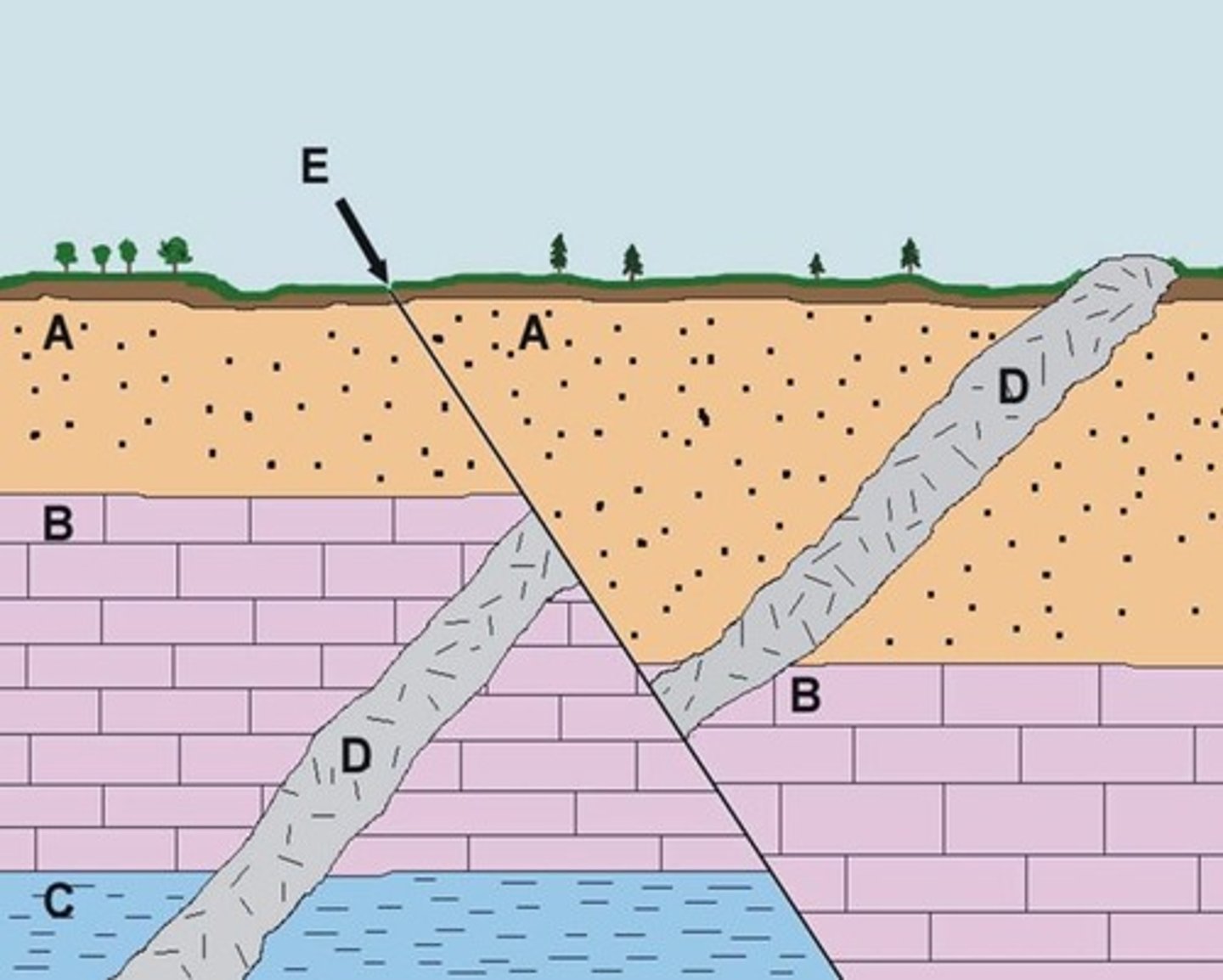
What is an igneous **** intrusion?
A vertical or near-vertical sheet of igneous rock that has intruded into pre-existing rock formations.
What is a tectonic fault?
A fracture in the Earth's crust where blocks of rock have moved relative to each other.
What does the Cambrian Explosion of Life represent?
A significant event in Earth's history marked by a rapid diversification of life forms during the Cambrian period.
What caused mass extinctions in geological history?
They were mainly the result of catastrophic events, though gradual geological changes also played a role.
What is the significance of supercontinent formation?
It has influenced the evolution of life on Earth by altering habitats and climate patterns.
What natural processes led to 'Snowball Earth'?
Global cooling events that caused extensive glaciation, with recovery involving greenhouse gas increases.
What are the causes of mass extinctions?
Events such as volcanic eruptions, asteroid impacts, and climate changes, followed by evolutionary recovery processes.
What led to the desiccation of the Mediterranean Sea?
Two main reasons include tectonic uplift and changes in sea level.
Where did Earth's initial surface water originate?
Current concepts suggest it originated from volcanic outgassing and icy comets.
Why is studying desert environments important?
It helps understand climate change, ecosystem dynamics, and resource management.