Role of Nutrients
 Call Kai
 Learn
Learn Practice Test
 Spaced Repetition
 Match
Match Flashcards
 Knowt Play
1/43

There's no tags or description
Looks like no tags are added yet.
Name | Mastery | Learn | Test | Matching | Spaced | Call with Kai |
|---|
No analytics yet
Send a link to your students to track their progress
44 Terms
What are the four primary roles of nutrients in living organisms?
Metabolism, growth, reproduction, and healing.
How do proteins contribute to metabolism?
They are broken into amino acids, which are then used to synthesize enzymes, hormones, and structural proteins.
What is the primary metabolic function of carbohydrates?
To provide glucose for energy.
What is the role of fats in cellular structure?
They serve as the building blocks for cell membranes.
Which nutrients are essential for maintaining homeostasis?
Vitamins and minerals.
Which specific minerals are critical for bone growth?
Calcium (Ca++) and Phosphorus (Phos).
What is the function of Vitamin D in relation to bone health?
It regulates calcium absorption and promotes bone mineralization.
How do micronutrients like Zinc, Iodine, and Selenium support reproduction?
They influence hormone synthesis, sperm quality, and fetal development.
Which vitamins are specifically noted for their roles in tissue healing?
Vitamin C (collagen formation) and Vitamin A (immune function and skin repair).
What minerals are essential for tissue regeneration and skin wound healing?
Zinc and Copper.
What are the four key stages of animal development?
Maintenance, growth, reproduction, and production.
What is defined as the 'base level' of nutritional status for an animal?
Maintenance, where the animal needs the minimum amount of nutrients to sustain healthy bodily functions without gain or loss in weight.
What are the four primary requirements provided by maintenance feed formulas?
Body tissue repair/regeneration, control of body temperature, energy for vital organs, and maintenance of water balance.
How does the 'Growth' stage differ from 'Maintenance'?
Growth requires additional nutrients to meet the animal's potential size or maturity, whereas maintenance only sustains existing functions.
What is the relationship between maintenance/growth requirements and reproduction?
Reproduction is a high-demand state; if an animal cannot meet its maintenance or growth requirements, it will be unable to reproduce.
What is the consequence of failing to meet maintenance or growth requirements in a production animal?
The animal will be unable to produce meat, milk, wool, or perform work.
What nutrients are primarily involved in the 'Growth' function?
Carbohydrates, protein, fats, calcium, phosphorus, and zinc.
Which nutrients are key for the 'Healing' function?
Carbohydrates, protein, fats, Vitamin C, Vitamin A, Zinc, Copper, and Omega-3s.
What are the key nutrients involved in 'Reproduction'?
Carbohydrates, proteins, fats, Vitamin E, selenium, and folate.
What is the primary role of carbohydrates in the context of reproduction?
They provide energy for the ovaries and testes, and support metabolic processes required for mating, pregnancy, and lactation.
Why are proteins and fats essential for reproduction?
They are required for the production of sperm and eggs, and for the hormonal changes necessary to regulate cycles.
What nutrients are involved in the 'Metabolism' function?
Carbohydrates, fats, proteins, vitamins, and water.
What is the definition of 'Dry Matter' in the context of pet food?
Dry matter refers to the amount of nutrients remaining in a food product once all the water content has been removed.
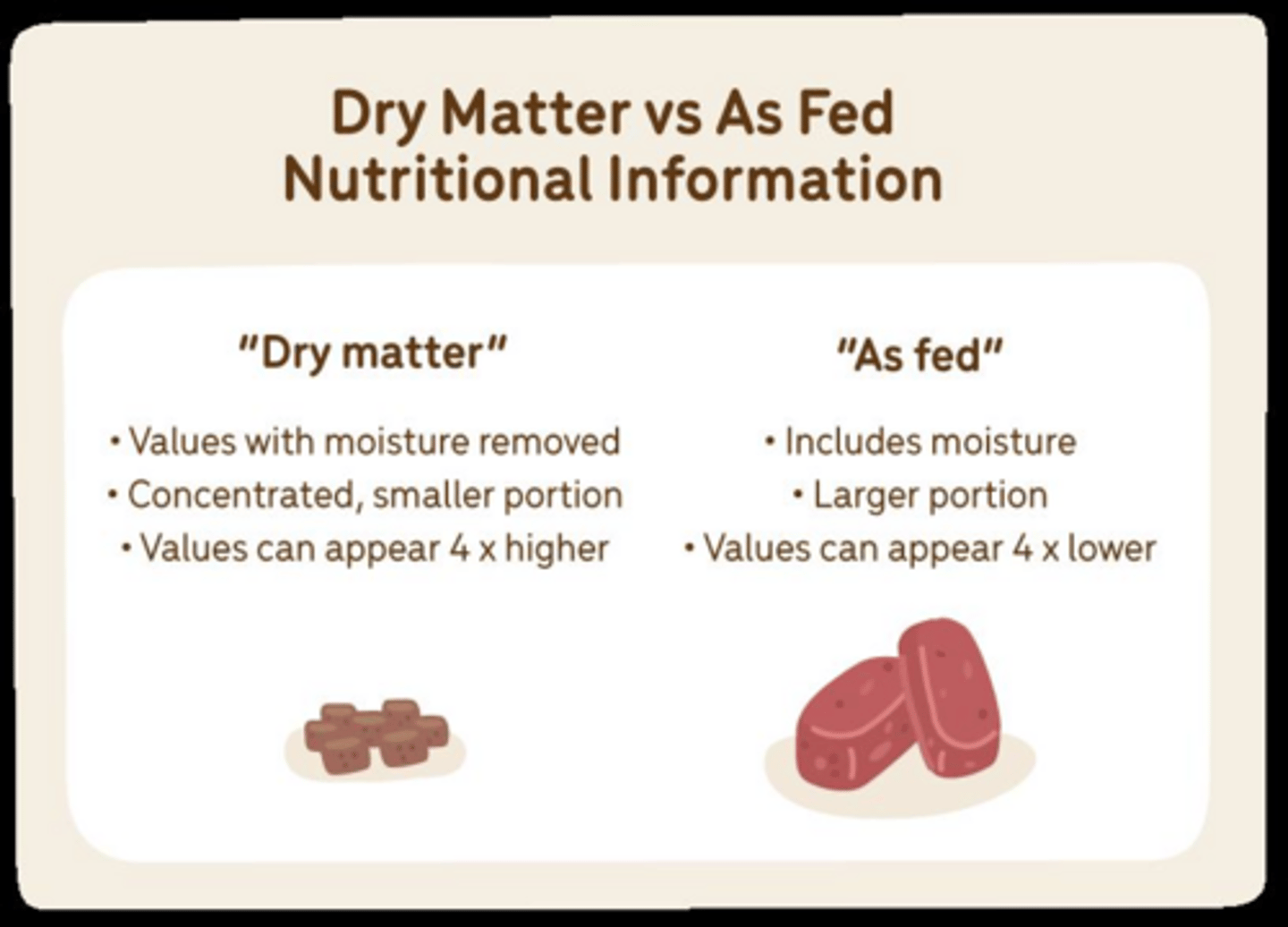
What does the 'As Fed Basis' represent on a pet food label?
The As Fed Basis represents the amount of a nutrient as it is present in the food, including both the nutrients and the water content.
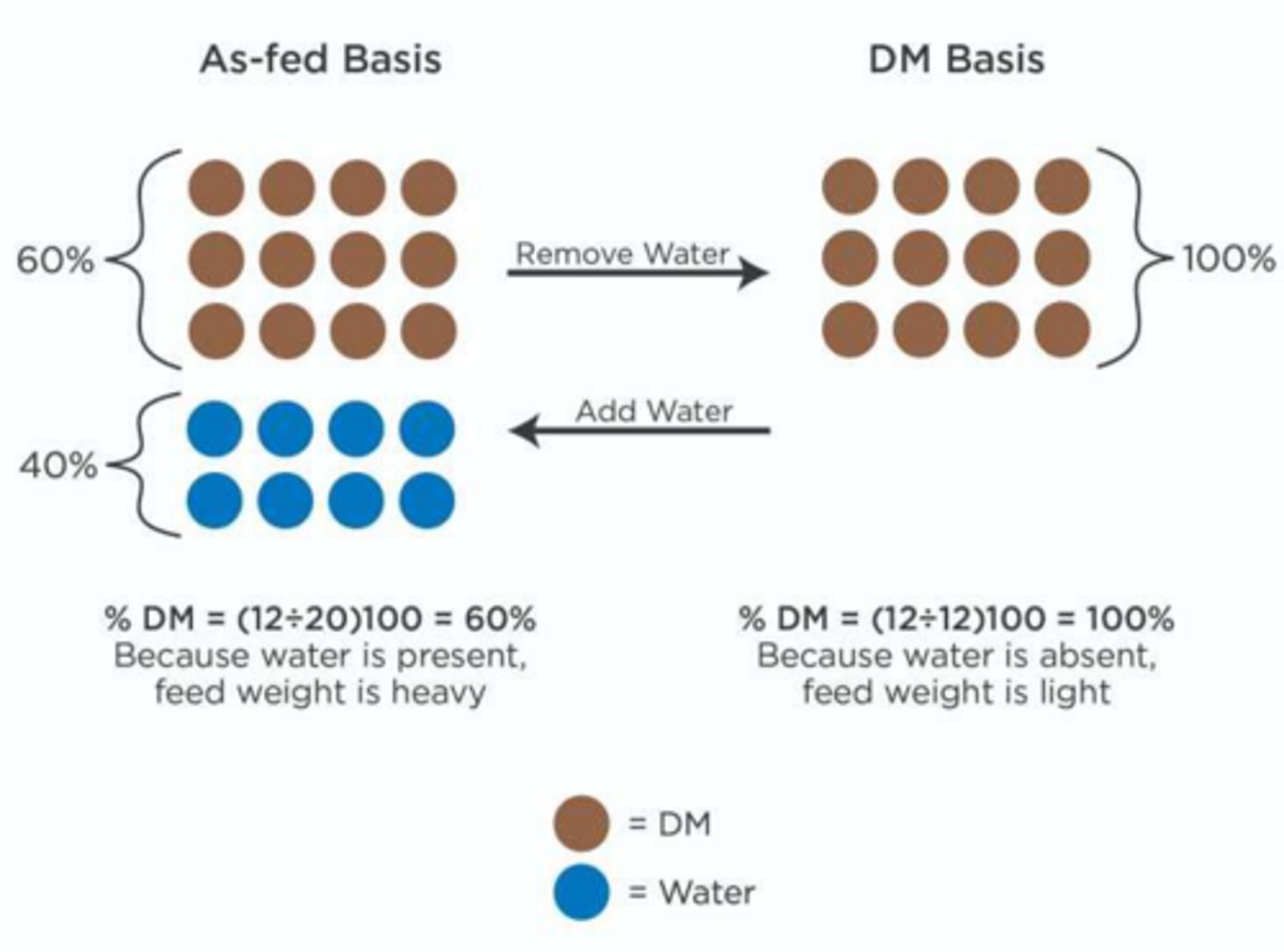
Where can you typically find the 'As Fed' nutrient percentages on a pet food label?
These are typically stated in the Guaranteed Analysis section of the food label.
What is the mathematical formula to calculate the percentage of Dry Matter (DM) in a food product?
Dry Matter percentage = 100% - Moisture percentage.
If a pet food label states it has 78% moisture, what is the Dry Matter percentage?
100% - 78% = 22% Dry Matter.
What are the four steps to calculate the Dry Matter Basis (DMB) of a specific nutrient?
1. Determine moisture percentage. 2. Calculate Dry Matter percentage (100 - moisture). 3. Divide the 'as fed' nutrient percentage by the Dry Matter percentage. 4. Multiply the result by 100.
If a canned food has 9% crude protein and 78% moisture, what is the protein percentage on a Dry Matter Basis?
First, find DM (100-78=22). Then, 9 divided by 22 equals approximately 0.409, which is 40.9% protein on a DMB.
Why is it important to convert 'As Fed' values to 'Dry Matter Basis' when comparing canned and dry pet foods?
Because canned food has significantly higher water content than dry food, comparing them on an 'as fed' basis is misleading; DMB allows for a direct comparison of nutrient density.
How does the water content of Alfalfa hay (10%) compare to Alfalfa pasture grass (80%) in terms of Dry Matter?
Alfalfa hay has 90% Dry Matter, while Alfalfa pasture grass has 20% Dry Matter.
Why might boneless cuts of meat have lower levels of certain macro minerals compared to other ingredients?
Boneless cuts lack the mineral-rich bone structure, leading to lower concentrations of specific macro minerals.
What are the four primary roles of nutrients in an animal's body?
Metabolism, growth, reproduction, and healing.
When comparing two diets, why is the 'As Fed' protein percentage often higher in dry kibble than in canned food?
Because dry kibble has much less water, the nutrients are more concentrated by weight compared to the high-water content of canned food.
If Diet A (Dry) has 24% protein and 12% moisture, what is the protein percentage on a DMB?
100% - 12% = 88% DM. 24 / 88 = 0.2727, or 27.3% protein on a DMB.
If Diet B (Canned) has 8% protein and 82% moisture, what is the protein percentage on a DMB?
100% - 82% = 18% DM. 8 / 18 = 0.4444, or 44.4% protein on a DMB.
In the example of Diet A and Diet B, which diet actually provides more protein on a Dry Matter Basis?
Diet B (Canned) provides 44.4% protein, while Diet A (Dry) provides 27.3% protein.
What is the primary factor that makes comparing 'As Fed' values between canned and dry food difficult?
The vast difference in moisture (water) content between the two types of food.
What is the first step in calculating the Dry Matter Basis of an ingredient?
Determine the percentage of moisture content from the ingredient label.
What is the final step in calculating the Dry Matter Basis of an ingredient?
Multiply the result of the division (As Fed nutrient / DM percentage) by 100 to express it as a percentage.
If a diet has 10% protein on an 'As Fed' basis and 75% water, what is the protein on a DMB?
100 - 75 = 25% DM. 10 / 25 = 0.4, or 40% protein on a DMB.
Why is it necessary to understand DMB when managing a pet with a history of pancreatitis?
Pancreatitis management often requires strict control of fat intake; DMB allows for an accurate comparison of the actual fat concentration across different food types.
True or False: The 'Guaranteed Analysis' on a pet food label is always provided on a Dry Matter Basis.
False; it is provided on an 'As Fed' basis.
What is the primary difference between 'As Fed' and 'Dry Matter Basis'?
As Fed includes the weight of water in the calculation, while Dry Matter Basis excludes water to show the concentration of nutrients alone.