Exam 2- Veins
 Call Kai
 Learn
Learn Practice Test
 Spaced Repetition
 Match
Match Flashcards
 Knowt Play
1/9

There's no tags or description
Looks like no tags are added yet.
Name | Mastery | Learn | Test | Matching | Spaced | Call with Kai |
|---|
No analytics yet
Send a link to your students to track their progress
10 Terms
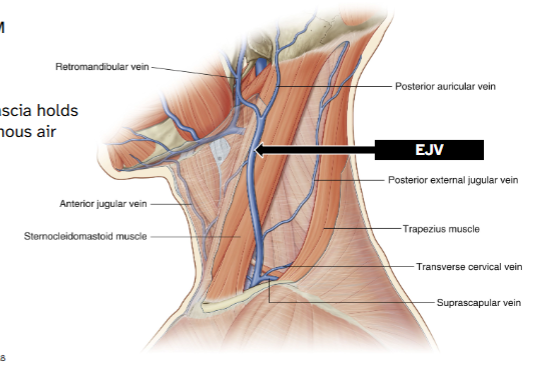
External Jugular Vein
Formed by union of posterior division of retromandibular vein and posterior auricular vein
Runs vertically superficial to SCM
Drains into subclavian
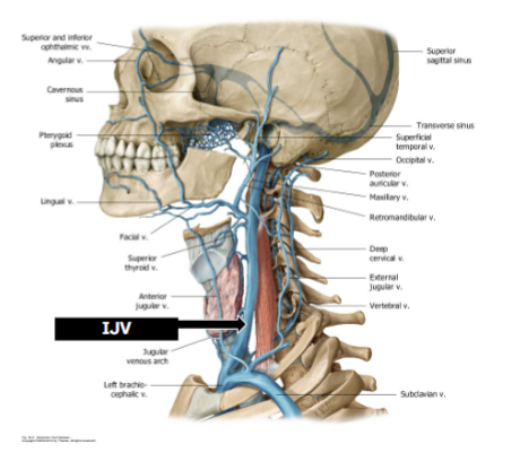
Internal Jugular Vein
Begins at jugular foramen on skull
Runs laterally within carotid sheath
Ends by joining subclavian vein to form brachiocephalic vein
Subclavian Vein
Begins at lateral border of first rib
Passes anterior to anterior scalene muscle
Joins internal jugular vein to form brachiocephalic vein
Venous Angle
IJV + subclavian veins
Lymphatic vessels end at venous angles
Retromandibular Vein
Formed from union of superficial temporal vein and maxillary vein
Deep vein
Posterior to ramus of mandible
Terminal branches: posterior and anterior branch
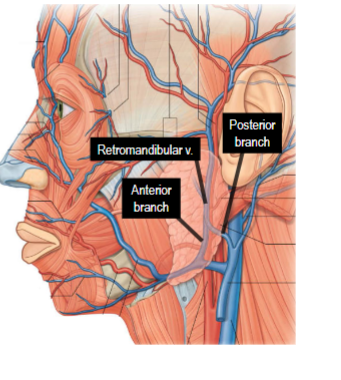
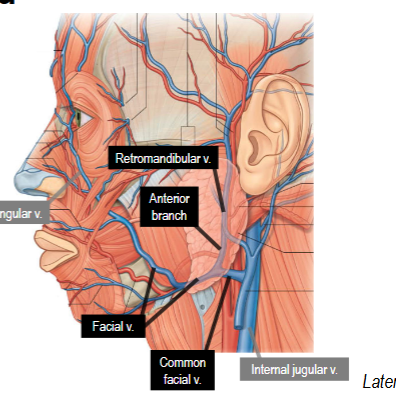
Anterior branch of retromandibular vein
Facial Vein: continuous with angular vein
Common Facial Vein: formed from anterior branch of retromandibular and facial vein
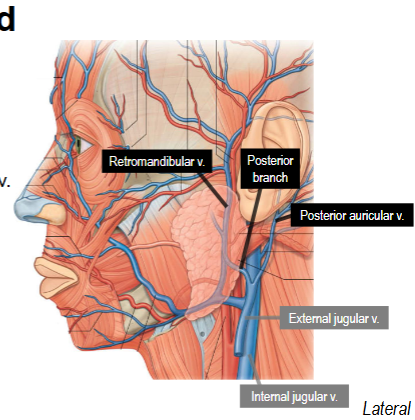
Posterior Branch of Retromandibular Vein
Posterior auricular vein
External jugular vein: formed from union of posterior branch of retromandibular and posterior auricular
Venous Return from Face
Angular vein forms at medial canthi
Tributaries: external nasal, superior labial, deep facial, inferior labial vein
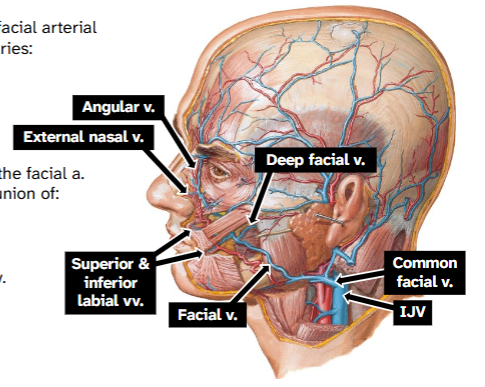
Common Facial Vein
Formed by union of facial v, submental, lingual, and anterior division of retromandibular
Empties into IJV
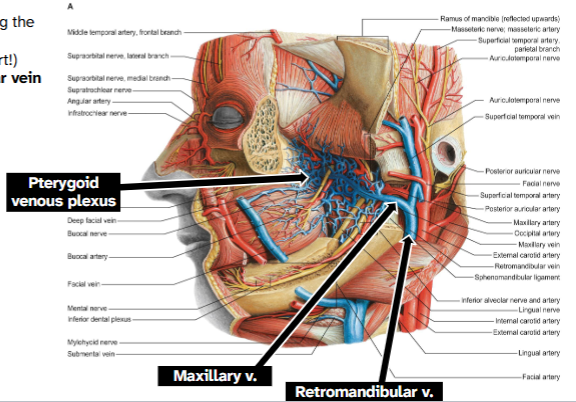
Pterygoid Venous Plexus
Network of veins accompanying maxillary artery
Forms maxillary vein (very short) that drains into retromandibular vein
Communicates with: cranial cavity- cavernous sinus, orbit-inferior ophthalmic veins, superficial face- deep facial vein, neck- retromandibular vein