AP Econ FULL year review
 Call Kai
 Learn
Learn Practice Test
 Spaced Repetition
 Match
Match Flashcards
 Knowt Play
1/235

Earn XP
Description and Tags
Review for AP econ exam. Good luck!
Name | Mastery | Learn | Test | Matching | Spaced | Call with Kai |
|---|
No analytics yet
Send a link to your students to track their progress
236 Terms
What is economics
Utilizing scarce resources to satisfy unlimited wants
What is the economizing problem
-Unlimited wants vs scarce resources
-Scarcity leads to tradeoffs → Tradeoffs create choices → Choices create opportunity cost
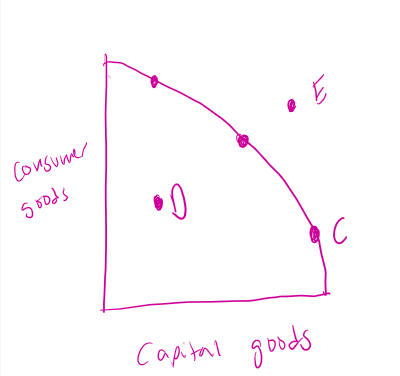
What point(s) on the PPC are attainable and efficient
-Pt a, b, c
-Anything on the frontier is attainable and efficient
How much cyclical unemployment is on the frontier of the PPC?
0 cyclical unemployment
What is the frontier of the PPC also known as?
-Qf
-Natural rate of unemployment
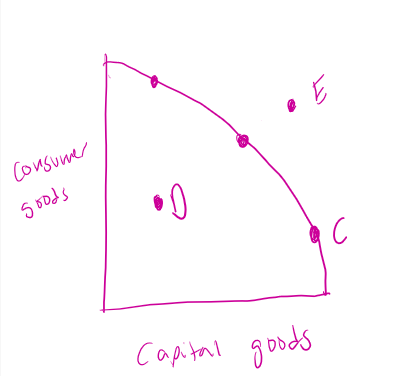
What point(s) on the curve are attainable and inefficient?
-Point D
-Any point inside the curve
Points inisde of the PPC have what time of unemployment
Cyclical unemployment
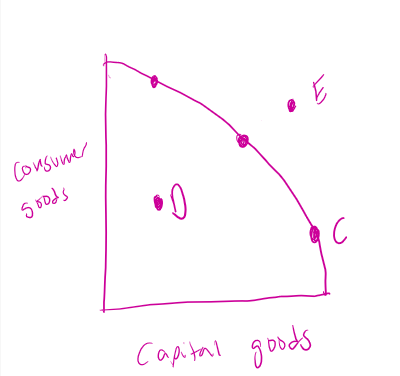
What points on the curve are unattainable with current resources and technology?
-Point E
-Any point outside of the curve
What are consumer goods?
Goods that are used up right away
What are capital goods?
Goods that are used to created other goods
What does a concave (circle-type) PPC curve reflect
It reflects the law of increasing opportunity cost
What is the law of increasing opportunity cost
As you produce one more of one good, you have to give up one more of another good.
-As you produce more of one good, the opportunity cost of producing each additional unit of that good increases.
What does the constant (linear) shape of the PPC curve reflect?
It reflects equal opportunity cost
What is the law of equal opportunity cost?
As you produce one more item of a good, you give up the same amount of other good at the same time.
1 gun = 2 butter
2 guns = 4 butter
What Shifts the PPC and changes economic growth?
-△ Capital goods
-△ interest rate
-△ productive capacity
-△ Productivity
-△ Education
-△ Population
-△ Labor force
-△ Trade
-△ Resources
What do changes in capital goods include?
△ Ig
△ Machinery
△ Tools
△ Equipment
What does the circular flow model explain?
How sectors communicate through factor markets
What are included in sectors?
C
Ig
G
Xn
What is C as a sector in the circular flow model
Households
What is Ig as a sector in the circular flow model
Businesses
What is G as a sector in the circular flow model
Government
What is Xn as a sector in the circular flow model
Int’l
-Foreign sector/ international market
What are the two factor markets in the circular flow model?
Resource market
Product Market
What are the four factors of production?
Land
Labor
Capital
Entrepreneurial Ability
What are the four factor payments?
WRIP
-Wages
-Rent
Interest
-Profit
What are factor payments?
Payments that businesses make to households in the circular flow model
-Households supply the factors of production to businesses
-Businesses pay households with factor payments
Labor → wages
Land → rent
Capital → interest
Entrepreneurship → profit
The law of demand is for the consumer/producer?
Consumer
The law of supply is for the consumer/producer?
Producer
What does the law of demand state?
Prices ↑ , QD ↓
What does the law of supply state?
As P ↑ , QS ↑
What shifts the demand curve (Demand determinants)
PINTE
Price of related goods
Income
Number of buyers
Taste
Expectations
What shifts the supply curve (Supply determinants)
PRENTT aka PUPS
Price of other goods
Resource prices
Expectations
Number of buyers
Technology
Taxes and subsidies
What does the P in PINTE stand for (Demand determinant)
Price of related goods
What does the I in PINTE stand for (Demand determinant)
Income
What does the N in PINTE stand for (Demand determinant)
Number of buyers
What does the T in PINTE stand for (Demand determinant)
Taste
What does the E in PINTE stand for (Demand determinant)
Expectations
What does the P in PRENTT stand for (Supply determinant)
Price of other goods
What does the R in PRENTT stand for (Supply determinant)
Resource prices
What does the E in PRENTT stand for (Supply determinant)
Expectations
What does the N in PRENTT stand for (Supply determinant)
Number of sellers
What does the T1 in PRENTT stand for (Supply determinant)
Technology
What does the T2 in PRENTT stand for (Supply determinant)
Taxes and subsidies
What is GDP
The monetary ($) value of final Goods and services produced in the economy in year.
What are the two ways to calculate GDP
Expenditure approach
Income approach
What is the expenditure approach formula
GDP= C+ Ig+ G + Xn (X-n)
What is the income approach formula
WRiPINDS
W+R+I+P + I + N + D + S (Four adjustments)
Wages+ Rent + interest + profits + indirect business taxes + net foreign factor + depreciation + Statistical discrepancy
What does W stand for in W+R+i+P + I + N + D + S
Wages
What does R stand for in W+R+i+P + I + N + D + S
Rent
What does i stand for in W+R+i+P + I + N + D + S
interest rates
What does P stand for in W+R+i+P + I + N + D + S
Profits
What does I stand for in W+R+i+P + I + N + D + S
Indirect business taxes
What does N stand for in W+R+i+P + I + N + D + S
Net Foreign Factor
What does D stand for in W+R+i+P + I + N + D + S
Depreciation
What does S stand for in W+R+i+P + I + N + D + S
Statistical Discrepancy
What are price indices?
Indexes used to measure changes in price
What are two price indices?
CPI
GDP Deflator
What is the formula for Price index?
Price index = (Pcy Market basket / Pby same market basket ) x 100
What is the formula for GDP Deflator
GDP Deflator = ( Nominal GDP/ Real GDP ) x 100
What is the formula for Nominal GDP
Nom GDP= (Pcy X Qcy ) + (Pcy x Qcy)
What is nominal gdp
Current GDP using current year prices
Nominal GDP in year 1 (base year) is also same as the ___ _____ in year 1
Real GDP
What is the formula for Real GDP?
(Pby x Qcy) + (Pby x Qcy)
or
Real GDP = (Nominal GDP / Price index ) x 100
What is real Gdp?
GDP in base year profits
percent change in Real GDP formula
Real GDP % △ = Nominal % △ - Inflation % △
What is the formula for the rate of inflation?
Rate of inflation = (This YR PI - Last YR PI / Last YR PI ) x 100
Rule of 70 formula
Rule of 70 = 70/ Rate of inflation
What is the rule of 70?
How long it takes for prices to double
What is the standard of living △ formula?
SOL △ = (This YR Real GDP - Last YR Real GDP / Last YR Real GDP ) x 100
Real GDP Per capita formula
Real GDP per capita = Real GDP / Population
What is real gdp per capita
inflation-adjusted output per person
inflation-adjusted value of goods and services produced per person in a country.
Best to use when comparing countries
What are the types of unemployment
-Frictional
-Structural
-Cyclical
What is frictional unemployment
Switching jobs voluntarily
Ex. College grad
What is structural unemployment
Unemployment due to lack of skill
What is cyclical unemployment
Unemployment due to lack of demand or a recession
What is the Natural Rate of Unemployment (NAIRU) equal to
Full employment (Qf)
What does NAIRU say
Frictional and structural unemployment exist
Cyclical unemployment = 0
Qf= LRAS
What is the formula for the unemployment rate?
(# of unemployed / labor force ) x 100
What is the population formula
Under 16 + Institutionalized + Not in the labor force + Labor force
What is the formula for labor force?
Unemployed + Employed
To be considered unemployed you must be…
actively seeking work and are able to work
How many hours do you have to work to be considered apart of the labor force?
15 hours+ per week
What are the problems with the unemployment rate
Discouraged workers (they stopped seeking
Part-time workers
False info
These things make the unemployment rate look lower than it is (understate it)
GDP is equal to….
Aggregate expenditures (AE)
AE formula
C + Ig + G + Xn
△ GDP Formula
△ GDP = multiplier x △ AE
Disposable income formula
DI= C + S (savings)
The AE Model is also known as the ____ model
keynesian
What are aggregate expenditures
Total Spending in an economy
Multiplier formula using the MPS
1/MPS
Multiplier formula using MPC
1/1-MPC
Multiplier formula using GDP
Mult= △ equil GDP/ △ AE
Can be used only if the graph is given
MPC formula
△ C/ △ DI or △ AE/ △ GDP
MPS formula
MPS= △ S / △ DI or △ Leakages / △ GDP
Leakages equation
Leakages = T + M + S
What are leakages
Things that don’t “pump” back into economy
What are injections
Things that “pump” back into economy
Injections formula
Injections = Ig + G + X
How to find leakages from T △
T ↑ ↓, DI goes in opposite direction x MPS = (Same direction as DI ) S
What does MPC stand for
Marginal propensity to consume