Mark Senn 1-6
 Call Kai
 Learn
Learn Practice Test
 Spaced Repetition
 Match
Match Flashcards
 Knowt Play
1/54

There's no tags or description
Looks like no tags are added yet.
Name | Mastery | Learn | Test | Matching | Spaced | Call with Kai |
|---|
No analytics yet
Send a link to your students to track their progress
55 Terms
For the sake of general knowledge, can you explain how each of the points work, or what is used.
microphone:
Touch screen:
non volatile storage
GPS aerial
microphone: piezoelectrics
Touch screen: capacitors, moisture from finger
non volatile storage:NAND flash memory
GPS aerial: high specification ceramic dielectrics
OLED and LC displays are usually for what (bg) and what material is used for screen usually
OLED: each pixel emit its own light
LCD: uses backlight behind liquid crystals
Tin oxide lets screen detect ur fingers while letting light go pass thru
What part of phone is responsible for memory
RAM for temporary storage
NAND for long term storage
and doped semi conductors
Some rocksalt revision, These are important because of most functional material are crystals
Rocksalt
Rutile
Corrundum
Perovskite
Spinel
rocksalt: AO
rutile AO2
corrundum: A2O3
Perovskite: ABO3
Spinel: AB2O4
identify what each are below
NiO
Mn3O4
Cr2O3
CrO2
AlFe22O4
NiO :rock salt
Mn3O4 is Spinel
Cr2O3 is corrundum
CrO2 is rutile
AlFe2O4 is spinel
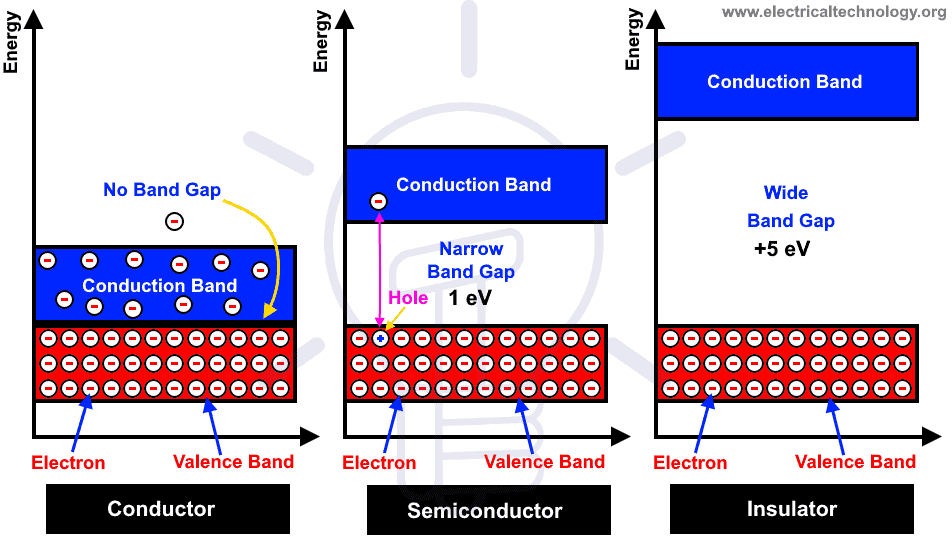
difference between metal, insulator and semiconductor in terms of fermi level
Metal fermi level is close
insulator, large gap
semi conductor a little gap
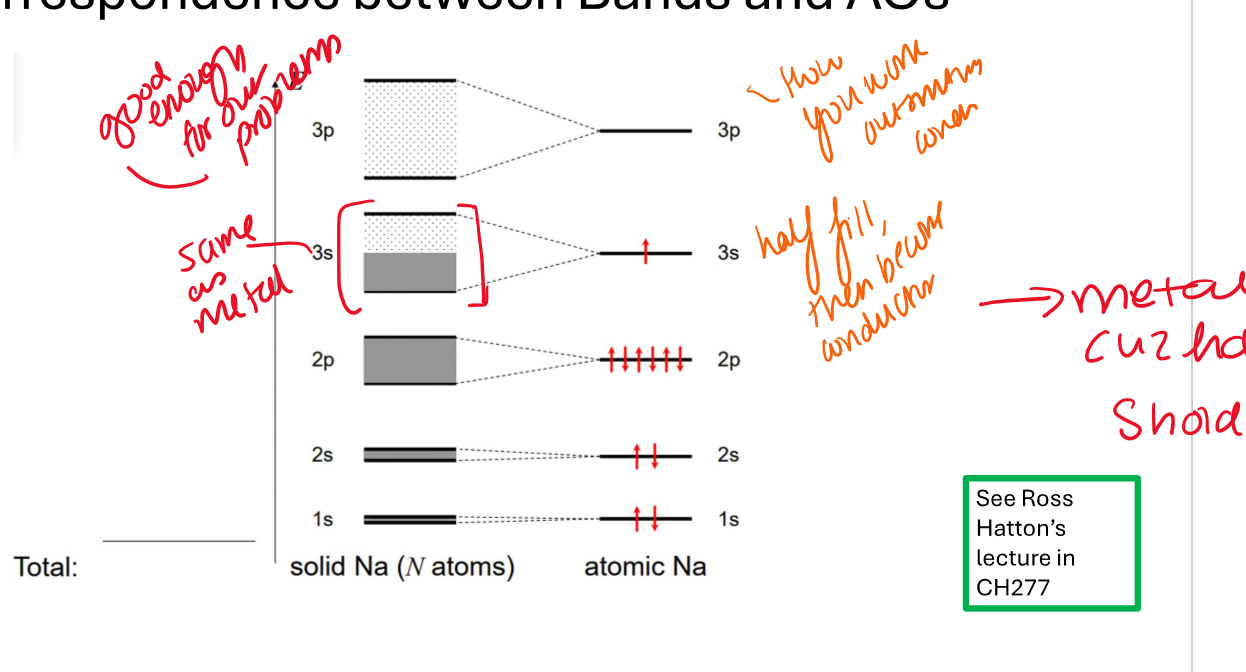
why is this metal N a conductor (recap)
The N has a configuration of 1s22s22p63s1 The one on 3s, shows its a partially filled, so electrons can move easily under electric field, hence making it conductive. Because conduction happens at 3s, it does not need to jump to 3p to have conduction
what is a factor that can affect semiconductors distribution of atomic orbitals
Temperature
difference between an insulator and semiconductor
Both have a zero density of state at fermi level, but semi has smaller band gap
What are the three classes that make bad dieelectric material
Conductors (metals)
narrow band gap semi conductors (doped Si)
transition metal that have part filled d orbitals that contribute to the valence band, as they likely to be metallic or narrow band gap
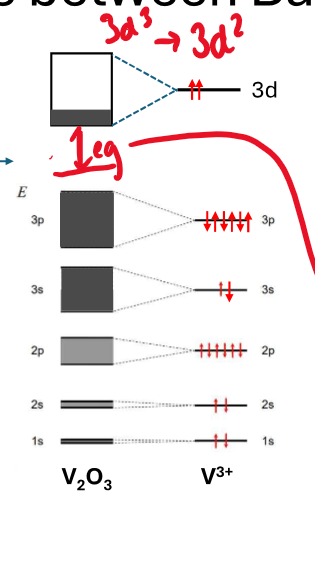
How does this show if V3+ is a good dielectric or not
So, V3+ is 4s23d3 making V3+ makes it 3d2 now looking at diagram, the gap between 3d and O2 is large. Large band gap means can be dielectric
Explain if TiO2 is a good dielectric
Ti charge here is +4. That makes the configuration 4s23d2. Making it 3d0 after. So nothing filled means no electron, hence large BAND gap, so its dielectric. Dielectric are basically insulators, where their band gap is bigger than semiconductor (narrow). Dieelectric also require polarisation to work not electrons. hence why 3d0 works. The Ti shifts one way and O2 shifts another. Bc Ti-O bonds are highly polarizable
What makes something polarisable
1)Large soft electron clouds I- is more polarisable than F- bc outershell is farther away
2)Highly charged ions can distort neighbors, In Ti4+, has high charge and small in size, so interacts with oxygen electron clouds, creating polarizable bonds
3) empty d orbitals, empty low energy orbital exists
Predict the following dielectrics
Cr2O3 → 3d3
ZnO→3d10
Ga2O3→3d10
Cr→ dielectric, the repulsion makes it big. cuz each filled in t2g first one way up
ZnO→ filled, no repulsion, so no bc, band gap is around 3.3 v, so narrow and
Ga→ 3d10, so no but electrons move so becomes metal conductor cuz of 4p1
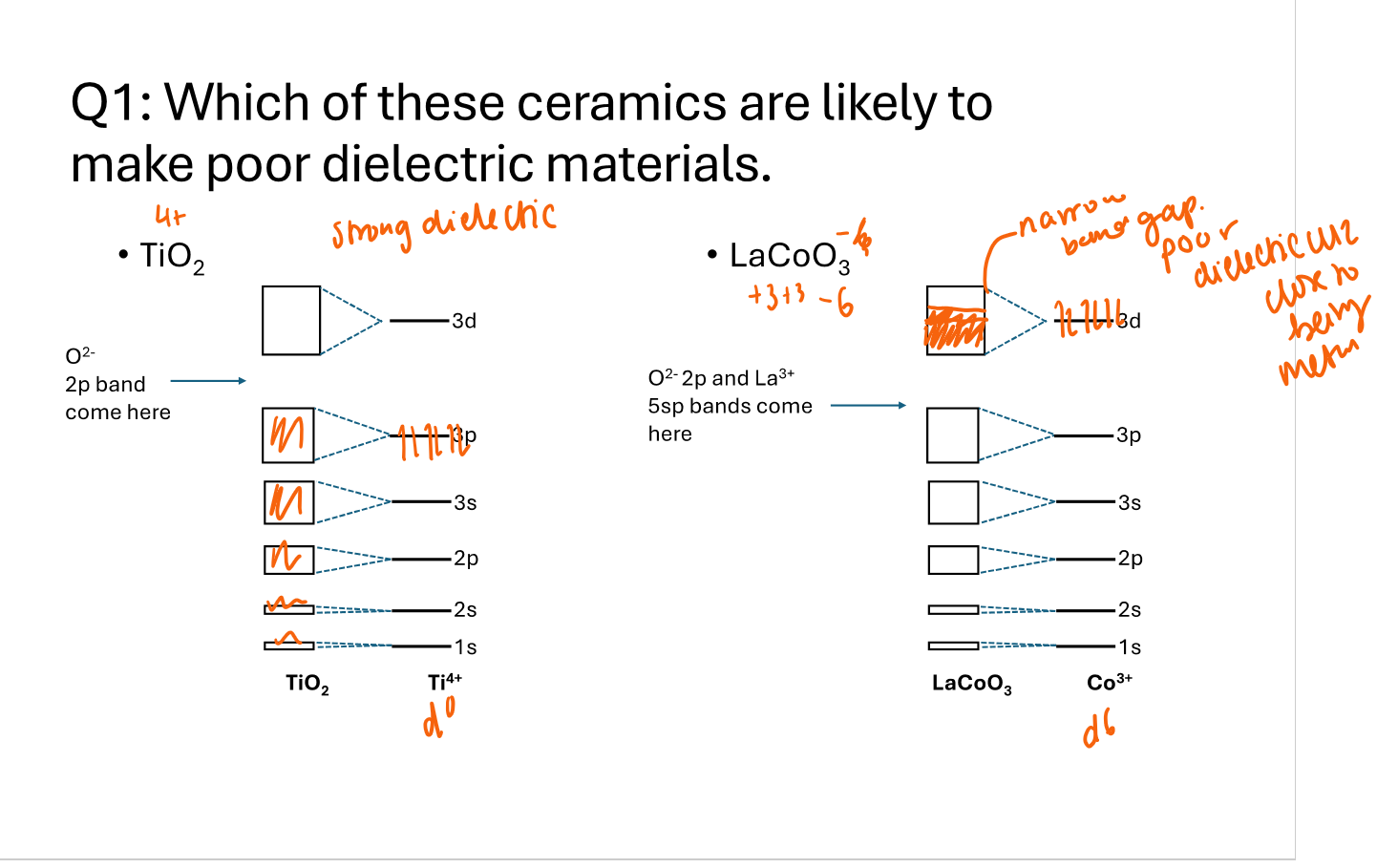
Between TiO2 and LaCoO3 which would make a poorer dielectric and why?
Ti has 4+ and the p orbital spins are all filled.
LaCoO3 has 3d6, and thats 6/10 filled, making it a narrow band gap between the band. hence it will be a weaker dielectric
What is εr
Measure of how good the material is at screening + and - from each other. Also described as capacitance
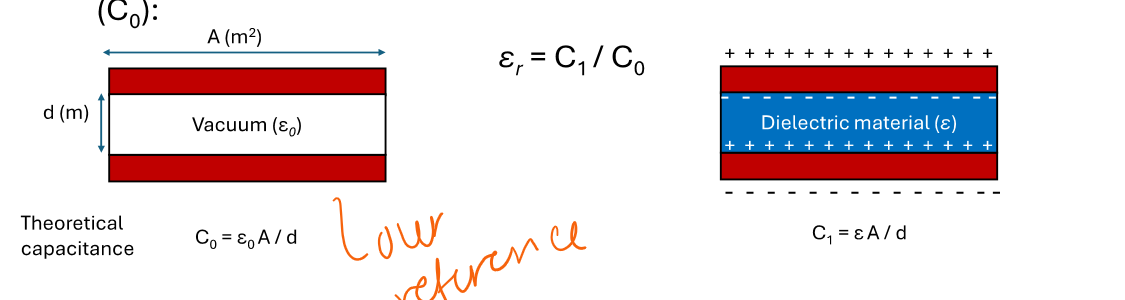
What is capacitance C1 and C0
C0 is reference and C1 is relative to reference
How can you measure C which in turn measures Epsilon
C=Q/V. so you run charge through built up per unit voltage.
Er= C1/C0
What increases capacitance when it comes to parallel plates
When a material is put inbetween because it develops dipoles that screen the applied field
Air has Er of 1.006
teflon is 2
TiO2 is 94, with these values what can you interpret
Most insulating Er values are <30. bigger than 30 can be functional dielectrics in electronic devices
What is the bulk polarisation(P)
A material contains positive and negative charges.
When an electric field is applied, those charges shift slightly.
This creates tiny dipoles inside the material.
The combined effect of all those dipoles across the whole material = bulk polarization.
What is P equation
P=ξ0 × Xe ×E
So now we have a big P and a little p. what is the difference
little p is polarisation of an atom, dipole etc. the equation is p=αxE(local) and big P is polarisation of many
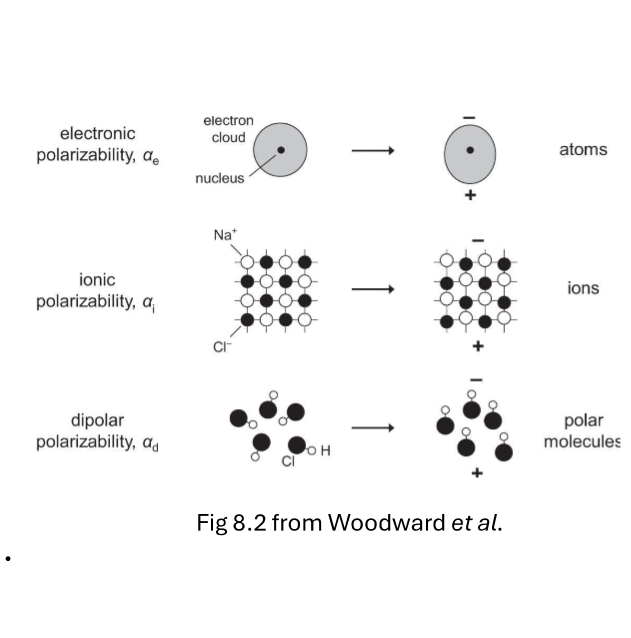
what are the three polarisability and its terms
Ae, is usually general for excite electron clouds of substituet atoms (e for evertyhing)
Ai, usually high for materials with ions of large charge that can easily vibrate with large amplitudes (ions and ionic)
Ad, is high for materials with large permanent dipoles, that can easily orinetate/ rotate in applied field (dipoles)
Diamon ξr= 6
CaF2 ξr=7
H2O ξr=80
what are the dominant mechanisms contributing
Diamond= usually covalent and mainly carbon, so mostly Ae
CaF2 is usually ionic so mostly Ai and Ae
and H2O is dipoles so Ad
whats typically the magnitude of order of the capacitance contribution
Ae<ei<ed but below 300mhz, all mechanism contribute
what is εopt
in short its how to measure ae, estimated from optical limit from refractive index.
εopt =n²
n=refractive index
What is the difference between εstat and εopt
Estat is the sum of all E acting on it. so electronicc+ ionic+dipolar +space charge.
E opt is the dielectric constant measured withing the optical light phase (10^14-10^15 Hz). can be known as E electronic too.
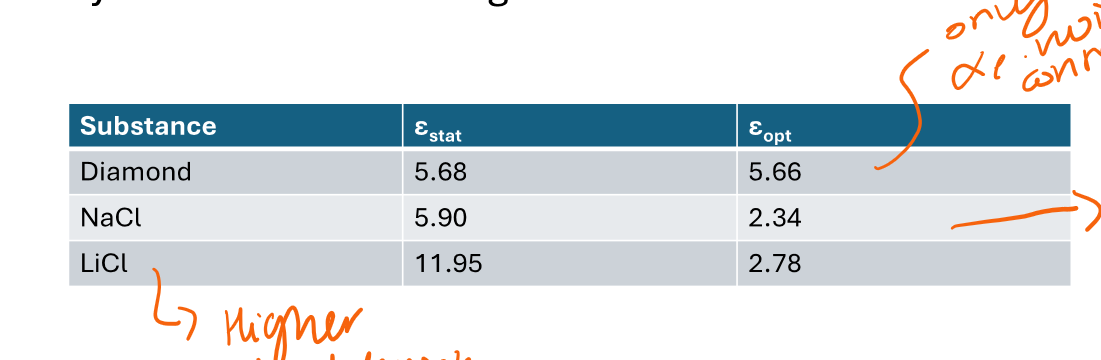
Answer, why is Estat and e opt similar for diamond.
what does the large difference between E stat and opt tell you
why is this difference larger in LiCl
1) the only contribution is Ae. electronic. because diamond has no ionic.
2)has ions in NaCl so the vibration contribution is large.
3)LiCl has higher cloud density, so higher vibration. Higher cloud means (+1 charge packed into a small volume, think of shells)
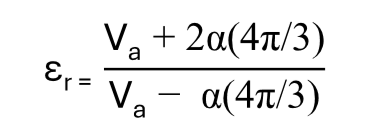
what is this equation specifically used for
εr = relative permittivity (dielectric constant)
α = polarizability of the ion/atom
Va = volume per atom (or molecular volume)
What it essentially shows is links microscopic atomic/ions interaction have on the effect of the whoole entire material. so an atom to a crystal.
what determines high dielectric constant
large polarisability of ionic
small atomic or unit cell volume
therefore large a/V ratio produce high Er
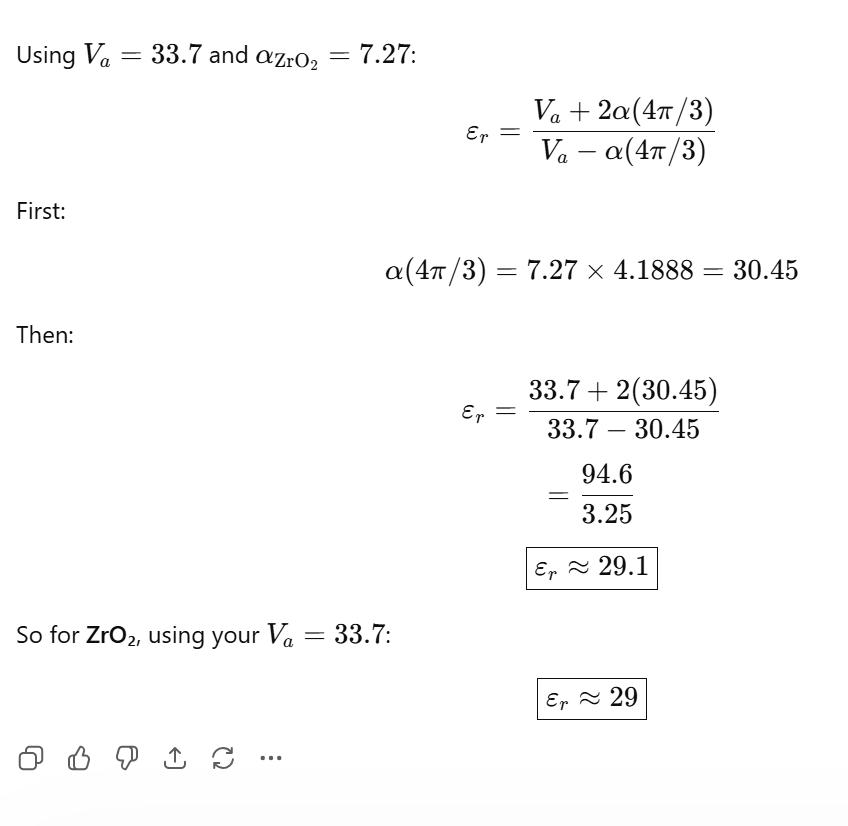
If ZrO2 was 33.7 as Va. what is the Er. The electroneg of O is 2.01and Zr is 3.25
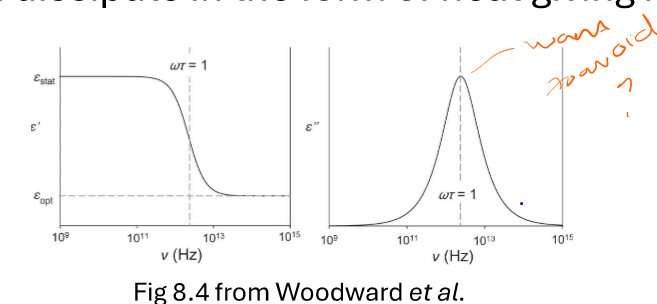
In alternate electric filled, what happens to the capacitors and then the polarisation
during alternating, the capacitor plates alternate from pos and neg, the polarisation of the materials in between try to keep up with the change by driving relevant ionic vibrations (and dipole rotation). this causes energy loss thru heat giving ride to dielectric loss.
Whats a dielectric resonator
its like a ceramic tuning fork for electromagnetic waves. It can be used to filter phones by vibrating strongly at one microwave frequency filtering others out. So wifi 2.4hz can be tuned to just respond to 2.4hz. Low Er is large ceramic puck. and so on. a ceramic puck is like a cavity.
However, Q, quality factor,measures how good the resonator is. small loss→ large Q. but its temerpature dependant sometimes.
So phone heat up, dimension changes, u dont want 2.4→2.3 everytime warm so Tf, should be small
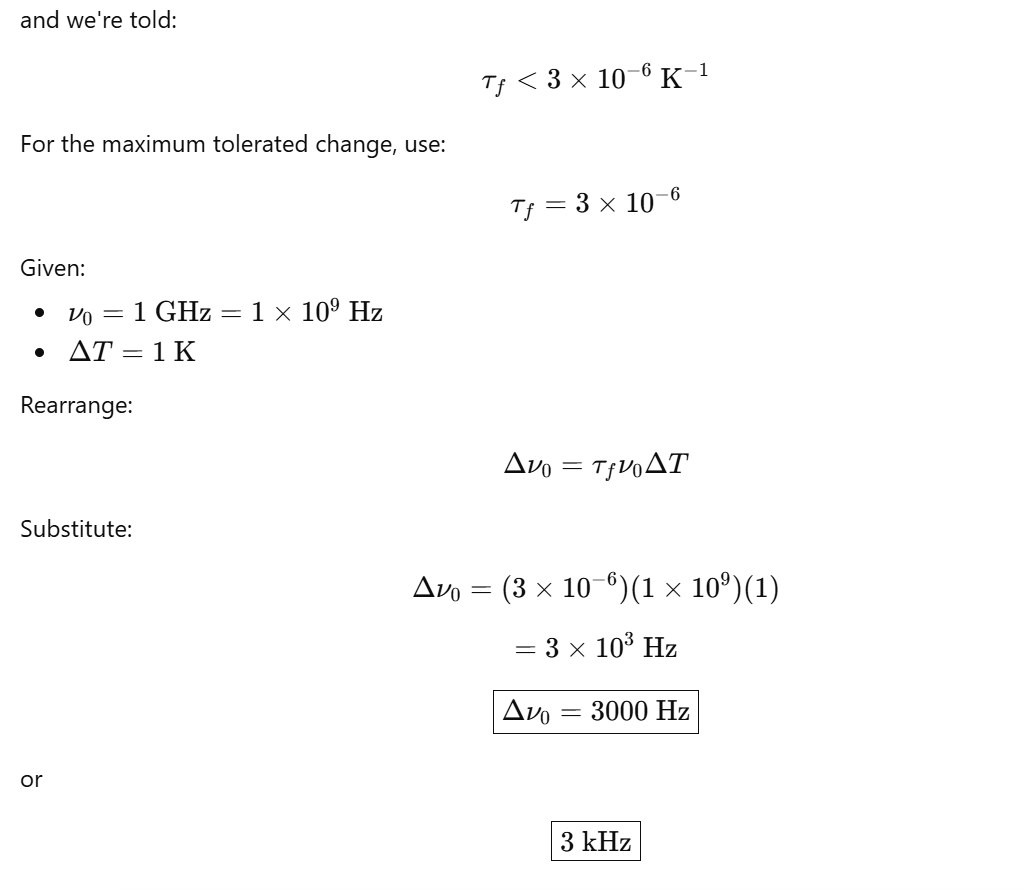
Tf=| (∆V-/V0)/ ∆T | <3×10⁻⁶
For a resonator to be detected at 5G, so V0=1 Ghz, what is the maximum Δv0 that can be tolerated per 1 kelvin
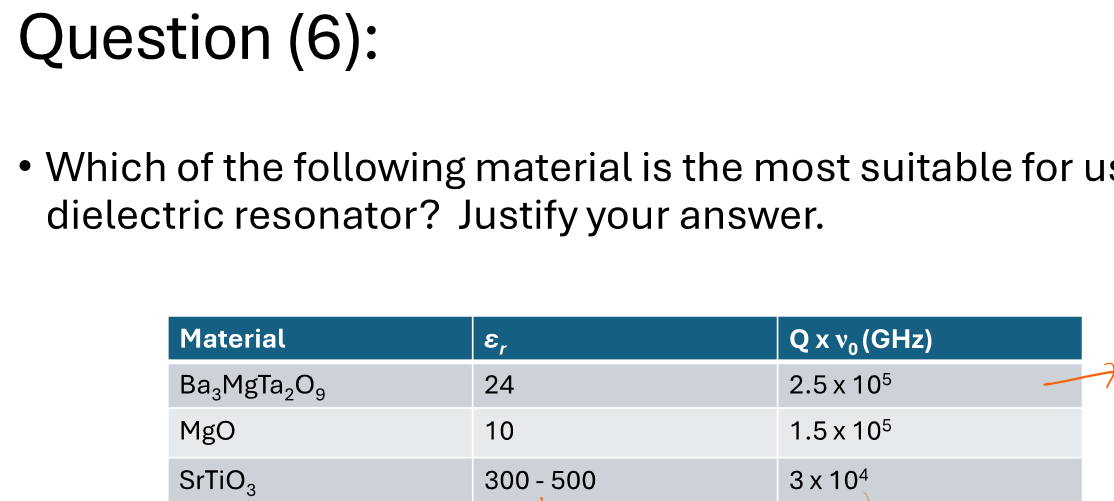
Ba₃MgTa₂O₉ is the most suitable dielectric resonator material because it has a moderate-high dielectric constant, allowing miniaturisation, while also having the highest Qν0Q\nu_0Qν0, meaning low dielectric loss and high frequency selectivity. MgO has lower losses but too low a dielectric constant, while SrTiO₃ has a very high dielectric constant but poor Qν0Q\nu_0Qν0, making it too lossy.
So what are ferrorelectrics and why are they of interest
ferrorelectirc have giant εr. which in theory can make 6G. but it also has high dielectric loss and lack temerpature stability. however they have relevant properties to low frequency AC and DC electric fields
BaTiO3 has anamolousy high εr. using its structure perovskite, can you explain why?
As we heat up the crystal, and cool it, distortion occurs on the edge and soon BaTi is making and breaking the distortion which results in a diff Er. Apply an electric field, Ti, the centre can move even further. between 300-400k tetragonal shape is where most BaTiO3 is used.
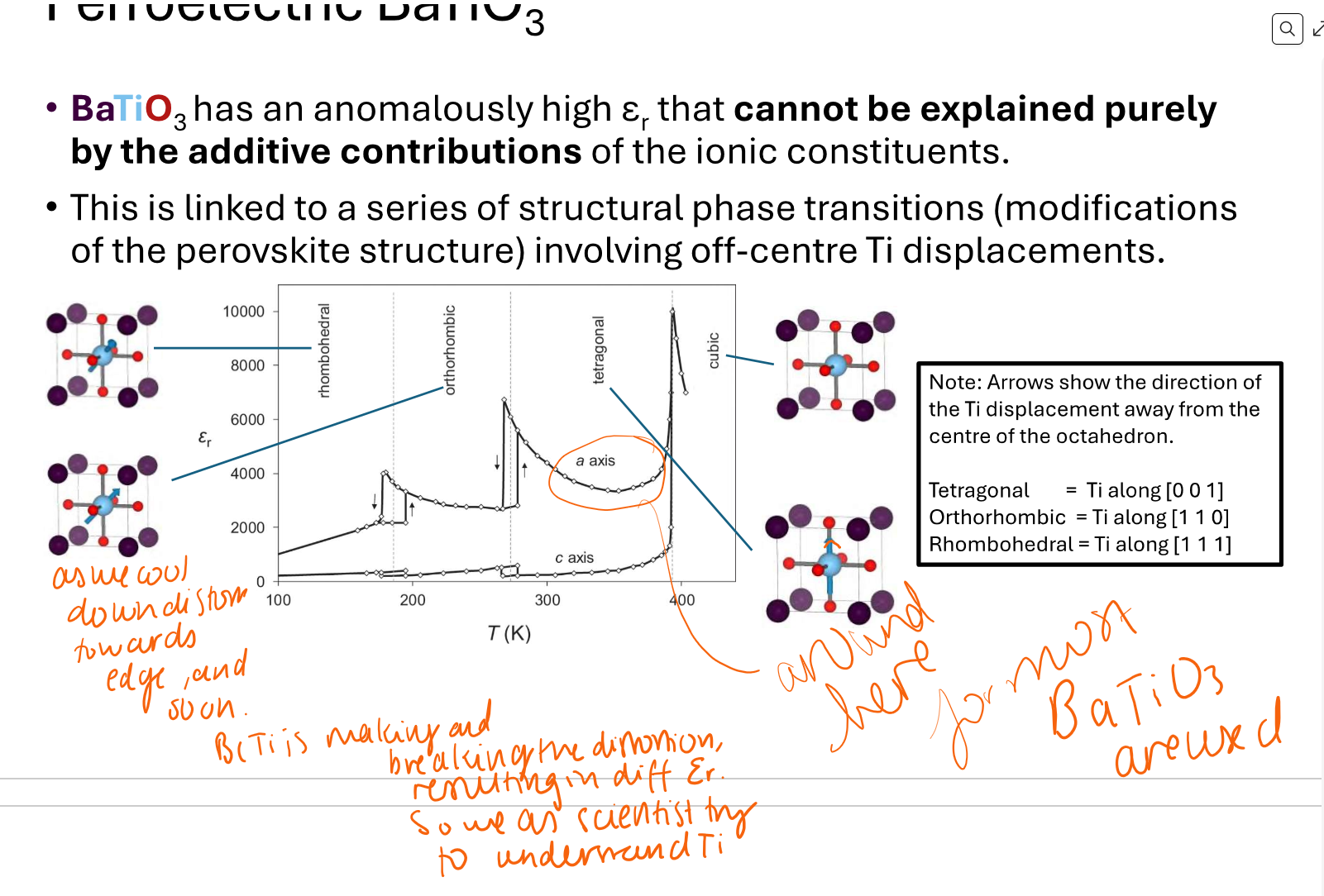
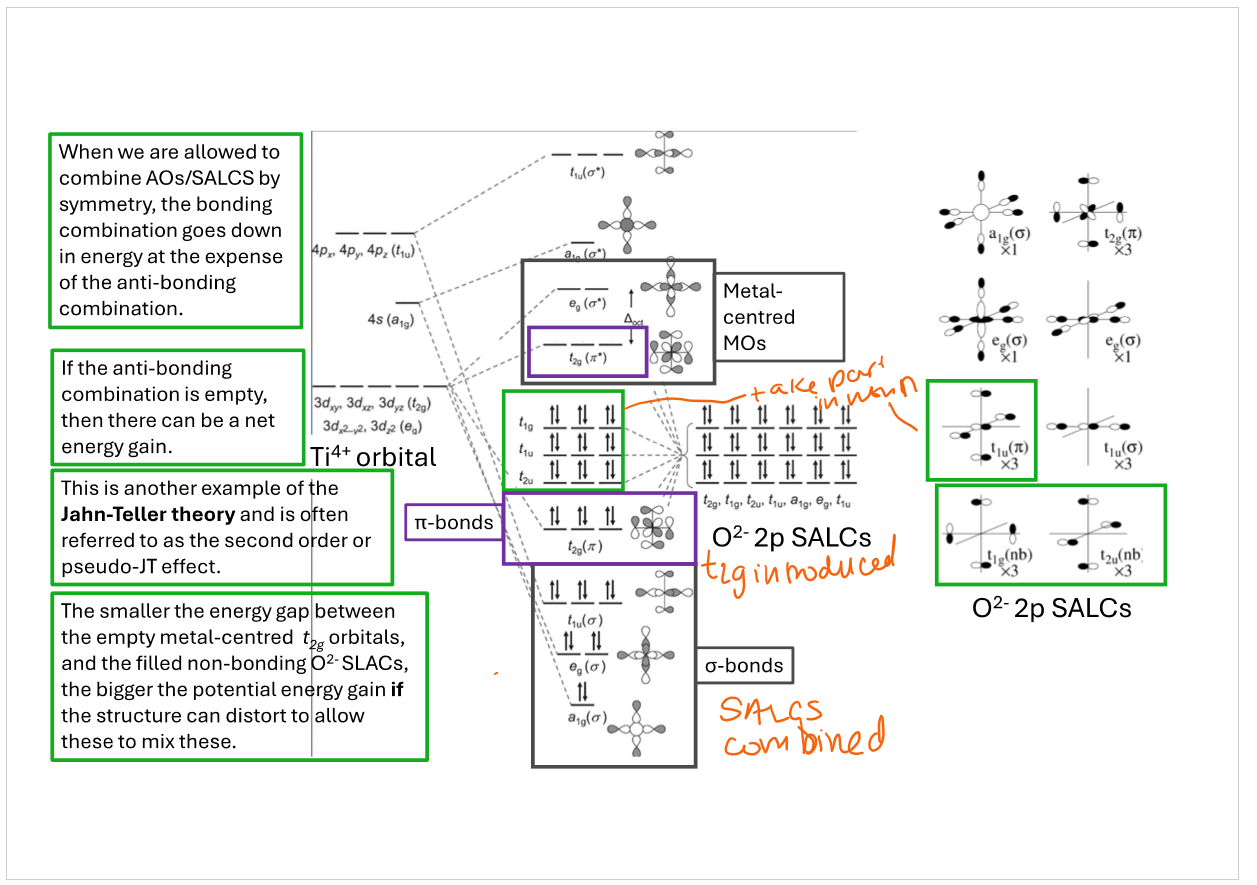
what exactly is this showing
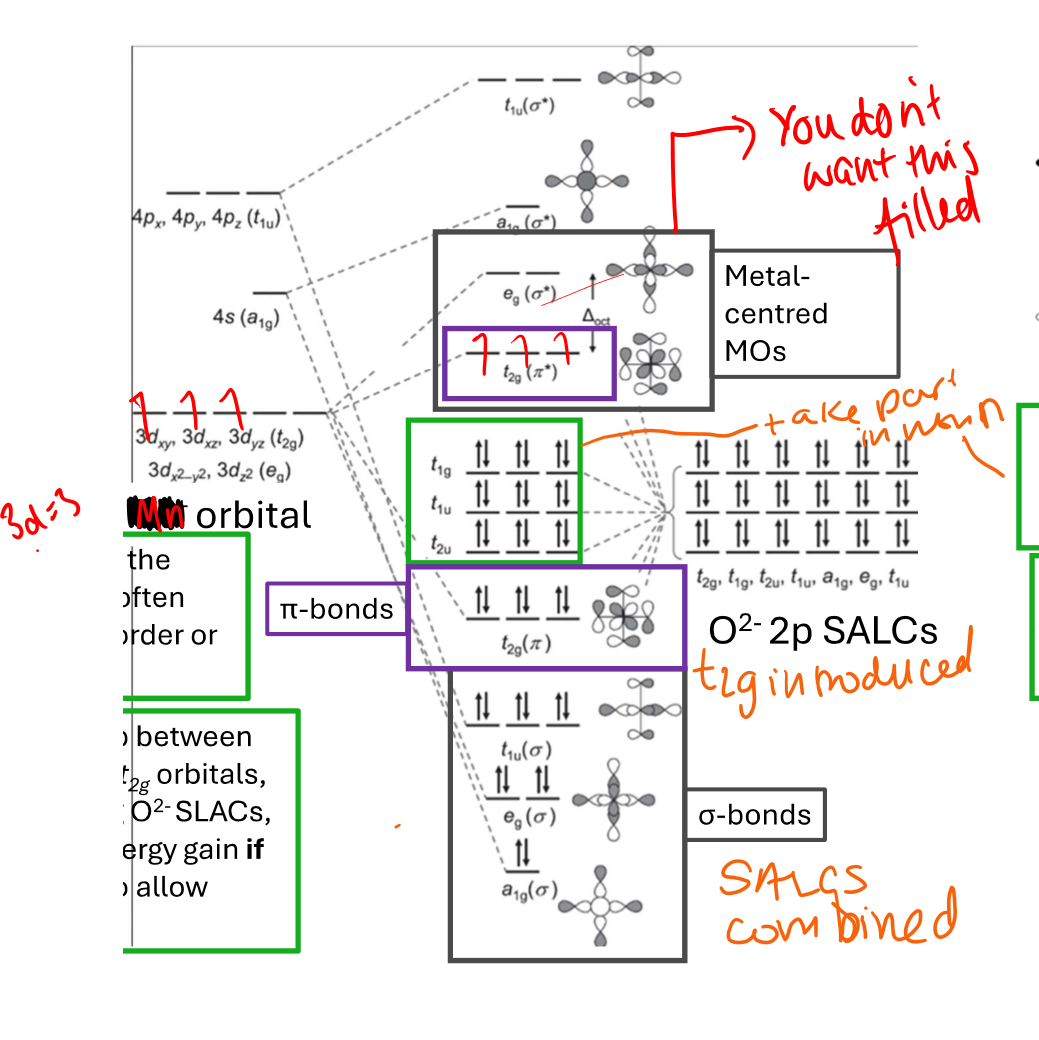
Ti⁴⁺ is d⁰, so its empty t₂g orbitals can mix with filled O²⁻ 2p SALCs. Moving Ti off-centre increases this mixing, lowers the total energy, and therefore the crystal spontaneously distorts. This off-centre Ti displacement creates the large polarization responsible for the huge dielectric constant of BaTiO₃.
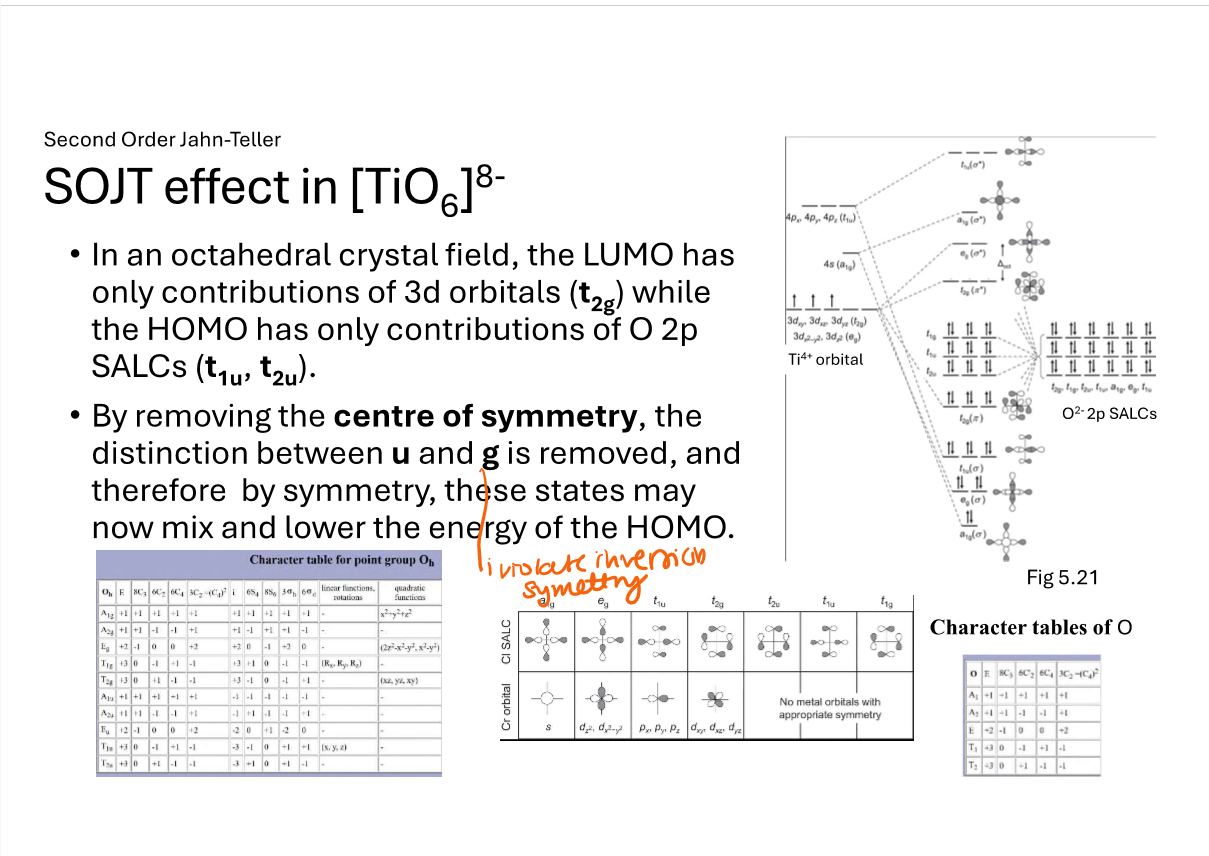
Can you simplify what this is saying
In centrosymmetric [TiO6]⁸⁻, the occupied O 2p SALCs (t1u,t2u and empty Ti t2g orbitals have opposite parity and cannot mix. Off-centre displacement of Ti removes inversion symmetry, allowing these orbitals to mix, lowering the energy of the occupied states and stabilizing the distorted structure. This is the second-order Jahn-Teller (pseudo-Jahn-Teller) effect responsible for ferroelectric distortion in BaTiO₃.
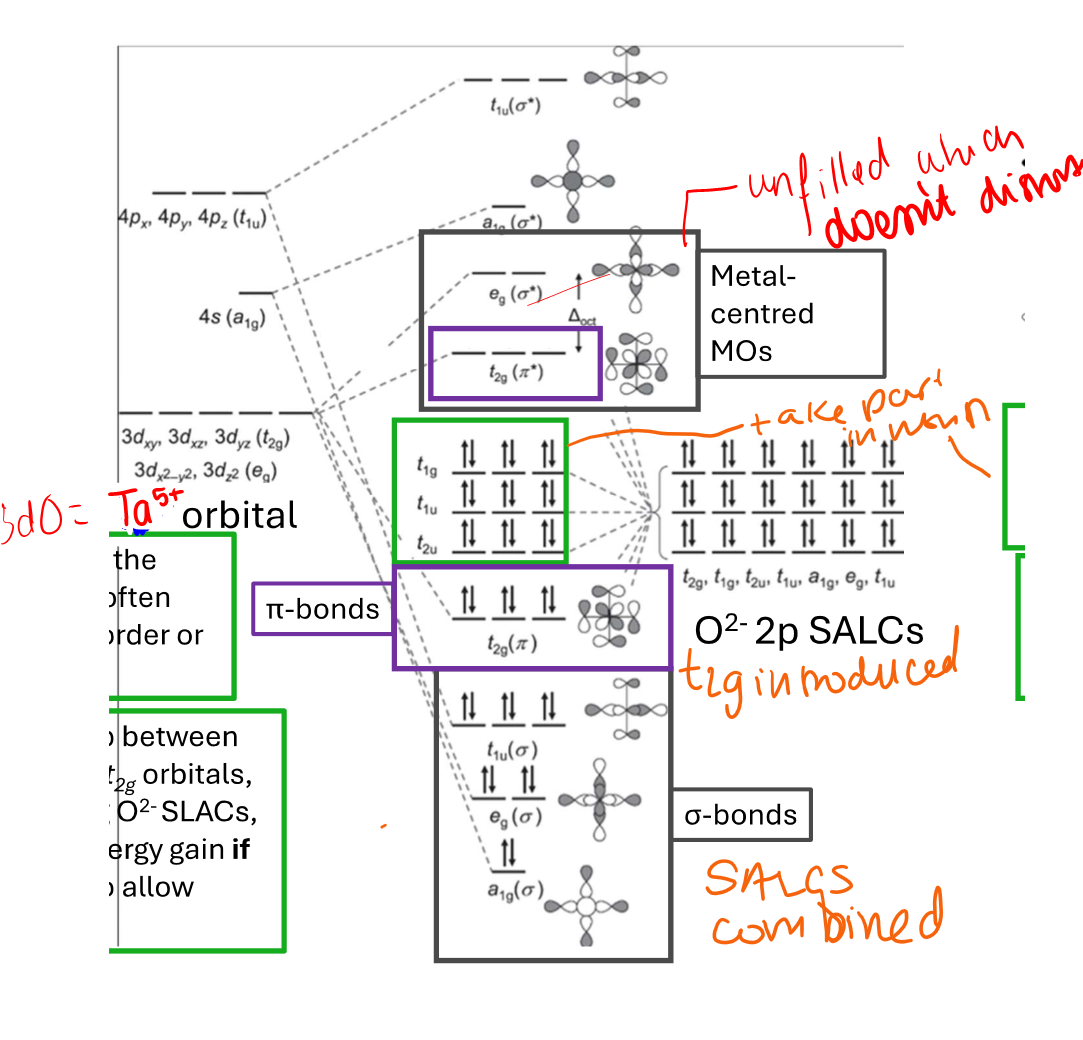
alright. KTaO3, will this have a Second Order Jahn teller effect
So Ta would become +5. Because its group 5, d=0.
look at the image. this basicaly means it will
SrMnO3
Mn is +4, Group 7, so d=3. There is a cancel on bonds so less susceptible to occur. look at image why
NaNbO3
Nb is group 5, has +5, so D=0. so no change per say
YTiO3
Ti is 3+, but in group 4. so 1+. has d=1. so some distortion not favourable as it starts filling t2g
WO₃
W is +6. its in group 6. so d=0. but theres a bit of distortion cuz its not perovskite.
why might not all the materials you predict to have SOJT effect end up having an associated polar structural distortion
Firstly, symettry, if the t2g is filled then it can’t occur. not rly expected to know
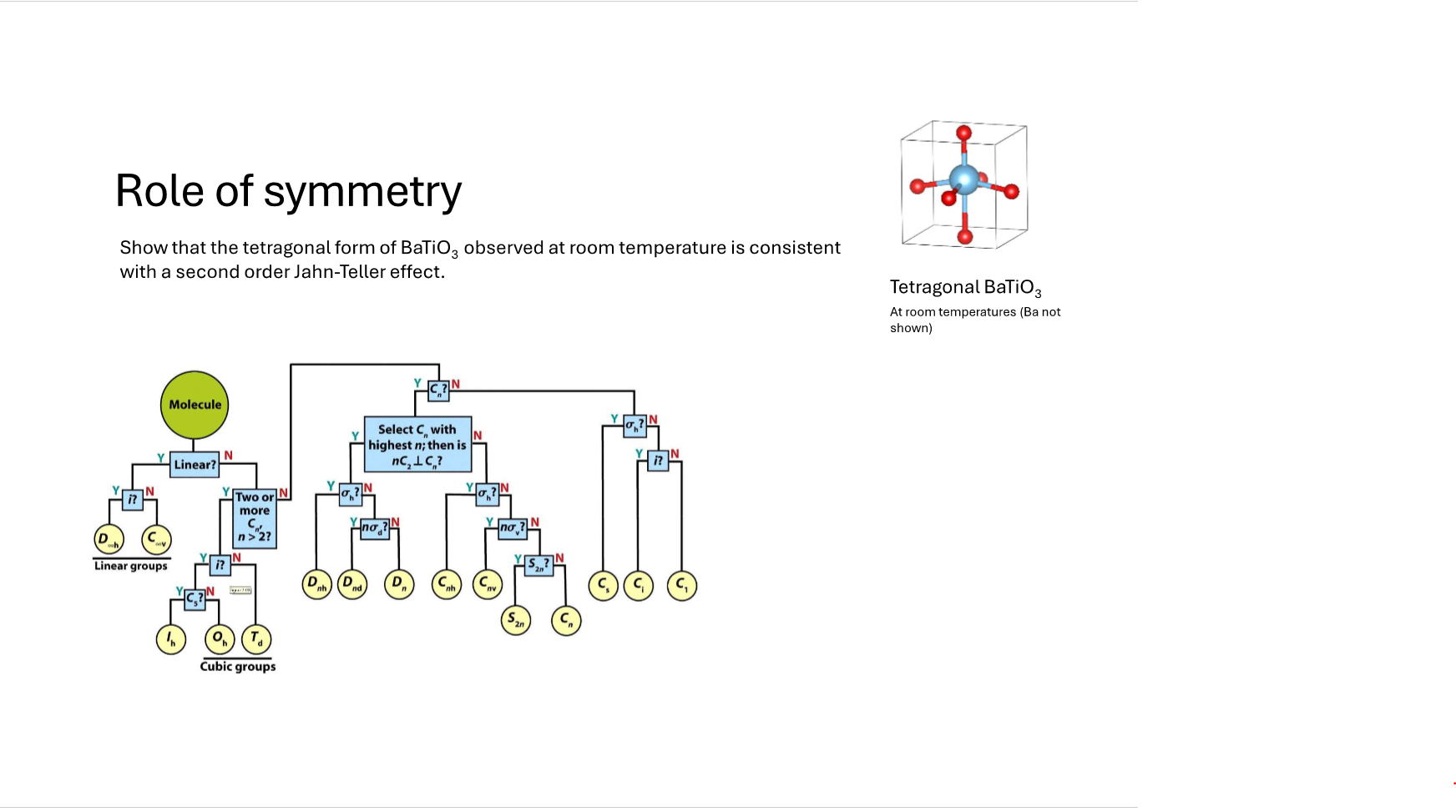
at high temps, originally BaTiO3 adopts an octahedral/cubic structure, but at room temperature, Ti shifts as shown in the picture. It has a C4v symettry. this also means that inversion is not allowed. because of this t2g and u can mix. The O 2p SALCS are allowed to mix with empty Ti d orbitals which lower the energy. the mixing allows energy lowering and makes distorted structure more stable and then a dipole moment gets created , spontaneous polarisation and this makes something ferooelectric.
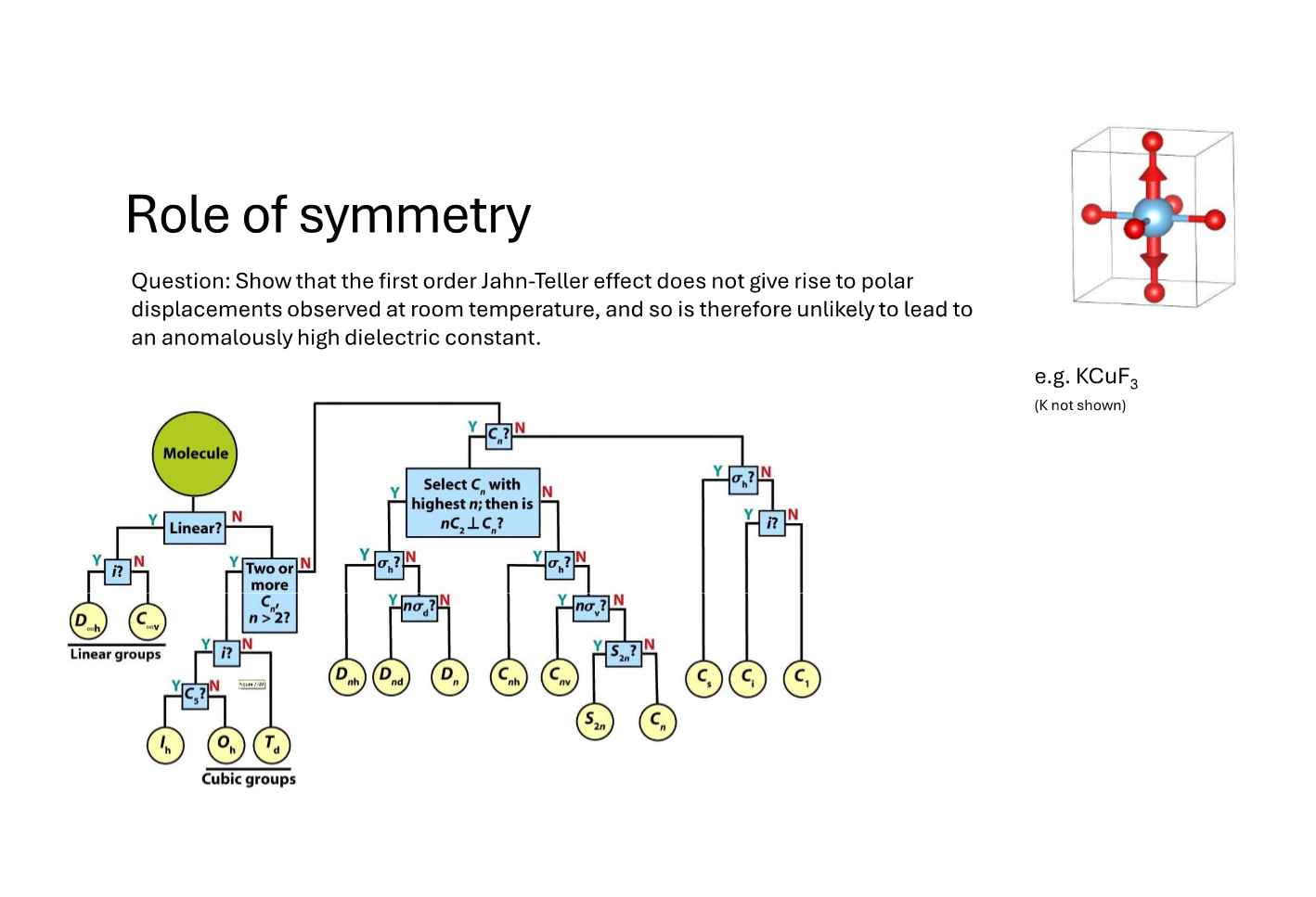
its basically asking "Why can't normal (1st order) Jahn-Teller distortion explain ferroelectricity like BaTiO₃ does
First-order Jahn-Teller distortions remove electronic degeneracy by elongating or compressing bonds but typically retain inversion symmetry (e.g. Oh→D4). Because inversion symmetry remains, no permanent dipole moment is generated and the distortion is non-polar. Therefore first-order Jahn-Teller effects do not usually produce the large spontaneous polarization or anomalously high dielectric constants associated with ferroelectric materials such as BaTiO₃, where a second-order Jahn-Teller distortion removes inversion symmetry and creates a polar structure.
Exam shortcut for identifying sojt or fojt
d⁹ → FOJT
d⁰ /d 10→ SOJT
FOJT → bond length changes
SOJT → metal moves off-centre
FOJT → usually non-polar
SOJT → can be ferroelectric (inversion symettry is usually gone)
non centrosymettric materials, give me an insight of what they are
we have met already ferroelectric.
other technology is piezoelectricity and circular dichroism
In this lecture, there are 3 things or numericals to describe crystals what do they entail
lattice parameters, one of the 7 crystals, one of the 32 crystallographic point symmetries
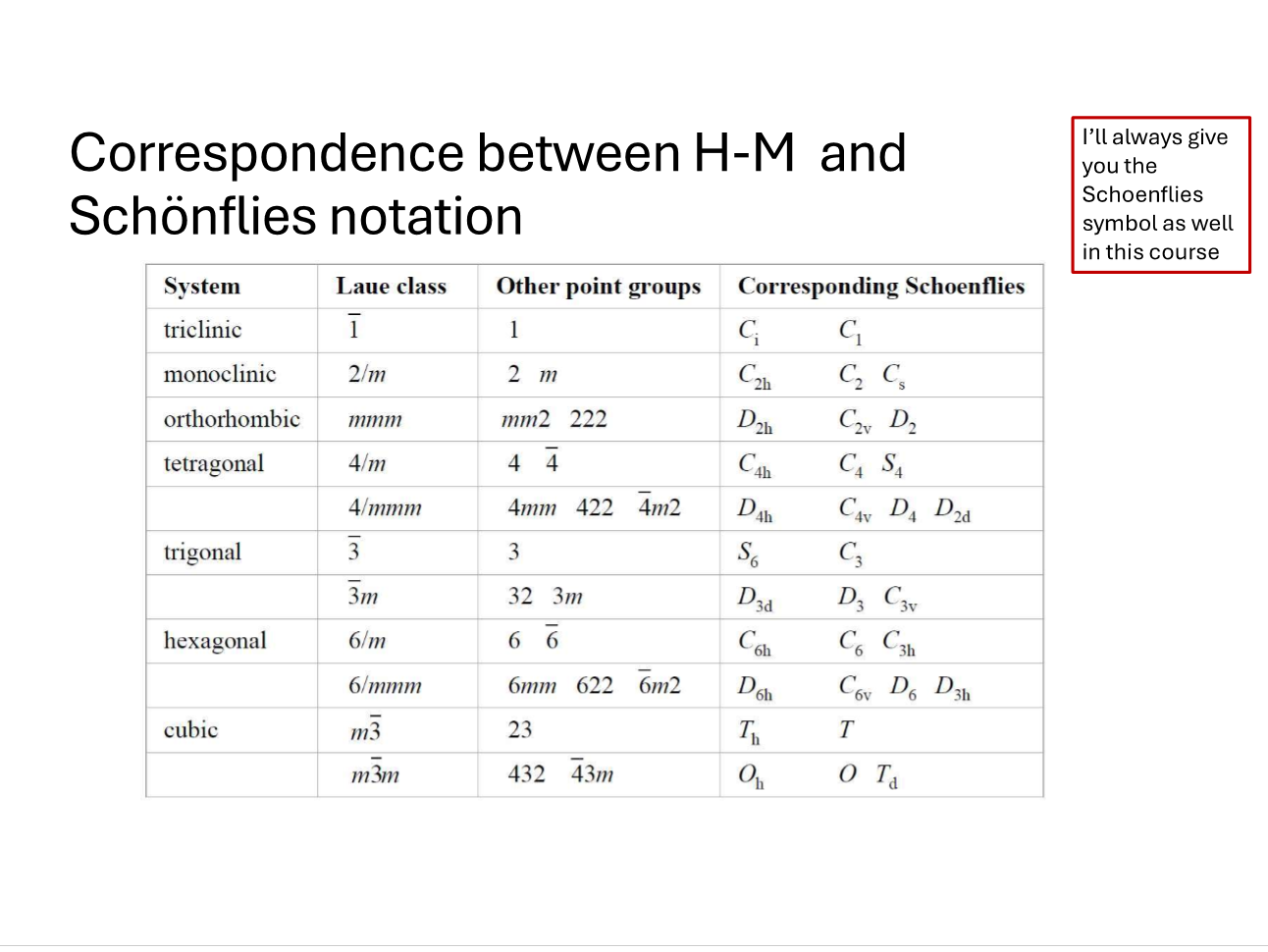
what is the use of the table here.
So if someone was to be like H-M was mmm, you see that that is D2h. then u ask does D2H have inversion symettry. yes it does. so NOT polar. so not ferroelectric. thats kind of the use of this
Main difference between centrosymmetry and non centrosymettric and piezoelectric
centro has inversion symettry. cannot be polar.
non centro doesnt have inversion, can be polar
piezo: apply pressure you get a voltage.
what is neumanns principle
The symmetry elements of a crystal must also be present in its physical properties.
Therefore crystal symmetry determines which properties (e.g. polarization, piezoelectricity, ferroelectricity) are allowed or forbidden.