SPMA 4P96 Mid Term
 View linked note
 Call Kai
 Learn
Learn Practice Test
 Spaced Repetition
 Match
Match Flashcards
 Knowt Play
1/54

There's no tags or description
Looks like no tags are added yet.
Name | Mastery | Learn | Test | Matching | Spaced | Call with Kai | Chat |
|---|
No analytics yet
Send a link to your students to track their progress
55 Terms
Negotiation
The process by which two or more parties attempt to reach an agreement when they perceive a difference in interests or perspective.
Conflict
A situation in which people have competing interests or divergent perspectives.
Ugly Conflicts
Formidable obstacles in negotiation, including mistrust, animosity, complexity, or a history of hostility.
Soft Negotiations
A negotiation strategy that seeks to avoid personal conflict and readily makes concessions to reach an agreement.
Hard Negotiations
A negotiation strategy that treats every situation as a contest with winners and losers, believing that extreme positions and "holding out" will lead to success.
Principled Negotiations
A negotiation approach that focuses on separating people from the problem, focusing on interests rather than positions, generating options, and using objective criteria.
Positional Bargaining
A negotiation approach where each side takes a position, argues for it, and makes concessions, potentially leading to agreements that only "split the difference" rather than meeting the parties' legitimate interests.
Positional Bargaining benefits
Tell the other side what you want.
Provides an anchor in an uncertain and pressured situation.
Can eventually produce the terms of an acceptable agreement
Positional Bargaining drawbacks
The more time that is paid to positions…
The less attention is devoted to meeting the underlying concerns of the parties.
Agreements may simply ‘split the difference’ rather than meet the legitimate interests of the parties.
Problems with positional bargaining
Arguing over positions is inefficient.
Arguing over positions endangers the relationship.
Multiple parties can make positional bargaining even worse.
Soft negotiators are especially vulnerable in positional bargaining.
Successful Negotiations
Negotiations that produce a wise agreement if possible, are efficient, and improve or maintain the relationship between the parties.
Stages of Negotiation
Analysis
Diagnose the situation
Gather information and think about it
Identify your interests and the interests of others
planning
Re-consider 4 things
1.People, 2.Interests, 3.Options, and 4. Criteria.
Anticipate questions you expect from your negotiating partner. How will you respond?
Interests
Needs, desires, concerns, and fears that motivate people in a negotiation.
Communication
The act of exchanging information and ideas between negotiating parties.
Effective Negotiators
Negotiators with personal background characteristics, abilities (cognitive intelligence, emotional intelligence, creativity, cultural intelligence), personality traits, and positive expectations.
22 Negotiation tips
1. Have a strategy meeting
2. Don’t reward people for coming up with the right strategy
3.Assess what happens if there’s “no deal”
4. Negotiate process before substance
5. Normalize the process
6.Think about all the questions you need to ask the other side
7.Ask the right questions
8. Prepare in advance for the toughest questions they may ask you
9. It has been said that whoever makes the first offer loses – should you make the first offer?
10. Never let your offer speak for itself. Always tell the story that goes with it.
11. Label your concessions
12.Avoid mindless haggling
13. Make multiple offers simultaneously
14. Initial reactions matter
15. Understand and respect their constraints
16.What looks like irrationality is usually ignorance or interests you don’t understand
17.Write their victory speech for them
18. Ignore ultimatums
19. Only make ultimatums if…
20.Don’t let negotiations end with“no”
21. Follow phone calls and meetings with an email
22.Always tell the truth
Emotional Regulation
The ability to recognize and understand emotions, make them explicit, and not react to emotional outbursts during negotiation.
Interests Define the Problem
The basic problem in a negotiation lies in the conflict between each side's needs, desires, concerns, and fears, rather than conflicting positions.
Identifying Interests
The process of asking "why not?" and understanding the basic decision that the negotiating partner sees as a barrier to agreement.
Most Powerful Interests
Security
Economic well-being
A sense of belonging
Recognition
Control over one’s life
Sharing Interests
Putting the problem before your answer, discussing where you would like to go rather than where you have come from, and inventing options for mutual gain.
Invent options for mutual gain
Premature judgment
Searching for a single answer
The assumption of the fixed pie
Thinking “solving their problem is their problem”
Before Brainstorming
1. Define your purpose
2. Choose the participants
3. Change the environment
4. Design an informal atmosphere
5. Choose a facilitator
During Brainstorming
1. Seat participants side by side
2. Clarify the ground rules
3. Brainstorm
4. Record the ideas in full view
After Brainstorming
1. Star the most promising ideas
2. Invent improvements for promising ideas
3. Set up a time to evaluate ideas and decide
Circle Chart
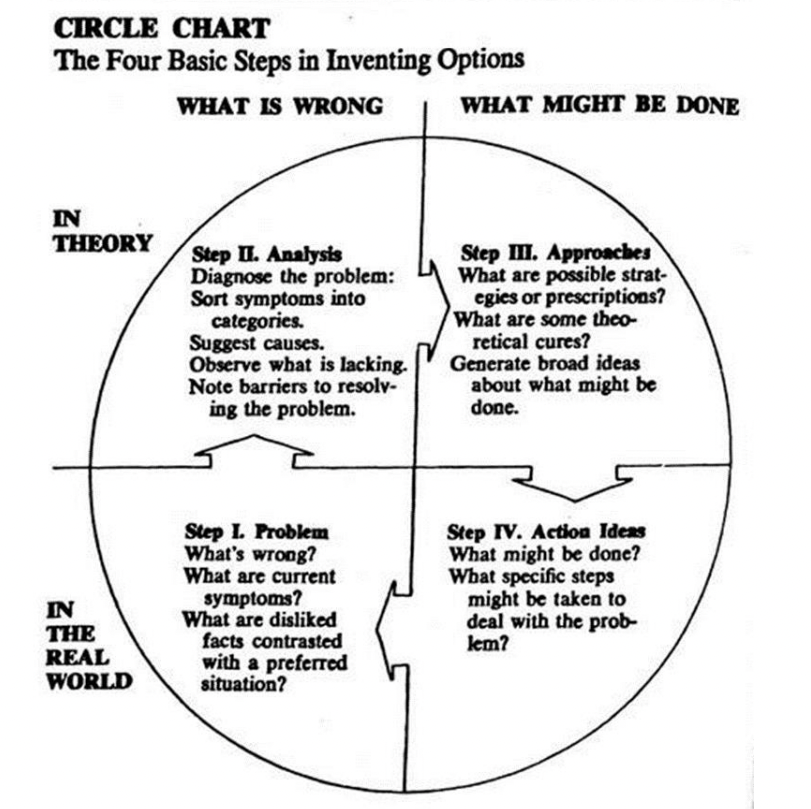
Using Objective Criteria
Insisting on using objective standards, precedents, market value, and other fair standards to guide the negotiation process.
Fair Standards
Market value
Precedent
Scientific judgement
Professional standards
Efficiency
Costs
What a court would decide
Moral standards
Equal treatment
Tradition
Reciprocity
BATNA
Best Alternative To a Negotiated Agreement, which protects against making an agreement you should reject and helps you make the most of your assets in negotiation.
Sources of Power
Coercive power, connection power, reward power, legitimate power, referent power, informational power, and expert power.
Power
Often people think it has to do with resources…
In fact, the relative negotiating power of two parties depends on how attractive to each the option of not reaching agreement is – that’s power.
Developing BATNA
Inventing a list of actions if no agreement is reached, improving promising ideas into practical alternatives, and selecting the best alternative.
Positional Bargaining
If you fall into positional bargaining…
Perhaps a third party can help solve your situation.
Tricky Bargaining
Tactics and tricks used to take advantage of negotiators, such as lies, psychological abuse, pressure tactics, and personal attacks.
Common tricks
Tricky tactics can be divided into three categories:
1. Deliberate deception
2. Psychological warfare
3. Positional pressure tactics
Deliberate deception
Phony facts
Making a knowingly false statement
Ambiguous Authority
After you’ve been pressed as hard as they can and you have worked out what you believe to be a firm agreement, they announce that they must take it to someone else for approval
Psychological warfare
Stressful Situations
E.g., meeting location…should you meet at their place or yours?
Personal Attacks
Verbal/nonverbal communication to make you uncomfortable
Positional pressure tactics
Good guy bad guy routine
Negotiate the Rules of the Game
Recognizing and addressing dirty tricks used by the other side, questioning their legitimacy, and negotiating over them.
Threats
Pressure tactics that often make decision-making more difficult for the other side.
Extreme Demands
Undermines credibility and may kill a deal if perceived as unreasonable.
Lock-In Tactics
Refusal to withdraw troops or take action to create leverage.
Calculated Delay
Postponing negotiations until a favorable date.
Refusal to Negotiate
Using the threat of legal action as a bargaining chip.
Interpersonal Issue
Dealing with shifting dynamics and surprises when negotiating with another party.
Building Rapport
Slowly establishing trust through friendly conversation.
Cultivating Healthy Skepticism
Maintaining some degree of skepticism about the motives and claims of a negotiating partner.
Protecting Yourself
Researching your negotiating partner, reaching out to your network, and negotiating safeguards into contracts.
Framing Losses and Gains
Highlighting potential losses the other side may suffer rather than focusing on benefits.
Token Concessions
Giving a small gift or making easy concessions to activate the norm of reciprocity.
Capitalizing on Social Proofs
Highlighting the popularity of a given option or enlisting peers for support.
Anchoring Trap
Giving disproportionate weight to the first information received, which influences subsequent thoughts and judgments.
Framing Trap
Distorting decision-making through different frames, such as gains versus losses or different reference points.
Overconfidence Trap
Setting too narrow a range of possibilities due to overconfidence in predictions.
Recallability Trap
Basing predictions on memory of past events, leading to being overly influenced by dramatic events.