Final Exam 1-Anatomy
 Call Kai
 Learn
Learn Practice Test
 Spaced Repetition
 Match
Match Flashcards
 Knowt Play
1/64

There's no tags or description
Looks like no tags are added yet.
Name | Mastery | Learn | Test | Matching | Spaced | Call with Kai |
|---|
No analytics yet
Send a link to your students to track their progress
65 Terms
Which of the following types of bonds between atoms results from sharing electrons
Covalent
Which one of the following statements CORRECTLY describes the relationship between an atom and an element
An atom is the smallest unit of an element that demonstrates all of the properties of that element.
A crazy professor has ripped apart an atom and collected all the subatomic particles located within the nucleus. What has she collected
Protons and Neutrons
Which if the following is true regarding water
Each molecule of water consists of two atoms of hydrogen and one atom of oxygen covalently bonded
Define pH
Greater the concentration of hydrogen, the more acidic the solution, the lower the pH
Greater the concentration of hydroxyl (OH-), the more basic the solution, higher the pH
Neutralization- occurs when acid and base are mixed together.
A buffer solution resists significant changes in pH upon the addition of small amounts of acid or base
True
Phospholipids are important in the structure of:
cell membrane
The main fuel used in the metabolic pathways of the body is
Glucose
Which of the following is NOT a function of a protein
Stores Genetic Material
Hemoglobin is example of which protein structure?
Quaternary
Which of the following nitrogen-containing bases is found in DNA but not in RNA
Thymine
Which of the following structures is characteristic of both eukaryotic and prokaryotic cells
Cell membrane
The organelle that is Power house of the cell and cellular respiration
Mitochondria
For packaging and modification
Golgi
For break down of cellular material
lysosome
Protein synthesis
Ribosome
Stores genetic material of the cell
Nucleus
Which of the following organelles is responsible for the production of cellular energy
Mitochondrion
Which of the following forms of transport across a membrane is passive
Diffusion
A student is designing an experiment to show the effects of the movement of water across a selectively permeable membrane. She places a highly concentrated saltwater solution into a bag that is permeable only to water. She then submerges the bag into a beaker of pure water. Which of the following can be expected
The net flow of water will be from the beaker to the bag, causing the contents of the bag to increase in volume
If you are using a 4x objective and the ocular lenses are 10x, what is the total magnification of the object you are viewing and what is the name of 4x objective?
40X, scanning
What is the following microscopic cell? Name the type of tissue. (Be specific)
Cheek cells, Stratified squamous epithelial tissue
On the microscopes that we used in our laboratory, what typically happens to the viewpoint when you view the letter “e” under 4x objective?
upside down and inverte
Groups of similar cells that share a common function are:
Tissues
______________________ tissue is the type of tissue that stores fat
Adipose
Skin is a type of which tissue?
Epithelial
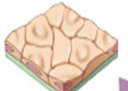
Give the complete name of the tissue shown below, what is the function and provide an example of where is this tissue found.
Simple squamous tissue which is found in the air sacs, and blood vessels of lungs. This tissue is used to secrete gases and absorb nutrients.
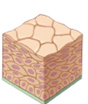
Give the complete name of the tissue shown below, what is the function and where is this tissue found.
Stratified squamous, outer layer of skin and mouth

Give the complete name of the tissue shown below, what is the function and where is this tissue found.
Simple columnar, GI
Which one of the following types of junctions in an epithelium allows the tissue to stretch and bend, as in the epithelium of the skin
Adhesion junction
The plane that divides teh body into left and right sections
Midsagittal
Located below another structure
Inferior
Farther away from a point of reference
Distal
Cartilage is generally avascular (lacks blood vessels) and aneural (lacks nerves
True
Which of the following is NOT a component of a negative feedback system
Amplification of the original charge
The central nervous system is composed of which of the following
brain and spinal
Control of smooth muscle and internal organs is the role of the _____ division of the nervous system
autonomic
What cell type in the CNS protects neurons from metabolic overactivity
astrocyte
Which of the following supporting cells (also known as glia) produce the protein myelin
Oligodendrocytes and Schawnn cells
During which one of the following phases of an action potential do the sodium channels close and potassium channels open, releasing potassium from the neuron
Repolarization
Which part of the neuron contains the organelles and nucleus
cell body
A neuron at rest has a charge difference across its cell membrane, with the interior of the cell negative relative to the exterior. This difference in charge across the plasma membrane is referred to as ________ potential.
resting
During which one of the following phases of an action potential do the sodium channels open and potassium channels closes, releasing sodium ions inside the cell?
depolarization
potassium channels within the membrane are open
C
voltage threshold for membrane
A
the membrane has repolarized
D
the membrane is depolarized
B
Which of the following happens during repolarization of a neuron
Sodium channels close, and potassium rushes out of the cell to temporarily reestablish the membrane potential
Which of the following establishes and maintains the resting potential?
Sodium-potassium pump
The arrival of an action potential at an axon terminal ultimately result in the release of Neurotransmitters into the synaptic cleft
True
Given a particular neuron, an action potential either occurs or does not occur, depending on the strength of the stimulus; therefore, the action potential is described as all or none.
True
Because the central nervous system is so important to the proper functioning of the body, the brain is protected by the skull and the spinal cord is protected by the vertebrae.
True
Axon branch into axon terminals, which have _____located at the terminal ends.
bulbs
The brainstem comprises the midbrain, pons, and medulla oblongata, forming a crucial link between the brain and the body
True
The occipital lobe processes what your eyes see
True
Olfactory receptors are located in which one of the following?
Upper part of the nasal passages
Which one of the following parts of the eye is continuous with the cornea and forms the outer surface of the back of the eye?
Sclera
The transparent covering of the front of the eye is the
Cornea
The “blind spot” is associated with which one of the following
optic disk
Color blindness usually results from a decrease in the number of
cones
As humans age, their ability to focus on nearby objects deteriorates. This is the result of
Stiffening of the lens and loss of accommodation capability
Different-pitched (high- or low-toned) sounds are discriminated by the
hair cells in specific regions of the cochlea
The malleus and incus function to
amplify sound
What are the key components of the organ of Corti?
Hair cells and Tectorial membrane