A&P II Chp. 23 - External Respiration, Internal Respiration, Gas Exchanges, & Transport of O2, CO2
 Call Kai
 Learn
Learn Practice Test
 Spaced Repetition
 Match
Match Flashcards
 Knowt Play
1/55

There's no tags or description
Looks like no tags are added yet.
Name | Mastery | Learn | Test | Matching | Spaced | Call with Kai |
|---|
No analytics yet
Send a link to your students to track their progress
56 Terms
external respiration
diffusion of oxygen from air in the alveoli of the lungs to blood in pulmonary capillaries and diffusion of carbon dioxide in the opposite direction
pulmonary gas exchange
external respiration is also called _______ _______ _________
deoxygenated, oxygenated
external respiration converts __________ blood coming from the right side of the heart into __________ blood that returns to the left side of the heart
perfusion
movement of blood into your lungs
cardiac output, ventilation
in order to have homeostasis, there should be a balance with your _______ _______ and ___________
Dalton's law
according to ________ _______, each gas in a mixture of gasses exerts its own pressure from an area where the pressure is high to where the pressure is low
partial pressure (Px)
the pressure of a specific gas in a mixture
percentage, total, 159 (mmHg)
partial pressure exerted by a gas = _______ of the gas in the mixture x the _________ pressure of the mixture
solve ex: 21% of nitrogen in the atmosphere
159 (mmHg)
the partial pressure of oxygen P(O2) in the atmosphere
0.3 (mmHg)
the partial pressure of carbon dioxide P(CO2) in the atmosphere
atmosphere
the place with the lowest CO2
105
oxygen diffuses from the alveolar air, where the PO2 is _______ mmHg
40 (mmHg)
the PCO2 in the alveolar air
100 (mmHg)
the P(O2) in the pulmonary VEINS
100 (mmHg)
the PO2 of oxygenated blood
40 (mmHg)
the PCO2 of oxygenated blood
45 (mmHg)
the PCO2 of deoxygenated blood
40 (mmHg)
the PO2 of deoxygenated blood
internal respiration
the exchange of O2 & CO2 between systemic capillaries and tissue cells is called ______ _______
systemic gas exchange
internal respiration is called _______ ________ _______
ATP
the PO2 of blood pumped into the systemic capillaries is higher than the PO2 in tissue cells because the cells constantly use the oxygen for making _____
40 (mmHg)
the PO2 in systemic tissue cells
45 (mmHg)
the PCO2 in systemic tissue cells
carbon dioxide
since ATP is being constantly made in the systemic tissue cells, _______ _______ is also constantly produced
atmosphere, lungs
pulmonary ventilation is used between _______ & _______
lungs, blood
external respiration/pulmonary gas exchange is used between _______ & _______
blood, cells
internal respiration/systemic gas exchange is used between ________ & ________
residual volume (RV)
quantity of air left in the lungs after maximum exhalation, air that prevents lungs from collapsing
1200 mL
average residual volume for males
cells (has 45 mmHg)
the place with the highest CO2
thickness, surface area, concentration
factors that affects the diffusion rate of gases
- ___________ of respiratory membrane
- _________ ________
- __________ of gases
internal respiration
the transport & use of O2 and the generation & transport of CO2 occurs during _________ _______
hemoglobin (Hgbo2/HbO2)
98.5% of oxygen is in ______________ in RBC
1.5
about ______% of inhaled oxygen is dissolved in blood plasmaand diffuse out of tissue capillaries into tissue cells
98.5
about _____% of blood O2 is bound to hemoglobin in RBC
4
the heme portion of hemoglobin contains _____ atoms of iron, each capable of binding to a molecule of O2
oxyhemoglobin (HgbO2 = Hb/reduced hemoglobin + O2/oxygen)
oxygen and hemoglobin bind in an easily reversible action to form ________
7%
percentage of dissolved carbon dioxide in plasma
carbaminohemoglobin
CO2 that's being carried in the hemoglobin
23%
percentage of CO2 that binds to hemoglobin to form carbaminohemoglobin
bicarbonate ion
the greatest percentage of CO2 that's carried in plasma is in the form of __________ ______
The most important buffer in human blood
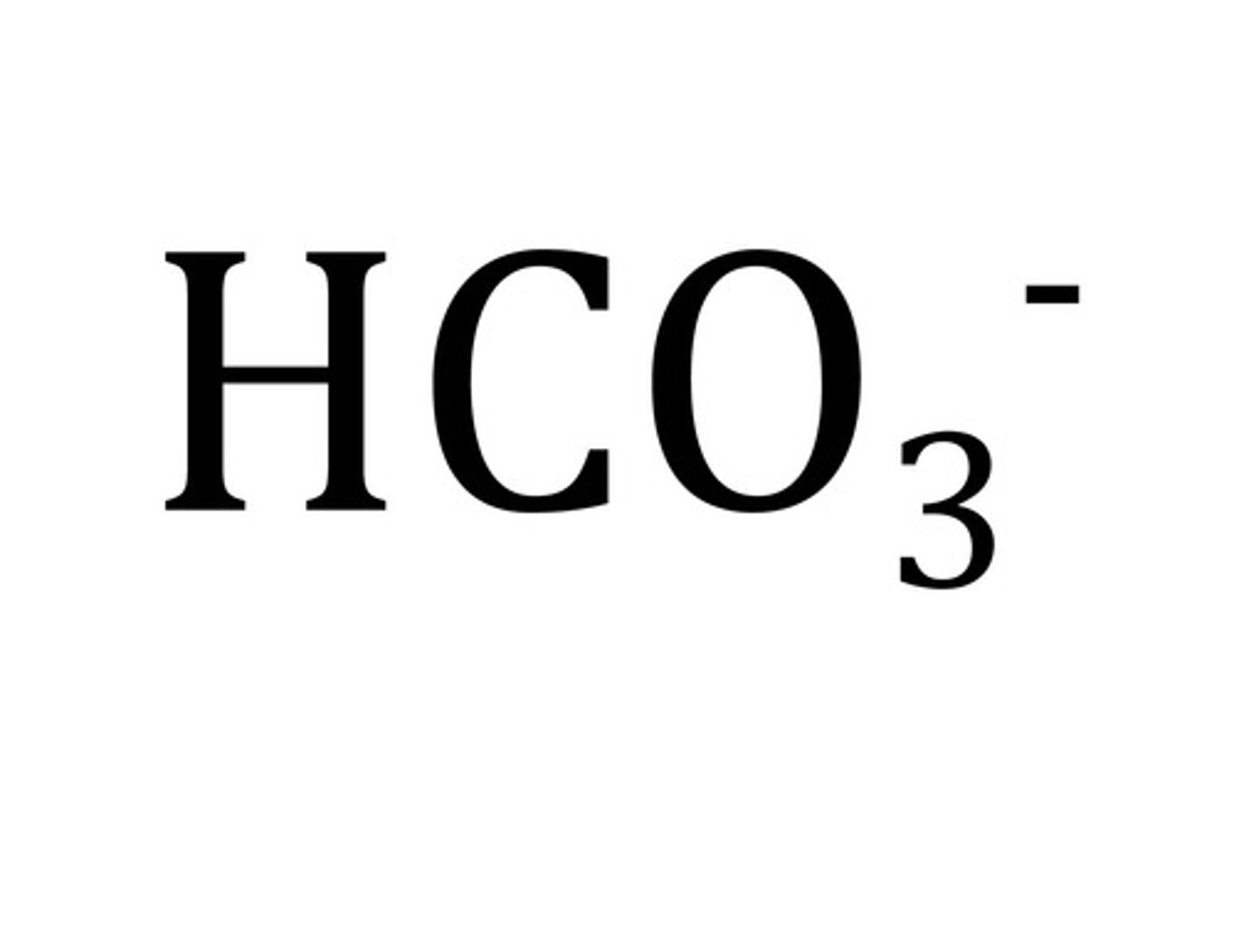
70%
percentage of bicarbonate ions transported in plasma
cell
turning CO2 to bicarbonate
1st: it starts where the CO2 is being made which is at the tissue _______, where there's high concentration of it
interstitial fluid, systemic capillaries, RBC
turning CO2 to bicarbonate
2nd: since there's a high concentration of CO2 in your cells, it diffuses out to the _________ ______, into the _________ ________, then to the ______
carbonic anhydrase
turning CO2 to bicarbonate
3rd: once the CO2 diffuses into the RBC, it's binded to water by an enzyme called _______ _______
carbonic acid
turning CO2 to bicarbonate
4th: once the CO2 & H2O are binded, it becomes H2CO3/ _________ _______
bicarbonate, H+
turning CO2 to bicarbonate
5th: carbonic acid is unstable and separates into _________ and ________
bicarbonate
turning CO2 to bicarbonate
6a: the _________ (after being separated from carbonic acid) diffuses out of the RBC into the plasma (and becomes a weak base making it a great buffer for the blood)
H+, reduced hemoglobin
turning CO2 to bicarbonate
6b: the _________ (after being separated from carbonic acid) is the strong acid, it binds with a hemoglobin molecule and becomes Hgb++ or ______ _______. This acts as a buffer system for the RBC
RBC
turning bicarbonate back to CO2
1st: it starts off at the lungs/alveoli, the bicarbonate is floating in your plasma, by diffusion it goes back to the ________
hemoglobin, H2CO3
turning bicarbonate back to CO2
2nd: once in the RBC it binds with a ___________ and it becomes carbonic acid/_________ (chem formula)
carbonic anhydrase
turning bicarbonate back to CO2
3rd: once the carbonic acid is formed, it's separated by ________ ________
H2O, CO2
turning bicarbonate back to CO2
4th: carbonic anhydrase separates the carbonic acid into _________ and _________
alveoli, 0.3
turning bicarbonate back to CO2
5th: the CO2 diffuses out of the RBC into the plasma, diffuse into the _______ and exhale it out to the atmosphere, which has the pCO2 of ______ mmHg
ventilation
_______ moves gases in and out of the lungs
gas exchange
the movement of gases into and out of the blood