PSYCH EXAM: 3/3
 Call Kai
 Learn
Learn Practice Test
 Spaced Repetition
 Match
Match Flashcards
 Knowt Play
1/181

There's no tags or description
Looks like no tags are added yet.
Name | Mastery | Learn | Test | Matching | Spaced | Call with Kai |
|---|
No analytics yet
Send a link to your students to track their progress
182 Terms
Personality
The characteristic thoughts, emotional responses, and behaviours that are RELATIVELY STABLE in an individual over time and across circumstances
There are numerous ways of ____________ and ______________ personality.
1. CONCEPTUALIZING
2. OPERATIONALIZING
Ways to Assess Personality
idiographic
Nomothetic
Idiographic Approaches
Person-centred, focus on individual lives
e.g., narrative approach; humanistic perspective
PERSONALIZED APPROACH
Nomothetic Approaches:
COMMON traits, unique combinations
1. projective measures
2. objective measures
Projective measures
having someone tell an ambiguous story about an image or story → e.g. Rorschach inkblot, TAT
- idea is that person is going to PROJECT their own personality, desires, goals onto story/image
Obejctive measures
fill out the survey → e.g. self-reports, informant ratings (getting someone who knows you well to fill out the survey about you as well)
- FLAWS: people might lie, be ignorant or have a different idealized version of themselves
- They have systems to try and ensure more accuracy (e.g information ratings)
Projective Measure Example: The Rorschach Inkblot Test
Poor psychometric properties → shows a lot more people than it should as being psychologically disturbed

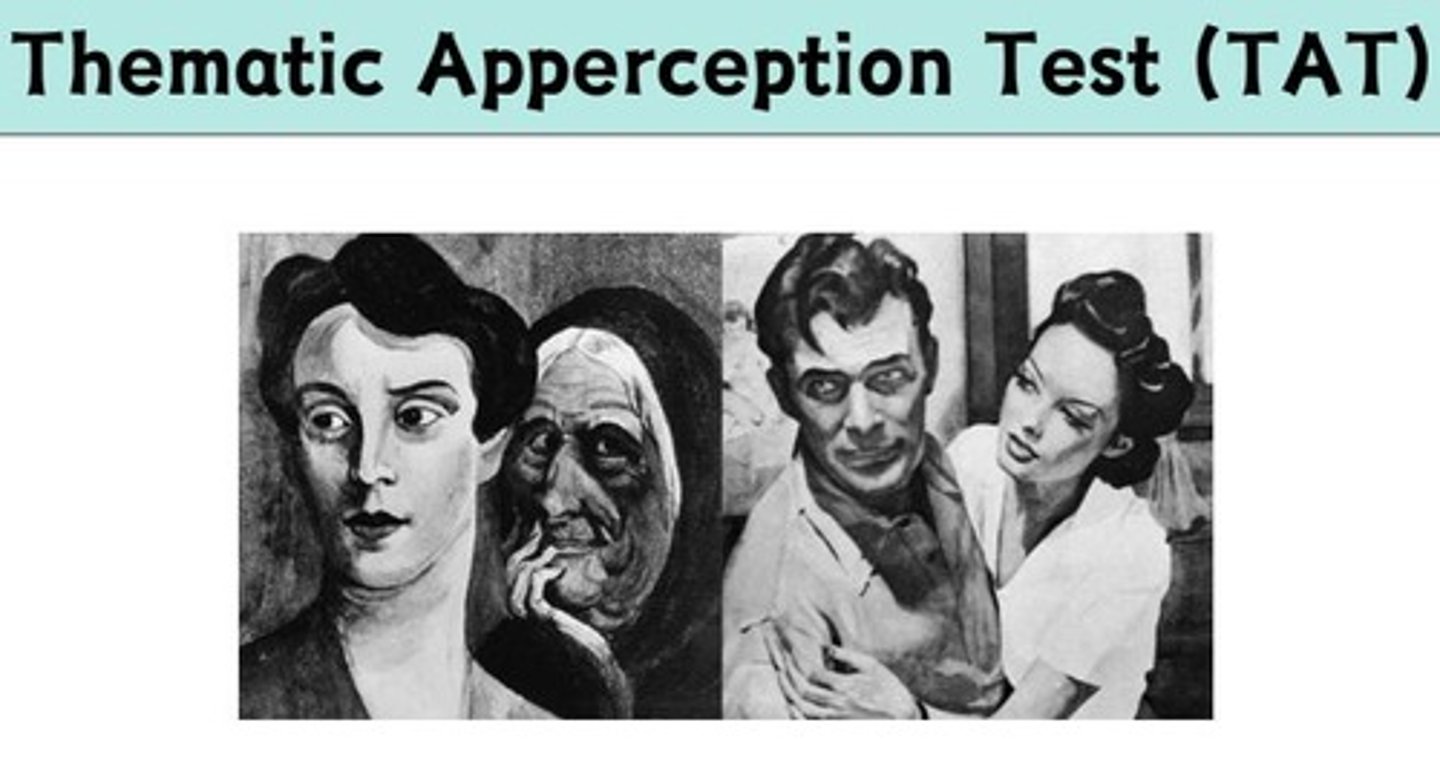
Projective Measure Example: The Thematic Apperception Test (TAT)
Participants are asked to: Write a story and imaginative story about this image
- Claims to study participant's need for: ACHIEVEMENT, POWER, AFFILIATION
- Not shown to be super accurate or consistent
Perspectives on Personality: Historical & Contemporary Approaches
1. Psychodynamic → Freudian, Neo-Freudian
2. Humanistic → Maslow and Rogers
3. Social-Cognitive → Bandura, Mischel
4. Trait Approaches → e.g. "the Big Five"
Psychodynamic and Humanistic Similarities
- Very difficult to test scientifically
- More interested in finding the way in which personality developments (not really the specific characteristics that people have)
Freud’s Psychodynamic Theory
3 sections of mind = unconscious, preconscious, conscious
3 PRINCIPLES OF MIND = ID, SUPEREGO, EGO
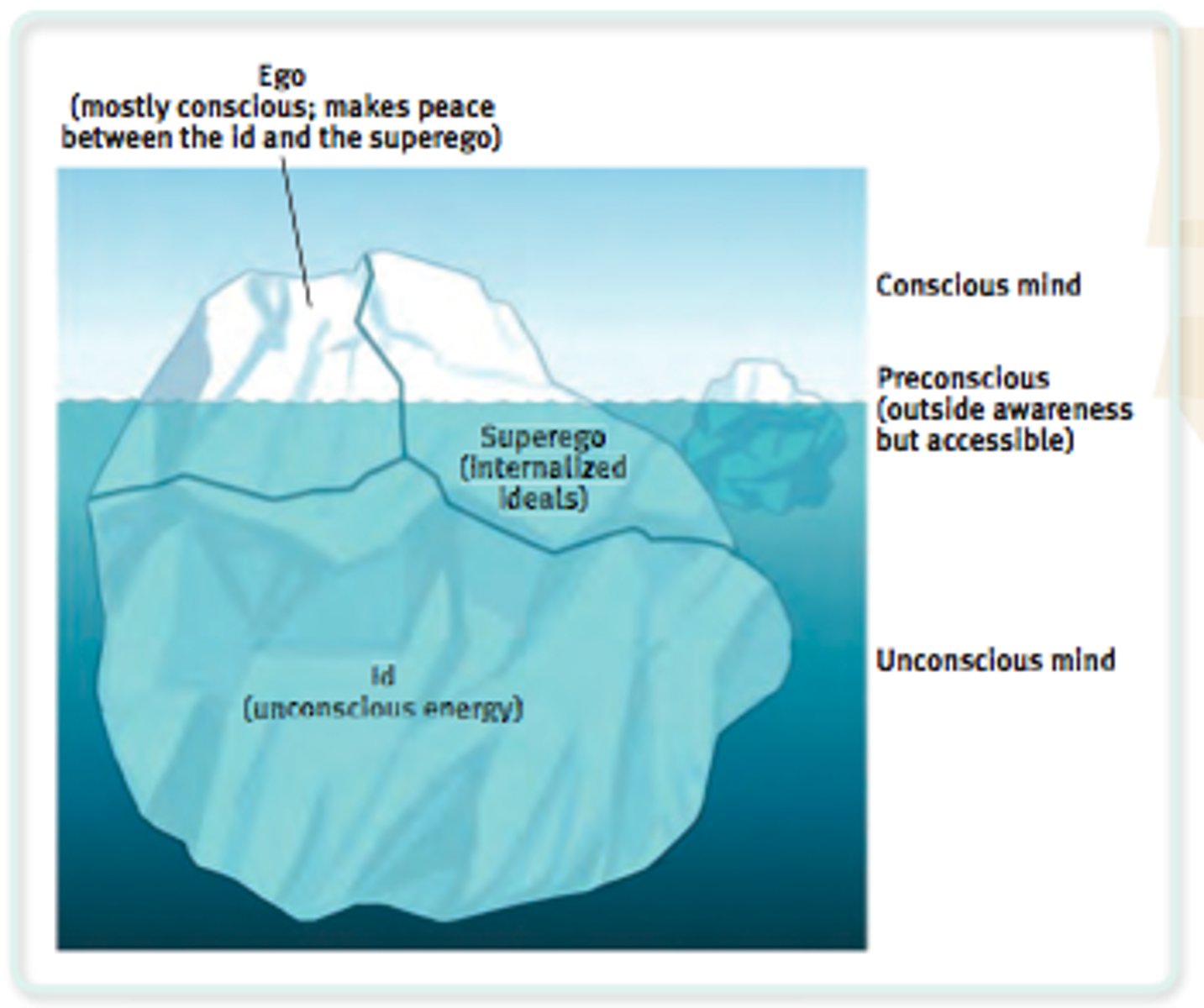
conscious mind
present awareness
Unconscious mind
NOT ACCESSIBLE
a large majority of our personality is in our unconscious mind → id
Preconscious
outside of current awareness, but is accessible (where our long-term memory is with memories we can retrieve) → ego and superego
Id
very selfish impulses → very instinctual, biological actions
- self-gratification, hedonistic
PLEASURE principle → E.g. babies are only focused on what they need
Superego
- internalized ideals
- angel on ur shoulder
MORAL Principle: rules of society, clear right and wrong
Ego
executive mediator → meditates between the superego and the id
REALITY principle
In a healthy person, the ego is the STRONGEST PART of the self (according to Freud)
- BALANCE SUPEREGO AND ID
Freud:
- Came up with talk therapy
- One of the first to help us investigate emotions
- His theories were NOT FALSIFIABLE
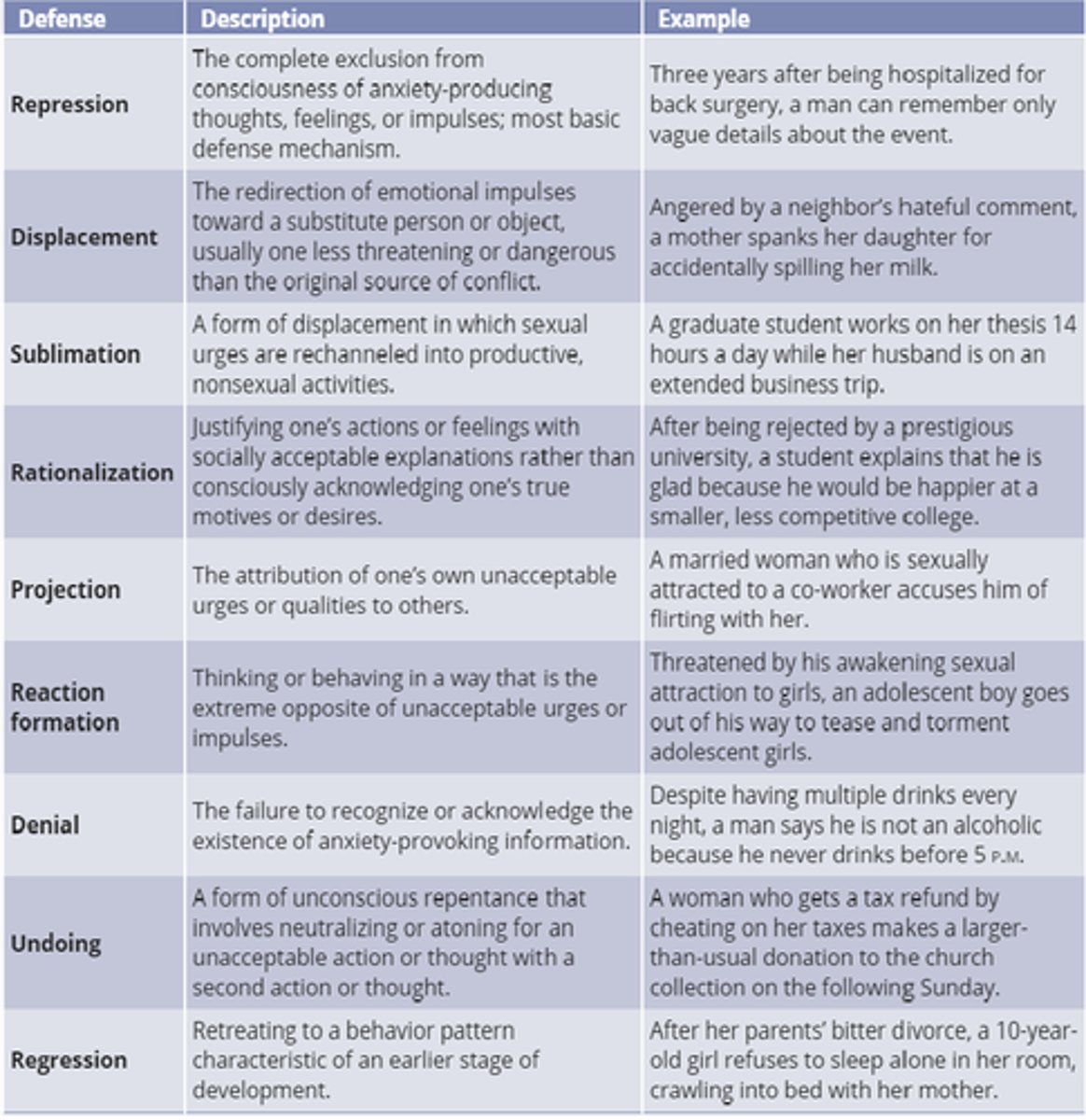
Defense Mechanisms
unconscious mental strategies the mind uses to PROTECT ITSELF
DONT NEED TO KNOW CHART
Neo-Freudian Approaches
Carl Jung - analytical psychology
Karen Horney - Feminist psychology
Carl Jung (analytical psychology)
Personal vs. collective unconscious; personality types reflecting opposing ways we can orient ourselves to the external environment
- PERSONAL unconscious → what Freud focused on
- COLLECTIVE unconscious → why so many different people have similarities in their responses due to the cultural similarities
Orienting ourselves to the external environment → introversion and extroversion
- Myers-Briggs test (e.g. INTJ) → very bad test-retest reliability and a poor measure of personality
- Jung DID NOT come up with the Myers-Briggs test, just came from his ideas
Karen Horney (feminist psychology)
emphasis on cultural and social conditions as a determinant of personality (rather than instinctual or biological drives)
- used Freud's ideas → chose to look into the opposite from Freud’s sexist ideas (womb envy)
- Impact of social structures on personality → this was not seen in Freud’s models
- Believed that patients could help themselves (could be taught to engage is psychoanalysis by themselves ← beginnings of self-help)
Humanistic Approaches - definition
PERSONAL EXPERIENCE and belief systems
- ppl seek personal growth to fulfill their potential
- SELF- ACTUALIZATION (Maslow)
- more OPTIMISTIC APPROACH - when things go right instead of wrong
self-actualization (Abraham Maslow)
the desire to become more and more of what one is, or to become everything that one can be
- Maslow NEVER put the hierarchy into a pyramid
- Maslow's ideas about self-actualization came from the time he spent with the Blackfoot tribe (a First Nations group which he never actually mentioned in his writings), where he saw a lot of people who were self-actualized, while many people in the Canadian culture were not self-actualized
Humanistic Approaches
Carl Roger's person-centred approach
more on next flashcard
Phenomenology
Subjective human experience
- Unconditional positive regard
Self-concept (or self)
"the organized, consistent set of perceptions and beliefs about oneself." (Carl Rogers)
Incongruent =little overlap in self-image and ideal self; lead to disordered behaviour (anxiety/depression)
Congruent = when treated with postive regard leads to self-actualization
Self
the totality of the individual, consisting of all characteristic attributes, conscious and unconscious, mental and physical.
Self-concept
People's description of their own characteristics (including psychological and physical characteristics, qualities, skills, etc.)
Self-construal
The extent to which the self is defined independently of others or interdependently with others
Individual self-construal
Your uniqueness ← not linked to a particular situation
Interdependent self-construal
focuses on your connection with others (less likely to be unique to you)
Cultural Differences in the Self
Western cultures: Independent self-construals
Non-Western cultures: Interdependent self-construals
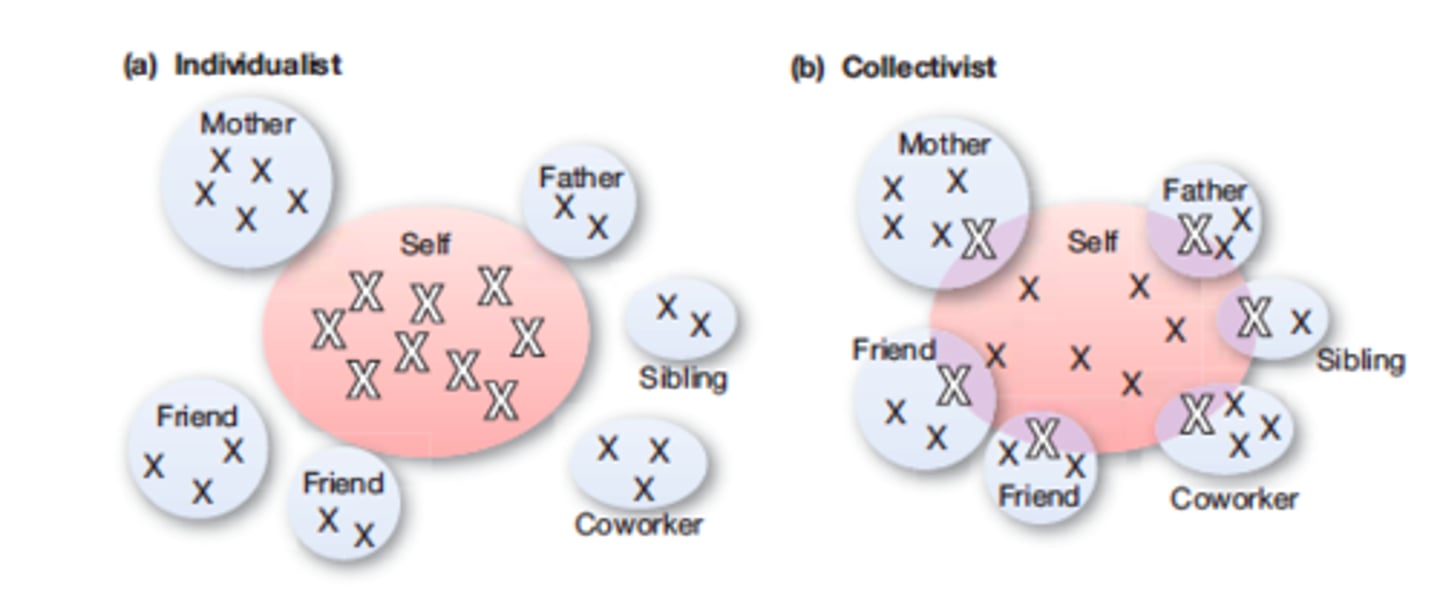
Both interdependent and independent self-construals
"can and do co-exist in individuals"
It's not like you either have one OR the other
Social-Cognitive Approach
Ways of understanding personality which emphasizes cognitive processes and the role of the environment
Albert Bandura (recall social learning theory)
Reciprocal determinism
bidirectional relationship (goes both ways)
behavioural perspective = how will this afect someone's behaviour
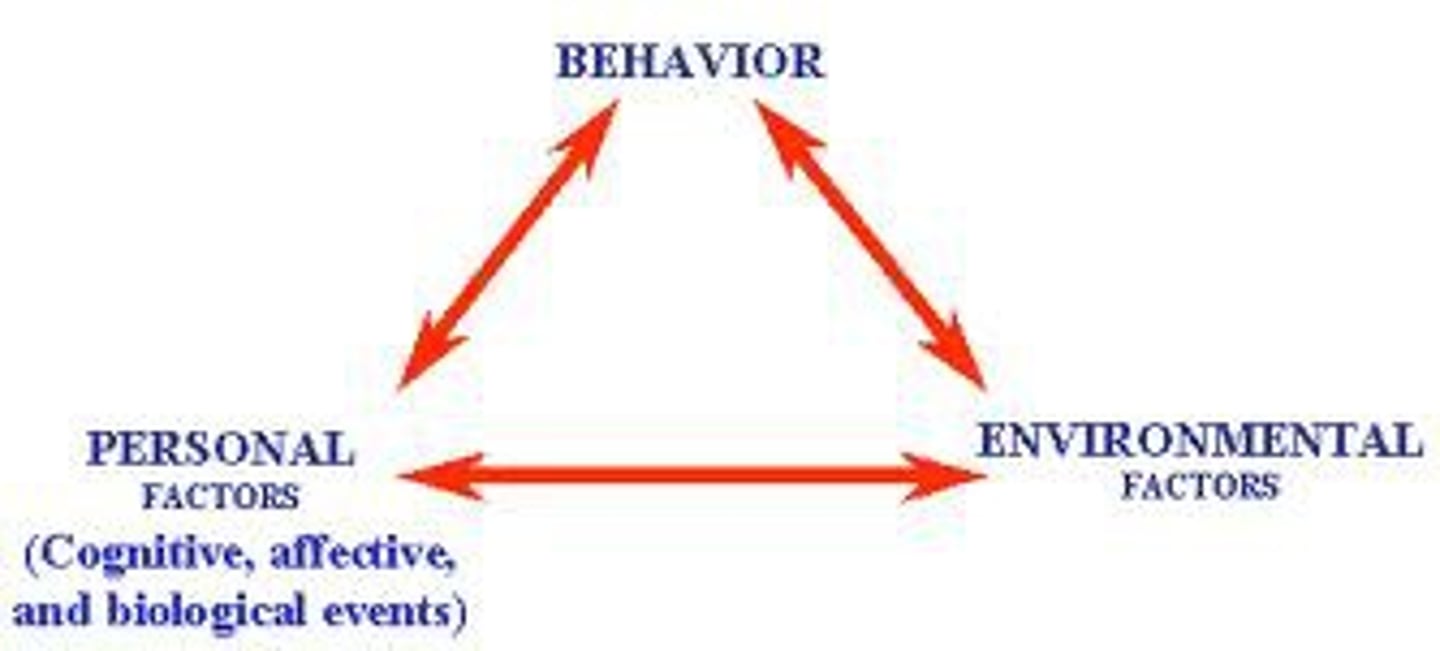
E.g. Girl who plays soccer
Condition: interest in soccer
Environment: joins the soccer team
Behaviour: spends lots of time with the soccer team
All relates back other other
Self-Efficacy
belief in being able to perform in a particular area
ex. belief someone can do rlly well in a hard math class/low self-efficacy in auditioning for school play
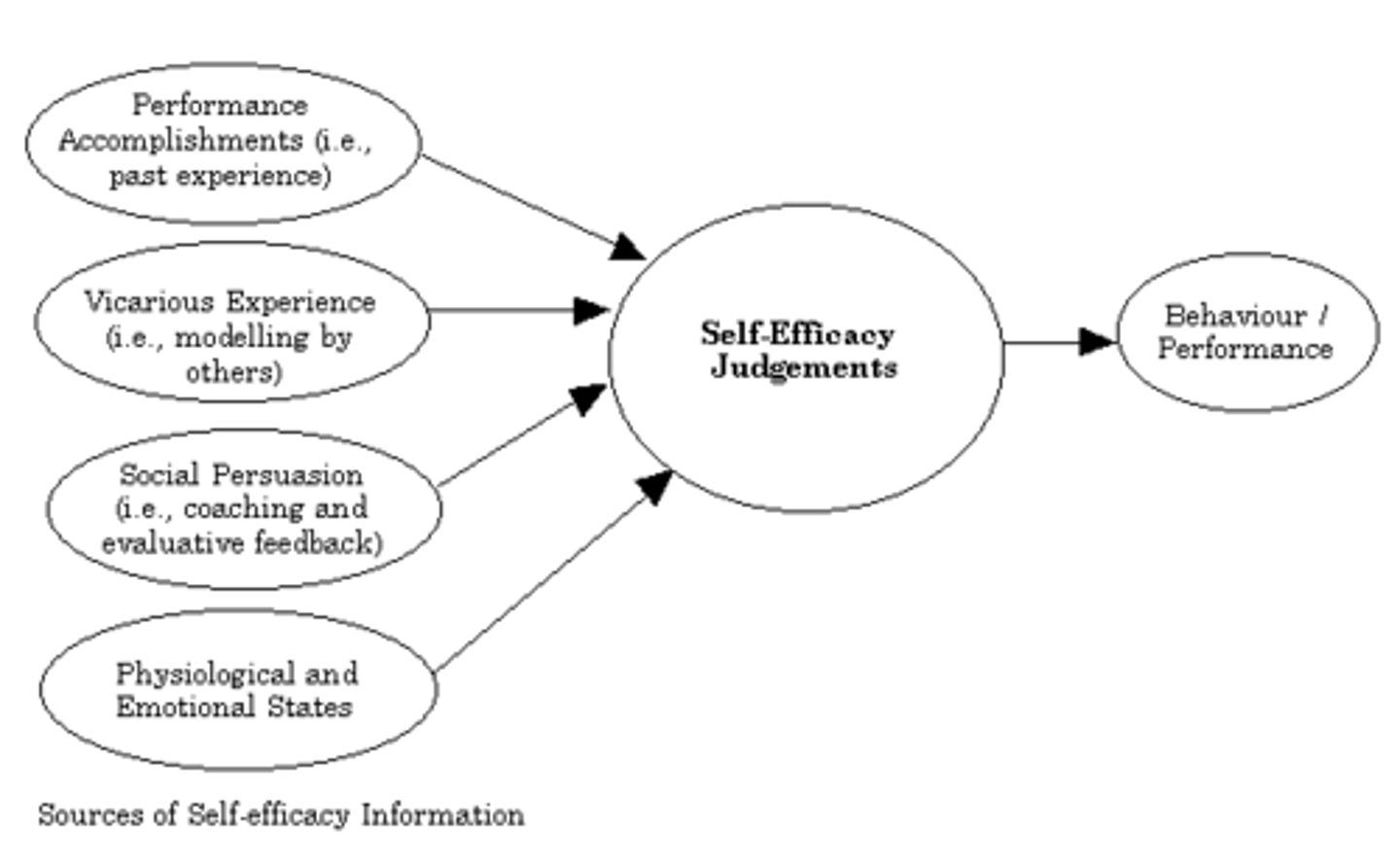
Where does this come from?
Performance experience: past experiences ← e.g. if you have taken a whole bunch of math classes and done well
Vicarious experience: observing others
Social persuasion: other people believing in us
Imaginal experience: visualizations of future success
Physical and emotional states: how u feel abt the situation
Locus of Control
Developed by Julian Rotter in the 1950s-60s
The degree to which people believe that they (as opposed to external forces) have control over the outcome of events in their lives
internal locus of control
they have control over what happens to them
active
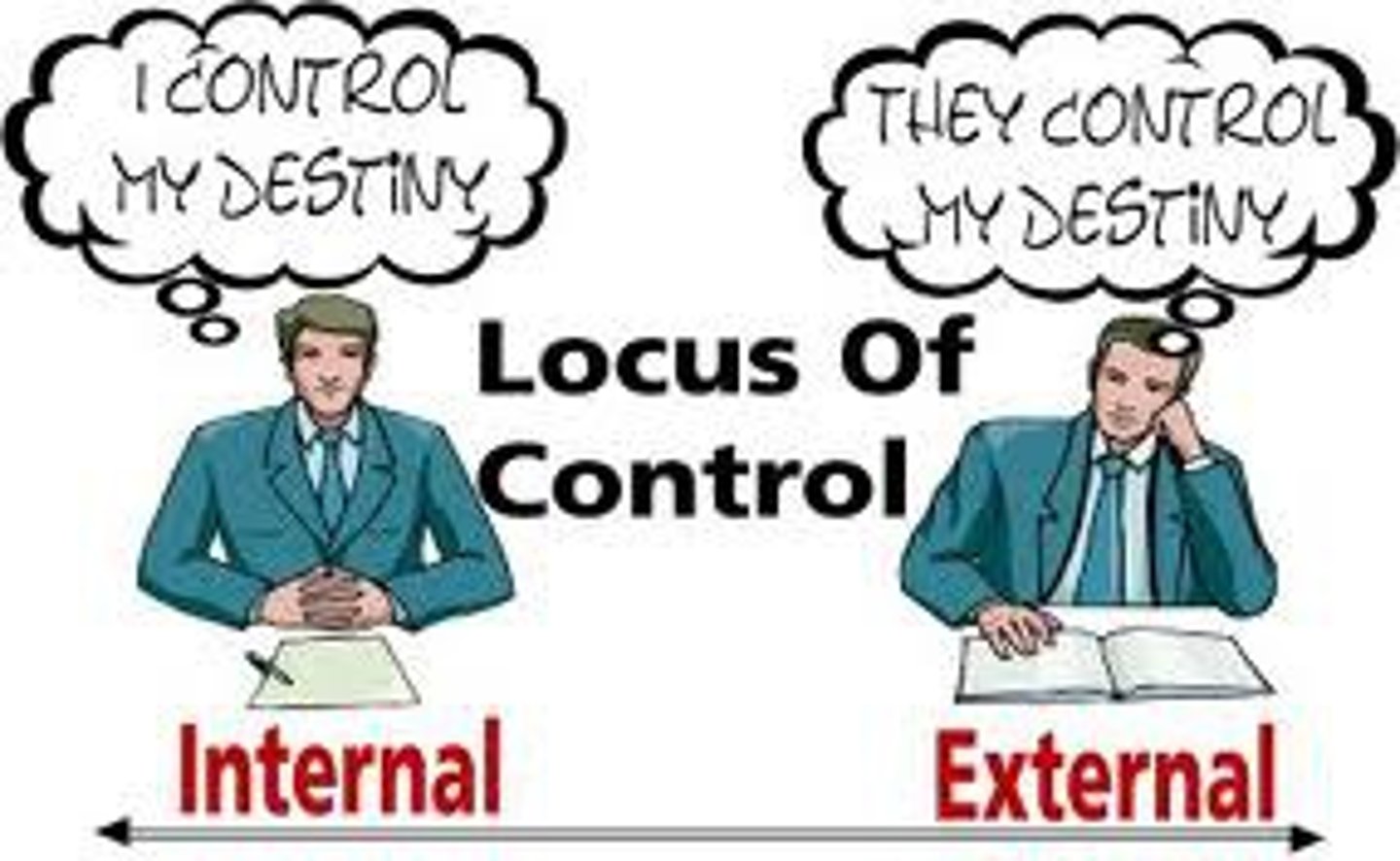
external locus of control
things happen to them
- they have no control over their life
-passive
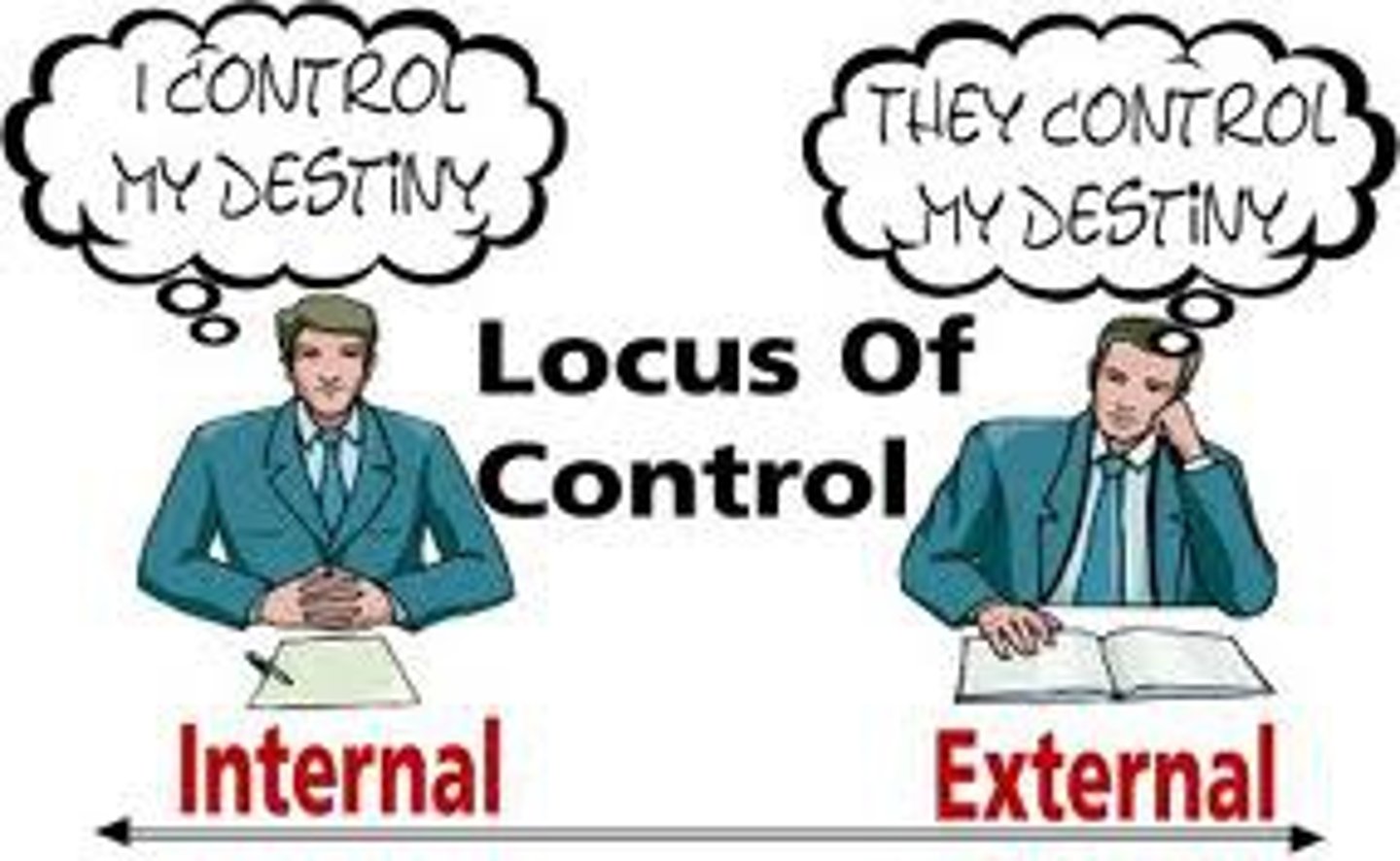
Importantly external vs. internal locus of control represent....
opposite ends of a CONTINUUM
Self-regulation
the process by which people alter or change their behaviour to attain personal goals
Self-control
a process of self-regulation in contexts involving a clear trade-off between long-term goals and short-term temptations
Delay of Gratification: "The Marshmallow Test" (self control)
Walter Mischel, 1970s (& later)
Some strategies: Turning "hot" cognitions into "cold" cognitions (reframing); ignoring; distraction
While original longitudinal studies suggested meaningful connections between delayed gratification at age 4 and things like SAT scores, recent replications have indicated otherwise
Personality as "if-then behavior profiles"
Emphasis on the interaction between the situation and the individual
People may not behave consistently across all situations ("if A, then she X, but if B, then she Y"), but these patterns of behaviour tend to be consistent
Personality trait:
A characteristic; a dispositional tendency to act in a certain way over time and across circumstances
Personality type:
A classification based on particular configurations of personality traits or other characteristics
Recall: Factor Analysis
How do we find underlying dimensions when we can only observe specific behaviours?
Big Five Theory
openness,
conscientiousness,
extraversion,
agreeableness,
neuroticism
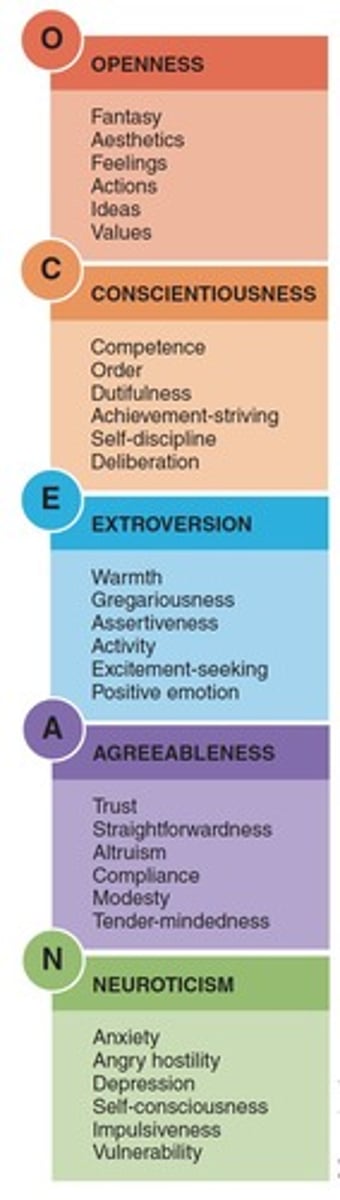
Openness
open to new things
- trying new situations, aesthetics
Conscientiousness
tendency to be organized, hardworking, responsible
Extraversion
orientation of ones interests and energies towards outer world rather than inner world
Agreeableness
cooperrative, altruistic
Neuroticism
emotional stability, characterized by a chronic level of emotional instability
prone to psychological distress and lack of emotional stability
Social Psychology
We are social animals who live in groups and depend on one another for survival
Social psychologists study how the thoughts, feelings, and behaviours of individuals are influenced by the actual, imagined, or implied presence of others
Pareidolia
the human tendency to see faces where they do not exist
- its bc human faces are so important for us
Importance of social contact
Genie
harlow and the baby monkey
Human babies that are never touched will die → we rely on that contact
Also Recall: Harvard & Glueck Studies
Longest running study on health & happiness - what makes a good life?
"The only thing that really matters in life are your relationships to other people." - Robert Waldinger
Affiliation Motivation: The Need to Belong
The motivation to be part of relationships, to belong to groups, and to be accepted by others
The need to belong → we are sensitive to the feeling of exclusion
We are profoundly influenced by other people - even strangers!
Example: The bystander effect (Latané & Darley, 1968, 1970)
Diffusion of responsibility
Evaluation apprehension
Pluralistic ignorance
bystander effect proven false
a murder had taken place outside a large apartment complex
False headline: all the people in the apartment building witnessed the murder, but no one called the police
- People actually did care and called the police in reality
studies done on the bystander effect
They did these studies where these participants are just casually filling out questionnaires (but in reality, some participants are hired by the researchers)
- Smoke (fog machine) fills the room, and the hired participants are told to act like nothing is happening
- They wanted to see what the real participants would do
- People were less likely to do something (get help, respond in an emergency situation)
Bystander effect
the more people do nothing (act as bystanders), make it more likely for more people to do the same
- if there r so many more ppl then u feel like someone else will help them
Diffusion of responsibility
other ppl will help them
Evaluation apprehension
ppl are going to judge me for helping
they will think im overreacting
Pluralistic ignorance
Nobody else is responding here, so that must mean there is nothing to be worried about"
Conformity
The altering of one's opinions or behaviours to match those of others or to match social norms
Social norms
Generally accepted ways of thinking, feeling, or behaving that most people in a group agree on and endorse as right and proper
Descriptive social norms
What people ACTUALLY think, feel, or do
Injuctive/prescriptive social norms
What people SHOULD think, feel, or do
People Tend To Conform To Norms For Two Reasons:
info influence
normative influence
information influence
A group has informational influence if we adopt the group consensus because it SEEMS CORRECT
- cover your sneeze with ur arm so u dont spread germs
Normative influence
A group has normative influence if we adopt the group consensus to show identification with the group
- dont wanna be excluded from grp, show ur a good member by covering ur sneeze with ur arm
Asch's Conformity Experiments
They were told that they were signing up for a perspective experiment
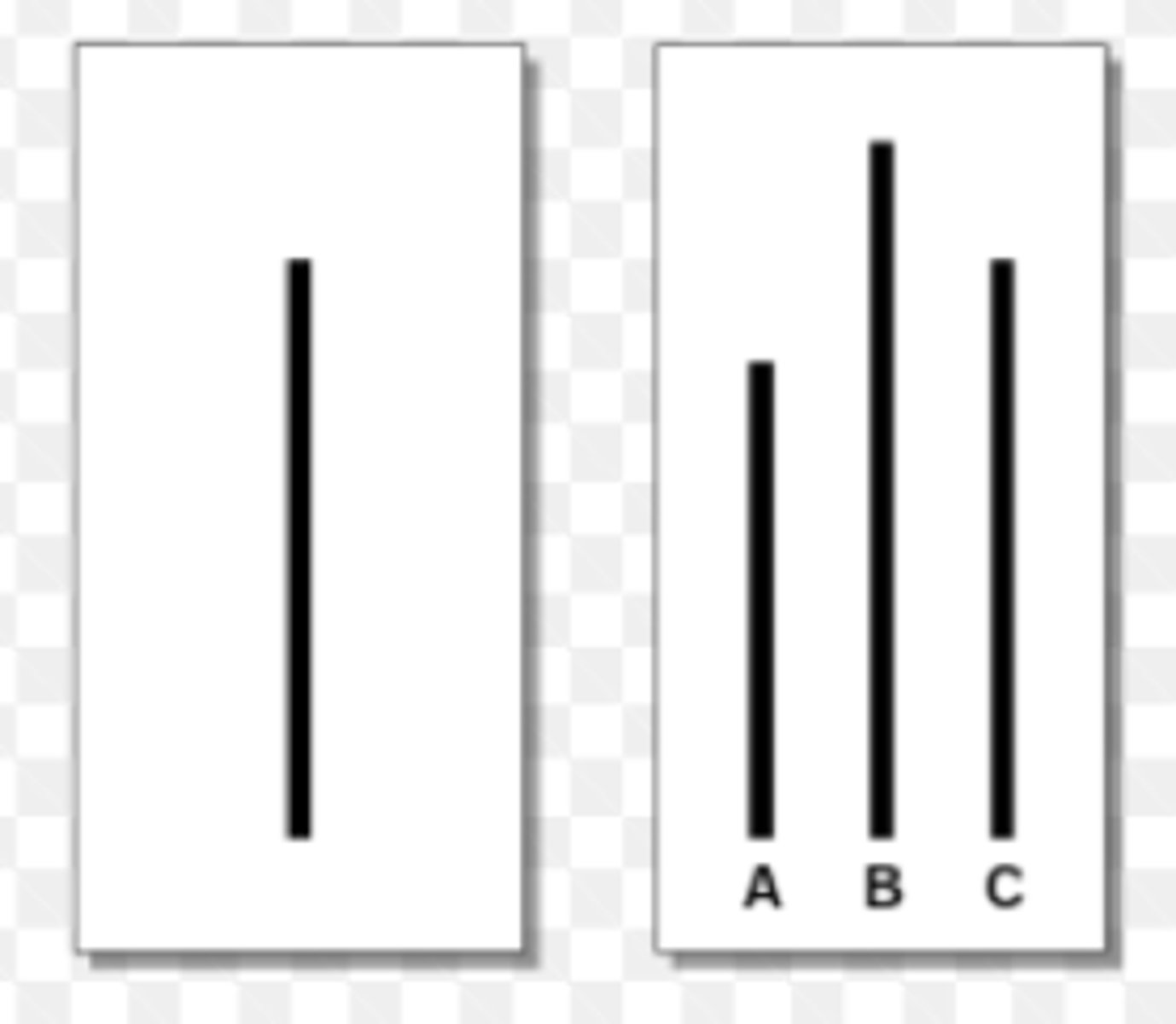
Showed a standard line, along with 3 other lines
- Asked to identify which of the 3 lines is the standard line
They made it very clear what the correct answer is (B)
Would people ever go against what their own eyes are telling them if a bunch of other people think otherwise?
- Everyone said A and then the last person was the real participant (they were testing if he would say B)
Why do ppl conform?
Importance of unanimity
• Normative influence (acceptance) & informational influence (correctness)
Related to groupthink
When group decision making is impaired because of a desire to reach or maintain consensus
Compliance
a change in a person's behaviour in response to a direct request; requester has no authority over us
obedience
When we comply to the request of someone in a position of authority
Stanley Milgram
- Influenced by Solomon Asch
- Milgram was very interested in studying conformity and differences based on culture
Milgram's studies of obedience important background info
Right after WWII → he believed that he would do this in America, and very few people would be willing to deliver electric shocks to another participant.
- But he believed, in Germany they would be more likely to obey authority figures
- He never actually went to Germany because he found a lot of things out from the American studies
Milgram's studies of obedience what happens in study
There is always an authority figure in the room, monitoring the situation (always a man in a lab coat)
Participants randomly assigned "teacher" and "learner"
Rigged → the participant is always the teacher
- Every time the learner makes a mistake, it is the job of the teacher to deliver the electric shock
- Original set up: teacher is sent to a different room (they don't see what is going on with the learner)
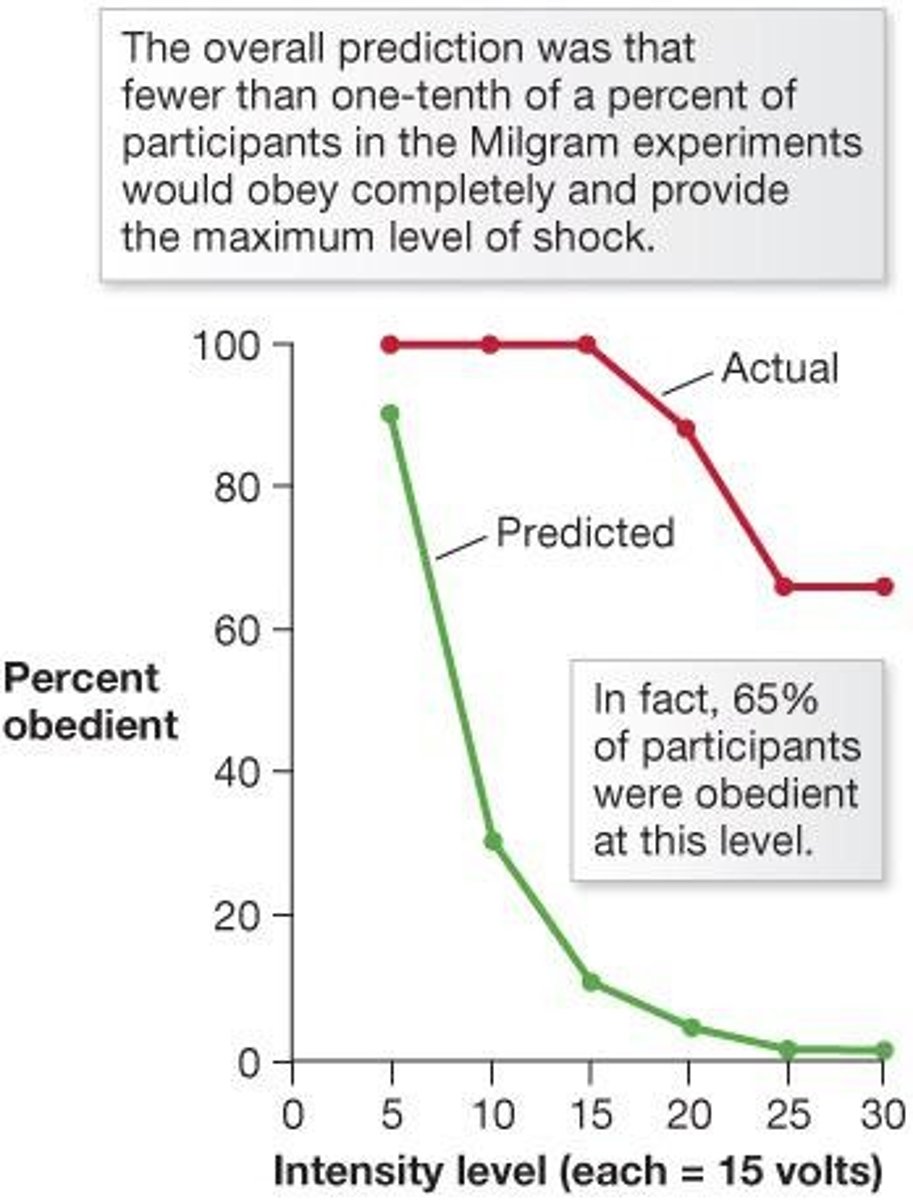
Predicted vs. Actual Obedience of Milgram's experiments
It was expected that only a few people would apply very high shocks
In reality → 65% of participants shocked until the max shock.
Factors that lowered rates of obedience include:
1. Proximity to the learner
2. Proximity of the experimenter
3. Presence of non-obedient confederates
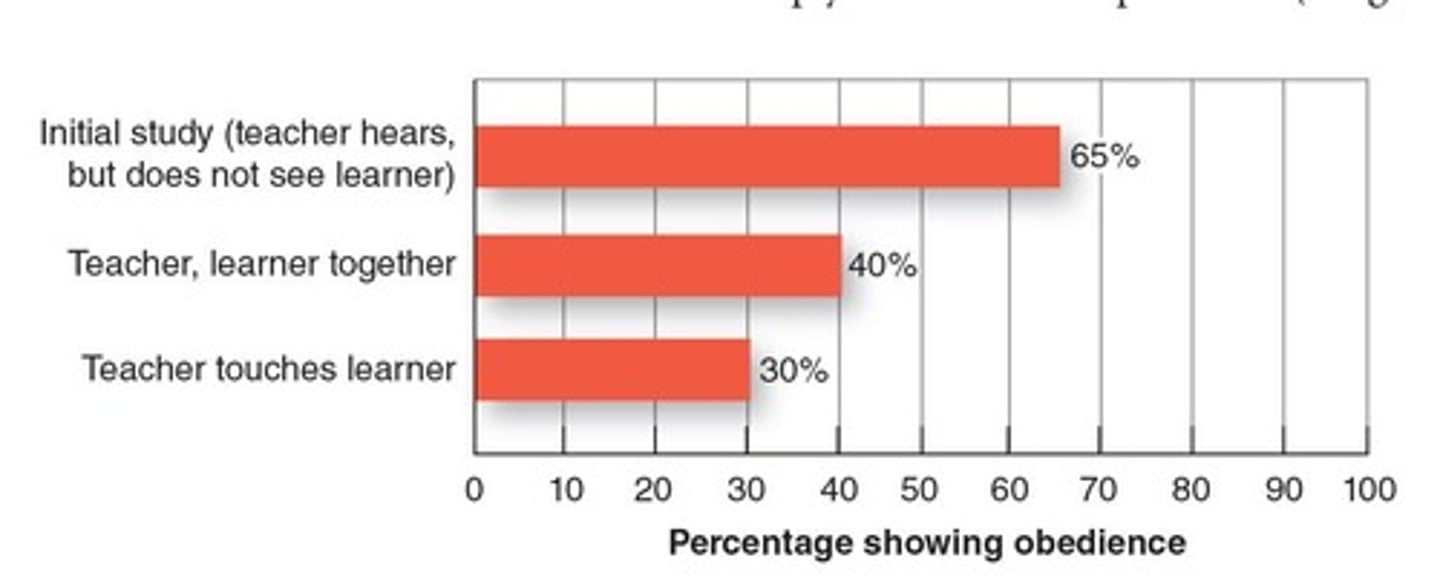
Proximity to the learner
E.g., same room, actual touch in order to send the shock
Proximity of the experimenter:
if they are sending the instructions over the phone OR if the instructions or sometime from an intermediary, obedience drops to around 20%
Presence of non-obedient confederates
instead of the real participant being the only teacher - variation where there are multiple teachers. If those other teachers said "no," then the obedience drops to 10%.
Ethical Concerns
Ethical violations didn't exist yet for the Milgram studies
Now: the benefit from the study has to be higher than the harm to the participants
Cross-Cultural Findings & Replications of milgram study
- Findings have been replicated in many different countries (e.g., Australia, South Africa, Jordan, Spain)
- No consistent gender differences (as Milgram found); started w only men but later found no diff w women
- Most recent replication (stopped at 150-volts) found that 65% of men and 73% of women would continue to obey the experimenter (Burger, 2009)
Most recent replication (stopped at 150-volts) continuation
Noted that at the 150-volt point, if they continued, they were more likely to continue from that point forward to 450-volts (they see themselves as not being responsible and separates themselves from the situation)
ENGAGED FOLLOWERSHIP
thinking about it in terms of the greater good (viewed it as important scientific discovery)
Are First Impressions as Important as We Think?
YES probably!
1st impressions impact...
how we view ppl's behaviour later
form impressions of others based on...
V LIMITED INFO
-appearances (halo effects), stereotypes, "thin slices of behaviour", etc.
- learn one things abt someone = making inferences abt other behaviours
example of 1st impressions
showing students a 5 second video of a prof with no sound and asking them to rate it, shows a strong correlation to the students who rated their profs after having them for an entire semester
1st impressions r...
REMARKABLY PERSISTENT
- but we are also capable of updating (and correcting) our impressions of others
- Negative information and uncommon behaviours are typically given more weight
Attributions:
Judgments about the cause of a person's behaviour
Dispositional attributions
Explanations that refer to internal characteristics (e.g., traits)