PE Paper 1 : Sport and society
 Call Kai
 Learn
Learn Practice Test
 Spaced Repetition
 Match
Match Flashcards
 Knowt Play
1/78

There's no tags or description
Looks like no tags are added yet.
Name | Mastery | Learn | Test | Matching | Spaced | Call with Kai |
|---|
No analytics yet
Send a link to your students to track their progress
79 Terms
B
A
B
C
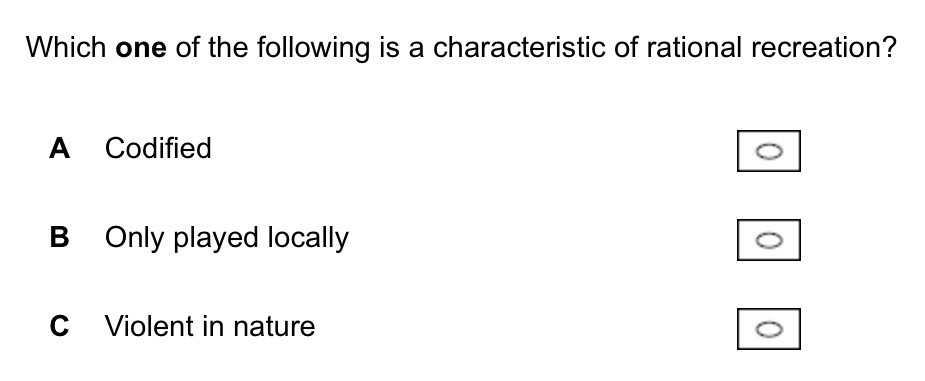
A

Which one of the following was a characteristics of 19th-century amateurs (1)
B

Which of the following is not a characteristics of amateurs in the 1800s (1)
D

Identify the correct timeline of events that influenced the development of rational recreation (1)
C

Identify the correct combination of characteristics that represent real tennis (1)
A

Which of these is a characteristics of popular recreation available to the lower class in pre-industrial Britain (1)
A

Which one of the following was played in pre-industrial society (1)
D

Which one of the following statements accurately describes the term urbanisation (1)
B
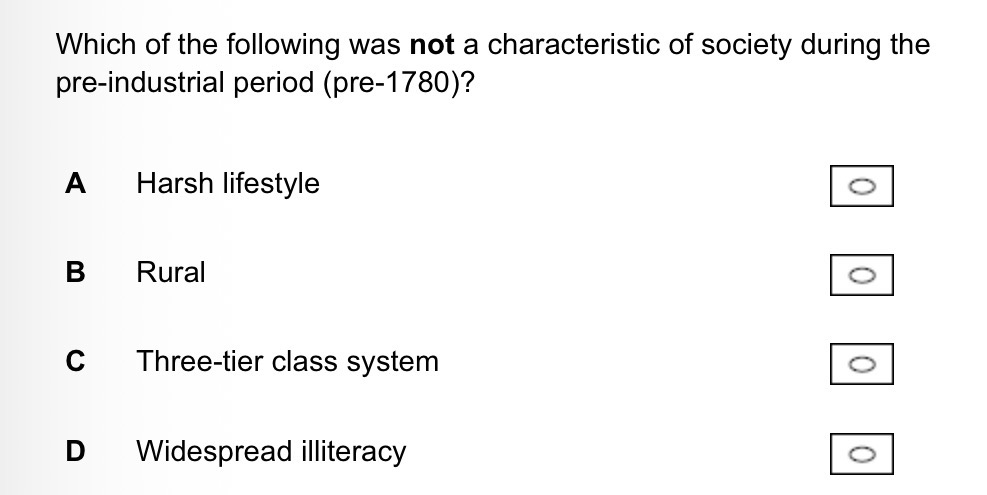
Explain how mob football reflected the characteristics of pre-industrial British Society (pre-1780) (3)
Lower class in a two-class system had little money so mob football required little equipment/facilities making it accessible. (1)
Rural living suited mob football as it was played over large and undefined areas. (1)
Lack of time/long working hours resulted in mob football only being played occasionally. (1)
Lack of transport/communication so mob football was played differently in each place. (1)
Widespread illiteracy made sharing of rules difficult, so mob football was simple. (1)
Harsh lifestyle meant mob football was physical and at times violent. (1)
Explain how the two-tier class system influenced the nature of sporting recreation in pre-industrial society (4)
(AO1) The class system determined an individual's status, (1) (AO2) and therefore the type of activity that would be appropriate for them to engage in (1).
(AO1) The upper class / gentry would participate in real tennis / rational recreation (1) (AO2) because they had the land / more time / money / facilities / could afford equipment / were educated so could understand the rules (1).
The lower class/ peasants would play mob football / popular recreation (1) because this reflected their harsh living conditions/ they did not have access to land and resources enjoyed by the gentry / were illiterate and so could not understand rules (1).
(AO1) (Different classes had different roles within the same activity) upper class would wager on lower class in activities such as pedestrian activities (1) (A2) because upper class had money / was form of entertainment / for high status (1).
Explain how social and cultural factors influenced the characteristics of popular recreation in pre-industrial (pre-1780) Britain (4)
Limited transport or communications - local
Illiteracy / uneducated - uncodified / simple rules / limited organisation
Reflection of life and times / harsh society - cruel / violent
Seasonal time / free time on Holy Days or annual holidays - occasional / festival
Before industrial revolution / before migration to towns / population - centred on village or county town life / rural
Two class society / feudal system - courtly and popular / upper / gentry class activities and lower or peasant class activities
Describe the ways in which real tennis was different from most other popular recreations (4)
Courtly / played by upper class / gentry
Written / complex rules / organised
Not cruel / violent / had etiquette / cultured / skilful
Played often / regularly
Purpose built facilities / equipment
Not local / transport available / travel
Explain two characteristics of pre-industrial football (4)
Played occasionally/holy days (1) because no other time available to play sport (1)
No clear division of labour/little strategy (1) as not yet rationalised (1)
No pitch/common land between villages used (1) because minimal equipment and facilities available (1)
Locally based (1) as poor transport/communication (1)
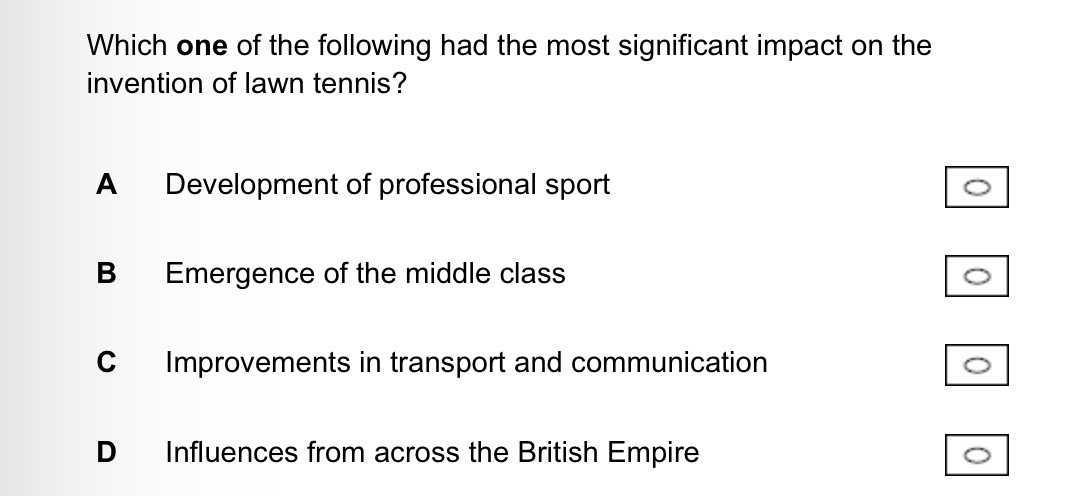
Explain two characteristics of nineteenth century lawn tennis (4)
Played regularly (1) because the players had more time to play (1)
Middle class development (1) due to involvement in creation of clubs/NGB (1)
Highly structured/skills/tactics (1) due to the rationalisation of tennis (1)
Equipment and facilities available to play (1) for example played in suburban gardens/manufacturing of equipment for purchase (1)
Social game (1) meant that both sexes could play together as it was considered a suitable activity for females (1)
Outline one positive benefit for factories developing football terms in post-industrial society (1)
Increased health and fitness of workers
Better workers due to increased moral
More disciplined workforce
Evaluate the importance of improved transport and urbanisation on the development of association football from the mid-19th century onwards (4)
Both equally as important as they allowed football to be played more regularly (1).
Urbanisation can be seen to be important as the large numbers of people in one place provided a captive audience (1).
The lack of space meant that purpose built facilities had to be built to manage crowds / provide a focus (1).
Perhaps more important than transport as the majority of crowds were 'home' supporters anyway (1).
Transport did however allow teams to travel so important as more and wider fixtures could be organised (1).
Football was able to develop as fans could also now travel to watch games (1).
Can be argued that transport was the most important as without it, new competitions could not have existed, eg FA Cup (1).
Explain why lawn tennis was deemed to be a suitable activity for women to play during the post-industrial period (3)
• Mixed sport so females were able to participate as part of social gatherings / with family. (1)
• Played in gardens / private clubs so women could take part in private. (1)
• Not vigorous so women could participate in modest dress. (1)
• Didn’t sweat so was deemed ladylike / not deemed unladylike. (1)
• Female role models emerged who broke down stereotypes. (1)
State three ways factory owners helped to increase participation in rational recreation (3)
Provided facilities for participation. (1)
Gave time off work to participate in rational recreation. (1)
Setting up teams / clubs. (1)
Provided broken time payments/ paid holidays / increased pay. (1)
Encouraged the health / wellbeing of their workforce. (1)
Encouraged loyalty / industrial patronage. (1)
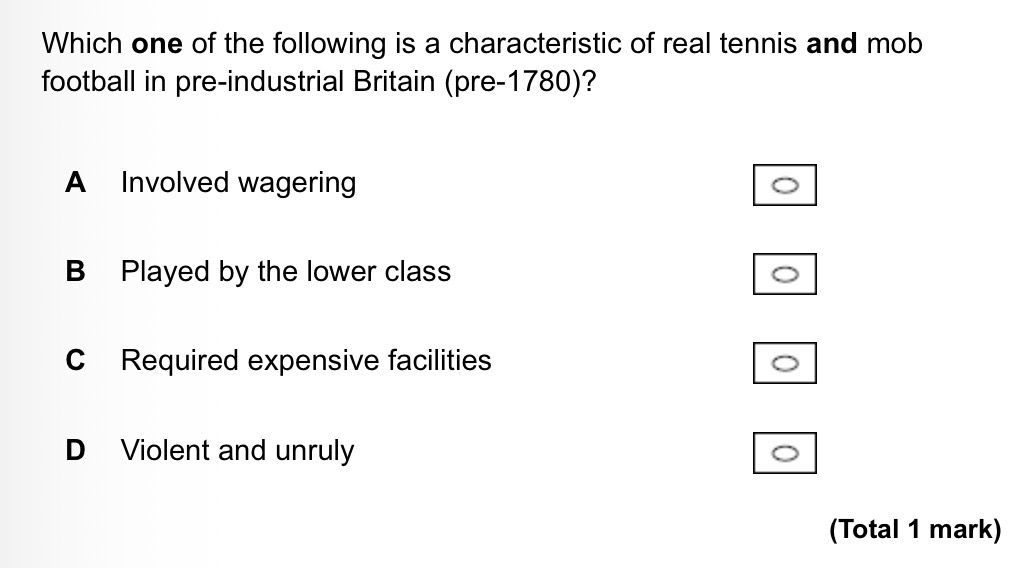
State two characteristics of mob football (2)
Played over large / rural / undefined areas. (1)
Aggressive / violent / unruly. (1)
Simple / few / unwritten rules. (1)
Played locally. (1)
Played differently from place to place. (1)
Occasional / not played often / only on holy days. (1)
Played by men. (1)
No limit on the number of players. (1)
Limited / no specialised equipment
Explain why the characteristics of real tennis prevented the lower class from playing it (2)
Complex/written rules which the lower class could not read as most were illiterate. (1)
Specialised equipment/dress code required which lower class could not afford. (1)
Specialist court required which lower class could not access (transport / cost / class). (1)
High level of skill required which the lower class did not have the time to develop. (1)
State three professions that were also responsible for the spread of sport throughout the British Empire during this period (3)
Teachers. (1)
Clergy/missionaries. (1)
Military officers/soldiers. (1)
Diplomats. (1)
Industrialists/factory owners. (1)
Explain how the Church supported and promoted sport and recreation during late-nineteenth century Britain (2)
Churches used sport to influence social control/redirecting time to sport to improve behaviour and less time was spent gambling/drinking (1)
Churches used their land to provide sporting/recreational activities (1)
Churches used sport to promote Christian values 1)
Churches used sport and recreation as a good way to increase congregation/attendance numbers (1)
Explain how the middle classes contributed to the development of lawn tennis during this periods (3)
Middle class formed NGB, the Lawn Tennis Association (1)
Middle class supported the codification of tennis / the development of rules / development of equipment / clubs (1)
(Middle class supported the development of competitions / they developed league and competition structures / tournaments (1)
Middle class supported women in participating in lawn tennis (1)
Explain how the church promoted sport and recreation among their local communities during the mid-to-late nineteenth century (3)
Encourage social controle.g. improving behaviour and diverting from less social behaviours (1)
Churches offered the use of halls which increased the availability of facilities/ spaces for sport and recreation to be played (1)
Churches looked to increase the morality and values of society through sport and recreation (1)
Churches organised teams/fixtures/leagues which encouraged participation in sport (1)
The church utilised sport and recreation to promote Christian values and increase church attendances (1)
The church promoted muscular Christianity through sport (1)
Suggest how the improvements in transport and communication during this period led to an increase in the standard of performance in sport (4)
Development of further / faster transport allowed team to travel further playing against a higher standard of opposition/play more (1)
Improved transport allowed the development of leagues increasing competitiveness and incentivising success (1)
Improved / cheaper transport allowed performers access to new activities increasing the number of performers and in turn the overall standard (1)
Improved communication led to the development of role models who younger performers aimed to emulate / copy (1)
Improved communication led to the codification of sport, enabling fixtures and leagues to occur between people from different areas (1)
Improved communication meant you could follow a team, increasing spectators, leading to professionalism (1)
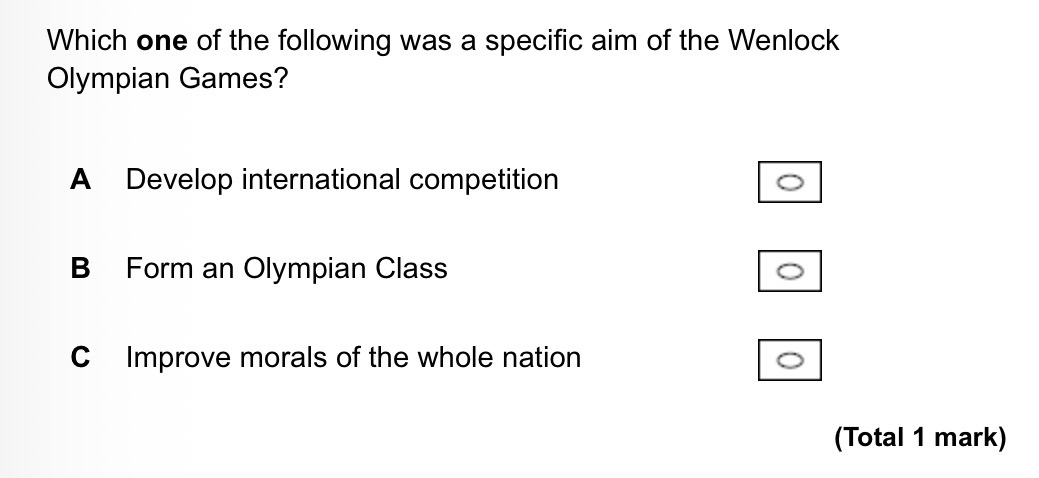
Identify two aims of the Wenlock Olympian Games (2)
Form Olympian Class (1)
Promote moral improvements (1)
Promote physical improvements (1)
Promote intellectual improvements (1)
Targeted at people of the town and neighbourhood of Wenlock (1)
Identify three characteristics of real tennis (3)
Played by the upper classes/ civilised (1)
Complex rules / strategy / skilful (1)
Specialised kit and equipment / facilities (1)
Played by men (1)
High moral code (1).
State three characteristics of amateurs during the industrial and post-industrial period (3)
High status / respected (1)
Played for the love of the game (1)
Controlled sport (1)
Top / best performers (1)
High moral values / sportsmanship / fair play (1)
State one positive effect that modern-day ‘amateurism’ has on sport. Give an example.
(1)
• Codes of conduct still exist/fair-play/sportsmanship, eg shaking hands with opponent and umpire after match in tennis (1)
• Amateurism viewed positively/promoted, eg fair-play awards in football/Olympic Ideal (1)
• Opens up high level sport to all, eg amateur football teams taking on professionals in the FA Cup (1)
• Amateur sport can be a platform to professional sport, eg through scouting of talented youths (1)
• Less pressure on performers/more enjoyment/less deviance/cheating, eg fair play/respect encouraged in grassroots rugby (1)
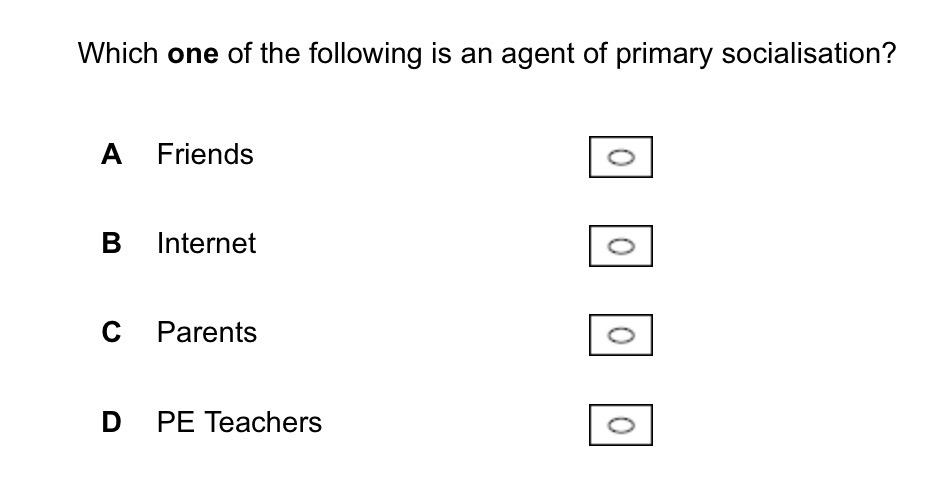
C
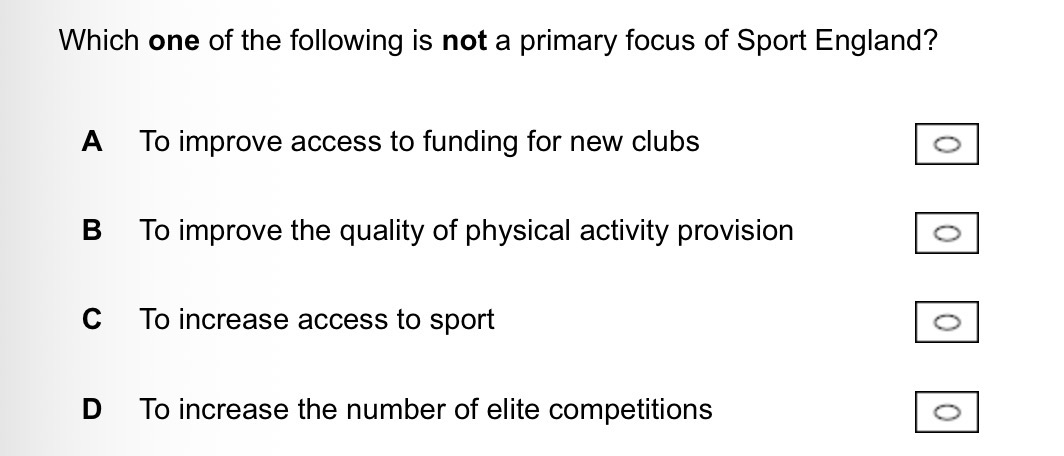
D
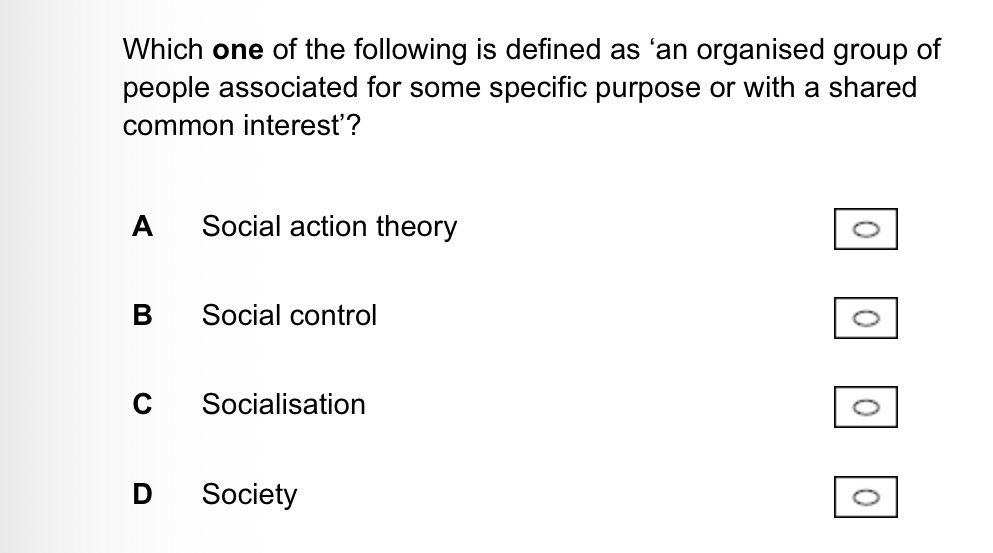
D
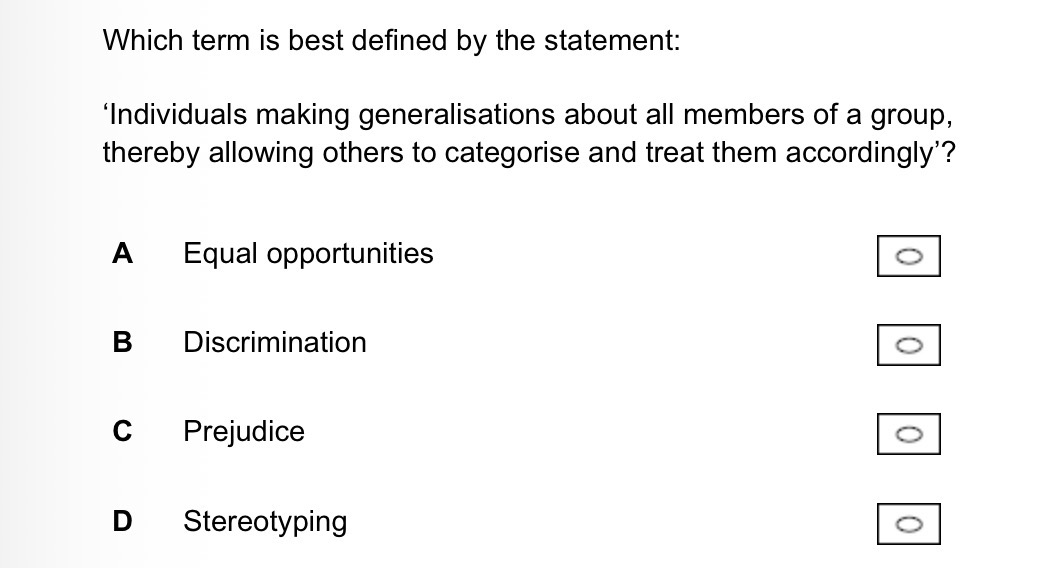
D
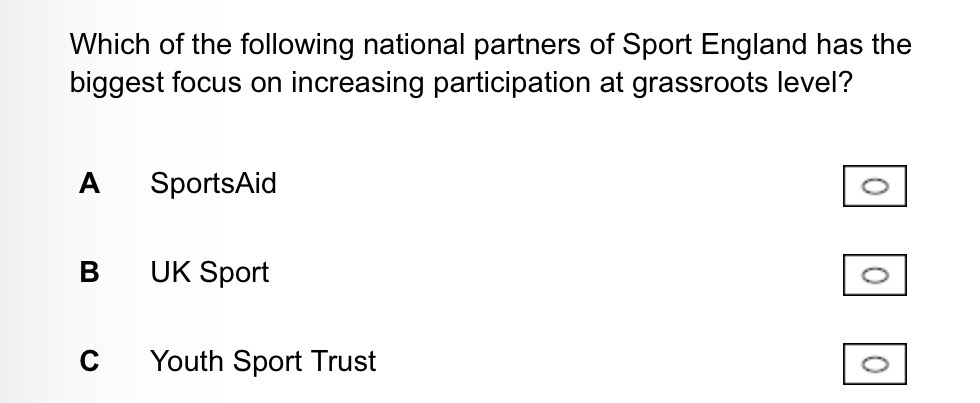
C
Steven has started regularly attending a running club to train for a marathon.
Explain one health benefit, one fitness benefit, and one socialbenefit of regularly attending training.
(3)
Health benefit (sub max 1)
• Decreased risk of heart disease due to cardiac hypertrophy. (1)
• Decreased risk of stroke due to decreased cholesterol. (1)
• Decreased risk of type 2 diabetes due to increased insulin sensitivity. (1)
• Decreased risk of obesity due to burning more calories. (1)
Fitness benefit (sub max 1)
• Improved aerobic power / stamina / cardiovascular endurance due to continuous / aerobic training. (1)
• Improved muscular endurance / dynamic strength due to continuous / aerobic training. (1)
• Improved speed due to interval training. (1)
• Improved strength / power due to hill repetitions. (1)
• Improved flexibility due to stretches completed during the warmup / cool down. (1)
Social benefit (sub max 1)
• Make new friends due to members of the running club having a shared interest. (1)
• Prevents loneliness due to making new friends. (1)
• Improved social skills / interpersonal skills due to more interactions with people. (1)
• Interactions with other people will result in improved confidence / self-esteem in company of others. (1)
• More approachable to others due to a more positive outlook on life. (1)
Define social stratification. (1)
Society is divided (into different levels/classes) based on wealth/status. (1)
State three reasons why attending a private school may improve a child’s opportunities in sport.
(3)
• Better facilities. (1)
• Better equipment. (1)
• Specialist coaching/more staff. (1)
• High level competition. (1)
• More opportunity for foreign tours/training camps. (1)
• More time dedicated to sport. (1)
• Wider range of sports available. (1)
Laura is trying to lead a more active lifestyle. She is considering taking up jogging or playing 5-a-side football.
Explain the similarities and differences of benefits gained from increased participation in:
• jogging alone
• playing 5-a-side football.
(5)
Similarities (sub max 2)
• (Physical health) Both could decrease the risk of coronary heart disease/obesity/stroke etc (1)
• (Mental health) Both could increase serotonin/improved mood etc. (1)
• (Fitness) Both could improve aerobic fitness/cardiovascular endurance/muscular endurance etc. (1)
Differences (sub max 2)
Points must be comparative, not simply stating the characteristics of football or jogging in isolation. Accept the reverse i.e. Jogging alone would improve skill less than football.
• (Fitness) Football could improve skill/coordination/agility etc more than/compared to jogging alone. (1)
• (Fitness) Football could improve anaerobic fitness/speed/power etc more than/compared to jogging alone. (1)
• (Social health) Football could improve friendships/communication skills etc more than/compared tojogging alone. (1)
Evaluate whether primary or secondary socialisation has a greater impact on an individual’s participation in sports throughout their life.
(3)
Primary socialisation greater impact (sub max 2)
• Primary socialisation occurs in early years so has a large impact on core values/beliefs. (1)
• Core values/beliefs created during primary socialisation will be very strong/difficult to change in later years. (1)
• Primary socialisation involves family members who you rely on to provide opportunities/support to participate in sport. (1)
Secondary socialisation greater impact (sub max 2)
• Secondary socialisation can occur over a longer period of time than primary socialisation so can change core values/beliefs. (1)
• Secondary socialisation comes from a broader range of sources which may make the messages more powerful than those coming only from immediate family. (1)
• Secondary socialisation is a result of your own choices/control regarding sports participation. (1)
• Peer pressure is a powerful force which can override primary socialisation. (1)
Define the term ‘stereotyping’. (1)
Making generalisations about all members of a group/an individual due to them belonging to a certain group. (1)
A 2019 survey looked at the physical activity of adults. The table below shows the percentage of men and women who completed a minimum of 150 minutes of physical activity per week.
| % who completed |
Men | 65% |
Women | 61% |
Analyse how stereotyping may contribute to the difference shown in the table.
• Fewer women are active as they are stereotypically viewed as homemakers of the family so may have less free time to take part in physical activity. (1)
• Fewer women are active as they are stereotypically viewed as the weaker sex and may be put off some physical activities due to these views. (1)
• Fewer women are active as they are channelled into a limited number of physical activities based on stereotypical views of which physical activities they should take part in resulting in less choice/less likely to find a physical activity they enjoy. (1)
• Fewer women are active due to stereotypical views that some physical activities are masculine/not feminine which limits their options. (1)
State three physical health benefits of increased participation in sport.
(3)
• Decreased risk of heart disease (1)
• Decreased risk of stroke (1)
• Avoidance of high/low blood pressure (1)
• Decreased risk of type 2 diabetes (1)
• Maintaining a healthy weight/decreased risk of obesity (1)
• Strengthening of bones and muscles/decreased risk of osteoporosis and back pain (1)
• Decreased risk of some cancers (1)
Describe how secondary socialisation differs from primary socialisation.
(1)
Family are less involved and other agencies/people/groups have more influence (1)
Socialisation is a lifelong process where members of a society learn its norms, values, ideas, practices and roles in order to take their place in that society.
Explain three ways an individual may be encouraged to participate in rock climbing through secondary socialisation.
(3)
• Their friends may enjoy rock climbing and encourage participation (1)
• There may be a rock climbing club nearby which they attend and make new friends (1)
• A teacher may encourage participation in lessons/as an extra-curricular club (1)
• May see climbing on TV/internet which makes it look appealing, so they seek out opportunities to participate (1)
Explain how secondary socialisation within schools can influence children in sport.
(2)
• Teachers influence the adoption of positive/negative key values (1)
• Teacher/sports coach influences choice through their own enthusiasm (1)
• Channelling/demographic influences sports played (1)
• Peer group preferences leads to following others/complying with social norms (1)
Evaluate whether social changes have increased participation in football amongst all ethnic groups.
(4)
Positives for social change (sub-max 3 marks)
• Ethnic minority role models are more present in football to encourage participation (1)
• Campaigns are run to encourage more ethnic minority groups to become involved in football (1)
• More inclusive society encourages all groups to participate in football (1)
• Punishment has increased against anyone being racist/showing racism in football (1)
Negatives for social change (sub-max 3 marks)
• Religion and culture demands/commitments can often still hinder ethnic groups’ participation in football (1)
• Fear of racism in football can result in ethnic groups not playing/joining clubs (1)
• Stereotyping can still channel ethnic groups into sports other than football (1)
• Language barriers may still exist and stop ethnic groups being able to access football (1)
• (Fewer role models) there are still less ethnic group role models in football to inspire participation (1)
State one national partner of Sport England. (1)
• National governing bodies (accept any named national governing body, eg FA, LTA, RFU) (1)
• English Federation of Disability Sport/Activity Alliance (1)
• Sporting Equals (1)
• Women in Sport (1)
• Street Games (1)
• Sports Aid (1)
• UK Sport (1)
• Youth Sport Trust (1)
Describe how local partners work to support Sport England. (2)
• Increasing participation rates/sporting habit for life (1)
• Create more opportunities for young people to play sport (1)
• Nurture and develop talent (1)
• Provide the right facilities in right places (1)
• Support the unlocking of funding (1)
• Marketing and communication (1)
• Safeguarding (1)
• Volunteer development (1)
Describe the main concepts of social action theory.
(4)
• Social action theory considers how sport can impact society (1)
• Society is created by social interaction/interactionalist theory (1)
• By interacting with others, people create organisations e.g. schools/clubs/campaign groups (1)
• These organisations influence people/shape wider society, eg expecting people to obey the rules of the organisation/decreasing racism (1)
• Interactions lead to change in the social processes that exist (1)
• Social institutions are the product of the interaction of the people with and within the institution (1)
• Promotes sports becoming more democratic/preventing the dominance of one group (1)
• Individual motives/meanings for sports participation can vary (1)
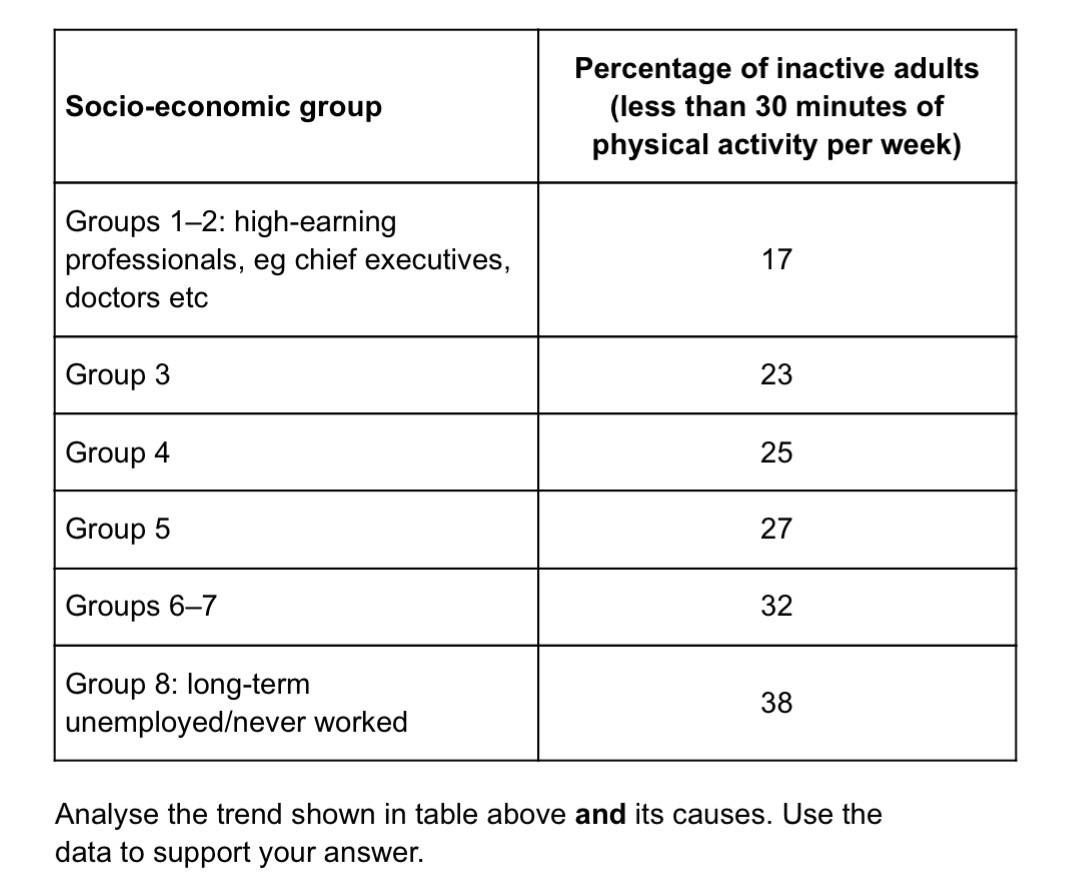
Trend:
• people in lower socio-economic groups are more likely to be inactive (Use of data to support), eg 38% of group 8/unemployed are inactive compared to only 17% of groups 1–2/High-earning professionals (1)
Causes (sub max 3)
• As they have less money, they are less able to afford to play sport (equipment, memberships fees, transport etc) (1)
• Areas with high levels of unemployment/low socio-economic classes have fewer facilities providing fewer opportunities (1)
• Lower socio-economic groups may be less well educated and not understand the benefits of participation in physical activity as well (1)
• Geographical causes, eg limited space, in inner-city area where lower socio-economic groups tend to reside (1)
• Schooling, eg state v private, with lower socio-economic groups generally attending state schools with fewer resources (1)
• Stereotyping, eg some sports have upper-class image, like equestrian sports putting off lower socioeconomic groups (1)
• Fewer role models in positions of responsibility for lower socio-economic groups (1)
Sport England works closely with local partners, such as the network of County Sports Partnerships.
Explain how the services provided by these partners allow Sport England to develop sport at a local level.
(4)
• Club development / better clubs (AO1) allows more people to participate (AO2)
• Coaching development / better coaches / more coaches (AO1) improves the standard of performance (AO2)
• Education programmes (AO1) increase awareness of the importance of health and fitness (AO2)
• Equality / targeted campaigns (AO1) working to increase participation among under-represented groups (AO2)
• Facility development / more / better facilities (AO1) allow more people to participate (AO2)
• Funding and support (AO1) for grassroots sports to provide the facilities / coaches / equipment to increase participation (AO2)
• Marketing and communication (AO1) to allow local clubs to spread the word about the opportunities which are available (AO2)
• Safeguarding (AO1) allows local clubs to provide safe environments so everyone feels comfortable taking part (AO2)
• Strategic network (AO1) working with other organisations to increase participation (AO2)
• Volunteer development (AO1) provide more volunteer coaches / officials so clubs can effectively cater for more participants (AO2)
Sportivate is a London 2012 legacy project. Its aim is to increase participation in sport.
Describe the features of a Sportivate project.
(1)
Lottery funded/run by Sport England
Aimed at 14-25 year olds/now 11-25 year olds
6-8 weeks/free coaching/subsidised coaching
Supports continued involvement after the project/exit routes to clubs
Inclusive to all/targets a variety of different social groups/disabilities/ethnic minority groups/disengaged with sport
The UK Government is encouraging organisations to increase participation in sport and active leisure.
How can schools and community sports clubs work together to increase participation in physical activity?
(4)
Publicise / advertise / notice boards;
Increase links between the two / visits / liaison / school–club links / personnel / coaches;
Dual use / sharing facilities;
Local / Government policy / eg PESSCLS / sports colleges / sport development officers / SSCOs;
Offer discounts / membership / subsidised use of facilities / youth sections;
Offer (increased) range of activities / roles / extra curricular activities;
Come and try days / taster sessions / holiday scheme;
Increased awareness of health and fitness issues.
The UK Government, through the Department for Culture, Media and Sport, funds Sport
England to promote and invest in grassroots and community sport.
What are the three key aims of Sport England?
(1)
Grow, Sustain, Excel
OR
Start, Stay, Succeed
Why has the UK Government become increasingly involved in developing specific policies to encourage participation in sport?
(4)
Sport seen as important part of society / people expect it / popular political vote;
Improves health / fitness of the population / concerns over obesity / prevention better than cure / prevents strain on NHS;
Helps prevent crime / social control;
Increase medal winners / national pride / feel good factor / standard of elite / talent ID;
Creates employment / gives people life skills;
Contributes to education policies;
Part of system of government’s joined up policies;
Wanting more control of sport / how money is spent / revenue from sport;
Social-cultural policies / integration of society / equal opportunities / regeneration; 2012 Olympics.
Many organisations, such as ‘Sport England’, are involved in the provision of sporting and physical recreational activities in the United Kingdom.
Identify some of the initiatives that Sport England has developed in order to achieve its objectives of “Grow, Sustain, Excel”.
(4)
Sports Colleges / School Sport coordinators / Competition Managers /
Sportsmark / Activemark / Clubmark / Sports partnership mark
Active Sports / schools / communities programme / Activ8
Step into Sport
Sporting equals
Sustainable Facilities
Recruit into Coaching;
Playground to podium
Whole sport plans
Women’s Cycling Network
Street Games
Sporting Champions
There are many influences which impact on an individual’s participation in sporting and recreational activities.
Name three ‘policies’ that Sport England has developed to encourage increased participation in sport.
(3)
Sports Colleges / School Sport coordinators / Competition Managers /
Sportsmark / Activemark / Clubmark / Sports partnership mark
Active Sports / schools / communities programme / Activ8
Step into Sport
Sporting equals
Sustainable Facilities
Recruit into Coaching;
Playground to podium
Whole sport plans
Women’s Cycling Network
Street Games
Sporting Champions
Why has the government in the United Kingdom (UK) become increasingly involved in developing specific policies to encourage participation in sport?
(4)
Sport seen as important part of society / people expect it / popular political vote;
Wanting more control of sport / how money is spent / revenue / taxes from sport;
Contributes to education policies;
Increased (psychological) health / fitness / obesity;
Effects on productivity / reduces demand on NHS;
Social control / reduced crime;
Employment opportunity;
Increase numbers of medal winners / patriotism / National pride / feel good factor / positive society;
Inclusiveness / reduce social exclusion / equal opportunities.
Explain how school provision can influence future participation in physical activities.
(5)
Amount of curriculum time / variety of activities;
Extra-curricular activities / clubs / teams;
School tradition / teachers’ influences;
Facilities / resources
Different roles / critical performer / leadership / officiating / coaching;
National Curriculum;
Gifted and talented;
Health / fitness benefits recognised;
Lifelong learning / lifetime sports / active lifestyle.
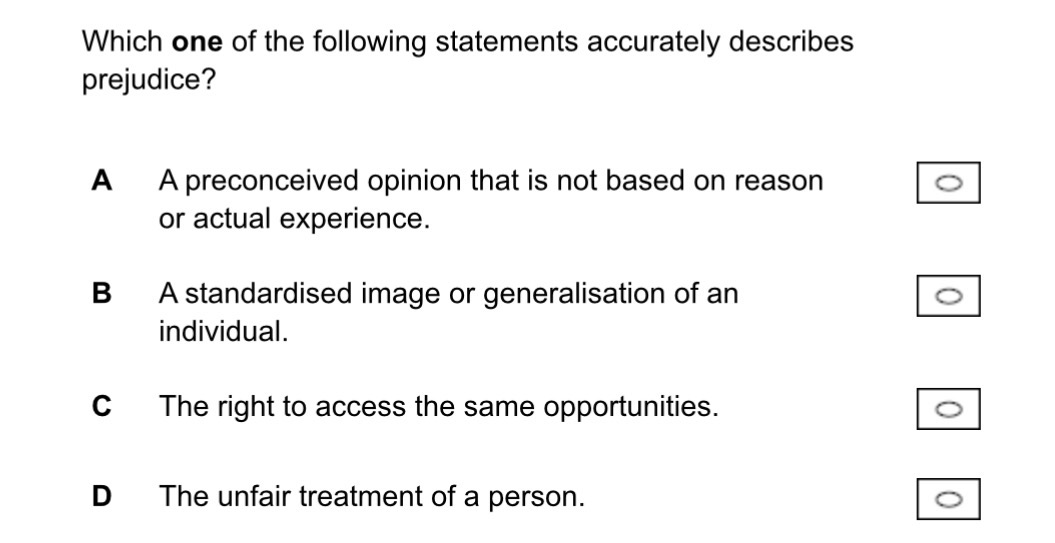
D
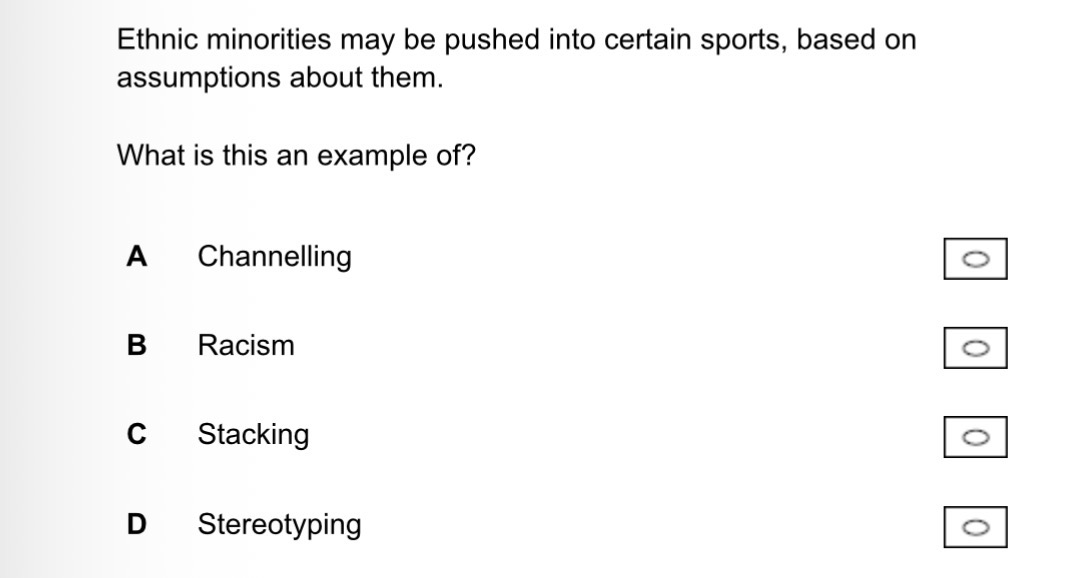
A
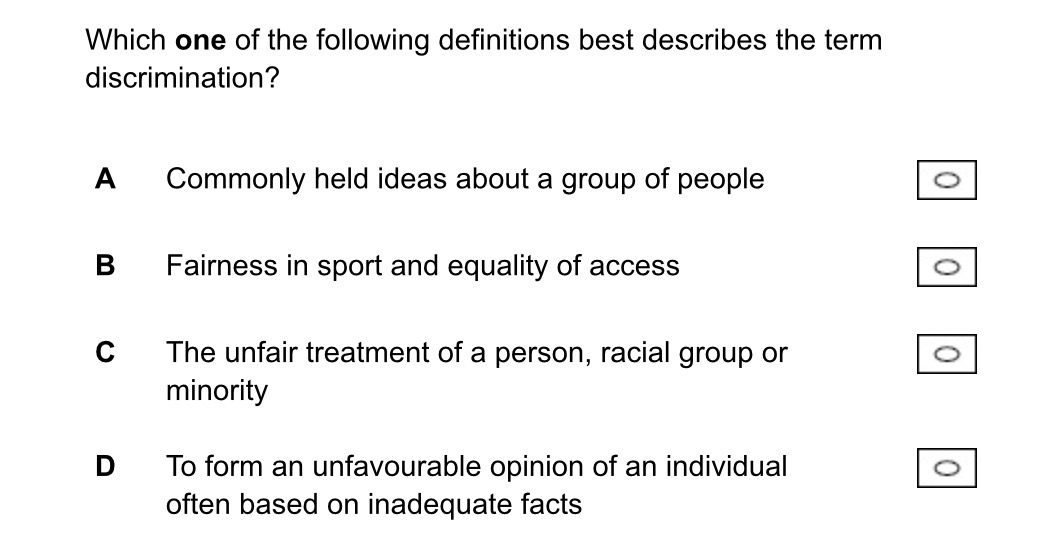
C
Identify three barriers to participation for people with a disability.
(3)
Lack of specialist coaches
Lack of specialist equipment
Lack of role models
Lack of specialist facilities
Lack of media coverage / education
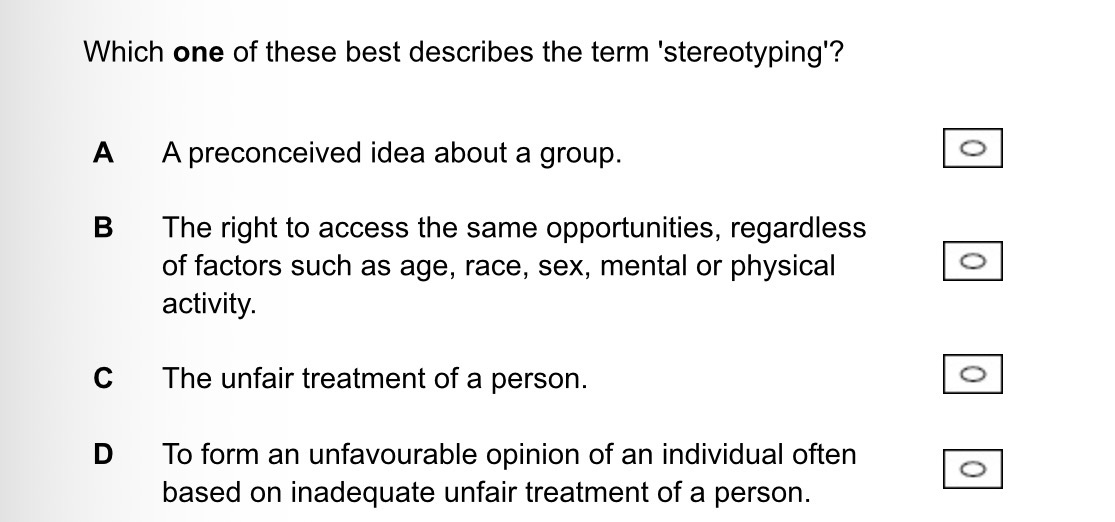
D
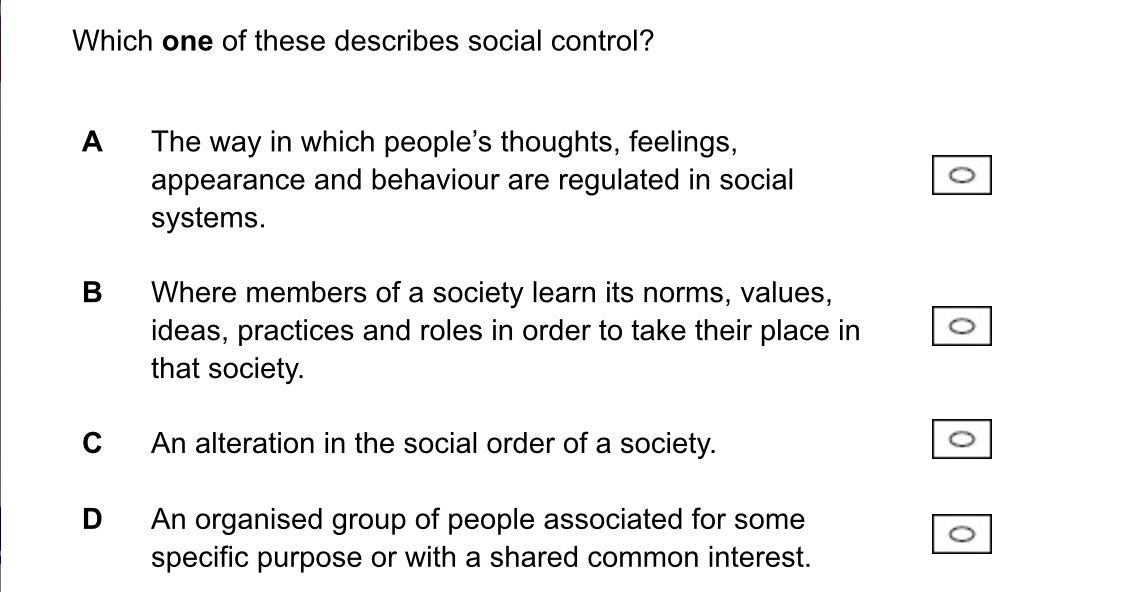
A
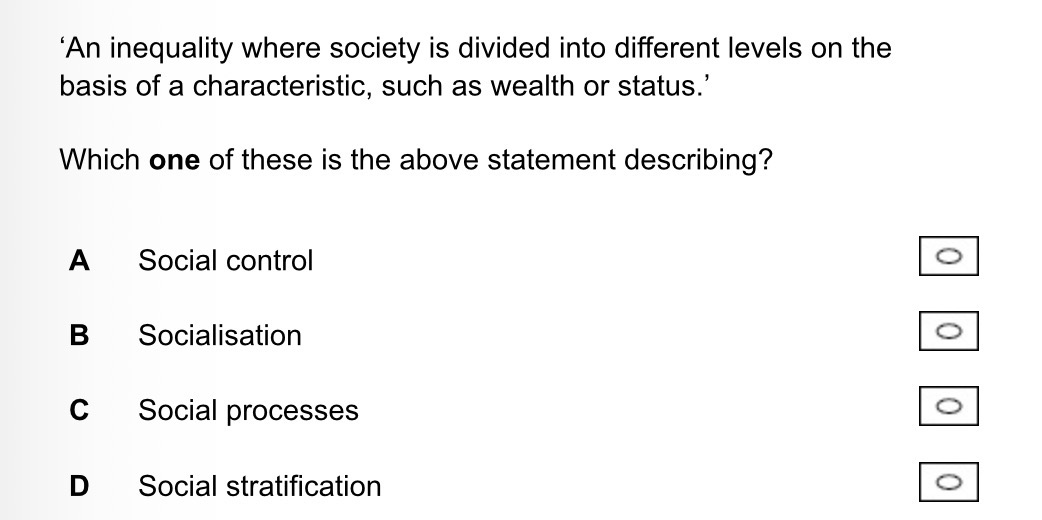
D
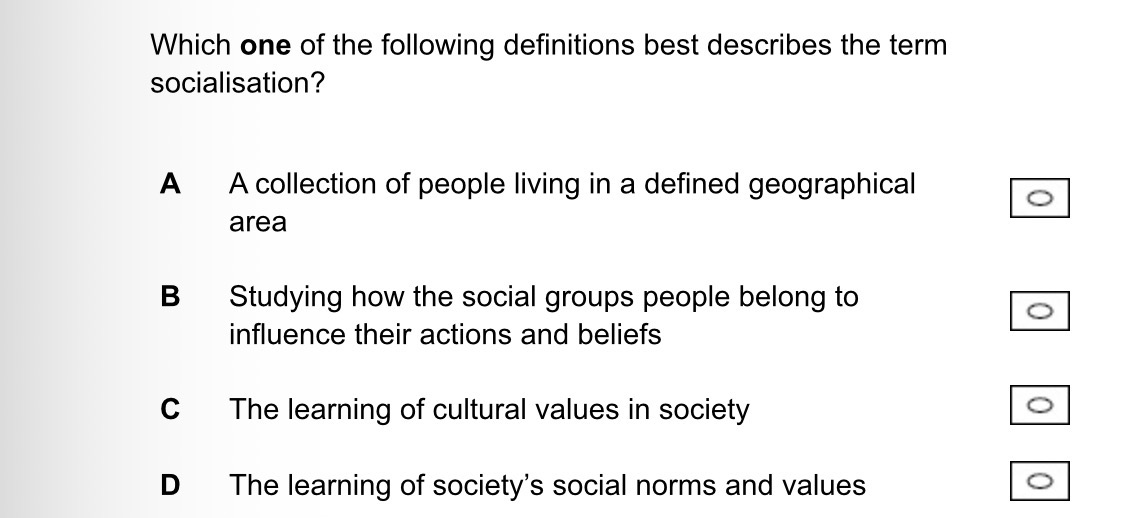
D
Explain how secondary socialisation within schools can influence children in sport.
(2)
• Teachers influence the adoption of positive/negative key values (1)
• Teacher/sports coach influences choice through their own enthusiasm (1)
• Channelling/demographic influences sports played (1)
• Peer group preferences leads to following others/complying with social norms (1)
Define social stratification. (1)
Social stratification is a type of social inequality / division associated to characteristics of wealth or status (1)
Some schools have skiing clubs. They take students on skiing trips abroad in the winter.
Explain why social stratification can affect participation rates in skiing.
(2)
• Those with increased wealth will be able to buy equipment to ski, compared to less wealthy (1)
• Increased wealth will allow individuals to travel to ski resorts (1)
• Those individuals that are able to participate in skiing because of wealth are more likely to compete in competitions / have coaching / lessons or become elite athletes (1)
• Lower participation rates from lower / working class people due to perception that skiing is a middle / upper class activity (1)
Consider the impact social stratification can have on sporting participation.
(4)
Type / choice of activity
• Social Class – may affect which activity choice is made – tennis / horse riding (1)
• Those with higher socio-economic status can select schooling (public / state schools) – better facilities in more affluent areas, some sports are still associated to wealth (1)
• It may be that sections or certain groups of society are still underrepresented in specific sports (1)
• Some in society may feel inferior / unwelcomed / embarrassed to participate in certain sports (1).
Number of opportunities
• Those individuals with more disposable income may be able to access clubs, facilities and resources more readily (1)
• It may be that sections or certain groups of society are still underrepresented in sport overall (1).
Time / money / transport
• Social Class – lower status families may place more emphasis on children working or contributing to chores / education (1)
• Social class may now not be having such an impact as there are clubs and facilities accessible for all classes (1).
‘Sport is a powerful force for bringing about social change.’
Evaluate this statement.
(3)
For (sub max 2)
• Sport has a large audience which allows it to highlight key issues in society. (1)
• Sport provides examples of people breaking down barriers / defying stereotypes which inspires others to follow. (1)
• Sport produces role models which can influence the behaviour of those who look up to them. (1)
• Sport can provide a positive use of leisure time which can reduce crime / deviant behaviour in society. (1)
• Sport provides opportunities which can boost social mobility. (1)
• Sport promotes values eg tolerance / respect which are then spread through society. (1)
• Sporting event / success can unite people which develops a sense of community in specific populations. (1)
Against (Sub max 2)
• Many of society’s major issues are still reflected in sport today which further embeds them in society. (1)
• For some issues the rate of change in society has been slow which suggested sport has a limited impact. (1)
• Not everyone is interested in sport which means messages can fail to spread / reach the whole population. (1)
• Sport has limited power to embed social changewhich means support from government / legislation is required. (1)
Sport England works with national partners to increase participation at grass roots level.
Sport England also works with local partners, such as Active Partnerships, to achieve its aims.
Identify two services provided by these partners.
(2)
• Clubs / club development / provide better clubs. (1)
• Coaching / coach development / provide better coaches / more coaches. (1)
• Education programmes. (1)
• Equality. (1)
• Equipment. (1)
• Targeted campaigns (eg workplace movement / school games). (1)
• Organise competitions. (1)
• Facilities / facility development / provide more / better facilities. (1)
• Funding. (1)
• Marketing / communication. (1)
• Safeguarding. (1)
• Networking. (1)
• Volunteer development. (1)
Sport England works with national partners to increase participation at grass roots level.
Name two national partners of Sport England.
(2)
• National governing bodies / any named national governing body eg FA, LTA, RFU. (1)
• English Federation of Disability Sport / Activity Alliance. (1)
• Women in Sport. (1)
• Sporting Equals. (1)
• Sports Aid. (1)
• Street Games. (1)
• UK Sport. (1)
• Youth Sport Trust (YST). (1)
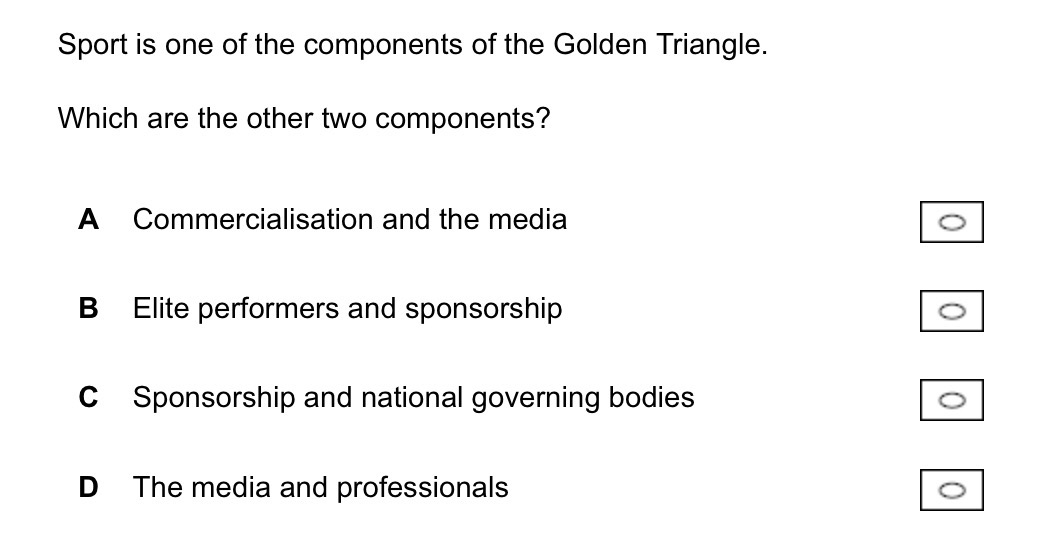
A