week 7 codon learning
 Call Kai
 Learn
Learn Practice Test
 Spaced Repetition
 Match
Match Flashcards
 Knowt Play
1/13

There's no tags or description
Looks like no tags are added yet.
Name | Mastery | Learn | Test | Matching | Spaced | Call with Kai | Chat |
|---|
No analytics yet
Send a link to your students to track their progress
14 Terms
REST is a transcriptional repressor that binds to silencer elements upstream of the DYRK1A gene. The gene that codes for REST has an upstream enhancer element with a mutation that prevents binding of an activator protein in patients with a familial form of Alzheimer’s disease. What would be the likely effect of this enhancer mutation on DYRK1A mRNA in these patients?
Higher expression
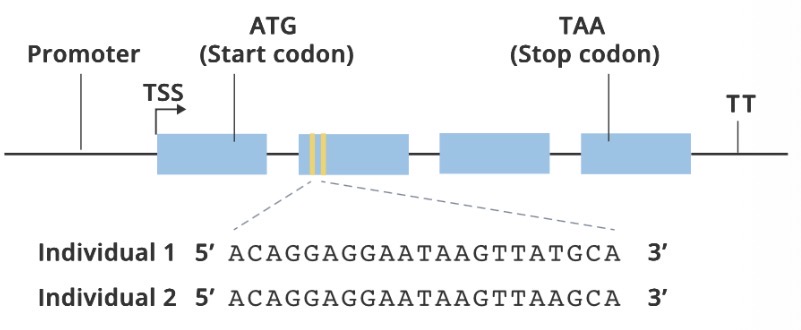
The indicated DNA sequences for two individuals are shown within exon 2 as indicated, with Individual 2 having a mutation. Both sequences are in-frame with the upstream start codon.
You isolate the mature mRNAs for each individual and run them on a northern blot. Compared with the mRNA for Individual 1, you find that the mRNA for Individual 2 is
The same length
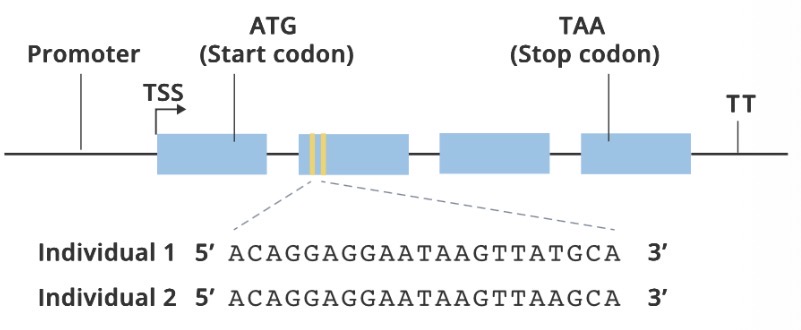
The indicated DNA sequences for two individuals are shown within exon 2 as indicated, with Individual 2 having a mutation. Both sequences are in-frame with the upstream start codon.
Regarding the proteins that are translated from the mRNA sequences described in the first question: Compared with the PROTEIN for Individual 1, you find that the PROTEIN for Individual 2 is
Shorter
miRNA, siRNA, or both: encoded in genome
MiRNA
miRNA, siRNA, or both: Typically exactly complementary to mRNA
SiRNA
miRNA, siRNA, or both: Typically imperfectly complementary to the 3’ UTR of an mRNA
MiRNA
miRNA, siRNA, or both: Originate from RNA viruses or are generated by scientists
SiRNA
miRNA, siRNA, or both: Cleaved by dicer
Both
miRNA, siRNA, or both: Forms a complex withe other proteins to form an RNA-induced silencing complex RISC
Both
miRNA, siRNA, or both: Can prevent the mRNA target from being translated or target the mRNA for degradation
MiRNA
miRNA, siRNA, or both: Only works by targeting mRNA for degradation
MiRNA
You are interested in manipulating the level of a protein called Pha-3 in a nemotode worm frequently used in genetics experiments (C. elegans). Pha-3 is usually expressed in pharyngeal cells, which are used for breaking down food. You have designed an siRNA to have exact complementarity to a section of the pha-3 mRNA. After treating C. elegans with this siRNA, you would expect to see:
____ pha-3 mRNA and ____ pha-3 protein compared to wild-type, untreated animals.
Less
Imagine you could shrink yourself so small that you could enter the nucleus of a friend's skin cell and observe their DNA. You notice that two different genes in your friend's cell have different chromatin structures. Gene A has tightly packed nucleosomes, and Gene B has loosely packed nucleosomes.
What other observations would you likely notice? Select the two best answers.
Responses
Activators can more easily bind to the DNA near Gene A than Gene B.
The amount of RNA being made from Gene B is greater than the amount of RNA being made from Gene A.
RNA polymerase is binding to Gene A's promoter and initiating lots of transcription.
Histone proteins near Gene A have lots of positive charges on them.
The amount of RNA being made from Gene B is greater than the amount of RNA being made from Gene A.
Histone proteins near Gene A have lots of positive charges on them.
In the chromosomal region that contains the ppk2 gene, the histones have different acetylation states in different cells types. In kidney cells, histones are acetylated in this region, and in liver cells, histones are not acetylated in this region. In an experiment, you add an excess of the HAT enzyme (which acetylates histones) to both cultured liver and kidney cells, and then measure ppk2 transcription (expression). Based only on the information in this question, in which cell type would you expect the ppk2 gene to be expressed?
Both kidney and liver