5. Scene Segmentation, Perceptual Organization, and Object Recognition in Visual Perception
 Call Kai
 Learn
Learn Practice Test
 Spaced Repetition
 Match
Match Flashcards
 Knowt Play
1/213

Earn XP
Description and Tags
figu
Name | Mastery | Learn | Test | Matching | Spaced | Call with Kai |
|---|
No analytics yet
Send a link to your students to track their progress
214 Terms
What is scene segmentation?
The process of partitioning a scene into multiple, meaningful elements, such as objects or object parts.
What are the neural pathways of object recognition
V1 — detects edges, lines, corners.
V4 — groups edges into shapes; important for perceptual organisation.
PIT (Posterior Inferotemporal cortex) — intermediate object features.
AIT (Anterior Inferotemporal cortex) — full object recognition; faces.
Prefrontal cortex (PFC) — decision making about what the object is.
Premotor cortex — planning actions.
Motor cortex — sending motor commands.
what are deep neural networks?
Use many hidden layers.
Early layers detect simple features (edges, colours).
Later layers detect complex objects (faces, cars, animals).
Mirrors the brain’s hierarchy: V1 → V4 → IT cortex.
What are the gestalt figure-ground cues
We are more likely to see something as a figure if it is:
Smaller
Lighter
Symmetrical
Convex
Closed
what are some additional figure ground cues
Movement — parts moving together form a figure.
Blur — figures are usually sharper than backgrounds.
Occlusion — figures block the background.
Shape — figures tend to have a stable base (not floating).
External edges — shading aligns with object edges, helping define shape.
Bottom‑up processing
Driven by stimulus properties- colour, edges, motion and brightness
Cues- properties of stimulus to grouping and figure-ground segregation determine what we see
Top‑down processing
Driven by prior knowledge- expectations, familiarity and context
Context helps identify blurry or ambiguous objects
Recognition of familiar objects determines how we perceive the scene
What are the gestalt grouping laws?
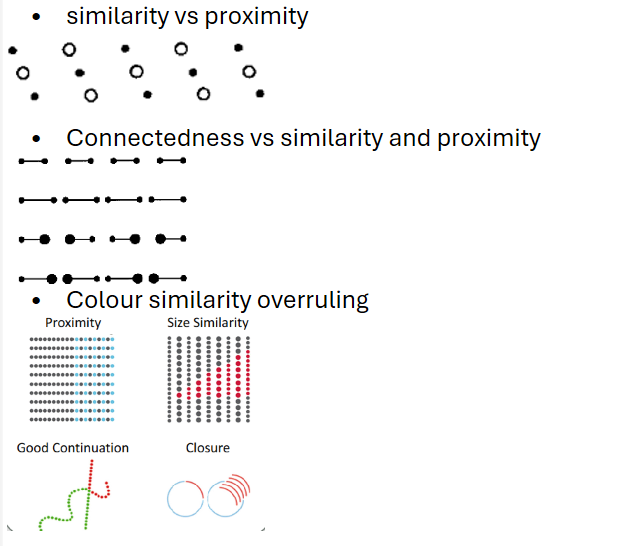
Proximity- elements close together are grouped
Similarity- similar-looking elements are grouped
Good Continuation- smooth, continuous lines are perceived as belonging together
Closure- incomplete figures are perceived as complete objects
Common Fate- objects moving together are grouped
Synchrony- elements changing simultaneously are grouped
what grouping cues can compete with each other?
Similarity vs proximity — similar items may group even if far apart, or close items may group even if dissimilar.
Connectedness beats both similarity and proximity — if two items are physically linked, we see them as one group.
Colour similarity can override other cues because colour is a strong grouping signal
What is the difference between figure and background in visual perception?
The figure is the object perceived to be in the foreground, while the background is the area surrounding the figure.
What challenges are associated with object and scene perception?
Finding boundaries of objects, separating objects from their backgrounds, and dealing with overlapping or blurry images.
What is perceptual organization?
The ability to understand how different elements in a scene belong together or are distinct, involving scene segmentation and perceptual grouping.
What is perceptual grouping?
The process of identifying elements that belong together in a scene.
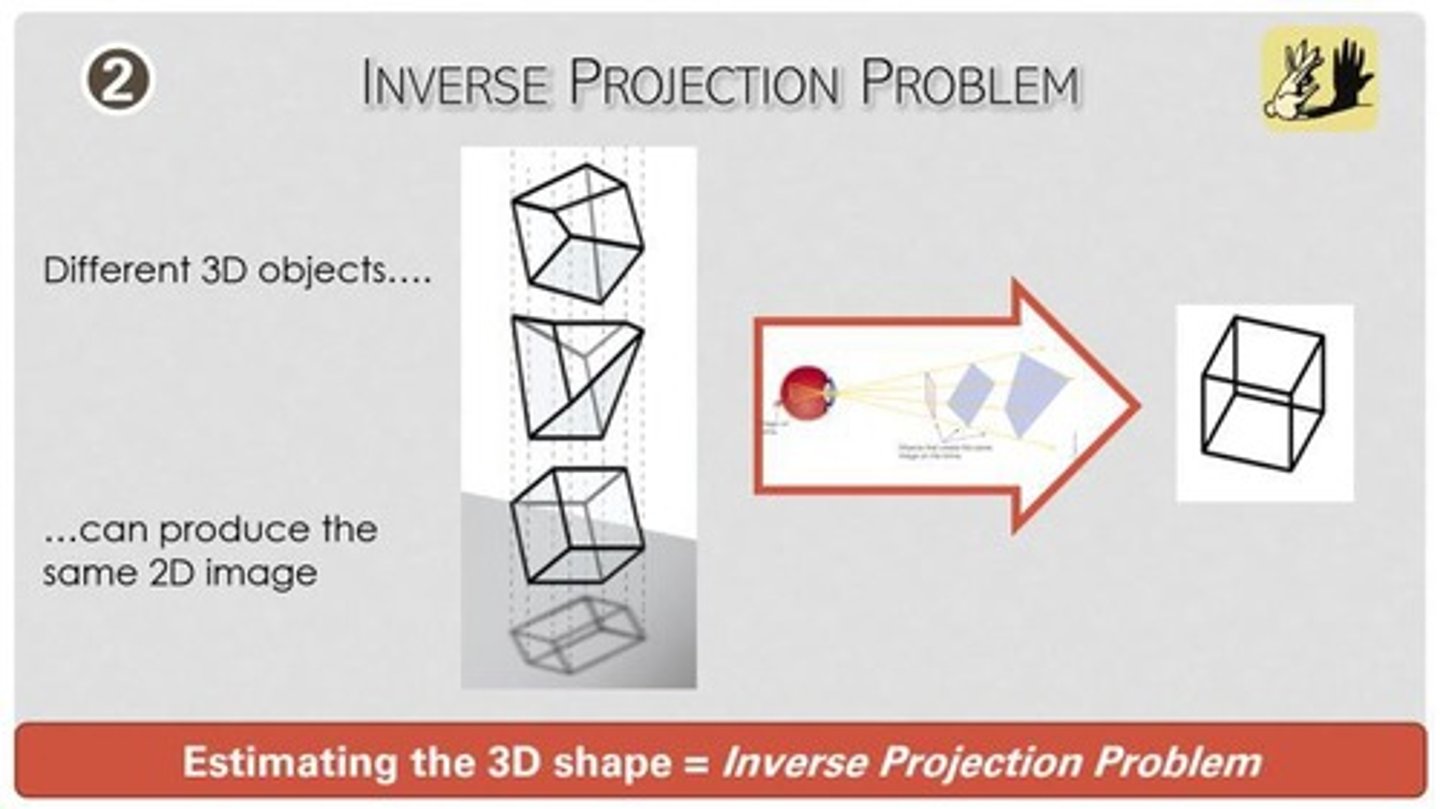
What is the inverse projection problem?
The challenge of estimating a three-dimensional shape from a two-dimensional projection.
How does our visual system deal with ambiguous two-dimensional projections?
It disambiguates the projection by estimating a corresponding three-dimensional shape.
What is the role of visual characteristics in scene perception?
color and edges for example, trigger inferences about objects and scenes.
What is an example of a fun illusion that challenges perception?
The goat or bird illusion, where the viewer must determine what they see based on visual cues.
How do military camouflage techniques relate to object perception?
They exploit the principles of scene segmentation to conceal objects in a visual environment.

What is the significance of object recognition in technology?
Companies like Google and Microsoft invest heavily in solving object recognition problems through artificial intelligence.
What does the term '3D interpretation' refer to in visual perception?
The ability to understand which parts of a scene belong to the same object and which parts are distinct.
What is a practical application of understanding object and scene perception?
Programming computers to segment images into meaningful objects.
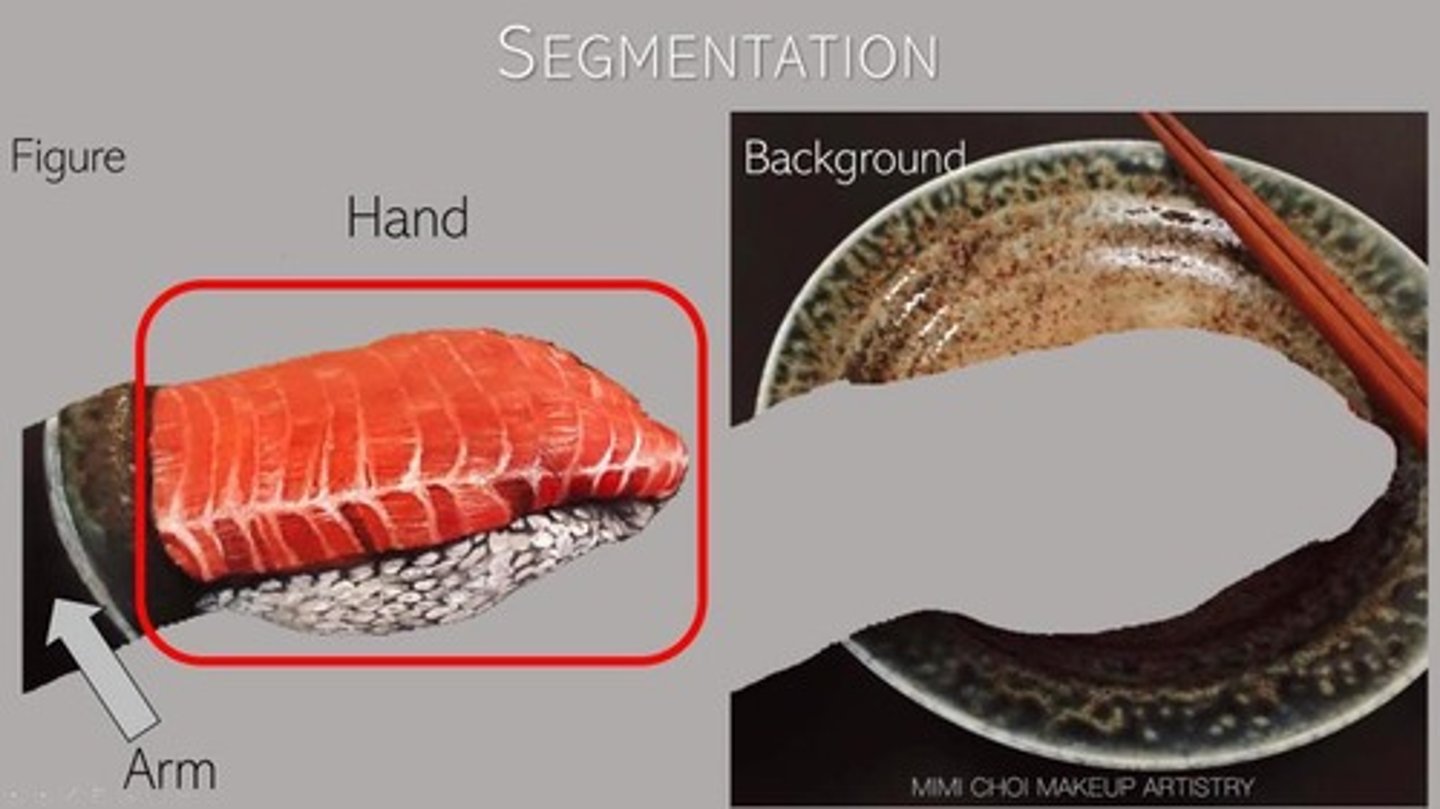
What is an example of an artwork that confuses scene segmentation?
A makeup artist painting a hand to look like sushi, merging it visually with the background.
What is the importance of understanding perceptual organization?
It helps in recognizing how we perceive complex scenes and can inform technology development.
What are the two complementary abilities involved in perceptual organization?
Scene segmentation and perceptual grouping.
How does the visual system interpret shapes in a two-dimensional image?
It often perceives shapes based on the assumption of three-dimensionality, even when the projection is ambiguous.
What is the effect of movement on object and scene perception?
Movement can complicate the ability to understand the composition of scenes, making perception more challenging.
What is the relationship between visual inferences and physical reality?
They can be automatic and seamless, but may not always align with the actual physical reality.
What is the role of cues in object recognition?
Cues help the visual system to identify and distinguish objects within a scene.
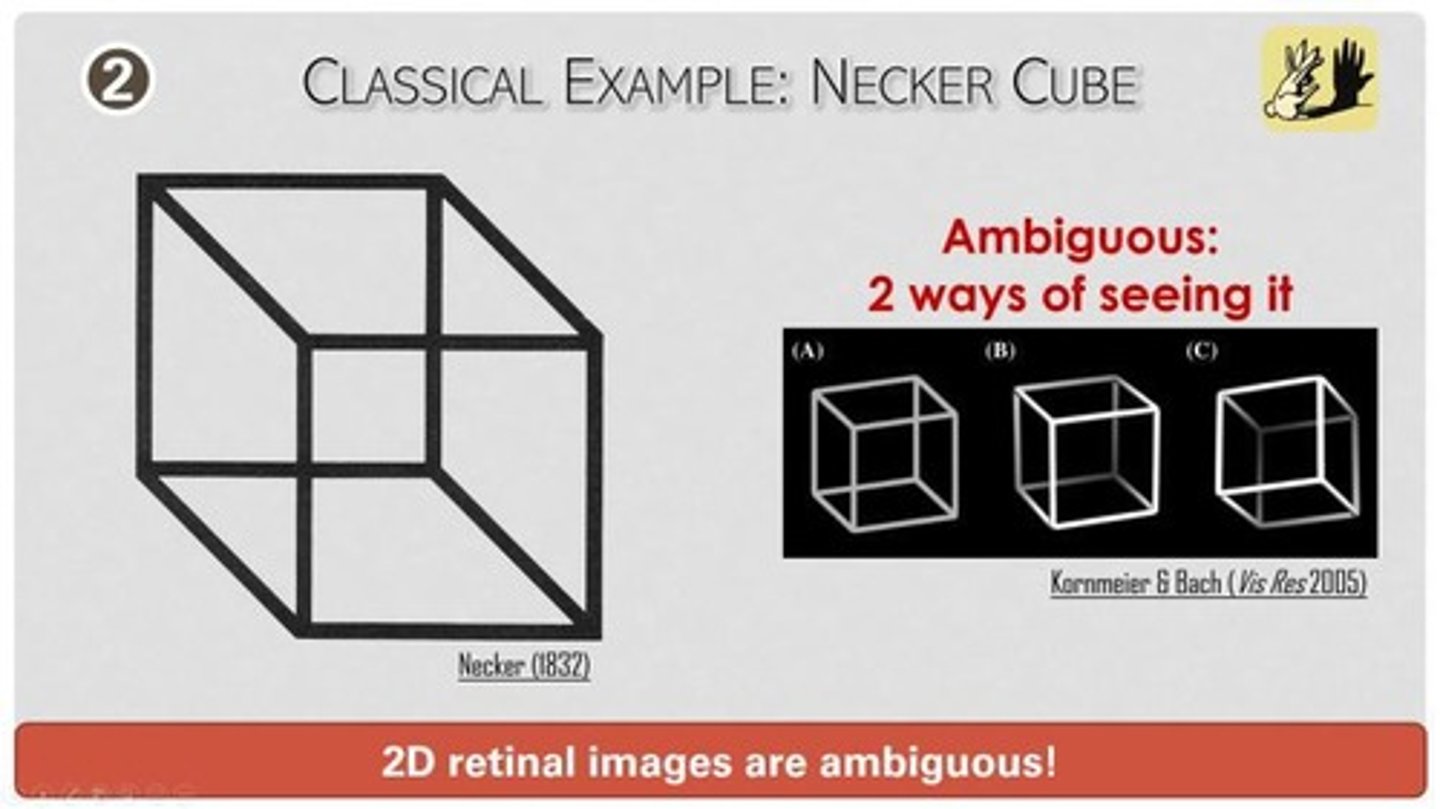
What is an example of a visual illusion that plays with perception?
The Necker cube, which can be interpreted in multiple ways. Either you can see the
lower square in front or you see the upper square in front
What is the main challenge of interpreting 2D projections?
Inferring three-dimensional configurations from two-dimensional projections on the retina.
What does perceptual organization involve?
Detecting whether there are objects and where they are in a visual scene.
What is the third problem in object recognition?
Recognizing the detected objects.
How does our visual system recognize objects independent of viewpoints?
By comparing the perceived object with known objects despite changes in the image on the retina.
What is a cue that can help in object recognition?
Providing specific information about an object, such as identifying an animal.
What is the significance of edges and colors in perceptual organization?
They help in organizing the scene and understanding the picture.
How does 3D interpretation assist in image segmentation?
It helps to organize the scene and understand the relationships between objects.
What was the finding of Fei-Fei and colleagues (2007) regarding scene perception?
measured how much we can see in black-and-
white images during very short presentations. Observers could recognize the gist of images in about 67 milliseconds. This time would
only be enough to roughly categorise the scenes, not to see single
objects and fine details.
What does the study by Thorpe and colleagues (1996) focus on?
Object recognition in complex real scenes and how quickly observers can spot whether a scene contained an animal or not. theydemonstrated that humans can categorise natural scenes extremely rapidly, with ERP differences emerging at ~150 ms. This shows that early object recognition relies on fast, feed‑forward visual processing rather than slow, attention‑dependent mechanisms.
What does the diagram from Thorpe and Fabre-Thorpe (2001) illustrate?
The time course of visual processing in the brain after an image is presented.
What is facial pareidolia?
The tendency to see faces in coincidental patterns that are not actual faces.
How quickly can our visual system recognize faces?
It can recognize faces independent of viewpoint or orientation almost instantly.
What is the role of facial expressions in object recognition?
Our visual system can interpret a range of facial expressions effortlessly.
What is the relationship between perceptual organization and object recognition?
They are interrelated; perceptual organization aids in recognizing objects.
What happens to recognition once the visual system understands how to organize an image?
Recognition of the object becomes automatic in future encounters.
What does the term 'gist of complex scenes' refer to?
The overall understanding of a scene that can be grasped quickly.
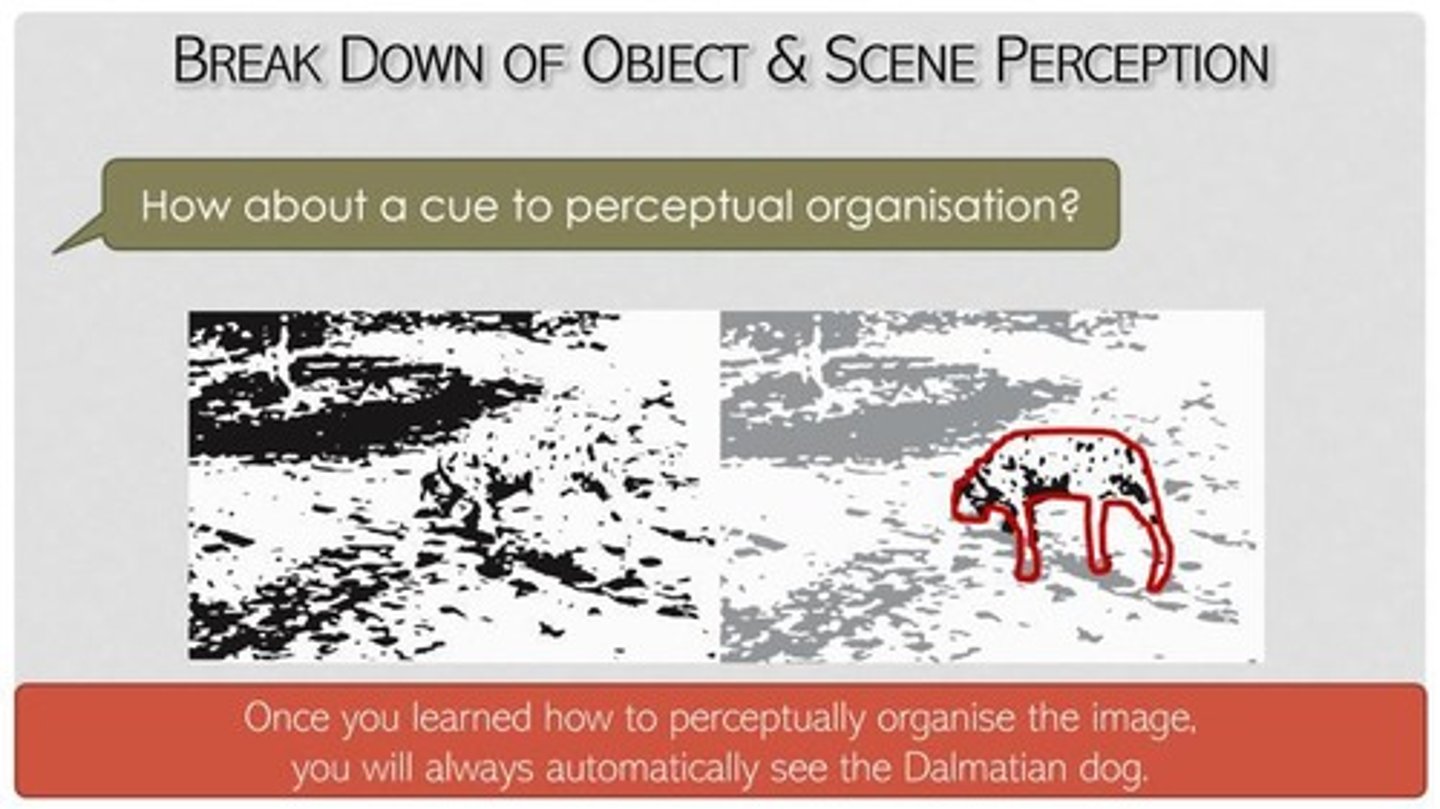
What is the significance of the Dalmatian example in the text?
It illustrates the challenges of object and scene perception and the interrelation of recognition processes.
What does the term 'segmentation' refer to in visual perception?
The process of distinguishing different objects within a visual scene.

What does the term '3D interpretation' involve?
Inferring the three-dimensional shape of an object or scene from its 2D representation.
How does the visual system categorize scenes?
By quickly processing visual information to identify the general type of scene.
What is the impact of background noise on object recognition?
It can hinder the ability to perceive and recognize objects clearly.
What is the role of the prefrontal cortex in visual processing?
It is involved in making perceptual decisions based on visual signals.
What can affect the speed of object recognition?
The complexity of the scene and the time allowed for processing.
What is the effect of rapid image presentation on recognition tasks?
It challenges the observer's ability to identify objects quickly.
What does the term 'object recognition' encompass?
The process of identifying and categorizing objects within a visual field. comparing the perceived object with objects we already know
What is the significance of the study's findings on EEG measurements?
They provide insights into the timing and processes involved in visual recognition.
What are the three major challenges of object and scene perception?
Perceptual organization, 3D interpretation, and object recognition.
What phenomenon illustrates how we perceive meaningful objects from random patterns?
Pareidolia.
What is the significance of the Dalmatian dog example in perception?
It shows how scene perception can break down and how we automatically perceive meaningful objects.
What does the Gestalt movement emphasize about perception?
The relationship between parts affects perception, and the whole experience must be considered.
How did structuralists approach the study of perception?
They believed perception could be decomposed into elementary sensations using introspection.
Who developed a systematic introspective analysis in the structuralist perspective?
Titchner, a student of Wundt.
What is the key idea expressed by Kurt Koffka regarding perception?
The whole is other than the sum of the parts.
What does the term 'Gestalt' mean in German?
Overall configuration.
What is an example of an illusory contour?
The Necker cube, which illustrates how perception can infer contours that do not exist.
What do illusory contours demonstrate about perception?
Perception creates something out of the arrangement of elements that does not exist in the isolated parts.
What is the concept of Prägnanz in Gestalt psychology?
A perceptual interpretation that is simplest, most compact, and stable.
How do ambiguous figures illustrate Gestalt principles?
They show that perception depends on the interpretation of the configuration rather than isolated elements.
What is the role of grouping cues in perception?
They help our visual system to organize and integrate elements into meaningful wholes.
What is the significance of the Necker cube in understanding perception?
It can be interpreted in multiple ways, illustrating the flexibility of perceptual interpretation.
What does the example of the moving dots illustrate about perception?
Perceptual grouping can make independent elements appear as a cohesive whole.
What does the Gestalt movement suggest about the interpretation of stimuli?
Perception is not determined by isolated properties but by the overall configuration.
What is the difference between the structuralist and Gestalt approaches to perception?
Structuralists analyze perception into elements, while Gestaltists view perception as a holistic experience.
What is an example of how context affects perception?
The same blob can be perceived as different objects depending on its orientation in a scene.
What is the implication of the phrase 'the visual system chooses one of many possible estimations'?
It suggests that perception is selective and influenced by context.
What is the role of historical context in the development of the Gestalt movement?
It arose in response to the structuralist perspective in the early 20th century.
How does the Gestalt movement view the experience of perception?
As a holistic experience that cannot be fully understood by breaking it down into parts.
What is the importance of the arrangement of elements in perception?
It is key to the perceptual experience of meaningful objects.
How do examples of apparent motion contribute to our understanding of perception?
They demonstrate how our visual system integrates elements to create the perception of movement.
What does the Gestalt movement suggest about the relationship between perception and configuration?
Perception depends on the interpretation of the overall configuration of objects and scenes.
What does the term 'grouping' refer to in the context of Gestalt psychology?
The process by which our visual system organizes elements into coherent groups.
What does the example of the shoe, car, and pedestrian illustrate about perception?
That the same visual input can be interpreted differently based on context.
What does the term 'Prägnanz' refer to in Gestalt psychology?
It refers to a perceptual interpretation that is simplest, most compact, and stable.
Who introduced the Gestalt laws?
Max Wertheimer
What do the Gestalt laws describe?
They describe how different parts of a picture or scene relate to each other.
What is the principle of proximity?
It states that closer elements tend to be grouped together.
What does the principle of similarity claim?
More similar elements tend to be grouped together.
What is the principle of good continuation?
Lines are perceived as continuing smoothly, without abrupt changes.
What does the principle of closure state?
Closed contours determine perceptual groups.
What is the principle of common fate?
Elements that move simultaneously tend to be grouped together.
What is the difference between figure and ground in Gestalt psychology?
The figure is perceived as a specific object, while the ground is the background.
What characteristics typically define a figure?
they tend to be smaller, lighter, closed by a border, symmetrical, and convex.
What is an ambiguous figure?
An image that can be perceived in multiple ways, such as Rubin's vase.
What role does lightness play in figure-ground perception?
Lightness can suggest which part of an image is the figure, but other cues can compete with it.
How does occlusion serve as a cue in figure-ground segregation?
it indicates which objects are in the foreground and which are in the background.
What are extremal edges?
Edges that result from 3D shading and texture gradients, helping to define figures.
What does the term 'good Gestalt' mean?
It refers to a perceptual interpretation that is coherent and well-formed.
How do Gestaltists view the laws of perception?
They view them as tendencies of the visual system to group elements together.
What is the significance of the principle of closure?
It allows us to perceive incomplete shapes as complete.
What is the effect of movement on figure-ground perception?
Movement can influence which elements are perceived as figures.
How do spatial frequency and shape contribute to figure-ground segregation?
They help distinguish between figures and their backgrounds based on their characteristics.