Atmosphere & Weather A level Geography 2027 spec
 Call Kai
 Learn
Learn Practice Test
 Spaced Repetition
 Match
Match Flashcards
 Knowt Play
1/33

There's no tags or description
Looks like no tags are added yet.
Name | Mastery | Learn | Test | Matching | Spaced | Call with Kai |
|---|
No analytics yet
Send a link to your students to track their progress
34 Terms
Order of the layers of the atmosphere
Troposphere
Stratosphere
Mesosphere
Thermosphere
Exosphere
TSMTE
Insolation (where does it occur)
Insolation is the incoming solar radiation, the main input into the energy budget. It is measured in watts per meter squared. Shortwave radiation, peak intensity is at the green spectrum. There is most insolation at the equator due to less curvature, more oblique angle as well as more albedo due to ice caps at the poles.
Outgoing terrestrial radiation (longwave) (mechanism)
This is the thermal energy emitted by earth back to space. As stuff gets heated by shortwave radiation, the particles vibrate faster. Heat is transferred, driven by temperature gradient. Longwave is more susceptible to being intercepted by greenhouse gases. Some of it is returned to earth in “back radiation”. Can also occur from dust particles in atmosphere
Absorption
The process by which radiation is retained by a substance and converted into internal heat energy. Occurs for both shortwave and longwave. It is converted into longwave radiation emissions that come from that particle, different from albedo because it heats the substance, whereas albedo doesnt. Occurs mainly by greenhouse gases in the atmosphere such as ozone, responsible for the greenhouse effect by things such as ozone and CO2.
Reflection
Incoming shortwave that is reflected, by the surface and clouds. This doesn’t change the wavelength. About 30% of shortwave is reflected at top of atmosphere (TOA). Shortwave that does not undergo reflection or absorption. The rate of reflection is driven by albedo effect, dark ocean absorbs more than light snow and ice, which reflects 95% of light.
Scattering
The process by which small particles diffuse or deflect incoming light. Unlike absorption doesnt convert into heat energy. Rayleigh scattering is when particles much smaller than wavelength of light (oxygen & nitrogen). Responsible for blue skies.
Conduction
Conduction is the transfer of heat through direct contact with molecules
Solar radiation heats the ground. The air molecules in the very thin layer touching the ground gain kinetic energy. Different surfaces conduct heat, but air is a very poor conductor so only the lowest few centimeters are affected
During the day heat is conducted to the air from the ground, whereas during the night heat is conducted from the air into the ground, part of diurnal energy budget. Surfaces with high conductive properties will also have more conductivity, leads to urban heat island effect due to asphalt having a high thermal heat capacity and being able to conduct and store heat more efficiently. Conduction is also a major factor in convectional rainfall
Back radiation
Back radiation occurs when the atmosphere emits longwave radiation downwards instead of allowing it to escape into space. Greenhouse gases like CO2, H2O and CH4 are selective conductors, they allow shortwave in but they don't allow longwave out. Once these gas molecules absorb it they reradiate it out, causing the longwave to be scattered back to earth.
Net longwave radiation is the difference between the outgoing terrestrial radiation and the back radiation
Latent heat transfer
Latent heat is the energy used to change states of matter without changing the temperature. It occurs during evaporation and condensation. In evaporation, when water turns to vapour, it “steals” heat from the surroundings. This cools the surface (evaporative cooling), as the energy is stored within the water molecules, cooling things down. When condensation occurs, latent heat is released, from the water vapour as temperature when it condenses. This warms air
Sensible heat transfer
Sensible heat is when there is no change in state. Sensible heat transfer mainly occurs during convection when there is a temperature gradient, and conduction. This occurs in the tricellular model as sensible heat transfers heat latitudinally, vertical transfer (ground heat flux) during the diurnal cycle, and in the urban heat island effect, where the heat in the ground is not evaporated out due to the asphalt surfaces not having moisture
Why is there an imbalance of energy between the poles and equator (3)
Suns strike at a more oblique angle at the equator so will be spread out over a smaller area, as you go poleward the rays are spread out over a larger area due to the curvature of the earth
There is more scattering at the poles due to a higher angle of incidence (separate reason)
Poles have more albedo so more is reflected away
Seasonality becomes more extreme poleward, impacts energy received
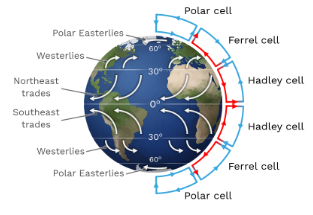
Direction of Hadlley cells
Goes left in Southern hemisphere, right in Northern.
Jetstream
The jetstream is very sinuous (curvy) meaning it is sometimes above or below the UK
These are known as Rossby waves, means that the UK can be above jetstream even in the summer. As Rossby waves become more extreme they break off, producing anticyclones.
Anticyclones are periods of unusually warm weather and are a high pressure system
Jetstream migrates south in winter and north in summer
Jetstream brings poor weather and rain
Components of the tricellular model
Hadley, ferrel, polar. Hadley is closest to the equator
Between Hadley cells is the ICTZ
The ICTZ shifts north in the summer and south in the winter
Impacts of high/ low pressure on temperature + rainfall
High temperature causes low pressure - due to rising air, increased rainfall
low temperature causes high pressure - less rainfall, sinking air
This creates coriolis winds
Semipermanent pressure cells and monsoons
Semipermanent pressure cells are a large stable mass of high or low pressure air that stays in place for weeks to months. Occur due to unequal distribution of land and sea. In a low pressure system the sun heating the ground warms faster, causing the hot air to rise. If ground is cold then cold air will sink and high pressure system is created. Pressure cells are driven by seasonality, not as much high pressure systems in the South hemisphere winter as the sea doesn’t warm as quickly. This system is responsible for monsoons in India as low pressure in Central Asia during Summer will cause air to flow over Western Ghats and create very rainy monsoons and orographic rainfall
Land has a low specific heat capacity
Thermohaline system
Ocean currents such as the gulf stream are responsible for 20% of total energy transfer.
There are large currents called gyres that circulate water between regions.
All gyres in the North go clockwise, all in Southern hemisphere go anticlockwise, driven by coriolis effect and jetstreams
Cold currents have less temperature and thus less evaporation, creating arid regions
Warm currents have more temperature and thus more evaporation, creating rain
There are also vertical currents, driven by salinity. Unsalty hot water flows on the surface to the poles. The water is frozen, taking out the freshwater and leaving salt increasing salt concentration. The more salty water is colder and heavier so sinks and travels back
Relationship between atmospheric and oceanic transfers.
Places that are more land dominated such as the Northern hemisphere will fluctuate more with seasonality than coastal regions like the Southern hemisphere
Absolute humidity
Absolute humidity is the amount of moisture in the air
Relative humidity
Relative humidity is the amount of moisture in the air relative to the total amount of moisture it can hold (given as a percentage)
Saturated air
Saturated air is air with a relative humidity of 100%, cant hold anymore
Dew point defenition
Dew point is the temperature at which condensation occurs, allowing the formation of dew mist or fog. The dew point is much higher for warm air than cold air.
Frontal rainfall
Two different air masses of differing temperature and humidity meet forcing the warm above the cold. They do not mix due to the differing densities and therefore this forms a front. The warm air is less dense so it rises, and the cold air forces the warm air over. The warm front cools adiabatically, until it reaches dew point temperature. Below the dew point the air begins to condense out water. At a warm front this creates large stratus clouds. The rain drops coalesce until they fall as rain.
The warm front brings longer rain and drizzle. Because the cold front causes the warm front to rise faster this causes brief but intense rain, then followed by clear weather, this is because there is high pressure due to the sinking air so that rain cannot occur. The cold front causes nimbostratus clouds
This rainfall is common in temperate areas where the hadley and feral cells meet, like UK
Orographic (frontal) rainfall
An orographic barrier causes moist air to rise as it flows over a mountain. This causes the air to cool adiabatically. The air rises until it reaches dew point. Thus rain occurs on the mountain. On the lee side of the mountain a rain shadow is formed, because the moisture has decreased. Example is in South East England, which is a rain shadow from the much wetter Welsh highlands.
Convection rainfall
Sun heats the ground, warming the shallow layers of air immediately above (boundary layer) by conduction. This air is warmer than the surrounding air so it rises. Parcels of more buoyant air start moving up, this is a form of sensible heat transfer. Air is drawn in filling the voids left behind, this creates cells. As the air rises it cools adiabatically with the expansion of the parcel, the temperature increases as the pressure rises when the air sinks.
The dew point is reached so condensation will form cumulus clouds. Latent heat release will continue to cause the air to rise leading to the development of a cloud. This process drives the ITCZ.
A thermal is a consistently rising patch of air
What are hygroscopic nuclei
Particles which have a high affinity for water, which causes water vapour to turn into water droplets, as they bind around them. Include things such as salt, smoke, smog, dust particles.
What is bergeron theory
How rain forms from cold clouds. There are both snow and water droplets present. The snow has a lower vapour pressure so it draws the water droplets towards it and grows heavier. The snow becomes too heavy for the updrafts and falls, cooling adiabatically.
How does snow form
Bergeron theory, snow droplets coalesce and grow. if the air temperature is below 0 it will fall as snow.
Formation of hail
Hail is more typical of summer, and forms in the tops of cumulonimbus clouds, due to their cold temperatures. This requires turbulence, so is more typical in turbulent conditions.
Hail begins with a strong updraft that brings water droplets into the freezing part of the cloud. Water droplets freeze into ice pellets, which act as nucleus from which more ice can accumulate around. As it moves up and down through the cloud it collides with supercooled water droplets which then freeze onto the ice pellet immediately, adding a new layer of ice in a process called accretion. This forms layers in the hail. There are opaque layers of what froze high in the cloud and clear ice from the warmer parts where there is more water. The hailstones continue to move up and down within the updraft until they are too heavy, falling to the ground as hail.
Dew
When the ground cools rapidly overnight, the air directly next to it cools by conduction/ direct heat transfer. This means that the water moisture will condense onto the surface. This happens due to radiation cooling at night, the air directly next to the ground will become much colder. Occurs most often when there are clear skies and cold ground
Advection fog
As warm air passes over a cooler surface, the air closest to the ground will cool, through conduction. As the air cools, its dew point decreases, and it is no longer able to hold the water. This is released from the air as water vapour, which coalesces about hygroscopic nuclei, and forms fog
Requires wind, moisture, temperature difference
Upslope fog
Upslope fog occurs as wind wind causes warm moist air to rise up a slope, such as a hill. This means that there is adiabatic cooling, and the air will undergo adiabatic cooling
Radiation fog
There is diurnal cooling at night due to terrestrial outgoing radiation. Layer in contact with the ground cools due to conduction. Relative humidity rises, drops to its dew point temperature. Condenses around hygroscopic nuclei
Requires clear skies, to minimize back radiation, high relative humidity. Common in winter as nights are longer. .
Counter radiation
The greenhouse effect, where outgoing radiation is absorbed by greenhouse gases and reemitted in all directions, including back to the earths surface.