AP Econ: chapter 20
 View linked note
 Call Kai
 Learn
Learn Practice Test
 Spaced Repetition
 Match
Match Flashcards
 Knowt Play
1/12

There's no tags or description
Looks like no tags are added yet.
Name | Mastery | Learn | Test | Matching | Spaced | Call with Kai |
|---|
No analytics yet
Send a link to your students to track their progress
13 Terms
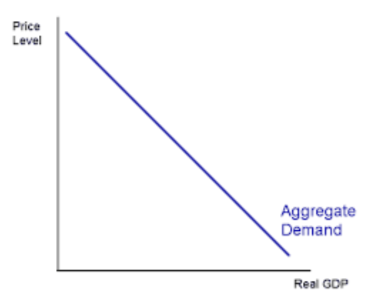
Aggregate Demand
Represents the total amount of Real Gross Domestic Product (RGDP) purchased by households, businesses, government, and foreigners at various price levels.
Real Balances or Wealth Effect
Describes the phenomenon where higher price levels reduce purchasing power, leading to lower demand for goods and services, while lower price levels increase purchasing power, resulting in higher demand.
Interest Rate Effect
Explains that higher price levels lead to higher interest rates, reducing the quantity of loans taken and thus decreasing the demand for goods and services, while lower price levels result in lower interest rates, increasing loans taken and demand.
Net Export / Foreign Purchases Effect
Indicates that at higher price levels, foreign interest in exports decreases, reducing the demand for goods and services, whereas at lower price levels, foreign interest in exports increases, boosting demand.
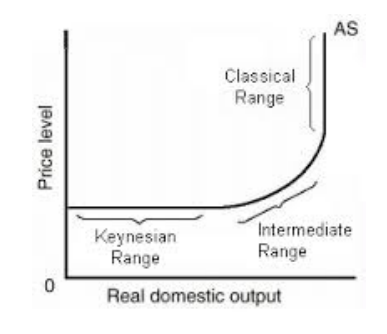
Aggregate Supply
Illustrates the total amount of RGDP produced at different price levels.
Keynesian Range
Reflects a scenario where prices, wages, and interest rates are fixed, typically seen during a recession with negative RGDP growth for two consecutive quarters.
Intermediate-Range
Represents a phase where the economy is moving towards full employment, characterized by a typical upward-sloping supply curve.
Classical Range
Occurs when the economy is at full employment, with flexible prices, wages, and interest rates, and any downturn is expected to be short-lived.
Ability to produce and cost of production
Factors influencing Aggregate Supply shifts, including resource prices, technological changes, taxes, subsidies, and regulations.
What do federal fund rates and interest rates equal?
r
How do you help stagflation?
You have to increase the aggregate supply curve.
Demand-pull
When the aggregate demand curve shifts up and there is no change to unemployment or to RGDP
Cost-push
When the aggregate supply curve leftwards and there is an increase in price level and in unemployment