CATA Unit 3 Concepts
 Call Kai
 Learn
Learn Practice Test
 Spaced Repetition
 Match
Match Flashcards
 Knowt Play
1/40

Name | Mastery | Learn | Test | Matching | Spaced | Call with Kai |
|---|
No analytics yet
Send a link to your students to track their progress
41 Terms
what is the rule for input and outputs of functions?
can have multiple x’s but not multiple y’s (vertical line test)
x rule for functions
cannot have multiple y outputs
y rule for functions
can have multiple x’s
even function equation
f(-x)=f(x)
odd function equation
f(-x)=-f(x), you can factor out a -1 and within the () should be the original f(x)
what do odd roots mean for the domain?
(-∞, ∞) always
what do even roots mean for the domain?
set the expression to be ≥ 0
how do you put turning points in interval notation?
if both lines include it, they are excluded () in notation
reflecting over x axis impacts
the y outputs
vertical stretch impacts
y points
-A means
points reflect over x axis, multiply by it
| A | > 1 means
stretch, multiply by it
-B means
reflect over the y
|B| > 1 means
you compress by multiplying by the reciprocal
0 < |B| < 1 means
you stretch by multiplying by the reciprocal
-C means
you add to the x, move to the right
+C
you subtract to the x, move to the left
+D means
add to y, move up
-D means
subtract to y, move down
constant, certain quadratics, absolute values are all
even
linear, cubic, cube root, and reciprocals are all
odd
exponential and square roots are
neither
when there is a quadratic on the bottom how do you find the domain?
set it ≠ 0 and factor to domain
equation for average rate of change
f(x2)-f(x1) / x2 - x1
A and D
impact the y
B and C
impact the x
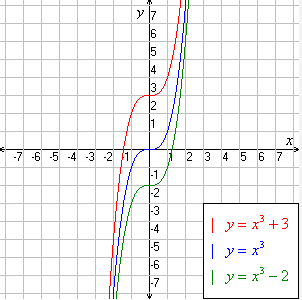
cubic equations look like
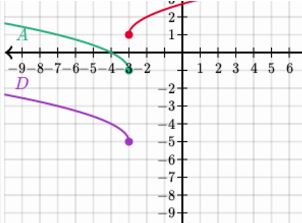
square root equations look like
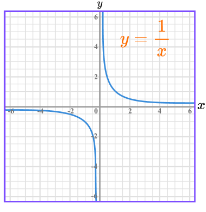
reciprocal equations
y= a/x
f(x) + 3
up 3
f(x +3)
left 3
f(4x-3)
multiply x by ¼ then add 3
-2f(x)+1
reflect over x by multiplying, up 1 by adding
how do you algebraically check if a function is one to one?
set the equation equal to itself and make one side x sub 1 and the other x sub 2
what is the difference quiotient?
f(x+h) - f(x) / h
how do you find the domain of a square root function?
set it more than or equal to zero
how do you find the domain and range of the inverse of a function?
the domain of the OG function is the range of inverse, and range of the OG function is the domain of the inverse
how do you test if an equation is one to one?
horizontal line test, no repeating xs or ys
how do you find the domain of a polynomial over another?
factor the denominator and those are the excluded points
how can do you make something one to one?
create domain restriction so it passes the horizontal line test
can you square root > or < equations?
never, have to factor and test critical points