Module 9: Cellular Energy Metabolism - Mechanisms of ATP generation
 Call Kai
 Learn
Learn Practice Test
 Spaced Repetition
 Match
Match Flashcards
 Knowt Play
1/18

There's no tags or description
Looks like no tags are added yet.
Name | Mastery | Learn | Test | Matching | Spaced | Call with Kai |
|---|
No analytics yet
Send a link to your students to track their progress
19 Terms
What is the electron transport chain (ETC)
final step of cellular respiration
uses donated e- from NADH FADH2 to make atp
made up on 5 protein complexes embedded in inner membrane (named 1-5)
what are the baseline roles of the first four protein complexes in the ETC
to accept e- and shuttle them along
pump protons out of the mitochondrial matrix into the intermembrane space
what are the two electron carriers and what do they do
coenzyme Q and cytochrome c
shuttle the electrons between protein complexes
e- do not diffuse well by themselves through membrane
charged and will not traverse through hydrophobic interior of membrane
these carriers are lipid soluable
what in the proteins accept the e-?
proteins themselves are not reversibly reduced and oxidized
there are several redox centres within them that are
redox centres are categorized as:
coenzymes
Fe-S clusters
cytochromes
Cu
each protein contains 2 or more combination of these types of redox centers
Electron pathway from NADH
first donates to complex 1 → complex 3 → complex 4
electron pathway fro FADH2
is a prosthetic group that is covalently boound to the enzyme succinate dehydrogenase (apart of complex 2), thus starts at:
complex 2 → 3 → 4
where do the two electron carriers shuttle electrons
conenzyme Q: through membrane to complex 3
cytochrome c: electrons from complex 3 to complex 4
why do the electrons move/shuttling?
due to reduction potential
NADH has low affinity for electrons (reduction potential)
O2 (final e- accepter) has high affinity
all the redox centers between these two have increasing reduction potential, hence there is an attraction gradient where the e- is pulled through
complex 1
takes e- from NADH and gives it to coE Q (ubiquinone)
it also pumps protons across the membrane → gives it to ubiquinone → becomes QH2 (ubiquinol)
complex 1 uses electron gradient of e- movement to pump 4H+ from matrix (inside) to intermembrane space (outside)
creates proton gradient for ATP
complex 2
succinate to ubiquinone (CoQ)
recall: succinate from the citric acid cycle
FAD accepts two e- from succinate (in citric acid cycle)
e- → via iron-sulfur centers to ubiquinone → reduced QH2 (in ETC)
no proton transport
complex 3
ubiquinone (CoQ) to cytrochrome c
uses two e- from QH2 to reduce two molecules of cytochrome c
4 H+ transferred to intermembrane space
complex 4
4 e- used to reduce one oxygen molecule into two H2O molecules
4 H+ picked up from the matrix in process
other 4H+ passed from matrix to intermembrane space
what are the numbers of protons pumped from each complex
after e- pass through protein complex with a redox center lower in reduction potential to a redox center with a higher reduction potential, E released
complexes harness that E to drive a proton pump mechanism: matrix → intermembrane space
complex 1 and 3: 4 protons for each pair of e- that passes through
complex 4: only 2 for each pair of e-
complex 2: none
what is the effect of shuttling e- and proton pumping
chemiosmotic gradient across the inner mitochondrial membrane
where high conc of protons outside the inner membrane relative to inside matrix
protons can only be moved through proteins as membrane is impermeable to charged compounds
gradient itself is called electrochemical (due to both electrical - charges, chemical - pH change)
potential energy is stored in the chemiosmotic gradient
which can be converted to ATP
how is ATP synthesized through oxidative phosphorylation
ADP is turned to ATP through oxidative phosphorylation
catalyzed by complex 5 (F1-F0 atp synthase)
complex 5 is composed of multiple subunits
F0 subunit: proton channel that spans the inner mitrochondrial membrane
responsible for allowing protons to enter the matrix
F1: bulbous portion of the complex on the matrix side on inner membrane
comprises of the ATP synthase enzyme responsible for making ATP (catalyzes hydrolysis of ATP)
How is ADP → ATP in regards to the subunits of complex 5
F0: protons pass through from outside to inside of matrix → drives atp synthase in f1 subunit
F1: atp synthase has ADP + Pi present in the active site
proton going through F0 drives conformational change in the active site, driving the catalysis of ATP
Yield of ATP per NADH and FADH2
one NADH pumps 10 protons, yielding 3 ATP
one FADH2 pumps 6 protons, yielding 2 ATP
how many ATP generated from the breakdown of glucose
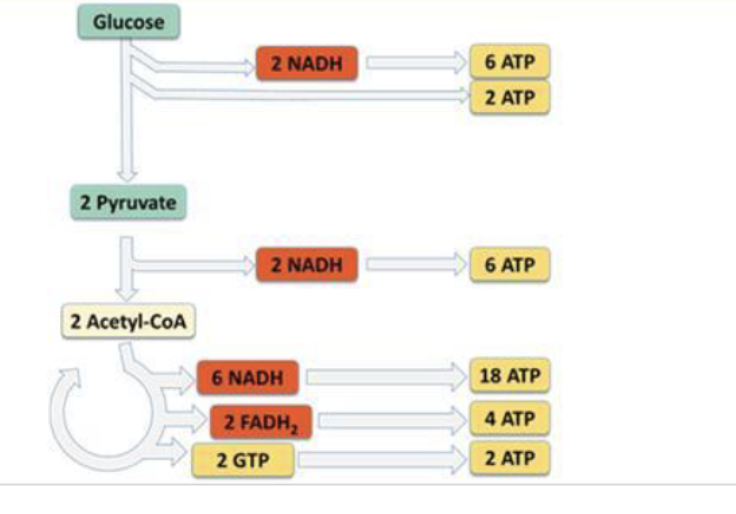
note: GTP is equiv to ATP
total: 38 per glucose molecule that is oxidized
the pyruvate to atp is in the pyruvate dehydrogenase reaction
What do electrons from the cytosolic (happening in cytosol, not mitochondria) NADH must do before getting to the ETC
NADH generated inside mitochondria through pyruvate dehydrogenae rxn and citric acid cycle will have easy access to the ETC
NADH generated from glycolysis (in cytosol) will not have access to ETC
e- must be transported through proteins as it is relatively impermeable
no NADH transporter → 2 mechanisms where NADH donates electron to intermediate which goes past membrane:
glycerol-3-phosphate shuttle
malate-aspartate shuttle