Nervous System Structures: Circulatory, BBB, Meninges, Ventricles, and Autonomic Functions
 Call Kai
 Learn
Learn Practice Test
 Spaced Repetition
 Match
Match Flashcards
 Knowt Play
1/75

There's no tags or description
Looks like no tags are added yet.
Name | Mastery | Learn | Test | Matching | Spaced | Call with Kai |
|---|
No analytics yet
Send a link to your students to track their progress
76 Terms
What is the function of the brain's blood supply?
To provide oxygen and nutrients necessary for brain function.
What percentage of total oxygenated blood does the brain receive?
About 15%.
Which arteries supply blood to the brain?
The vertebral arteries and the internal carotid arteries.
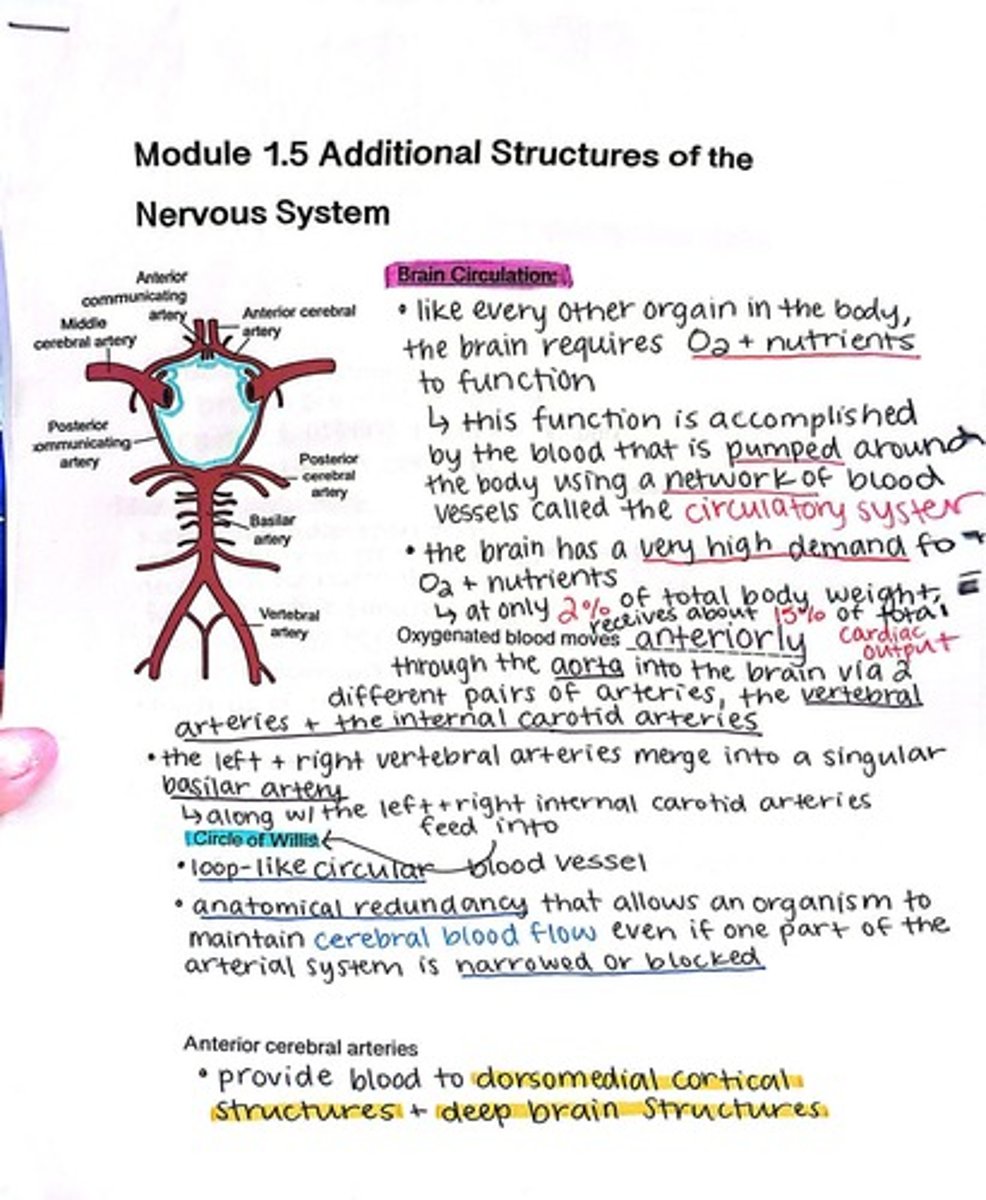
What is the Circle of Willis?
A loop-like circulatory blood vessel that provides anatomical redundancy for cerebral blood flow.
What do the anterior cerebral arteries supply?
Blood to dorsomedial cortical structures and deep brain structures.
What is the role of the blood-brain barrier (BBB)?
To selectively transport substances necessary for brain function while excluding harmful invaders.
What are the three layers of the meninges?
Dura mater, arachnoid mater, and pia mater.
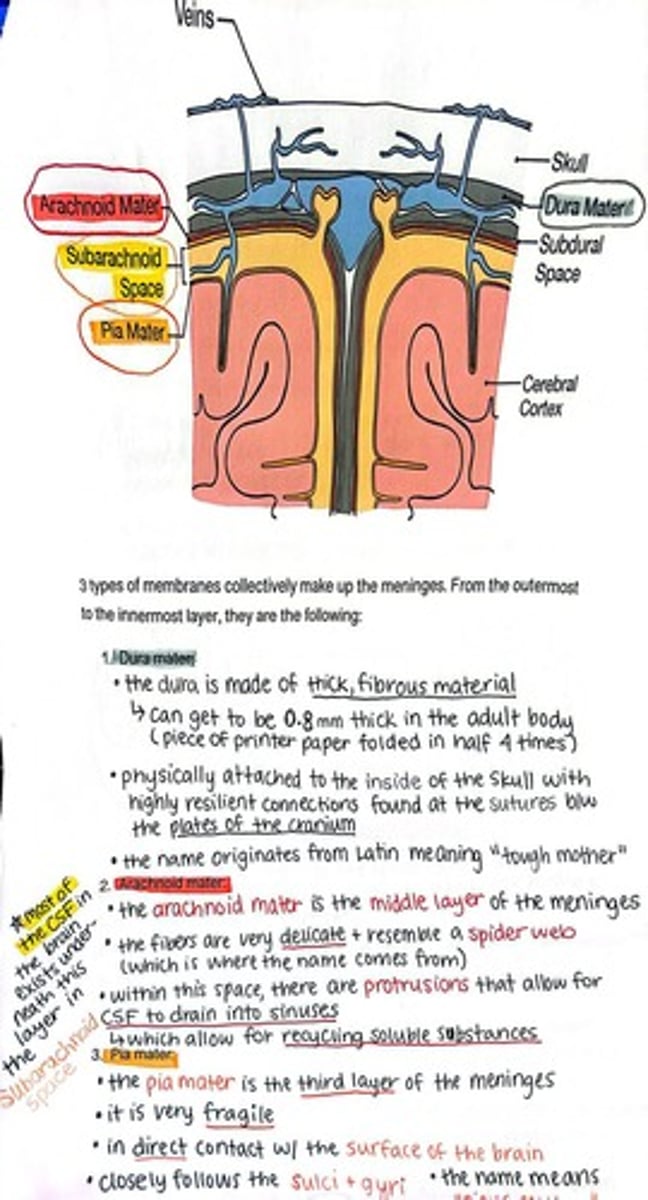
What is the dura mater?
The outermost layer of the meninges, made of thick, fibrous material.
What is the arachnoid mater?
The middle layer of the meninges, characterized by delicate fibers resembling a spider web.
What is the pia mater?
The innermost layer of the meninges, fragile and in direct contact with the brain's surface.
How many ventricles are in the human brain?
Four ventricles.
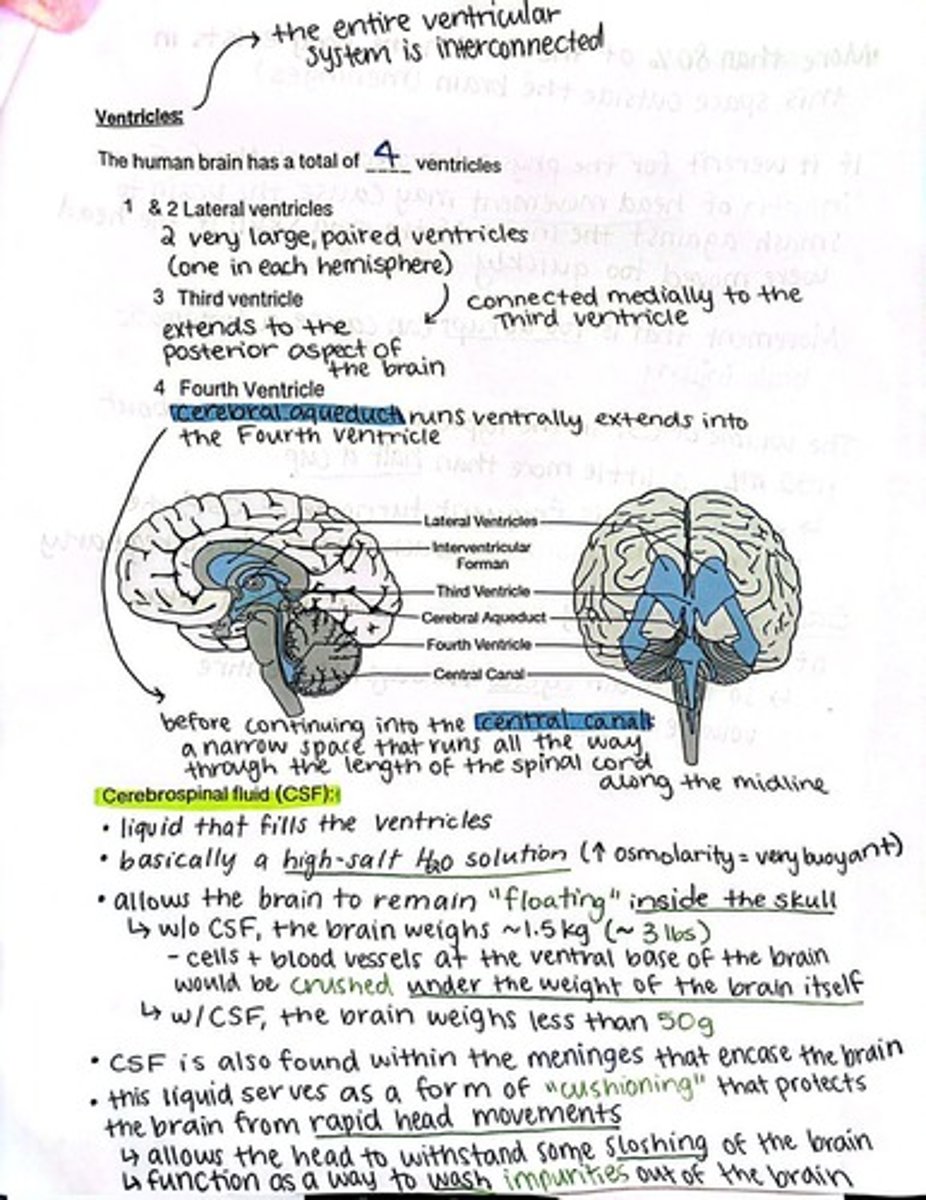
What is cerebrospinal fluid (CSF)?
A liquid that fills the ventricles and provides cushioning for the brain.
What is the primary function of CSF?
To protect the brain from rapid head movements and wash impurities out of the brain.
What happens to the brain's weight when CSF is present?
The brain weighs less than 50 grams due to buoyancy from CSF.
What is the volume of CSF in a typical human body?
About 150 mL.
How much CSF does the body produce daily?
About half a liter.
What is the significance of the blood-brain barrier's selectivity?
It makes drug delivery to the brain challenging, as many therapeutic drugs cannot cross it.
What is L-DOPA used for?
To increase the brain's levels of dopamine, as dopamine cannot cross the BBB.
What anatomical feature allows for the drainage of CSF into sinuses?
Protrusions in the arachnoid mater.
What is the role of astrocytes in the blood-brain barrier?
They help form the barrier and support endothelial cells.
What happens to the brain without CSF?
The brain would be crushed under its own weight.
What is the function of the central canal?
It runs through the length of the spinal cord and is part of the ventricular system.
What is the anatomical redundancy provided by the Circle of Willis?
It allows for continued blood flow to the brain even if one part of the arterial system is blocked.
What is the relationship between the meninges and the spinal cord?
The meninges surround the brain and extend down the spinal cord.
What is the significance of the BBB being a double-edged sword?
While it protects the brain, it also complicates drug delivery for treatments.
What is the primary role of the middle cerebral arteries?
To deliver blood to the lateral cortices of the brain.
What anatomical feature protects the brain from injury during head movement?
The meninges and cerebrospinal fluid.
What are the three branches of the Peripheral Nervous System (PNS)?
Somatic Nervous System, Autonomic Nervous System, Enteric Nervous System.
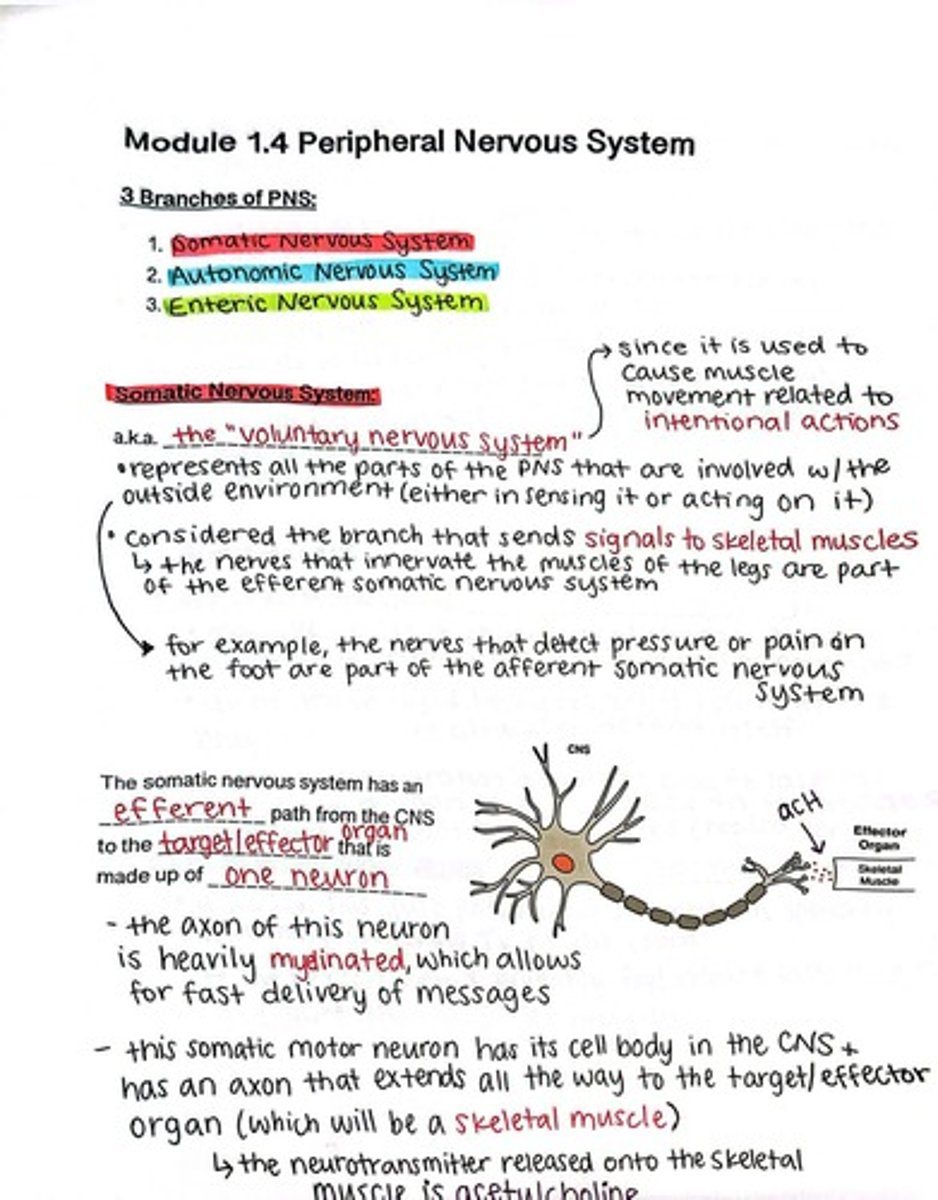
What is the Somatic Nervous System also known as?
The voluntary nervous system.
What is the primary function of the Somatic Nervous System?
To cause muscle movement related to intentional actions.
What types of muscles does the Somatic Nervous System innervate?
Skeletal muscles.
What is the difference between afferent and efferent pathways in the Somatic Nervous System?
Afferent pathways carry signals from sensory receptors to the CNS, while efferent pathways send signals from the CNS to skeletal muscles.
How many neurons are involved in the efferent pathway of the Somatic Nervous System?
One neuron.
What neurotransmitter is released by the somatic motor neuron onto skeletal muscles?
Acetylcholine.
What does the Autonomic Nervous System (ANS) encompass?
All branches of the PNS that deal with the internal environment.
What types of functions does the Autonomic Nervous System control?
Functions and responses that occur unconsciously without intentional control.
What are the two main branches of the Autonomic Nervous System?
Sympathetic Nervous System and Parasympathetic Nervous System.
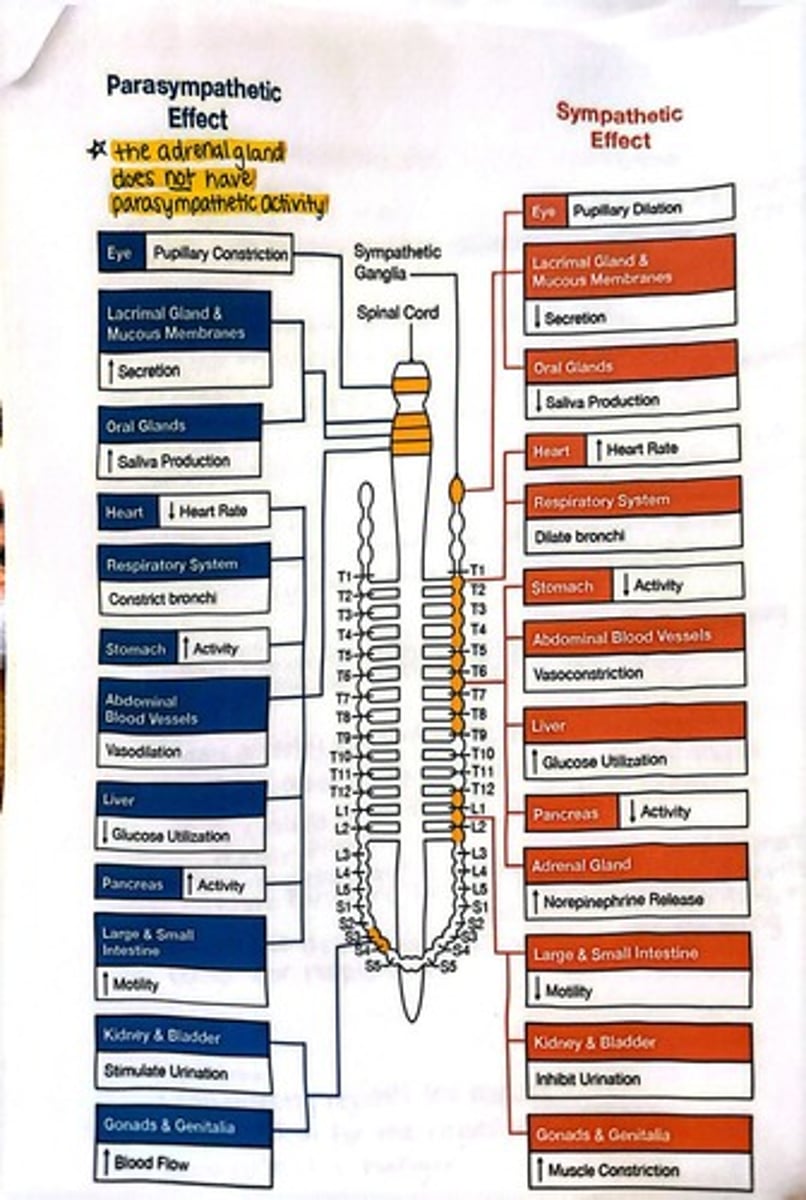
What is the primary role of the Sympathetic Nervous System?
To mobilize physiological changes in response to threats (fight-or-flight response).
What physiological changes occur during the fight-or-flight response?
Increased respiration and dilation of blood vessels in muscles.
What is the primary role of the Parasympathetic Nervous System?
To promote rest-and-digest responses.
What neurotransmitter is primarily used in the Parasympathetic Nervous System?
Acetylcholine.
How does the communication pathway differ between the Sympathetic and Parasympathetic Nervous Systems?
Sympathetic uses short presynaptic neurons and long postsynaptic neurons; Parasympathetic uses long presynaptic neurons and short postsynaptic neurons.
What neurotransmitter does the postganglionic neuron release in the Sympathetic Nervous System?
Norepinephrine.
What is meant by the term 'antagonistic' in relation to the Sympathetic and Parasympathetic Nervous Systems?
They typically have opposite effects at target tissues.
What types of tissues are influenced by the Autonomic Nervous System?
Smooth muscle, cardiac muscle, glands, and organs.
What is the role of the Enteric Nervous System?
To control the functions of the gastrointestinal system.
What happens to blood pressure during a fight-or-flight response?
Blood pressure increases due to physiological changes mobilized by the Sympathetic Nervous System.
What is the effect of acetylcholine at the target tissues of the Parasympathetic Nervous System?
The effects can be either stimulatory or inhibitory depending on the properties of the postsynaptic receptor.
What is the primary function of the autonomic nervous system?
To regulate involuntary bodily functions, including heart rate, digestion, and respiratory rate.
What are the two main divisions of the autonomic nervous system?
Sympathetic and parasympathetic nervous systems.
What effect does sympathetic activity have on the pupils?
Pupillary dilation.
What effect does parasympathetic activity have on the pupils?
Pupillary constriction.
How does sympathetic activity affect heart rate?
It increases heart rate.
How does parasympathetic activity affect heart rate?
It decreases heart rate.
What is the effect of sympathetic activity on stomach activity?
It decreases stomach activity.
What is the effect of parasympathetic activity on stomach activity?
It increases stomach activity.
What role does the medulla play in autonomic control?
It directly controls autonomic activity and receives information via the vagus nerve.
What is the function of the hypothalamus in the autonomic nervous system?
It regulates the medulla and is critical for water balance, temperature control, and hunger.
What is the enteric nervous system responsible for?
Regulating digestive functions of internal organs like the esophagus, stomach, and intestines.
What is dual innervation in the context of the autonomic nervous system?
Target organs receive connections from both sympathetic and parasympathetic neurons.
What is the effect of sympathetic activity on saliva production?
It decreases saliva production.
What is the effect of parasympathetic activity on saliva production?
It increases saliva production.
What is the role of cranial nerves in the autonomic nervous system?
They control motor functions and carry sensory information, primarily related to the head.
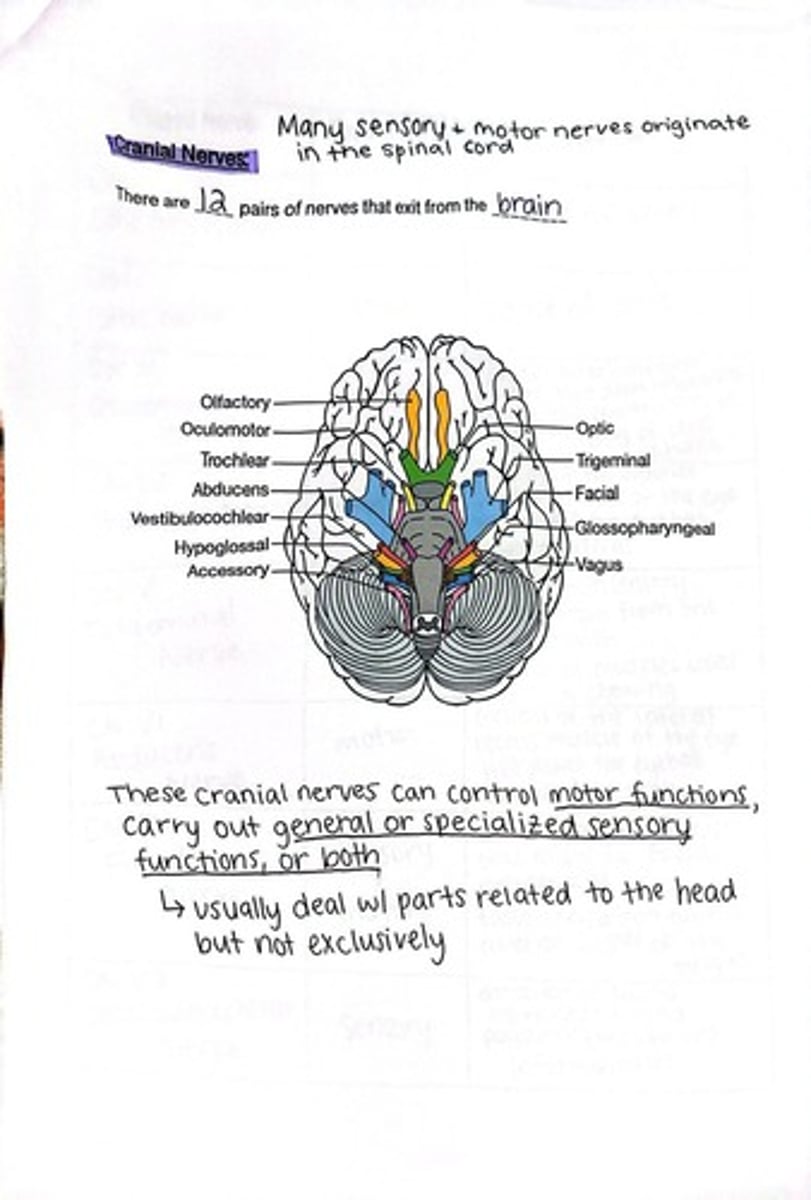
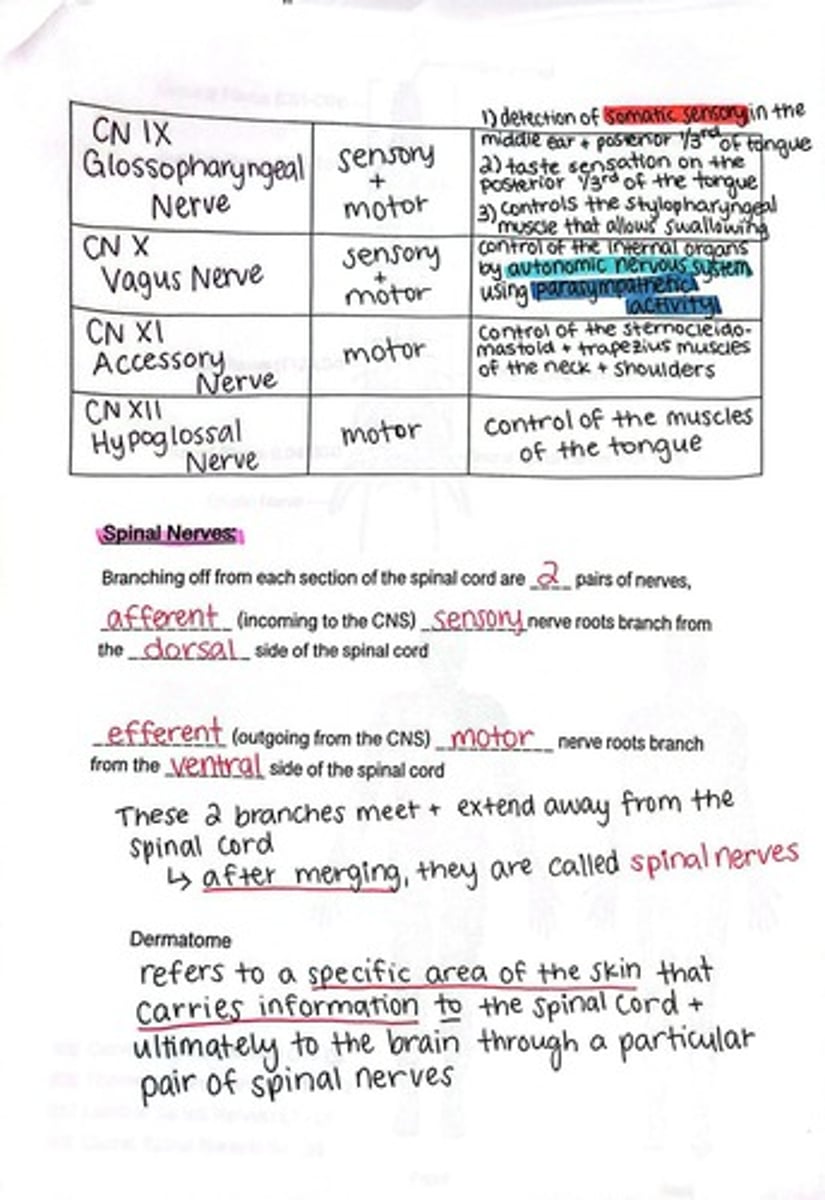
What is the function of the vagus nerve?
It controls internal organs through the autonomic nervous system, primarily using parasympathetic activity.
What are the spinal nerves responsible for?
They carry sensory and motor information to and from the central nervous system.
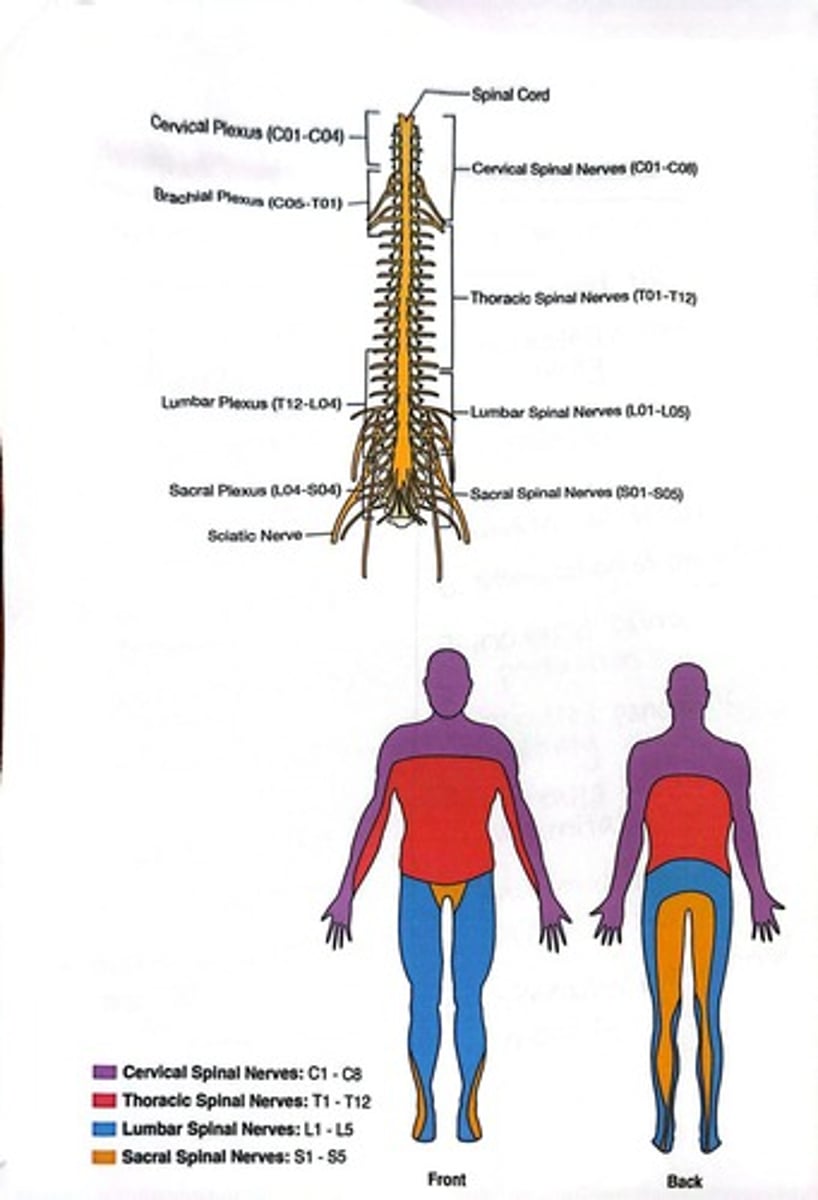
What is a dermatome?
A specific area of skin that carries sensory information to the spinal cord.
What is the sympathetic effect on blood vessels?
It causes vasoconstriction of abdominal blood vessels.
What is the parasympathetic effect on blood vessels?
It causes vasodilation of abdominal blood vessels.
What is the effect of sympathetic activity on glucose utilization in the liver?
It increases glucose utilization.
What is the effect of parasympathetic activity on glucose utilization in the liver?
It decreases glucose utilization.
What is the role of the limbic system in the autonomic nervous system?
It is responsible for visceral responses associated with emotional states.
What are the cranial nerves responsible for taste sensation?
Glossopharyngeal nerve (posterior 1/3 of the tongue) and facial nerve (anterior 2/3 of the tongue).
How does sympathetic activity affect kidney and bladder function?
It inhibits urination.
How does parasympathetic activity affect kidney and bladder function?
It stimulates urination.
What is the effect of sympathetic activity on intestinal motility?
It decreases intestinal motility.
What is the effect of parasympathetic activity on intestinal motility?
It increases intestinal motility.