Chapter 14 - Social Media Marketing
 Call Kai
 Learn
Learn Practice Test
 Spaced Repetition
 Match
Match Flashcards
 Knowt Play
1/29

There's no tags or description
Looks like no tags are added yet.
Name | Mastery | Learn | Test | Matching | Spaced | Call with Kai |
|---|
No analytics yet
Send a link to your students to track their progress
30 Terms
Digital Marketing
Digital marketing is a catch-all term for the use of technology in marketing
An adaptive, technology-enabled process by which firms collaborate with customers and partners to jointly create, communicate, deliver, and sustain value for all stakeholders
Technology is the key diver in digital marketing
Digital disruption in marketing has occured due to technology that enables:
Data capture – because you can see real-time consumer activity through metrics, analytics and insights
Globalisation – because organisations gain wider access to their online presence
Marketing agility – because data is gathered in seconds, it enables marketing teams to change campaigns in minutes, create websites in days or launch businesses in weeks
Data Capture
As marketers, we can capture evidence and gain insights within days not years
Called the datafication of business
Worldwide data protection legislation has continued to grow
The ethics of data use and protecting our privacy are two major issues. It requires greater trust and transparency within organisations in how they collect and use our data.
Globalization
Technology- businesses in one country can sell products to consumers in anther country
Businesses have discovered new markets, employed more people and created new products all of which lead to prosperous economies
Products and workers’ lives have been disrupted by technology
Globalisation is often considered to be a positive economic approach, yet it can damage the environment and lead to inequality
Downsides of Globalization
Has a wider impact on the environment
Increasing inequalities
Digital Nomads
People who use digital technologies to work remotely, they have the ability to work and travel simultaneously, have autonomy over frequency and choice of location, and visit at least three locations a year that are not their own or a friend’s or family home
Marketing Agility
the extent to which an entity rapidly iterates between making sense of the market and executing marketing decisions to adapt to the market
Market sensing has been enhanced by analytics platforms which enable businesses to understand online customer behaviour in real time.
Market sensing is a key element within digital transformation – identifying and acting on issues before they negatively impact a business.
When businesses make sense of a situation, the actions they take can involve reviewing the marketing mix and tactics in order to adapt to the market
Key is that businesses need to address their customer’s needs and expectations which can lead to digital disruption
Digital Disruption
The change that occurs when new digital technologies change customer experiences, business processes and business models, thereby changing how value is cocreated by actors in an ecosystem
Broader: transformation in industry value caused by advances in information and communication technologies such as AI, cloud computing, IoT [the Internet of Things] and data analytics
Examples of Digital Disruption
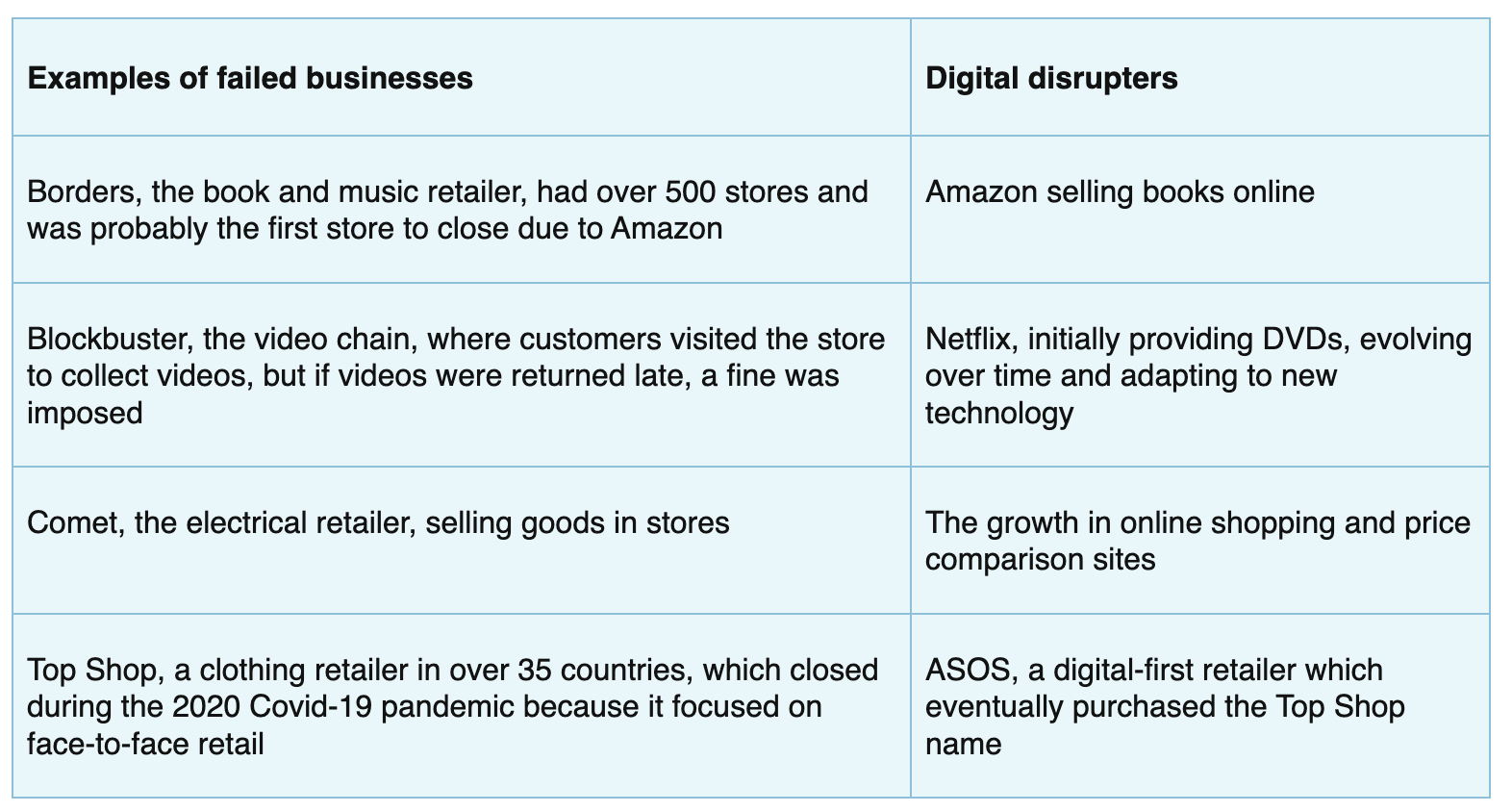
Key Elements within Competivie Value
Software, processes and information
Disruption impacts more than a single competitor; it can transform the entire market sector- convergence of technologies makes this happen
Product and place: Competitiveness from software
The world’s largest taxi firm, Uber, doesn’t own a single vehicle – it has clever software that connects drivers to passengers.The world’s largest accommodation agency, Airbnb, doesn’t own a single hotel room – it has clever software that matches hosts to guests.
Processes and physical evidence: Competitiveness from processes
The world’s largest retailer, Amazon, doesn’t own a single product – it has clever processes that match buyers to sellers, facilitates easy purchasing with the one-click to buy now, and encourages customers to pay in advance for delivery with Prime. Customers can use the platform for all their shopping requirements.
People and processes: Competitiveness from information
One of the world’s largest social platforms, Meta, helps sellers to specify exact buyer types based on user profiles and behaviour – their source information.
Drivers of Digital Disruption
Technology and its adoption
It’s not just individual devices that drive disruption, but how they connect with other devices.
Technology Convergence
Connecting devices, or when two or more devices combine to offer additional benefits, is described as a technology ecosystem
Examples include using smartphones as digital wallets or using smart speakers to create lists.
AI is both disrupting anf transforming businesses
Although technology enables improvements, customer adoption is essential.
Disruptive Digital innovation
Occurs when an existing market or product is challenged using technology; it is not necessarily because a completely new idea has been introduced
Innovation is a driving goal within the United Nations. It is critical to society as it contributes to improving food supplies, healthcare and well-being, education, equality, water supplies, energy supplies, workplaces and infrastructures.
Customers as Co-Creators
Customers demand better user experiences, whether that’s face-to-face interactions, in online environments, or via an app
Examples of co-creation or collaboration include creating positive reviews, sharing authentic feedback, and praising organisations for their service
Digital marketing provides opportunities for co-creation as consumers can share problems, ask questions, and make suggestions
The additional value of co-creation is innovation. If consumers are involved in the process, the innovation is more likely to succeed
Digital Transformation
a process that aims to improve an entity by triggering significant changes to its properties through combinations of information, computing, communication, and connectivity technologies
Within a marketing context, digital transformation is the process of moving an organisation from a traditional marketing focus to one that embraces digital technology.
The European Union measures best performance in ‘digital skills, digital infrastructure, the digital transformation of businesses, and digital public services- transformation important on a global scale
The Process of Digital Transformation
Involves three progressive phases: digitisation, digitalisation and transformation
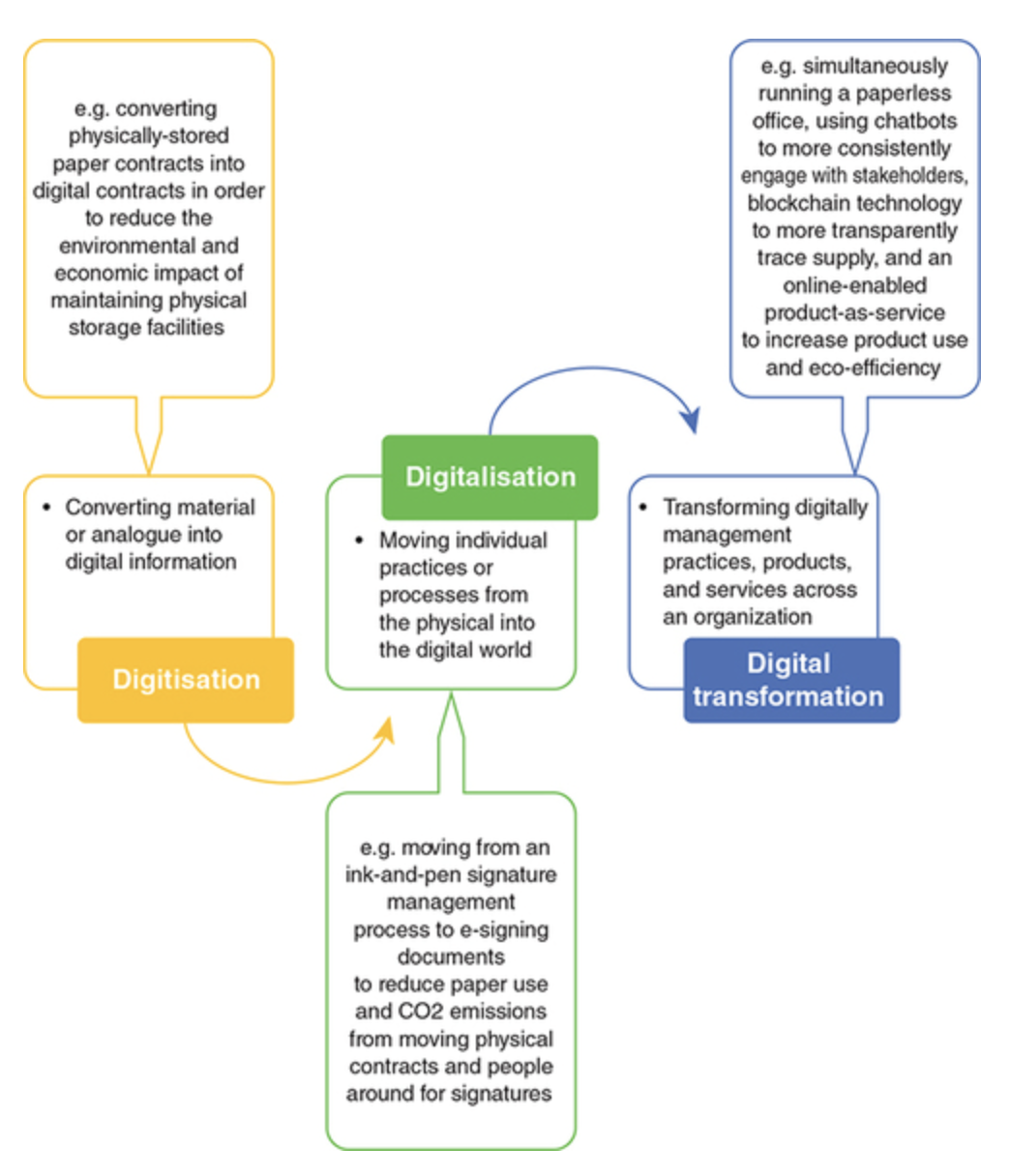
Digitization
involves converting analogue processes to digital systems
Example: creating digital records of medication files, the moe from printe brochures to digital downloads
Digitalisation
about changing the organisation with technology
involves technological changes in some departments in business, not changing the whole business
It involves changing business processes, which can be due to technology convergence
Having digitised a process, the next step is ‘the application of digital technologies—in our work related to the application in businesses
Digitalisation is not simply using the tools, but how the tools are used or applied to make life in the organisation easier
Digital transformation
the last step and takes the changes from one or two processes, in one or two departments, across the entire organisation.
As digital transformation applies to technology and people, it also encompasses more than marketing. It is often considered to be part of IT and information systems, due to its connection with technology.
While technology helps the process, successful digital transformation only happens when people are willing to support the digital transformation
Digital Mindset
A set of beliefs which contributes towards technological change.
It is the opposite of a fixed mindset and involves ‘having an organizational climate or culture that emphasizes the importance of, and supports, digital transformation
Towards Digital Transformation
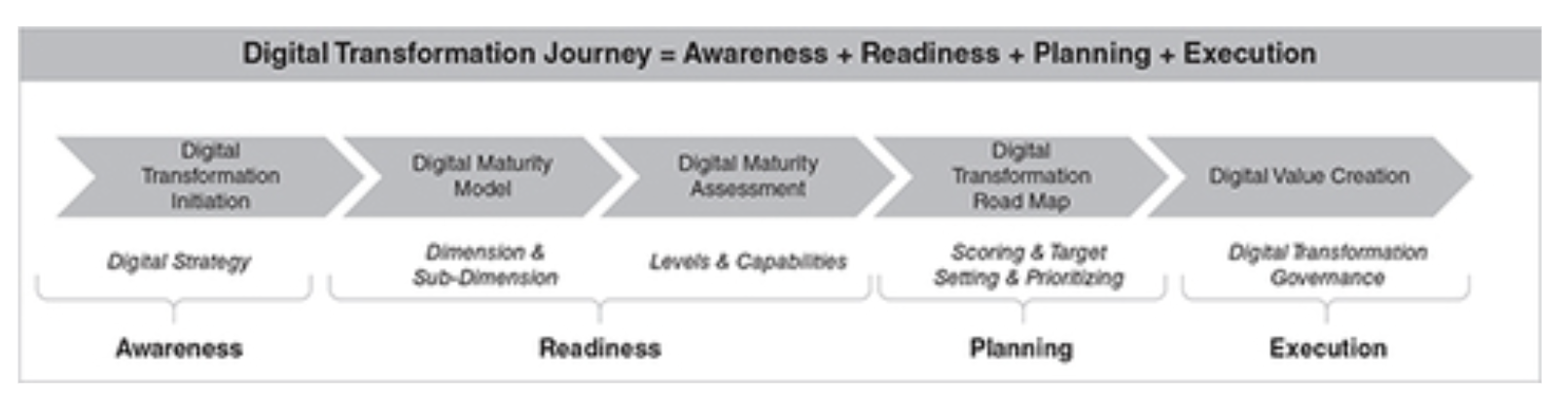
Digital transformation is a gradual process and is often compared to taking a journey. It can take years rather than months to complete, due to the different parts of a business that need to undergo change
Digital Transformation Journey
Awareness - an understanding that change is needed in order to achieve the business’s goals. Might be forced and can be cultural
Readiness - having a framework in place to assess whether the business is prepared for the changes. Lack is why digital transformation projects fail
Planning - creating a ‘digital roadmap’ (Aras & Büyüközkan, 2023, p. 20) that lists the priorities for action.
Execution - delivering the plan (this is where it can fail due to a lack of the previous steps)
Disrupting and transforming with artificial intelligence
This has enabled traditional items to be replaced with apps that collaborate with other data sources
AI Systems- rational agents that autonomously respond to inputs – with little or no user intervention – by performing tasks guided by their underlying models and functions
Application of AI in disruptive Marketing
Artificial intelligence (AI) is disrupting all businesses through technology convergence.
AI provides opportunities to transform marketing by gaining insights from customer behaviour data.
Chat GPT has the power to disrupt traditional marketing management activities. This means that AI provides opportunities to transform marketing by gaining insights from customer behaviour data.
Marketing campaigns can be automated to ensure the right messages are delivered to the right people at the right time
Personalised customer journeys can be improved with AI-led customer journey mapping
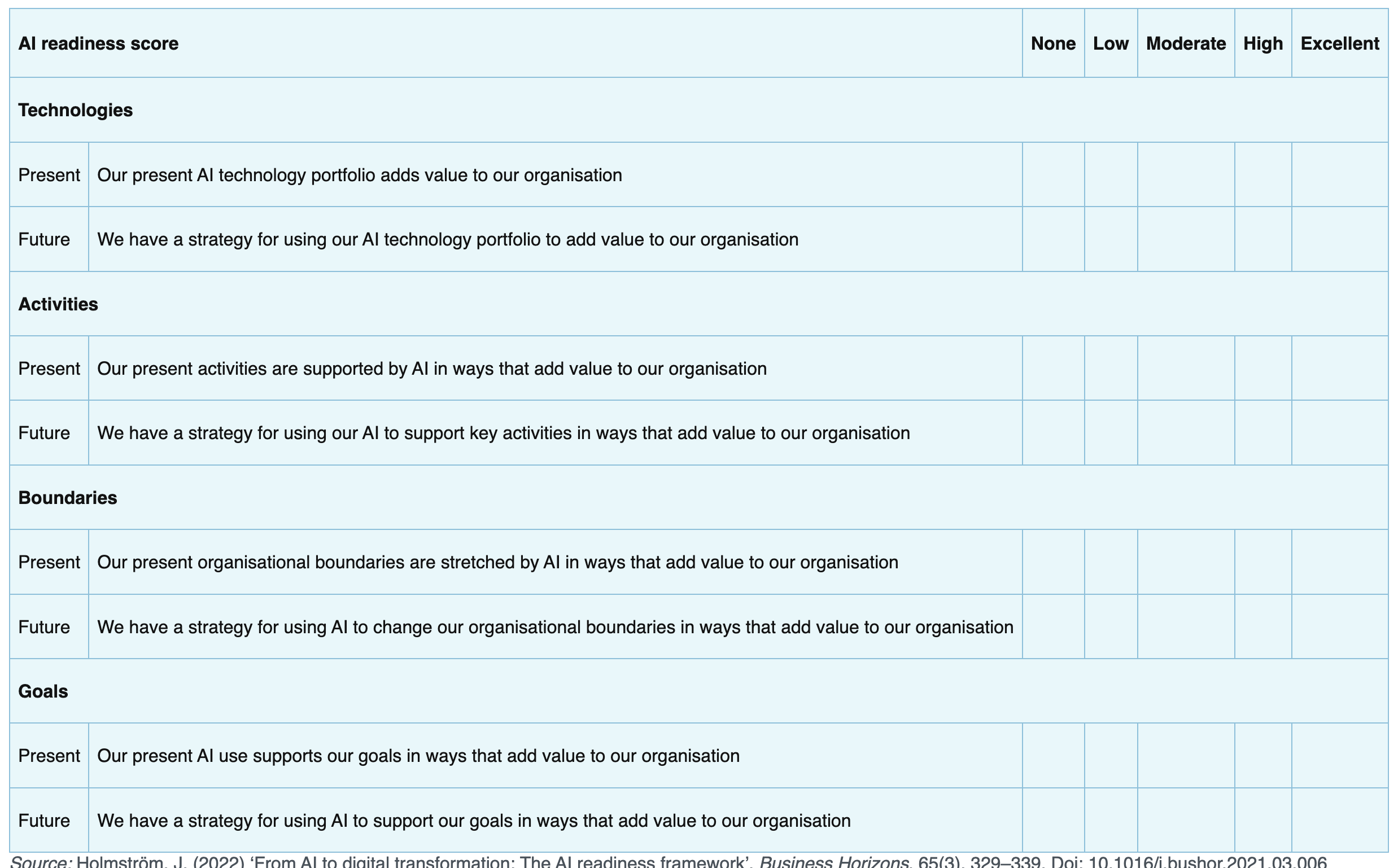
AI Readiness
4 Dimensions (assessed based on organization present and future states)
Technologies are considered to be automatic; without them, digital transformation cannot happen.
Activities are the tasks or functional actions that organisations need to take.
Internal boundaries may be better known as silos, where organisations operate in discrete teams and fail to communicate with each other
Goals are essential when ‘delivering value from digital transformation
Responsible digital transformation with AI
The misuse of AI can lead to discrimination and deepfakes.
Governments are working on guidelines to ensure that AI is used for good purposes.
Corporate digital responsibility may be needed
Developers are therefore encouraged to apply the FATE principles – Fairness, Accountability, Transparency and Ethical standards – to reduce bias and to create AI for good purposes
Corporate Digital Responsibility
Corporate social responsibility is a well-known concept in business, where companies seek to engage with stakeholders and foster ways to be more sustainable.
The set of shared values and norms guiding an organization’s operations with respect to four main processes related to digital technology and data.
These processes are the creation of technology and data capture, operation and decision making, inspection and impact assessment, and refinement of technology and data
Corporate digital responsibility involves many stakeholders
Organisations, such as third parties, which provide technology services, or other suppliers involved in digital aspects of the business
Individual actors, such as managers of data inside the organisation as well as employees and customers
Artificial and technological actors, such as the use of algorithms and machine learning
Institutional, governmental and legal actors, such as legal data privacy frameworks, and trade associations, which may offer codes of conduct
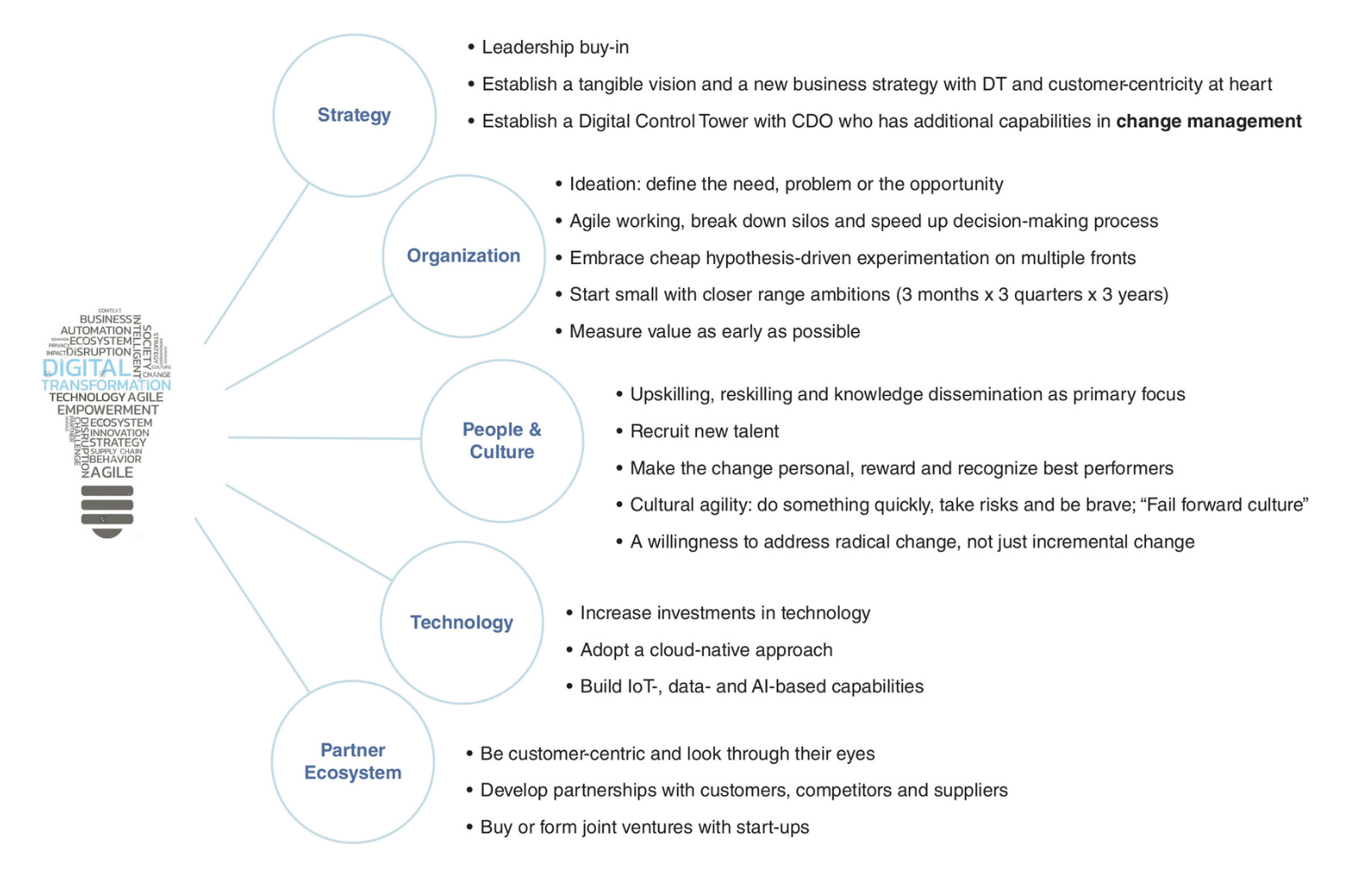
Pathways to a successful digital transformation
Strategy- clear strategy supported by leadership ad investment
Organization- changes taking place in businesses and governments. Understanding current and future desires states
People and culture- Digital expertise is growing in demand, and having the processes in place to do something (capability) is one side of the equation; the other is possessing the skill or knowledge to make it happen (competence).
Technology- Having the technology and processes in place, as well as the budget to make it happen, is essential in managing digital transformation. Technology is often seen as the driver of digital transformation, which of course it is. Yet without the stakeholders, no amount of amazing technology will make it happen
Partner Ecosystem- not simply about the staff or leaders of a business; it involves the wider communities because ‘digital transformation changes societies. Stakeholders are also involved
Failures in Digital Transformation
Main Reasons for Failure
Vision – lack of a shared vision, so the project fails to gather momentum
People – lack of communication or agreement between teams
Skills – not having the abilities to run and manage the systems and believing the technology will work on its own
Silos – internal boundaries where organisations don’t communicate with each other
Investment – budgets grow and further investment may be required