Chemistry Rotation Exam
 Call Kai
 Learn
Learn Practice Test
 Spaced Repetition
 Match
Match Flashcards
 Knowt Play
1/36

There's no tags or description
Looks like no tags are added yet.
Name | Mastery | Learn | Test | Matching | Spaced | Call with Kai |
|---|
No analytics yet
Send a link to your students to track their progress
37 Terms
Accuracy
closeness of agreement between the measured value and a true concentration of the analyte
Precision
Agreement among replicate measurements
AMR
Analytical measurement range- range a method can directly measure without dilution, concentration, or other pretreatments
RR
Reportable Range- Range of values that can be reported to include dilutions
Sensitivity
Abillty to assess small variations in concentration of analytes (Also known as how low can we detect our analyte)
Specificity
Ability to determine the concentration of the target analyte in the presence of potentially interfering substances ( also known as are you sure what you see is our analyte)
Control
Should always include 2+ levels of controls
Assayed- controls with stated/expected value
Unassayed- Controls with values that are not known expect when assayed by the lab
Requires > 20 data points from 20- separate runs over no more than 30 days
Imprecision
Change in SD caused by increased variation in values around the mean, due to random analytical error
Inaccuracy
Difference between measured value and actual value, due to systematic error (all samples are affected)
Shift
Abrupt change, could be due to change in lot, maintenance, inaccurate calibration, failure in sampling system
Trend
Gradual change over a period of 6 consecutive days, could be due to deterioration of light, reagents, controls, etc.
1-2s
1 sample exceeds the mean by 2SD ±
warning flag, don’t need to reject run
1-3s
1 sample exceeds the mean by 3SD ±
Must reject the run
2-2s
2 consecutive controls exceed the means by 2SD ±
must be on the same side of the mean
Must reject run
R-4s
The difference between 2 consecutive controls greater than 4 SD
Must reject the run
4-1s
4 consecutive controls exceed the mean by 1 SD ± on 1 side of the mean
must reject the run
10x bar
10 consecutive controls fall on 1 side of the mean
Must reject the run
KLAAMPI
Hemolysis causes increased
K+
LD
AST
Ammonia
Mg
PO4
iCal
Serum
Used for special testing or Most therapeutic drugs
Plasma
Used for most chemistry tests
Ice- ammonia, blood gas, whole blood iCals
Grey top
Sodium fluoride: slows glycolysis and inhibits urease
CANNOT use for BUN
Used for Lactic acid testing
EDTA
contains K and chelates Ca
Cannot be used for chemistry
Friedewald Equation
LDL= (Total cholesterol - HDL) - (Triglyceride / 5)
Trigs MUST be <400 mg/dL
CK-MB RI Equation
RI= (CK-MB / Total CK Activity) * 100
if > 2.5% there is likely cardiac damage
if > 5-6% there is definite cardiac damage
Sample Problems
Hemolysis: Cannot test for K or AST
Icterus: Cannot test for Bilirubin (Direct or Total)
Lipemia: Cannot test Triglycerides
Increased Na/Cl and all other analytes decreased
Think line draw/saline contamination
Increased glucose and Decreased K (and all other values)
TPN contamination, call nurse and ask if the patient is on a TPN line, ask for a redraw
Big increase in K/AST
Think hemolysis, look at the sample, ask for a redraw
Large jump in K and steep decrease in Ca
Think EDTA contamination, ask for a redraw due to incorrect collection
Direct ELISA
Looks for Antigen
Patient antigen is on the well
Specific antibody is added with enzyme
Indirect ELISA
Looking for Antibody
Well is coated with Ag
Patient sample is added (Antibodies)
Enzymes is added and measured
Sandwich ELISA
Looking for Antigen
Well is coated with antibodies
Patient sample (Ag) is added to the well
Enzyme-Ab is added to well and measured
Competitive ELISA
Looking for Antigen or Antibody
Ab and Ag are incubated together
Add this mixture to an Ag coated well
Add enzyme Ab to well and measure
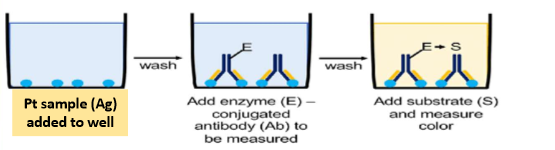
What ELISA is this?
Direct ELISA
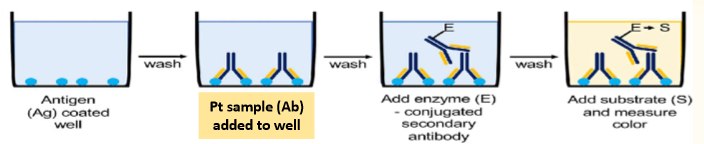
What ELISA is this?
Indirect ELISA
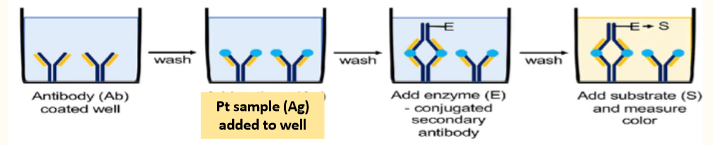
What ELISA is this?
Sandwich ELISA
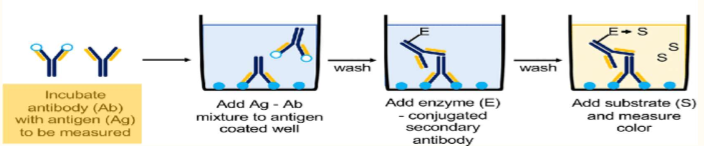
What ELISA is this?
Competitive ELISA