Main brain structures NEURO II Exam 2
 Call Kai
 Learn
Learn Practice Test
 Spaced Repetition
 Match
Match Flashcards
 Knowt Play
1/14

There's no tags or description
Looks like no tags are added yet.
Name | Mastery | Learn | Test | Matching | Spaced | Call with Kai |
|---|
No analytics yet
Send a link to your students to track their progress
15 Terms
Facial expression pathway
face area of motor cortex → facial nerve (cranial nerve VII) → superficial facial muscles
Reward circuit/brain self-stimulation
septum/medial forebrain bundle → nucleus accumbens
Fear Pathway low road
sensory organ → thalamus → amygdala (reacts to threat immediately)
Fear pathway high road
sensory organ → thalamus → sensory cortex/hippocampus → amygdala
(conscious response to threat)
Medial amygdala and aggression
medial amygdala → aggression-related processing
(aids in differentiation of sex of other mice for mice & aids in supporting social information relevant to whether aggression occurs)
Ventromedial hypothalamus
medial amygdala → VMH (“Switch” for aggression)
(medial amygdala processes social information → VMH acts as switch for turning aggressive behaviors on/off)
HPA axis (slow stress pathway)
hypothalamus (PVN neuroendocrine cells) → anterior pituitary → ACTH → adrenal cortex → cortisol
(hypothalamus/PVN starts signal → AP releases ACTH → ACTH travels in bloodstream & activates adrenal cortex → adrenal cortex releases cortisol → cortisol supports sustained stress responses & shifts energy usage)
Sympathetic-adrenal pathway (fast stress pathway)
hypothalamus → autonomic preganglionic neurons in brainstem/spinal cord → adrenal medulla → epinephrine + norepinephrine
(hypothalamus initiates rapid stress response → preganglionic neurons carry signal → adrenal medulla releases epinephrine & norepinephrine → body is prepared for “fight-or-flight”
Glucocorticoid receptor feedback
cortisol → glucocorticoid receptors in brain (including hypothalamus) → negative feedback
(aids in regulating cortisol levels → brain can dampen stress response)
Hippocampus & stress regulation
early neglect = reduced hippocampal neurogenesis
Epigenetics & glucocorticoid receptors
early abuse/neglect → altered gene expressions → fewer glucocorticoid receptors → weaker cortisol shutoff
medial temporal lobe for declarative memories
new declarative memories depend on set of structures of medial temporal lobe system (hippocampus, mammillary bodies, dorsomedial thalamus)
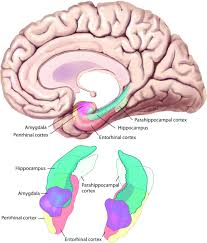
Hippocampus vs cerebral cortex
hippocampus forms/consolidates declarative memories
cerebral cortex stores declarative memories in LTM
Patient K.C & semantic vs episodic memories
Patient K.C showed distinction between semantic and episodic memories
Emotion & Memory Connection
epinephrine → amygdala → hippocampus
(emotions enhance memory formation & recall through action of epinephrine on amygdala which then modulates hippocampal activity)