Psychology of Sleep Final Exam
 Call Kai
 Learn
Learn Practice Test
 Spaced Repetition
 Match
Match Flashcards
 Knowt Play
1/61

There's no tags or description
Looks like no tags are added yet.
Name | Mastery | Learn | Test | Matching | Spaced | Call with Kai |
|---|
No analytics yet
Send a link to your students to track their progress
62 Terms
What is the difference between a REM dream and a dream-like experience that happens during NREM?
NREM dreaming
Shorter - duller
Less activity
Not clear
Often lack narrative structure that includes dreamer
More like day dreaming
Less often recalled as during REM dream
Should be called: NREM mentation
REM dreams: memories replayed at exact same speed
5x longer than NREM dreams
Trying to experience the future
Simulations??
Step into future world with no consequences
• What percentage of dreams are remembered and why is the percentage so small?
no recall following 10-20% of REM awakenings
why:
they are unlike normal sensory experiences
dreams that are interrupted and result in waking are recalled more often
recall of dreams may be lost during transition to waking
• What is meant by dreams are semi-autonomous? Provide some characteristics of dream that support this notion.
About 25% of recalled dream content influences successive dreams
50% of dream content is continuous with thoughts from waking life
Personality traits like depression and anxiety often reflected in dream content
Much of what we dream about in unrelated to recent experiences
Waking life can influence dream content at times
Semi-autonomous: they seem to have their own agenda but their content can sometimes be influenced
• What happens to the brain regions controlling dreaming versus waking thought?
???
• What is the goal of dream content analysis? Why is it not the same as dream interpretation?
Formulating categories with precise boundaries for all the elements appearing frequently in dreams.
Determining frequencies for those categories in dreams from an individual or a group.
Turning the frequencies into percentages and rates.
Comparing the findings with norms to determine what is unique about the dreams of the person or group being studied.
• What is meant by: Dreams can be best described as “inventive realism” or “realistic-fictional”
Dreams are more like creative short stories than factual histories.
Dreams are self-governing and out of our control.
Thought processes are simpler than during waking
Dreams are uncritically accepted regardless of how bizarre.
• Be familiar with the general content of dreams in terms of characters, social interaction, culture, sex, settings, objects.
Dream content - characters
Dreamers usually active character
Both familiar and unfamiliar characters
Male dreams often about males - females 50/50
Acquaintances and colleagues
Most characters are adults from present life rather than childhood
Dream content - social interaction
Aggressive social interactions
80% time dreamer is the victim
If attacked - males are unfamilar (that are attacking them) - females dream of familiar males (attackers)
Females dreams typically more friendly interactions
Dream content - culture
Cultural trends also reflected in dreams
Dream content - sex
Low - 12% men and 4% women
Females dream of romantic interactions with familiar males
Males more likely to dream of sex with unfamilar females
Dream content - settings and objects
Unknown - familair vague - distorted
Females dream more indoors
Settings change in 25% of dreams
Males - cars and weapons
females - household objects
More likely to recall specifics of how a character looked
Naked in public - common
• How does the content of dreams change during development?
Aged 3-5 = start report dreams
Less likely story line
Fairy tale animals
5-9
Genuine
Longer
Characters other than dream - in playing activities
9-11
Content and frequency mature
Social interactions are positive more than negative
11-15
Vague settings
Decrease social interactions
Longer dreams
• What are the characteristics and differences between nightmare and night terrors?
Nightmares
Long terrifying dreams - rem sleep
Latter part of night - more likely to wake up - more likely to remember them - more likely to dream about it again
Lasting effect
Children higher rates (peaking 2.5 years of age)
Develop before age of 15 (average - 1-2 per year)
5% adults get more than twice a week
Often linked with schizophrenia, depression, PTSD
Associated with cellular aging and 3x increased risk for death before age of 70
Associated with lactose intolerance and eating bad food before bed
Night terrors - DIFFERENT FROM NIGHTMARES
Sudden arousal from stage 3 - 4 sleep marked by intense fear and autonomic activation
Common in children
Not associated with vivid dream but are associated with a crushing suffocating feeling of the chest
Descriptions very common across cultures
• Be able to identify and describe the different methods of dream interpretation.
?
• What are the two important questions when considering dream interpretation?
1) how do theoretical assumptions influence dream interpretation
2) what are the roles of the dreamer and the interpreter
• Why has Freud’s interpretation of the mind been described as an iceberg? Why were dreams so important to Freud?
Like an iceberg, the most important part of the mind is the part you cannot see (unconscious mind)
conscious = top = mental processes we are aware of (thoughts, perceptions)
preconscoous = middle = thoughts + feelings not currently aware of, but can be easily brought to consciousness
unconscious = inaccessible to consciousness but influence judgments, feelings, behavior (primary source of human behavior)
• Be able to describe Freud’s three conflicting components of the mind and what happens if they are out of balance.
Id
Pleasure principle (immediate self-gratification)
Oldest part
Primal - self-centered
“Devil”
Ego
Trapped in middle (yourself)
Reality principle - balance between id and superego
Superego
Moral part
2 parts
Ego ideal: rules of good behavior
Conscience: rules of bad behavior
Id too dominant = only care about yourself
Ex: socialize rather than study for an exam
Superego too dominant = guilt-ridden and sanctimonious
Ex: only study - no rest or relaxation
Ego too dominant = efficient and rational (sometimes distant)
Ex: study and socialize
• Describe the components of dreamwork: displacement, projection, symbolism, condensation, rationalization.
Displacement
Desire of one thing or person symbolized by something or someone else
Projection
Dreamer propels own desires and wants onto another person
Symbolization
Dreamers repressed urges suppressed desires acted out metaphorically
Condensation
Dreamer hides feelings or urges by contracting it or underplaying it into a brief dream image or event
Meaning may not be clear
Rationalization
Final stage
Dreaming mind organizes incoherent dream into one that is more comprehensible and logical
• Carl Jung was a psychodynamic theorist like Freud. How was he different when it came to dreams?
Psychodynamic theorist - dream is a way of communicating and acquainting yourself with the unconscious - guide waking self to achieve wholeness
Dreams telling us something (different from freud - not just bad desires)
Dreams are not attempts to conceal your true feelings from the waking mind, but rather they are a window to your unconscious.
therapist helps amplify meaning of dream
• What are Jung’s dream archetypes and what od each represent?
Persona (Self): How you present yourself to the world vs. your true identity.
Shadow: The hidden, rejected parts of yourself (fear, anger, weakness) that you avoid but need to confront.
Anima / Animus: Your inner feminine/masculine side → balance emotional vs. assertive traits.
Divine Child: Your pure, vulnerable, potential self → innocence + growth.
Wise Old Man/Woman: The inner guide → provides wisdom and direction.
Great Mother: Nurturing vs. controlling force → care, protection, or dominance.
Trickster: Exposes your blind spots/ego → forces self-awareness through discomfort or mistakes.
• Why did Adler consider dreams to be problematic and “self-protective fantasies”?
Dreams are an open pathway toward your true thoughts, emotions and actions where you clearly see your aggressive impulses and desires. However, dreams are often ineffectual because they are “self protective fantasies” created to protect our sense of self worth.
more dreams = more probelms you have
fewer dreams = more psychologically healthy
• Why was Menard Boss considered an “existential” psychologist and what did he think about dreams?
Boss was an “existential psychologist” who believed there is no such thing as the unconscious and that we exist solely in relationship to other people and things.
dreams characterize how we relate to waking life
individualistic
• Why did Calvin Hall think dream symbols are “pictorial metaphors”?
Dream symbols are “pictorial metaphors” that are an efficient and concise way of presenting complex and hard to understand ideas that are often otherwise invisible such as emotions.
• Explain the Activation Synthesis theory of dreams and how it is connected to memory
During REM, most of the brain is active except for the areas responsible for reception of sensory information and control of voluntary movement. The brain is isolated and “offline” accounting for the illogical, nonvolitional, bizarre quality of dreams. Random information from activated areas is “synthesized” into a unified whole in a process that is no different from what occurs during waking. Dreams are simply the brain’s way of making sense of brain activity during sleep.
• Name some cognitive dream theorists and what they believed.
David Foulkes: Dreaming is a cognitive, developmental process based on memory and experience (like thinking/language).
Harry Hunt: Dreams should be studied in real-life context and include both personal and deeper symbolic/spiritual experiences.
Ernest Hartmann: Dreaming involves looser, more emotional brain connections, allowing broader associations.
G. William Domhoff: Dreams reflect current and past concerns, shaped by cognitive development over time.
• How do many indigenous peoples cultures view dreams?
Dreams are alive and are there to help us.
Dreams are collective, shared among our relations and give us wisdom from our ancestors.
Dreams are a tool to help us process and give us access to unresolved traumatic experiences that might also be collective experiences.
Dreams contain fragments of information, insight or wisdom that can help us on our path to maturation and healing.
• Explain the NEXTUP theory and how it is connected to memory.
(network exploration to understand possibiblies)
Brain stores a lot of info - just cant access it
During sleep, deemphasizes strong memories and brings to light weaker memories
REM strengthens some memories while removing unnecessary memories
Steps
1) Hypagogia (N1) = what ongoing concerns was I just thinking about
2) N2 dreams = what associated recent memories can I find
3) REM dreams = what remote, weak associations can I find
Why are dreams often negative and bizarre? Why do they lack voluntary control and seem to tell a story that we unquestionably accept? (check)
during REM amygdala highly active in combination with PFC being inactive
• Why is testing dream theories so difficult?
Dreaming is subjective: we rly on dreamers interpretation which may be inaccurate or incomplete
Dreams may not ever reach waking consciousness
No control group
Brain-damaged people
People may claim they do not dream
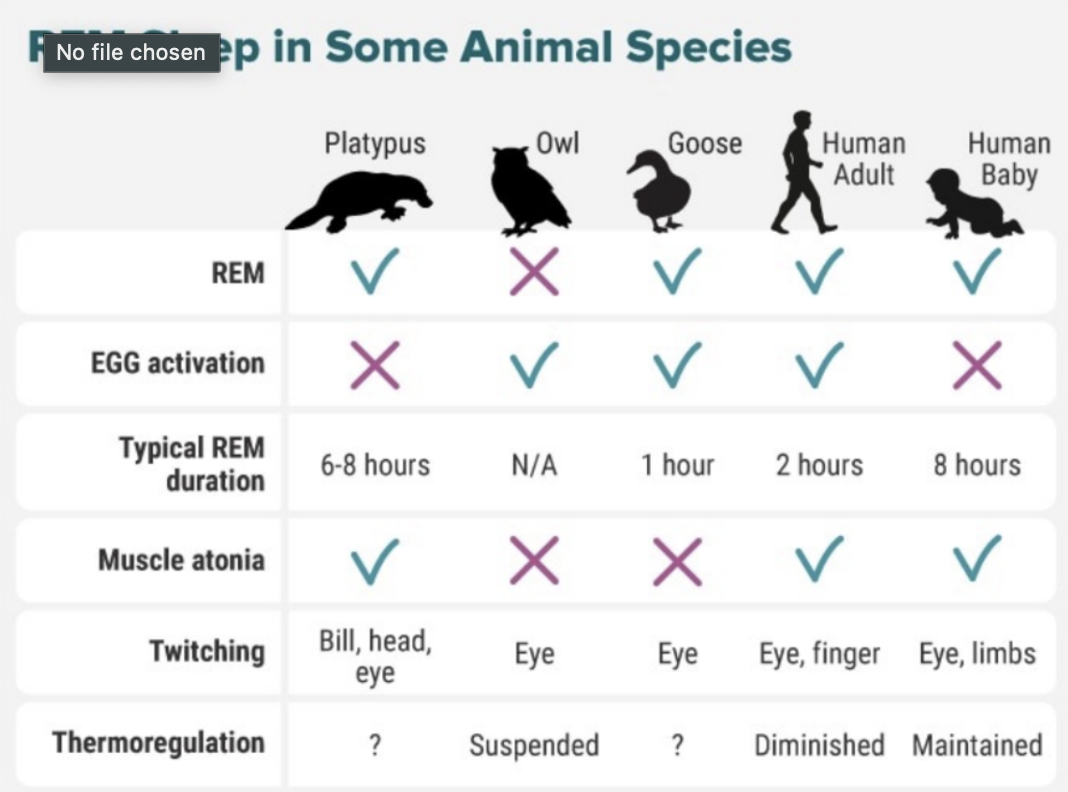
• How does REM sleep in other animals compare to humans?
Mammals + birds engage in REM
Platypus = most REM (6-8 hours)
Special class of mammal = lay eggs but have fur and can regulate body temp
Similar to humans AND birds
No EEG activation (same as human baby)
Muscle atonia
Owls and Goose do not have atonia due to sleeping in trees
Own no rem (there eyes are fixed)
Colder climate = more REM sleep animal gets
Brain stays warm as the body cools due to brain activity
• What evidence suggests that the function of REM sleep may be connected to brain development?
REMS facilitates brain development
Synaptic pruning - retain functionally useful neurons and neural connections
Remembering something - activity based (connection between neurons)
Improve memory consolidation
External stimulation during wakefulness may not be enough or too irregular for proper pruning - internal stimulation (REMS) more controlled - may be necessary for pruning
Explains: young kids have more REMS than adults (brain is still developing)
REMS is neccesary for brain restoration
During day brain connections overused and neurotransmitters levels depleted
Predictable source of internal stimulation
Brain may use REM stimulation to self-autocorrect functional pathways and replenish neurotransmitters
REMS decreased in senility and mental deficiency and increased following brain damage
• What are the four “Fs” of inherited behaviors and what do they have to do with REM? (check)
feeding, fighting, fleeing, fornicating - sympathetic nervous system arrousal
• What is the sentinel hypothesis about the function of REM?
Sentinel Function: REMS may serve to prepare the brain for awakening
REM EEG similar to wakefulness
Easier to wake from REM - transition to wakefulness
Present at end of night
AGAINST: paralysis (why would this turn off when waking up)
• What is the mood regulatory hypothesis of the function of REM and how is it connected to depression? (check)
Mood regulatory hypothesis of dreaming: mood is better and less variable following dreaming in the non-depressed
• What aspects of dreams suggests that their function is connected to creativity and problem solving?
Dreams may suggest solutions to problems because associations between memories and cognition are less constrained than during waking. Creativity tests of remote word associations reveal better performance following dreaming.
einstein, frankenstein, periodic table
What happens when you REM deprive rats?
Morris water maze
Visual cews around the body of water (mini pool)
Platform slightly below water
First time: swim around randomly - finally bump into it
After learning: use cews to know where platform is
Deprivation
REM deprived: beginning part of learning process is blunted by REM deprivation then they ultimately figure it out and becomes equal
• What role does ZIF-268 play in memory formation and how is it connected to REM?
Protein synthesis required for new memory formation
Zif-268 protein involved in formation of new synapses
Animals exposed to enriched environment (new learning experiences) showed increased Zif-268 expression in hippocampus and cortical areas during REMS
• What role do MCH neurons play in memory consolidation and why is REM important to their functioning?
To remember important info - need to forget what is unimportant - function of REMS
Rehearsal during dreams
Forgetting associated with activation of MCH (melatonin concentrating hormone - goldilocks neurons) neurons in hypothalamus
MCH responds to high levels of melatonin and are most active during REMS
Sorting of memories at a certain temperature in the brain
What is meant by the saying “sleep on it” and how have animal studies supported for the theory it is connected to?
Distressing experiences across a night of sound sleep
Memories formed during a stressful day are strong due to hippocampus-amygdala connection
Serotonin involved in learning emotional experiences
Noradrenaline allows us to assess and respond to danger during fight or flight
Both turned off during REM
Allows memories to be movers into familiar storage without experiencing fight or flight response during REM
People with insomnia dont get the REM sleep that allows for reorganization of memories
Simplified: when in REM sleep - work through problems in a safe environment without stressful sympathetic activation (helps take the emotional charge out of traumatic memories - people with PTSD dont have this ability)
This was showed using optogenetics to control the brain areas involved in sleep, emotion and memory (Amsterdram)
• How are dreaming and children’s play similar?
Fanciful yet important and enjoyable yet useful
Strong emotions, yet governed by rules and is free and unpressured
Social relationships
Involves both emotion and creativity
• Why does Antti Revensuo say that nightmares are “threat scripts”?
Antti Revensuo: Dreaming became established during evolution
Dreams are a rehearsal of perceptions of threats and ways to avoid them.
Dreams are a safe way to enhance the probability of surviving real threats.
The normative content of dreams, recurrent dreams, children’s dreams and nightmares are filled with the kinds of threats our ancestors faced but are not necessarily relevant today.
Dreams are more often negative and contain aggression, chasing and threats.
• Describe four theories about the sources of dreams. ???
???
• Why do some people believe in déjà vu or omens? What does Träume sind Schäume refer to?
• Describe three studies presented in class that provide support for the theory that dreaming enhances creativity.
• What is lucid dreaming and its two types? What empirical evidence supports it?
• Define dyssomnia and parasomnia and describe their differences.
• Be familiar with the epidemiology of insomnia and why it is considered a public health crisis.
What are the sleep patterns of insomnia and what is the difference between transient, short-term and chronic insomnia?
• List some predisposing, perpetuating and precipitating factors for insomnia.
• What are some medical and psychological conditions that are co-morbid with insomnia?
• Why insomnia considered a vicious positive feedback cycle?
• What is the course of fatal familial insomnia? What causes it?
• Be familiar with the symptoms of hypersomnia and Klein-Levin syndrome and their differences
• What are the features of narcolepsy and how are they connected to the orexin/hypocretin system?
• Why is narcolepsy considered an autoimmune disorder?
• What are the features of restless leg syndrome and how do they differ from periodic limb disorder?
• What causes snoring/sleep apnea and how can it be corrected? What is the Inspire device?
• What are the different types of circadian rhythm dyssomnias?
Be familiar with the characteristics of sonambulism, confusional arousals, sleep terror disorder, sleep-related eating disorder, somniloquy, catathrenia, REM behavior disorder, sleep paralysis, nightmare disorder, exploding head syndrome, sleep-related hallucinations, bruxism, nocturnal enuresis. Why are they considered parasomnias and not dyssomnias?
Compare benzodiazepines, Z-drugs, ramelteon and suvorexant in terms of their mechanism of action, risks and side effects. When might one be prescribed over another?
• How do hypnotics generally affect sleep? What can be said about their effectiveness and harmfulness?
• What are the five domains of cognitive activity hypothesized to contribute to insomnia?
Describe stimulus control therapy, sleep hygiene education, sleep restriction therapy and relaxation training as components to CBT-I.
• Describe the efficacy of CBT-I alone or in combination with pharmacotherapy.
• What is the 10-5-4-3-2-1-0 method?
• Describe some alternative methods for controlling insomnia.