PHYSICS UNIT 4 TOPIC 2 - Quantum Theory
 Call Kai
 Learn
 Practice Test
 Spaced Repetition
 Match
 Flashcards
 Knowt Play
1/91

92 Terms
How does the double slit experiment provide evidence for the wave model of light?
When light passes through two narrow slits, it produces an interference pattern of alternating bright and dark bands on a screen. Interference is a wave behaviour, so this supports the wave model of light.
What is observed in the double slit experiment when light passes through two slits?
A series of bright and dark fringes forms on the screen behind the slits, creating an interference pattern.
Why does the double slit experiment support the wave model rather than a simple particle model?
If light behaved only as particles, two bright patches would be expected behind the slits. Instead, an interference pattern forms, demonstrating wave behaviour.
How are the bright and dark fringes in a double slit experiment formed?
Bright fringes: Constructive interference occurs when waves arrive in phase.
Dark fringes: Destructive interference occurs when waves arrive out of phase.
What is constructive interference in the double slit experiment?
Constructive interference occurs when two light waves meet in phase, producing a bright fringe.
What is destructive interference in the double slit experiment?
Destructive interference occurs when two light waves meet out of phase, producing a dark fringe.
What feature of the double slit experiment is the strongest evidence that light behaves as a wave?
The formation of an interference pattern consisting of alternating bright and dark fringes.
What is meant by describing light as an electromagnetic wave?
Light is a transverse electromagnetic wave consisting of oscillating electric and magnetic fields that travel through space.
What fields make up an electromagnetic wave?
An electromagnetic wave consists of:
An oscillating electric field.
An oscillating magnetic field.
These fields are perpendicular to each other.
Why is light described as a transverse wave?
The electric and magnetic fields oscillate at right angles to the direction of wave travel.
How does light travel through space?
Light travels as an electromagnetic wave and does not require a medium. It can travel through a vacuum.
At what speed does light travel in a vacuum?
Light travels at:
c = 3.00 x 10^8 m/s
in a vacuum.
How are the electric field, magnetic field and direction of travel oriented in an electromagnetic wave?
They are all perpendicular to each other:
Electric field ⟂ Magnetic field
Electric field ⟂ Direction of travel
Magnetic field ⟂ Direction of travel
Why can light travel through space while sound cannot?
Light is an electromagnetic wave and does not require a medium, whereas sound is a mechanical wave that requires particles to transmit energy.
What is black-body radiation?
Black-body radiation is the electromagnetic radiation emitted by an object due to its temperature. A black body absorbs all incoming radiation and emits radiation across a range of wavelengths.
What is a black body?
A black body is an ideal object that absorbs all electromagnetic radiation that falls on it and emits the maximum possible radiation for its temperature.
How does temperature affect black-body radiation?
As temperature increases:
More radiation is emitted.
The peak wavelength becomes shorter.
The peak shifts toward the blue end of the spectrum.
Why is black-body radiation significant?
The experimental results could not be explained by classical physics and led to the development of quantum theory.
How did Max Planck explain black-body radiation?
Planck proposed that energy is emitted and absorbed in discrete packets called quanta rather than continuously.
How did black-body radiation provide evidence for quantum theory?
The observed spectrum matched predictions only when energy was treated as quantised, supporting the idea that energy is emitted in discrete amounts.
What is the ultraviolet catastrophe?
The incorrect classical prediction that black bodies should emit an infinite amount of energy at very short wavelengths.
What major scientific idea emerged from studies of black-body radiation?
The concept that energy is quantised and can only be emitted or absorbed in discrete packets (quanta).
What is the photoelectric effect?
The photoelectric effect is the emission of electrons from a metal surface when light of a sufficiently high frequency shines on it.
How does the photon model explain the photoelectric effect?
Light consists of packets of energy called photons. When a photon strikes an electron in a metal, it transfers its energy to the electron. If the photon has enough energy, the electron is emitted from the metal.
What is a photon?
A photon is a discrete packet (quantum) of electromagnetic energy.
What is the threshold frequency?
The threshold frequency is the minimum frequency of light required to eject electrons from a particular metal.
Why is frequency more important than intensity in the photoelectric effect?
The energy of a photon depends on its frequency. If the frequency is below the threshold frequency, no electrons are emitted regardless of the intensity.
What happens when the frequency of light increases above the threshold frequency?
The emitted electrons have greater kinetic energy because each photon carries more energy.
What happens when the intensity of light increases above the threshold frequency?
More photons strike the metal each second, so more electrons are emitted, but their maximum kinetic energy does not increase.
How does the photoelectric effect provide evidence for photons?
Electrons are emitted only when photons have sufficient energy, showing that light transfers energy in discrete packets rather than as a continuous wave.
Why could the photoelectric effect not be explained by the classical wave model of light?
The wave model predicted that increasing light intensity should eventually eject electrons. However, experiments showed that a minimum frequency is required, regardless of intensity.
What is threshold frequency?
Threshold frequency (f0) is the minimum frequency of light required to eject electrons from the surface of a particular metal.
What is the work function?
The work function (ϕ) is the minimum energy required to remove an electron from the surface of a metal.
How are threshold frequency and work function related?
The work function is the energy corresponding to the threshold frequency:
ϕ = hf0
where:
ϕ = work function
h = Planck's constant
f0 = threshold frequency
What happens if light has a frequency below the threshold frequency?
No electrons are emitted, regardless of how intense the light is.
What happens if light has a frequency above the threshold frequency?
Electrons are emitted from the metal surface, and any excess photon energy becomes the kinetic energy of the electrons.
Why does every metal have its own threshold frequency?
Different metals hold their electrons with different amounts of energy, so each metal has a different work function and therefore a different threshold frequency.
Why can't high-intensity, low-frequency light eject electrons if it is below the threshold frequency?
Individual photons do not have enough energy to overcome the work function, regardless of how many photons are present.
Which quantity is measured in hertz (Hz) and which is measured in joules (J)?
Threshold frequency (f0) → Hz
Work function (ϕ) → J
What equation is used to solve black-body radiation problems involving peak wavelength?
where:
λmax = peak wavelength (m)
b = Wien's constant (2.90×10⁻³ m K)(2.90 \times 10^{-3}\,\text{m K})(2.90×10⁻³m K)
T = temperature (K)

According to Wien's Law, what happens to the peak wavelength as temperature increases?
λmax ∝ T1
As temperature increases, the peak wavelength decreases.
What equation is used to calculate the energy of a photon?
E = hf
where:
E = photon energy (J)
h = Planck's constant
f = frequency (Hz)
What equation relates photon energy to wavelength?
where:
E = photon energy
h = Planck's constant
c = speed of light
λ = wavelength

How does photon energy change as frequency increases?
Photon energy increases because:
E = hf
Higher frequency → higher energy.
How does photon energy change as wavelength increases?
Photon energy decreases because:
E = hc / λ
Longer wavelength → lower energy.
What equation is used to calculate the maximum kinetic energy of photoelectrons?
where:
Ek = maximum kinetic energy
hf = photon energy
W = work function

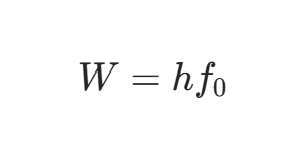
How is work function related to threshold frequency?
where:
W = work function
h = Planck's constant
f0 = threshold frequency
How did Rutherford's and Bohr's models of the atom differ?
Rutherford proposed that electrons orbit a small, dense, positively charged nucleus. Bohr improved this model by proposing that electrons can only occupy specific energy levels (shells) around the nucleus.
What were the main features of Rutherford's atomic model?
A small, dense, positively charged nucleus at the centre.
Most of the atom is empty space.
Electrons orbit the nucleus.
What was a major limitation of Rutherford's atomic model?
It could not explain why orbiting electrons do not lose energy and spiral into the nucleus, nor could it explain atomic line spectra.
What were the main features of Bohr's atomic model?
Electrons occupy fixed energy levels (shells).
Electrons cannot exist between energy levels.
Electrons absorb or emit specific amounts of energy when moving between levels.
How did Bohr improve Rutherford's model?
Bohr introduced quantised energy levels, explaining why electrons remain stable in atoms and why atoms produce discrete spectral lines.
According to Bohr's model, what happens when an electron moves to a higher energy level?
The electron absorbs a specific amount of energy.
According to Bohr's model, what happens when an electron moves to a lower energy level?
The electron emits a photon whose energy equals the difference between the two energy levels.
Which atomic model explains atomic line spectra?
Bohr's model, because electrons can only move between specific energy levels, producing photons with specific energies.
How does Bohr's model explain the hydrogen line spectrum?
Bohr proposed that electrons in hydrogen can only occupy specific energy levels. When electrons move between these levels, they absorb or emit photons with specific energies, producing specific wavelengths in the hydrogen line spectrum.
What did Bohr propose about electron energy in atoms?
Electrons can only exist in fixed, quantised energy levels and cannot exist between those levels.
How are light quanta involved in Bohr's model of the hydrogen atom?
Light is emitted or absorbed in discrete packets called photons (quanta). Each photon has an energy equal to the difference between two atomic energy levels.
What happens when an electron moves from a higher energy level to a lower energy level?
The electron emits a photon with energy equal to the difference between the two energy levels.
What happens when an electron moves from a lower energy level to a higher energy level?
The electron absorbs a photon whose energy exactly matches the energy difference between the two levels.
Why does hydrogen produce a line spectrum instead of a continuous spectrum?
Because electrons can only occupy specific energy levels, only specific photon energies and wavelengths can be emitted or absorbed.
Why are only specific wavelengths observed in the hydrogen line spectrum?
Each wavelength corresponds to a particular electron transition between quantised energy levels in the hydrogen atom.
How does the hydrogen line spectrum support Bohr's model?
The presence of discrete spectral lines shows that electrons can only occupy specific energy levels and undergo specific energy transitions.
What equation describes the standing wave condition for an electron in Bohr's model?
nλ = 2πr
where:
n = energy level number
λ = de Broglie wavelength
r = orbit radius
This means an integer number of wavelengths must fit around the electron's orbit.
What does the equation nλ = 2πr imply about electron orbits?
Only certain electron orbits are allowed because only specific wavelengths can form stable standing waves around the nucleus.
What equation describes the quantisation of angular momentum in Bohr's model?
mvr = 2π / nh
where:
m = electron mass
v = electron speed
r = orbit radius
n = energy level number
h = Planck's constant
What does mvr = nh / 2π tell us?
Electrons can only have specific, quantised angular momenta and therefore occupy specific energy levels.
What equation is used to calculate wavelengths in atomic line spectra?
1 / λ = R (1/ nf2− 1/ni2)
where:
λ = wavelength
R = Rydberg constant
ni = initial energy level
nf = final energy level
When should the Rydberg equation be used?
When calculating the wavelength of light emitted or absorbed during electron transitions in hydrogen.
What happens during an emission line in a hydrogen spectrum?
An electron moves from a higher energy level to a lower energy level and emits a photon.
ni > nf
What happens during an absorption line in a hydrogen spectrum?
An electron absorbs a photon and moves from a lower energy level to a higher energy level.
What equation is used to calculate the de Broglie wavelength of a particle?
λ = ph
where:
λ = wavelength
h = Planck's constant
p = momentum
What is wave-particle duality of light?
Wave-particle duality is the idea that light exhibits both wave-like and particle-like behaviour, depending on the experiment being performed.
What evidence supports the wave nature of light?
The double slit experiment produces an interference pattern of bright and dark fringes, demonstrating that light behaves as a wave.
What evidence supports the particle nature of light?
The photoelectric effect shows that light transfers energy in discrete packets called photons, demonstrating that light behaves as particles.
How does the double slit experiment support the wave model of light?
Light passing through two slits produces an interference pattern caused by constructive and destructive interference, which is a characteristic property of waves.
How does the photoelectric effect support the particle model of light?
Electrons are emitted only when photons have sufficient energy, showing that light transfers energy as discrete particles called photons.
Why was wave-particle duality important to the development of quantum physics?
It showed that neither the classical wave model nor the classical particle model alone could fully explain the behaviour of light.
Give one piece of evidence that light behaves as a wave and one piece of evidence that light behaves as a particle.
Wave evidence: Double slit interference pattern.
Particle evidence: Photoelectric effect.
What does photoelectric effect data show about frequency and electron emission?
Electrons are only emitted when the frequency of light exceeds the threshold frequency of the metal.
How can the threshold frequency be identified from photoelectric effect data?
It is the minimum frequency at which photoelectrons begin to be emitted.
What happens to the maximum kinetic energy of photoelectrons as light frequency increases?
The maximum kinetic energy increases linearly with increasing frequency.
What effect does increasing light intensity have on the maximum kinetic energy of photoelectrons?
It has no effect on the maximum kinetic energy.
What effect does increasing light intensity have on photoelectron emission?
More photoelectrons are emitted because more photons strike the metal each second.
What does a graph of maximum kinetic energy against frequency show?
It shows:
A straight-line relationship.
A threshold frequency where kinetic energy is zero.
Kinetic energy increases with frequency above the threshold frequency.
What does it mean if the maximum kinetic energy is zero?
The frequency of the incident light is equal to the threshold frequency.
hf = W
What conclusion can be drawn if no electrons are emitted from a metal?
The incident light frequency is below the threshold frequency.
How does photoelectric effect data support the photon model of light?
The existence of a threshold frequency and the relationship between frequency and kinetic energy show that light transfers energy in discrete packets called photons.
What does the x-intercept on a graph of maximum kinetic energy versus frequency represent?
The threshold frequency (f0) of the metal.
What does a positive slope on a graph of maximum kinetic energy versus frequency indicate?
As frequency increases, photon energy increases, causing greater photoelectron kinetic energy.