Microbiology - Metabolism
 Call Kai
 Learn
Learn Practice Test
 Spaced Repetition
 Match
Match Flashcards
 Knowt Play
1/29

There's no tags or description
Looks like no tags are added yet.
Name | Mastery | Learn | Test | Matching | Spaced | Call with Kai |
|---|
No analytics yet
Send a link to your students to track their progress
30 Terms
Definitions
Metabolism — the sum of all chemical reactions in a cell that sustain life.
Catabolism — metabolic reactions that break down molecules to release energy.
Anabolism — metabolic reactions that build complex molecules using energy.
Enzyme — a protein catalyst that speeds up biochemical reactions by lowering activation energy.
Coenzyme — a small organic molecule that assists enzymes by carrying electrons or chemical groups.
Apoenzyme — the inactive protein portion of an enzyme that requires a cofactor or coenzyme to function.
Anaerobic metabolism — energy production that occurs without oxygen, typically yielding less ATP.
Aerobic metabolism — energy production that requires oxygen and generates large amounts of ATP.
Adenosine triphosphate (ATP) — the cell’s primary energy currency that stores and releases usable energy.
Amination — the addition of an amino group to a molecule.
Deamination — the removal of an amino group from an amino acid or molecule.
Decarboxylation — the removal of a carboxyl group (CO₂) from an organic molecule.
Assimilation — the incorporation of nutrients into cellular biomass.
Beta‑oxidation — the stepwise breakdown of fatty acids into acetyl‑CoA units for energy production.
Oxidation — the loss of electrons from a molecule.
Reduction — the gain of electrons by a molecule.
Electron transport chain
all need to make ATP
mitochondria
inner and outermembrane folds
electron transport chain
proteins in the phospholipid bilayer
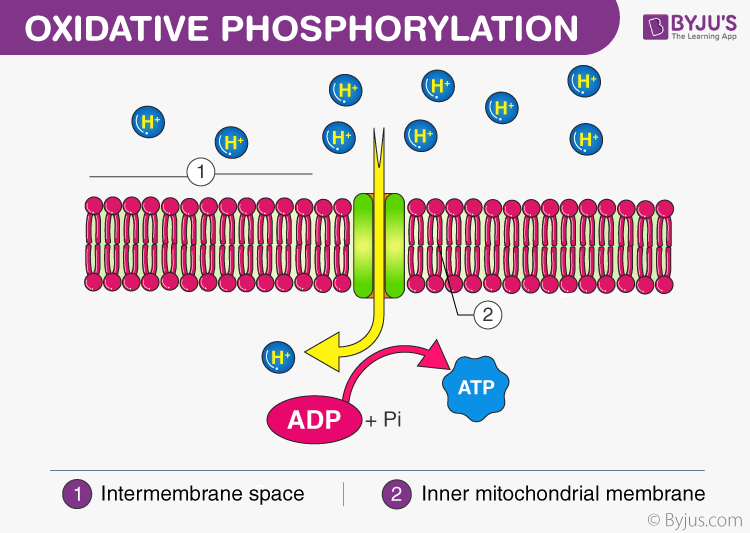
ATP Synthase- Important protein (molecular propeller) located in phospholipid bilayer
nadh dehydrogenase- enzyme; molecular dumptruck (carries electrons and H)→ electron transport chain → nad
from glycolysis or Kreb cycle
takes nadh, removes h2O and gains energy
FADH 2- another molecular dumptruck
FADH 2 - >FAD
Cytochrome x2- cyanide poisoning inhibits atp creation
OIL RIG - electrons
electrons are passed
To make ATP
ADP gets phosphorylated with P and makes ATP
Facilitated diffusion- all protons and hydrogen ions that get pumped out create high concentration of H outside and low concentration inside
atp synthase- LIKE GUMBALL MACHINE
H join with oxygen to form water
cellular respiration
(Glucose) CHO + O → carbon dioxide + water
gives off ATP
chemiosmosis- proton motive force
Dumptrucks
NAD+- nicotinamide adenine dinucleotide (dumptruck) also called Niacin
why sugarfree energy drinks
FAD- flavin adenine dinucleotide
NAD+ reduces 2 Hydrogen atoms and carries 2 electrons away represented as NADH (loaded dumptruck)
final electron acceptor is Oxygen and aerobic respiration
reduced substrate- substrate x gets electrons stuck on it
oxidized substrate- electrons get removed from substrate x
make substrate NAD+
NAD+ is oxidized
NADH is reduced (dumptruck)
ATP: 1 ecoli bacteria can consume 2.5 atp
Oxidative phosphorylation
respiration, fermentation, photosynthesis, chemoautotrophy (chemically making own food. maybe how life was made.)
all use when adp+P <-> atp
chemical work, transport work, and mechanical work
Most ATPs in aerobic organisms are formed during oxidative phosphorylation using ATP synthase
bringing electron and hydrogen dumptrucks (oxidation) then take adp and add phosphorus (phosphorylation)
photosynthetic organisms have a system of photophosphorylation using sunlight driven electron transport
catabolism for chemoheterotrophs have three pathways
glycolysis (EMP pathway)
Kreb cycle (citric acid cycle, tricarboxylic acid cycle)
electron transport chain (respiratory chain, oxidative phosphorylation)
Energy strategies
all living organisms use one or more of these
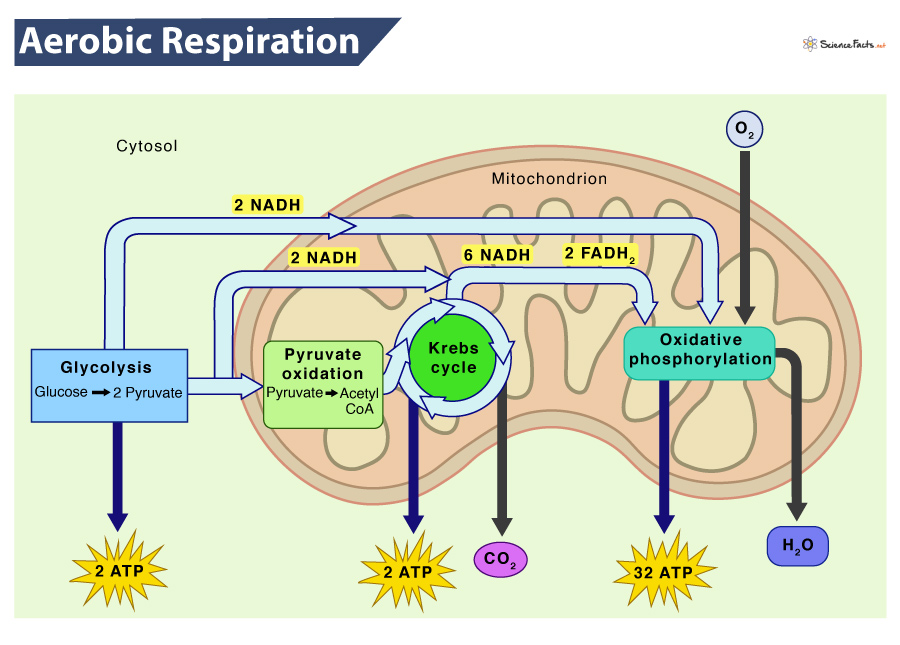
aerobic respiration: is cellular respiration.
get glucose + O → make CO2 and water
also taking 38 ADP and taking 38 Pi and making 38 ADP
can use glucose, fructose, galactose, fatty acid subunits can all be used as reactants
glycolysis converts glucose into pyruvic acid (pyruvate)
synthesizes a small amount of ATP to release NADH
anaerobic respiration
fermentation
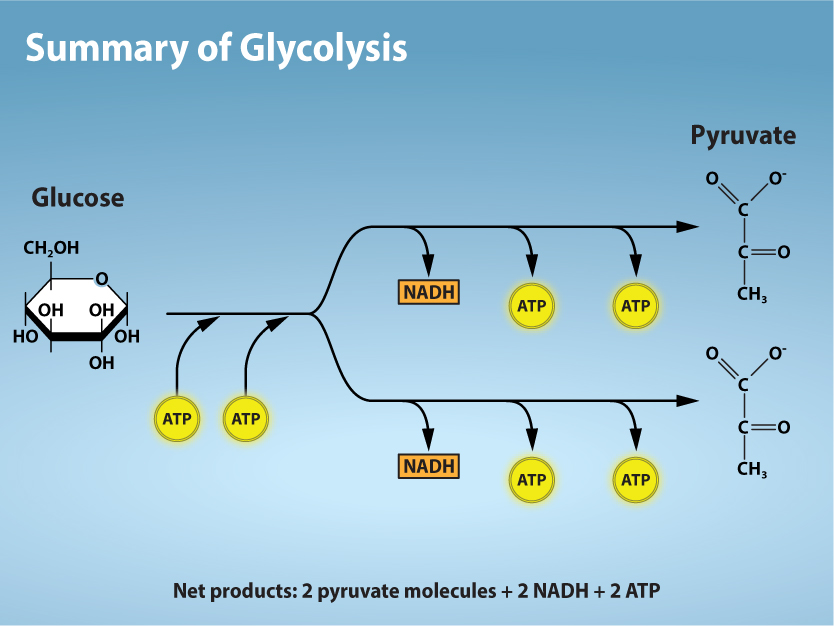
Glycolysis
takes glucose (C-C-C-C-C-C) and splits it evenly into 2 halves
each half (C-C-C) is called pyruvic acid
In process
NAD+ turns to NADH for both halves → ETC
ADP is phosphorylated into ATP (4 atp made but 2 of the atp are used to make it) net atp is 2
then pyruvate goes to the Kreb’s cycle
about 9 different steps processed
just need to know big picture
loading up dumptrucks and making some atp
make a tiny bit of atp and each pyruvate give 8 nadh and 2 fadh2
What are the starting and end products of glycolysis? Where does glycolysis occur? How many ATP (net) are produced as a result of glycolysis?
Start: Glucose
End: 2 pyruvate + 2 NADH + 2 ATP (net)
Location: Cytoplasm
Purpose: Break glucose in half and generate small amounts of ATP + NADH for later steps
Kreb Cycle
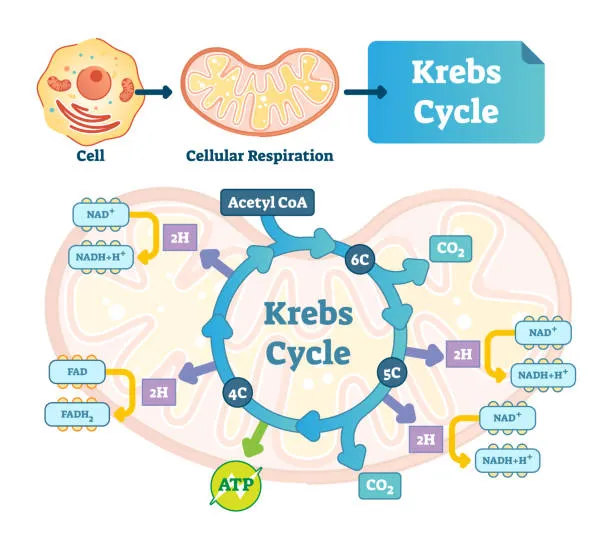
2 pyruvates from glycolysis
before enter Kreb, have to be converted to acetyl coA
one carbon given off at NAD+ → NADh
another is given off
each pyruvate goes through 8 diff chem reactions
then FAD to Fadh2
all give off atp
Identify the series of reactions known as the Kreb's cycle. What waste products are generated in this cycle? How many ATP are generated in this cycle? Which and how many coenzymes are reduced in the Kreb's cycle? Identify starting and end products of the Kreb's cycle.
Cycle purpose: Strip electrons from Acetyl‑CoA to load NADH & FADH₂
Waste: CO₂
ATP yield: 1 ATP per turn (2 per glucose)
Reduced coenzymes: 3 NADH + 1 FADH₂ per turn
Start: Acetyl‑CoA
End: Oxaloacetate regenerated + CO₂ + NADH + FADH₂ + ATP
Aerobic Respiration
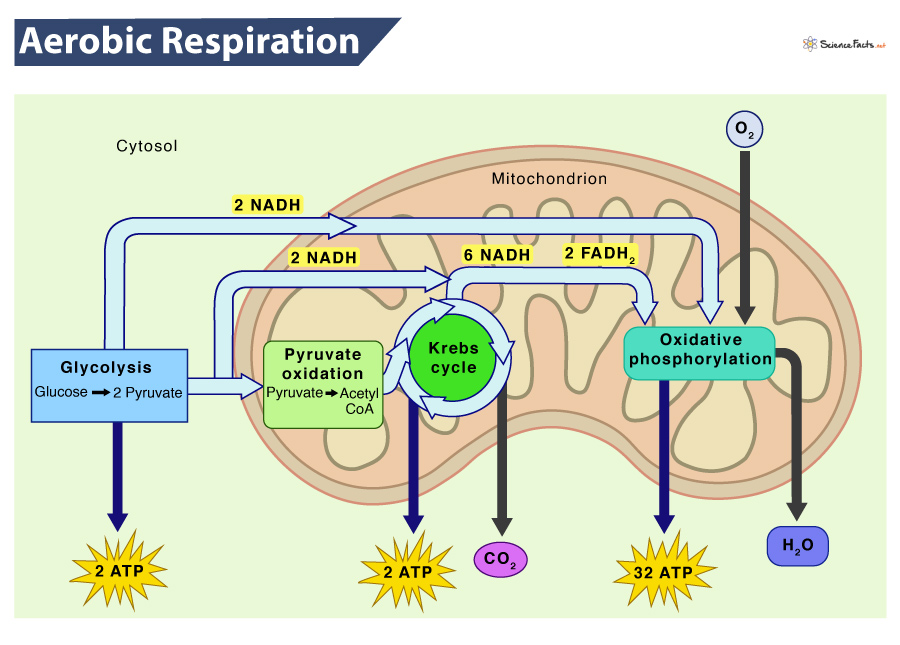
o2 is the final electron acceptor
max theoretical ATP yield= 38
Aerobic Net transport
FADH2 → 2 ATP in ETC
NADH2 → 3 ATP in ETC
Glycolysis : 6 ATP
2ATP
2 NADH
2 Pyruvate
Transition Step: 6 ATP
2 NADH
2 CO2
Kreb’s Cycle: 18 ATP+ 4ATP
4 CO2
6 NADH
2 ATP
2 FADH2
ETC + Oxidative Phosphorylation
34 ATP
Anaerobic respiration
nonoxygen electron
acceptors ex. So34 NO-3 CO 2-3
possible ATP varies with microbes
Fermentation
an organic molecule is the final electron acceptor
pyruvate. acetaldehyde, etc.
max atp yield= 2atp
do it without oxygen, but cannot live off alone
Lose weight?
cellular respiration formula
use more ATP
Use more oxygen
eat less sugars
Where does weight go?
you exhale weight: CO2
Photosynthesis is opposite
What is the purpose of catabolic degradation of glucose? Identify the 3 pathways required for the total aerobic breakdown of glucose. Where does each occur?
Purpose of glucose catabolism: Make ATP by extracting electrons and sending them to the ETC
Three pathways:
Glycolysis — cytoplasm
Kreb’s cycle — mitochondrial matrix
ETC + chemiosmosis — inner mitochondrial membrane
Your page confirms: NADH, FADH₂, proton gradient, ATP synthase, oxygen → water, and ATP production
Enzymes
Enzymes
simple enzymes- proteins alone
holoenzymes- conjugated enzymes contain protein and nonprotein molecules
apoenzyme- protein portion
temporary enzyme- substrate union occurs (induced fit)
cofactors- nonprotein portion
metallic cofactors: iron, copper, magnesium
coenzymes, organic molecules: vitamins
micronutrients are needed as cofactors
act as carriers to assist the enzyme in its activity
Exoenzymes
transported extracellularily, where break down large food molecules or harmful chemicals
cellulase, amylase, penicillinase
Endoenzymes
retained intracellularly and function there
most enzymes are endoenzymes
Constitutive enzymes
regulated enzymes
enzymes may be active extracellularly
operate under temp pH and osmotic pressure of organisms habit
labile: chemically unstable enzyme
denaturation: weak bonds that maintain shape of apoenzyme are broken
regulation of enzyme action
competitive inhibition
allosteric inhibition
enzyme repression
normal protein synthesis
enzyme produced
end products block transcription of dna
Energy
Endergonic reactions
exergonic reaction
redox reactions
electron and proton carriers- facilitate transfer
gain electrons and hydrogens
ATP made of
bioenergetics- study of mech of cellular energy release
catabolic and anabolic
Kreb cycle- co2 given off
What are coenzymes? Identify the components from which coenzymes are synthesized. Name and state the function of 3 coenzymes we discussed in class. Are there other coenzymes
Coenzymes are small, organic, non‑protein molecules that bind to enzymes and help them carry out chemical reactions.
They act as carriers—usually of electrons, hydrogen atoms, or functional groups—allowing metabolic reactions to proceed.
They are not enzymes themselves, but they are essential for enzyme function.
From what are coenzymes synthesized?
Most coenzymes are synthesized from vitamins, especially B‑vitamins, combined with other organic components made by the cell.
Examples:
Niacin (vitamin B₃) → precursor for NAD⁺ / NADH
Riboflavin (vitamin B₂) → precursor for FAD / FADH₂
Pantothenic acid (vitamin B₅) → precursor for Coenzyme A
Three coenzymes we discussed in class (with functions)1. NAD⁺ / NADH (Nicotinamide adenine dinucleotide)
Made from: Niacin (vitamin B₃)
Function:
Electron and hydrogen carrier
Accepts electrons during glycolysis and the Krebs cycle
Delivers them to the electron transport chain to help make ATP
(Your notes call NADH a “molecular dump truck,” which is exactly right.)
2. FAD / FADH₂ (Flavin adenine dinucleotide)
Made from: Riboflavin (vitamin B₂)
Function:
Electron and hydrogen carrier
Accepts electrons in the Krebs cycle
Donates them to the electron transport chain
(Your notes list FADH₂ as another “molecular dump truck.”)
3. Coenzyme A (CoA)
Made from: Pantothenic acid (vitamin B₅)
Function:
Transfers acetyl groups
Forms acetyl‑CoA, the molecule that enters the Krebs cycle
Essential for carbohydrate, lipid, and amino acid metabolism
Are there other coenzymes?
Yes—many. Some important examples include:
TPP (Thiamine pyrophosphate) – from vitamin B₁; used in decarboxylation reactions
Biotin – carries CO₂ in carboxylation reactions
Pyridoxal phosphate (PLP) – from vitamin B₆; used in amino acid metabolism
Tetrahydrofolate (THF) – from folate; carries one‑carbon units
Coenzyme Q (Ubiquinone) – electron carrier in the electron transport chain
Lipoic acid – involved in pyruvate dehydrogenase complex
What are the many fates of pyruvic acid?
Aerobic: Pyruvate → Acetyl‑CoA → Krebs cycle → ETC
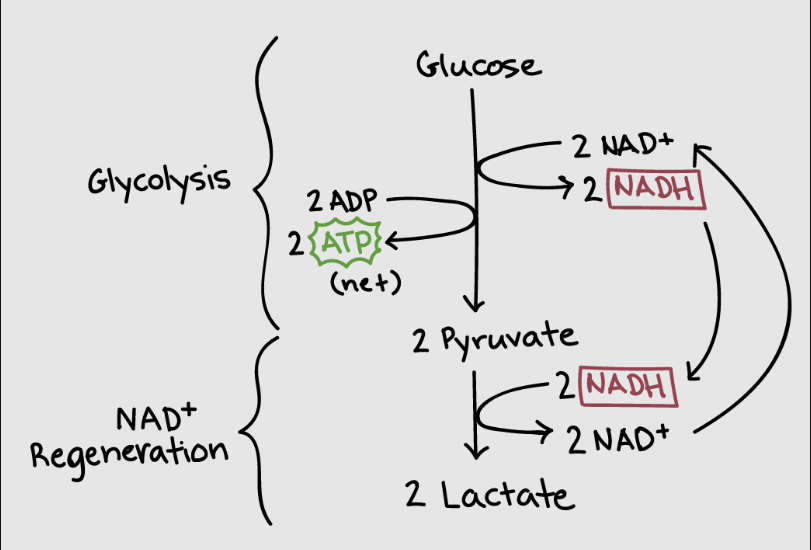
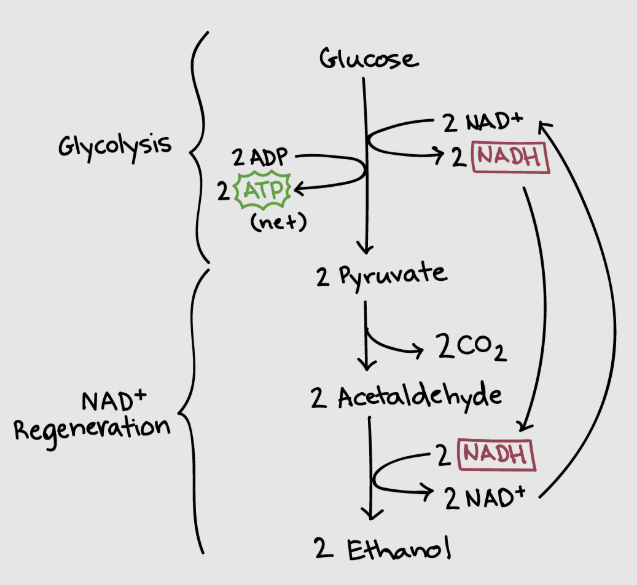
Anaerobic: Pyruvate → Lactic acid or Ethanol
Other fates: Amino acids, oxaloacetate, fatty acid synthesi
What is Coenzyme A? Acetyl Coenzyme A? Succinyl Coenzyme A? What is the importance of this coenzyme?
CoA: Vitamin‑derived carrier of acyl groups
Acetyl‑CoA: Entry molecule for Krebs cycle; central metabolic hub
Succinyl‑CoA: Krebs cycle intermediate that helps generate ATP/GTP
Importance: Links glycolysis → Krebs → ETC; enables NADH/FADH₂ production → ATP synthesis
Why are the reactions of the electron system termed oxidative phosphorylation? What waste product is generated in the ets?
Why oxidative? NADH and FADH₂ are oxidized as they pass electrons down the chain.
Why phosphorylation? ATP synthase uses the proton gradient to phosphorylate ADP → ATP.
Waste product: Water, formed when oxygen accepts electrons and H⁺
How can oxidation of a substrate proceed without oxygen?
Oxidation requires NAD⁺.
Without oxygen, cells regenerate NAD⁺ by:
Fermentation (pyruvate or acetaldehyde accepts electrons)
Anaerobic respiration (nitrate, sulfate, CO₂, etc. accept electrons)
This allows glycolysis and other catabolic reactions to continue even when oxygen is absent.
Using the concept of fermentation, describe the microbial mechanisms (biochemical mechanisms) that cause milk to sour
Milk sours because lactic acid bacteria perform lactic acid fermentation:
Lactose → glucose + galactose
Glycolysis → pyruvate + NADH
Pyruvate is reduced to lactic acid, regenerating NAD⁺
Lactic acid accumulates → pH drops
Acid denatures milk proteins → sour, curdled milk
➡ Fermentation is the biochemical mechanism that allows bacteria to oxidize NADH without oxygen, producing lactic acid that sours milk.
What is the commercial importance of fermentation reactions? Are the products of fermentation limited to alcohol? List at least 3 other products that are produced fermentation reactions.
Fermentation is commercially important for food preservation, flavor production, industrial chemicals, and biofuels.
Products are not limited to alcohol.
Other fermentation products include:
Lactic acid
Acetic acid
Propionic acid
Butyric acid
Acetone
Butanol
CO₂
Intermediary products of metabolism are said to be amphibolic. Define Amphibolism. List a few examples of amphibolic compounds. What is produced from these products?
Fermentation is commercially important for food preservation, flavor production, industrial chemicals, and biofuels.
Products are not limited to alcohol.
Other fermentation products include:
Lactic acid
Acetic acid
Propionic acid
Butyric acid
Acetone
Butanol
CO₂
Identify the 6 major categories of enzymes and their function
Enzyme Class | What It Does | Easy Memory Cue |
|---|---|---|
Oxidoreductases | Redox reactions; electron transfer | ETC enzymes like NADH dehydrogenase |
Transferases | Move functional groups | “Transfers stuff” |
Hydrolases | Break bonds with water | Hydrolysis |
Lyases | Break/form bonds without water | “Leave or add groups” |
Isomerases | Rearrange atoms | Same formula, new shape |
Ligases | Join molecules using ATP | “Glue with ATP” |
What is the biological importance of fermentation reactions?
Biological importance of fermentation:
Regenerates NAD⁺ so glycolysis can continue
Allows ATP production without oxygen
Supports survival in anaerobic environments
Produces acids/alcohols that shape microbial communities
Provides rapid ATP when oxygen is limited
➡ Fermentation keeps cells alive when the electron transport chain cannot function.
Explain how ATP is generated by chemiosmotic coupling on the cristae of the mitochondria. What is proton motive force?
ETC pumps H⁺ out → creates proton motive force
H⁺ flows back through ATP synthase (“gumball machine”)
Flow of protons spins ATP synthase → ATP is made
Oxygen accepts electrons → water is formed
Cyanide binds irreversible to the cytochromes of the electron transport system. How do organisms die from cyanide poisoning?
Cyanide binds to cytochromes in the ETC, blocking electron transfer to oxygen. This stops proton pumping, collapses the proton motive force, shuts down ATP synthase, and halts ATP production. Cells die from energy failure, causing rapid death of the organism
What is stated in the Heterotroph Hypothesis? How does this hypothesis attempt to explain metabolic evolution?
Heterotroph Hypothesis:
First life forms were anaerobic heterotrophs that fed on organic molecules in the primordial oceans.
Metabolic evolution according to the hypothesis:
Fermentation was the earliest metabolism (no oxygen needed).
Organic molecules ran low → pressure to evolve autotrophs.
Autotrophs produced oxygen → atmosphere changed.
Oxygen allowed evolution of aerobic respiration, the most efficient ATP‑producing pathway.
Compare photosynthesis and respiration. How are these processes similar? Different?
Photosynthesis stores energy in glucose; respiration releases energy from glucose
Similarities
Both use electron transport chains
Both create H⁺ gradients to power ATP synthase
Both involve redox reactions
Both occur in membrane‑bound organelles
Both are essential to energy flow in ecosystems
Differences
Feature | Photosynthesis | Respiration |
|---|---|---|
Energy | Requires light | Releases energy |
Pathway | Anabolic | Catabolic |
Organelle | Chloroplast | Mitochondrion |
Reactants | CO₂ + H₂O | Glucose + O₂ |
Products | Glucose + O₂ | CO₂ + H₂O |
ETC Location | Thylakoid membrane | Inner mitochondrial membrane |
Electron Carrier | NADPH | NADH/FADH₂ |